The Little Book of Aviation is a collection of facts, figures and interesting stories from the world of flight. Sad, humorous, baffling and astounding stories abound, from the pioneering days of the Wright Brothers to the present day, and covering everything from great milestones, famous names who've served, and the greatest of aircraft icons; phantom pilots and aircraft and a glossary of slang; the origins of plane-spotting and unusual aircraft names; great feats and enduring mysteries; lucky escapes and great aircraft in the movies… the trivia is limitless and will appeal to everyone, whether you want help telling your Spitfire from your Messerschmitt or you know a Spitfire I from a Spitfire II!
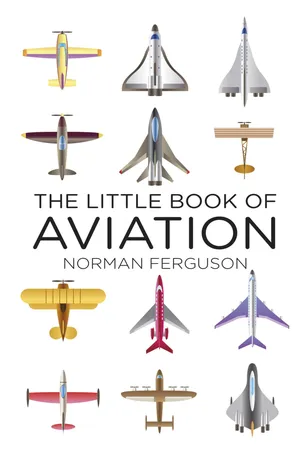
- 144 pages
- English
- ePUB (mobile friendly)
- Available on iOS & Android
eBook - ePub
The Little Book of Aviation
About this book
Information
FIRST FLIGHT
120 – 175 – 200 – 852:
The distances in feet of four successive flights made on the most notable date in aviation: 17 December 1903. On this day, Orville and Wilbur Wright took the ‘giant leap’ that led to a revolution in transportation. The brothers from Ohio had worked on developing gliders before moving on to creating powered machines. On the morning of the 17th, on the beach at Kitty Hawk in North Carolina, Orville took his position on top of the lower wing of the Wright Flyer. With a photographer standing by, the biplane moved off down metal tracks before lifting off. Orville described the flight as ‘exceedingly erratic’ with the aircraft difficult to control and subject to large pitching movements. Nonetheless, it flew for twelve seconds, enough to complete the first powered and sustained flight by a heavier-than-air flying machine. Flights continued but on the fourth and last flight of the day, which lasted almost a minute, the machine hit the ground heavily and became damaged. While it was being retrieved, winds caused further damage. It never flew again. It was repaired for display and after a period in the Science Museum in London was returned to America. It is displayed in the Smithsonian National Air and Space Museum in Washington DC, alongside Charles Lindbergh’s Spirit of St Louis, the sound barrier-breaking Bell X-1 and Apollo 11’s command module Columbia. Apollo 11, in fact, carried small pieces of fabric and wood from the Wright Flyer to the moon.
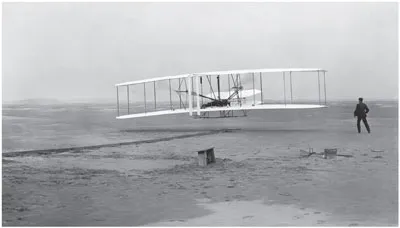
Wilbur watches as his brother Orville Wright makes history at Kitty Hawk on 17 December 1903 by lifting off in the Wright Flyer. J.T. Daniels, USLSS/US Coast Guard
FIRST SUPERSONIC AIRLINER
The first supersonic airliner was not Concorde, as might be thought. In 1961 another type was first to break the sound barrier. Flying from the location for so many aviation firsts – Edwards Air Force Base in California – a four-engined Douglas DC-8 was put into a dive from 52,000ft. The intentional test flight saw the airliner reach Mach 1.012 (660mph) before pulling up. No harm or damage was done and the actual aircraft later entered service with Canadian Pacific Air Lines.
FAMOUS FEATS OF AVIATION: ATLANTIC THERE AND BACK
The Scottish county of East Lothian is known for its scenic golf courses, historic castles and one of the biggest gannet colonies in the world at the Bass Rock. What’s less known is its place in aviation history. In the early hours of 2 July 1919 the biggest airship in Britain left its hangar at the airfield at East Fortune. The 643ft-long craft soon took off and headed west. After a journey of four and a half days that encountered poor weather and engine problems the dirigible landed in the USA. The R34 had completed the first east-to-west aerial crossing of the Atlantic. It touched down with approximately one hour’s fuel left.
Along the way two stowaways had been discovered, a kitten called Wopsie and a human called William Ballantyne – a crew member who had been removed to make room for an American observer but didn’t want to miss out. He was found over water, otherwise he would have been given a parachute and sent homewards. A parachute was used by one of the officers who jumped to help the American reception personnel who were unused to dealing with an airship of that size.
The crew were fêted by the people of New York, and met the American President Woodrow Wilson. After several days of being entertained and re-equipping the airship, it was time to return. The journey home encountered no major issues. The R34 was scrapped in 1921 following an accident. In the Museum of Flight that now stands on the East Fortune airfield site, the airship’s nose cone, in the shape of a heraldic crest, can be seen.
AVIATION-RELATED PUBS AND RESTAURANTS
Air Balloon Tavern, Bristol
Airfield Tavern, Yeovil
Airport Tavern, Bristol
Dambusters Inn, Scampton
Happy Landing, Stanwell
Memphis Belle, Westbrook
Red Arrow, Lutterworth
The Air Balloon, Birdlip
The Airfield, Hatfield
The Airman, Feltham
The Aviator, Cheltenham
The Barnes Wallis, North Howden
The Concorde, Rainham
The Douglas Bader, Mart...
Table of contents
- Cover
- Title
- Acknowledgements
- Contents
- Introduction
- The Little Book of Aviation
- Bibliography
- Copyright
Trusted by 375,005 students
Access to over 1.5 million titles for a fair monthly price.
Study more efficiently using our study tools.
Frequently asked questions
Yes, you can cancel anytime from the Subscription tab in your account settings on the Perlego website. Your subscription will stay active until the end of your current billing period. Learn how to cancel your subscription
No, books cannot be downloaded as external files, such as PDFs, for use outside of Perlego. However, you can download books within the Perlego app for offline reading on mobile or tablet. Learn how to download books offline
Perlego offers two plans: Essential and Complete
- Essential is ideal for learners and professionals who enjoy exploring a wide range of subjects. Access the Essential Library with 800,000+ trusted titles and best-sellers across business, personal growth, and the humanities. Includes unlimited reading time and Standard Read Aloud voice.
- Complete: Perfect for advanced learners and researchers needing full, unrestricted access. Unlock 1.5M+ books across hundreds of subjects, including academic and specialized titles. The Complete Plan also includes advanced features like Premium Read Aloud and Research Assistant.
We are an online textbook subscription service, where you can get access to an entire online library for less than the price of a single book per month. With over 1.5 million books across 990+ topics, we’ve got you covered! Learn about our mission
Look out for the read-aloud symbol on your next book to see if you can listen to it. The read-aloud tool reads text aloud for you, highlighting the text as it is being read. You can pause it, speed it up and slow it down. Learn more about Read Aloud
Yes! You can use the Perlego app on both iOS and Android devices to read anytime, anywhere — even offline. Perfect for commutes or when you’re on the go.
Please note we cannot support devices running on iOS 13 and Android 7 or earlier. Learn more about using the app
Please note we cannot support devices running on iOS 13 and Android 7 or earlier. Learn more about using the app
Yes, you can access The Little Book of Aviation by Norman Ferguson in PDF and/or ePUB format, as well as other popular books in Technology & Engineering & Aeronautic & Astronautic Engineering. We have over 1.5 million books available in our catalogue for you to explore.