In 1739, the London Foundling Hospital opened its doors to take in the abandoned children of the city. It was the culmination of seventeen years of campaigning by Captain Thomas Coram, driven by his horror at seeing children die in the streets. He was supported in his endeavours by a royal charter and by William Hogarth and George Frideric Handel. The Hospital would continue as both home and school for over 215 years, raising thousands of children until they could be apprenticed out.
London's Forgotten Children is a fascinating history of the first children's charity, charting the rise of this incredible institution and examining the attitude towards illegitimate children over the years. The story comes alive with the voices of children who grew up in the Hospital, and the concluding, fully updated, account of today's children's charity Coram is an ongoing testament to the vision of its founder.
eBook - ePub
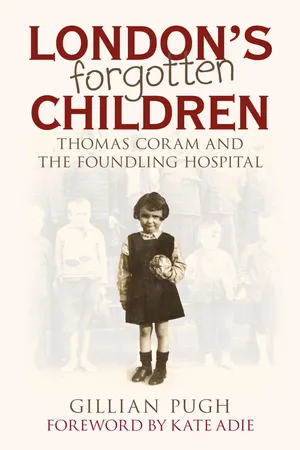
London's Forgotten Children
Thomas Coram and the Foundling Hospital
- 192 pages
- English
- ePUB (mobile friendly)
- Available on iOS & Android
eBook - ePub
About this book
Information
NOTES
INTRODUCTION
1 The Foundling Hospital records are stored in the London Metropolitan Archives, where they take up 800 linear feet of shelving, comprising an estimated 8 tons of paper, and over 1,000 plans. More recent files are kept at the headquarters of Coram Family.
CHAPTER I. THOMAS CORAM – THE MAN AND HIS MISSION
1 Jeremiah Dummer, Massachusetts, cited in Ruth McClure Coram’s Children (Yale, 1981), p19
2 Gillian Wagner Thomas Coram, Gent (Boydell, 2004), p4. I am indebted to Gillian Wagner, a former chairman of governors of the Thomas Coram Foundation for the scholarship of her excellent biography of Thomas Coram
3 Letter from Thomas Coram to Rev. Benjamin Colman in Boston. Quoted in Wagner, p6
4 Roy Porter London: a social history (Hamish Hamilton, 1994), p164
5 Daniel Defoe Giving Alms No Charity, and Employing the Poor London, (1704)
6 See Jean Heywood Children in Care: the development of services for the deprived child (Routledge and Kegan Paul, 1959)
7 Maureen Waller London in 1700: scenes from London Life (Hodder and Stoughton, 2000)
8 The Guardian 105 11 July 1713
9 John Brownlow Memoranda, or Chronicle of the Foundling Hospital (Sampson Low, 1847), p182
10 Jonas Hanway Candid Historical Account quoted in McClure’s Coram’s Children, p9
11 David Stansfield, alias CA A Rejoinder to Mr Hanway’s Reply to CA’s Candid Remarks 1760 quoted in Pinchbeck and Hewitt Children in English Society. Vol 1. From Tudor Times to the Eighteenth Century, p36
12 Roy Porter ‘Every human want: the world of eighteenth-century charity’ in Enlightened Self-interest: the Foundling Hospital and Hogarth (Thomas Coram Foundation for Children, 1997), p12
13 Society for the Propagation of Christian Knowledge
14 Thomas Bernard An Account of the Foundling Hospital in London, for the Maintenance and Education of Exposed and Deserted Young Children (London, 1799), p3, quoted in Wagner, p84
15 A full list of all the subscribers is given in Nichols and Wray’s History of the Foundling Hospital, pp345–353
16 Herbert Compston, ‘Thomas Coram, Churchman, Empire Builder and Philanthropist’, (1918), pp98–9, quoted in Nichols and Wray’s The History of the Foundling Hospital, p20
17 The relationship between Hogarth and the Foundling Hospital is explored further in Chapter four
18 London Metropolitan Archives A/FH/A03/002/001 General Committee Minutes, 4 March 1742
19 London Metropolitan Archives A/FH/A03/004/001/ Daily Committee Minutes, 25 March–22 June 1741, pp6–7
20 Wagner, p149
21 London Metropolitan Archives A/FH/A09/001 Billet Book 1741, March–May
22 Cited in Wagner, p188
23 When the Foundling Hospital was pulled down, Thomas Coram’s coffin was moved to the vaults of the chapel at Berkamstead. It was later moved to St Andrews Holborn, where a copy of this inscription can be seen. The original inscription is still in the chapel of what is now called Ashlyns School in Berkamstead
24 Cited in Nichols and Wray, p14
CHAPTER II: THE FOUNDLING HOSPITAL GETS UNDERWAY: THE FIRST SIXTY YEARS
1 For this and other information I am indebted to R.H.Nichols and F.A.Wray The History of the Foundling Hospital (Oxford University Press, 1935); and Ruth McClure Coram’s Children: the London Foundling Hospital in the Eighteenth Century (Yale University Press, 1981)
2 General Committee report cited in McClure, pp47–48
3 The records of all children admitted to the Foundling Hospital are kept in the London Metropolitan Archive
4 Nichols and Wray, p33
5 For a description of the role of the inspectors see Gill Clark Correspondence of the Foundling Hospital Inspectors in Berkshire 1757–6, Berkshire Record Society vol 1, (1994)
6 Clark, p27
7 D. Owen English Philanthropy 1660–1690 (Cambridge Mass, 1964)
8 J.A. Rouquet The Present State of the Arts in England (London, 1755)
9 E. Pollard ‘A time for living: the story of Ackworth Hospital for exposed and deserted young children’ Friends Quarterly 1960; and Nichols and Wray, p161–171
10 L. Hart John Wilkes and the Foundling Hospital at Aylesbury 1759–1768, p31
11 Jamila Gavin Coram Boy (Mammoth, 2000). See also the play of the same name adapted by Helen Edmundson for production by the National Theatre, 2005–2007
12 John Brownlow Memoranda; or Chronicles of the Foundling Hospital, including Memoirs of Captain Coram (1847)
13 Quoted in McClure op cit, p106
14 B. Young ‘Rags to riches–the story of Paul Holton’ in The Wokingham Historian, 9 August 1996, pp2–11
15 John Brownlow, pp189–190
16 A. Levene ‘The estimation of mortality at the London Foundling Hospital 1741–99 Population Studies 59, 1, 87–97’
17 General Committee minutes, quoted in McClure, p143
18 Nichols and Wray, p223
19 Nichols and Wray, p265
20 McClure, p189
CHAPTER III: A CHILD’S EYE VIEW: THE EARLY DAYS OF THE FOUNDLING HOSPITAL
1 General committee minutes, quoted in McClure, p190
2 Gill Clark ‘Infant fashion in the eighteenth century: evidence from Foundlings nurses in Berkshire’ The Local Historian February, 3–13
3 Quoted in McClure, p191
4 Dr Cadogan, quoted in Nichols and Wray, p129
5 Paper to the General Committee 29 March 1758 cited in Hart, pp17–19
6 P.M. Dunn ‘Sir Hans Sloane (1660–1753) and the value of breast milk’ Archives of Disease in Childhood, Neonatal Ed 85, 73–4
7 Quoted in Nichols and Wray, pp106–7
8 McClure, p212
9 See appendix VI in McClure, p270
10 McClure, p201
11 Gentleman’s Magazine 17 June 1747 quoted in McClure, p193
12 Lord Chesterfield (1741) Letters to his son. Cited in Pinchbeck and Hewitt, p298
13 G. Chapman A Treatise on Education with a Sketch of the Author’s Method 1773, quoted in McClure, pp119–220
14 Letter to Rev. Colman 2 March 1737, quoted in McClure, p223
15 From Psalms, Hymns and Anthems Used in the Chapel of the Hospital for the Maintenance and Education of Exposed and Deserted Young Children Foundling Hospital (1774)
16 John Brownlow, p160
17 Quoted in Nichols and Wray, pp149–150
CHAPTER IV: HOGARTH AND HANDEL: CHARITY AND THE ARTS
1 Quoted in David Solkin Painting for Money: the visual arts and the public sphere in eighteenth century England, (Yale University Press, 1992), p158
2 For a full account of the paintings and other artefacts now on display in the Foundling Museum readers are referred to the Foundling Museum guide book, or better still are encouraged to visit the Museum to see the treasures for themselves
3 Jenny Uglow Hogarth; a life and a world (Faber and Faber, 1997), p333
4 Quoted in Wagner, p142
5 Brownlow, p12
6 Brian Allen ‘Art and charity in Hogarth...
Table of contents
- Cover
- Title
- Copyright
- Contents
- Acknowledgements
- Foreword
- Introduction
- I. Thomas Coram: The Man and his Mission
- II. The Foundling Hospital Gets Underway: the First Sixty Years
- III. A Child’s Eye View: the Early Days of the Foundling Hospital
- IV. Hogarth and Handel: Charity and the Arts
- V. No Goodnight Kiss: Brownlow, Dickens and the Nineteenth Century
- VI. The End of an Era: the Foundling Hospital in the Twentieth Century
- VII. Who am I? Where did I come from? Former Pupils Look Back on their Childhood Experiences
- VIII. From Thomas Coram Foundation for Children to Coram Family: 1955–2005
- IX. London’s Forgotten Children: Then and Now
- Notes
- Bibliography
Trusted by 375,005 students
Access to over 1.5 million titles for a fair monthly price.
Study more efficiently using our study tools.
Frequently asked questions
Yes, you can cancel anytime from the Subscription tab in your account settings on the Perlego website. Your subscription will stay active until the end of your current billing period. Learn how to cancel your subscription
No, books cannot be downloaded as external files, such as PDFs, for use outside of Perlego. However, you can download books within the Perlego app for offline reading on mobile or tablet. Learn how to download books offline
Perlego offers two plans: Essential and Complete
- Essential is ideal for learners and professionals who enjoy exploring a wide range of subjects. Access the Essential Library with 800,000+ trusted titles and best-sellers across business, personal growth, and the humanities. Includes unlimited reading time and Standard Read Aloud voice.
- Complete: Perfect for advanced learners and researchers needing full, unrestricted access. Unlock 1.5M+ books across hundreds of subjects, including academic and specialized titles. The Complete Plan also includes advanced features like Premium Read Aloud and Research Assistant.
We are an online textbook subscription service, where you can get access to an entire online library for less than the price of a single book per month. With over 1.5 million books across 990+ topics, we’ve got you covered! Learn about our mission
Look out for the read-aloud symbol on your next book to see if you can listen to it. The read-aloud tool reads text aloud for you, highlighting the text as it is being read. You can pause it, speed it up and slow it down. Learn more about Read Aloud
Yes! You can use the Perlego app on both iOS and Android devices to read anytime, anywhere — even offline. Perfect for commutes or when you’re on the go.
Please note we cannot support devices running on iOS 13 and Android 7 or earlier. Learn more about using the app
Please note we cannot support devices running on iOS 13 and Android 7 or earlier. Learn more about using the app
Yes, you can access London's Forgotten Children by Gillian Pugh,Gilliam Pugh in PDF and/or ePUB format, as well as other popular books in History & British History. We have over 1.5 million books available in our catalogue for you to explore.