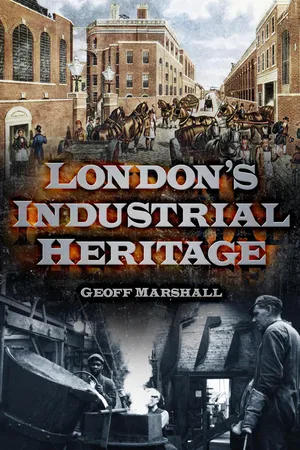
Did you know that apart from Lancashire, the greatest concentration of Boulton & Watt steam engines was in London, demonstrating the enormous and often overlooked significance of London as an industrial centre? The story behind the many industries found in the capital is described in this unique book. London once had scores of breweries; the world's first plastic material was synthesised in the East End; there was even a gasworks opposite the Palace of Westminster. Clerkenwell was a centre for watch and clock makers; the River Thames used to be full of colliers bringing coal from Newcastle; Joseph Bramah invented his water closet and hydraulic pump here, and Henry Maudslay made machines to make machines. Many household names began in London: Schweppes, Crosse & Blackwell, and Vauxhall motor cars. The list of fascinating facts goes on. In this, the first book of its kind on the subject, Geoff Marshall provides an enthralling overview of London's industrial face through history.
- 256 pages
- English
- ePUB (mobile friendly)
- Available on iOS & Android
eBook - ePub
London's Industrial Heritage
About this book
Information
Part 1
PUBLIC UTILITIES
1 The Electricity Industry
Electricity Generation
Michael Faraday’s parents came from Yorkshire. They moved to London, where his father, James, worked as a blacksmith in Newington Butts. It was here – the area now known as Elephant and Castle – that Michael Faraday was born in 1791. In 1796, the family moved to rooms over a coach house in Jacob’s Well Mews, Manchester Square. Faraday’s education was rudimentary and in his own words, ‘my hours out of school were passed at home and in the streets’. He was apprenticed to a bookbinder and his seven-year apprenticeship exposed him to books which he read avidly, most importantly those on science: ‘I loved to read the scientific books which were under my hands … I made such experiments in chemistry as could be defrayed in their expense by a few pence per week.’ In 1812, Faraday saved up sufficient money to attend the last four lectures that Sir Humphry Davy was giving at the Royal Institution. Faraday was entranced. He returned to the bookbinders, wrote up all the lectures and illustrated them with diagrams and sketches and bound them in a book which he sent to Davy, in effect asking for a job:
My desire to escape from trade, which I thought vicious and selfish, and to enter into the service of science, which I had imagined made its pursuers amiable and liberal, induced me at last to take the bold and simple step of writing to Sir H. Davy expressing my wishes and a hope that, if an opportunity came in his way, he would favour my views: at the same time I sent the notes I had taken of his lectures.
After a while Davy took him on to clean and dust his apparatus at 25s a week and he never looked back. At the Royal Institution, on 17 October 1831, Faraday generated a ‘wave of electricity’ by moving a bar magnet into a coil of wire. Thus he discovered electromagnetic induction, the means to generate electricity by converting kinetic energy to electrical energy.
Due to the inadequacies of early dynamos, forty years elapsed before Faraday’s discovery could be exploited. It was the semi-literate but brilliant electrical engineer Zénobe Théophile Gramme who opened the way for electricity to be generated on a commercial basis. Gramme was born in Belgium and in 1871 he demonstrated his dynamo, with ring-mounted armature, at the Academy of Sciences in Paris. The Gramme machine gave a much smoother supply of direct current (d.c.) than had been possible hitherto.
In its early days electricity was employed solely for lighting. The earliest form of lighting was the arc lamp. Humphry Davy, at the Royal Institution, had discovered the arc lamp in 1808. He allowed current (generated by electrolysis) to jump between carbon electrodes thereby producing a brilliant light. But early arc lamps had a short lifespan and were unreliable. It was not until the Russian telegraph engineer Paul Jablochkoff, working in Paris in 1876, invented the Jablochkoff Candle that arc lamps became a practical possibility. Jablochkoff’s lamp consisted of two carbons rods separated by a paste of kaolin. When a current flowed, carbon paste between the two electrodes burned away emitting a dazzling light.
Given that both Gramme and Jablochkoff were working in France, it is hardly surprising that the French took the lead in installing electrically powered public lighting. In July 1878, the journal The Electrician highlighted the lack of progress in England, complaining, ‘in London there is not one such light to be seen’. Yet within one month things were to change.
The first public building to be lit by the new electric light was the Gaiety Theatre, where arc lamps were installed in August 1878, described as ‘half a dozen harvest moons shining at once in the Strand’. Then, a couple of months later, the French company Société Générale d’Électricité began an ambitious programme of street lighting along the Victoria Embankment between Westminster and Waterloo Bridges. Their power station – if that is the most appropriate way to describe it – was situated on the opposite side of the river, west of Charing Cross Bridge. It consisted of a wooden shed containing a steam engine, operating at 60psi pressure and driving a Gramme dynamo at 650rpm. Power lines ran beneath the Thames via a subway to power twenty Jablochkoff lamps on the north bank. More lamps were installed later, including some on Waterloo Bridge, but then, in 1884, the Jablochkoff Company went into liquidation and gas lights were reinstated.
Meanwhile, another scheme was under way at Holborn Viaduct. Sixteen Jablochkoff lamps were installed over a 500yd stretch of the viaduct and powered in a similar way to the Victoria Embankment scheme. The Times newspaper of 16 December 1878 reported:
On Saturday evening the electric light was experimentally tried upon the Holborn Viaduct, at the instance of the City Commission of Sewers [and] the light was remarkably steady and brilliant. The trial will be continued for some time and arrangements are being made for it to light the Royal Exchange and the Mansion House.
The trial was, however, less than successful and Colonel Haywood, engineer to the City Commission of Sewers, was reported in The Times of 21 March 1879 as ‘estimating the cost to be seven times that of gas and that the commission have resolved not to continue the experiment’. And that would appear to be that!
The gas companies were jubilant, boasting that ‘we are quite satisfied that the electric light can never be applied indoors without the production of an offensive smell which undoubtedly causes headaches and in its naked state it can never be used in a room of even a large size without damage to sight’. The problem lay with the intensity and dazzling light of arc lamps, and the fact that they smelled and emitted a hissing noise. But the gas companies had not bargained with the pioneering work of Thomas Edison and Joseph Swan.
Joseph Swan was born in Sunderland in 1828. Having trained and set up in business as a pharmacist, he began experimenting with incandescent lamps in the mid-nineteenth century but was hampered because he could not obtain a good vacuum in his bulbs. Vacuum pump technology improved later in the century and, in 1875, he was successful in making an incandescent lamp with a carbonised thread as filament. He patented his bulb in 1878, just before Thomas Edison in America did just the same. The two men joined forces and the Edison & Swan Electric Light Company was founded. By not having to rely on arc lamps, electric light now became a practical possibility.
Thomas Edison was quick to exploit the new electric light. In January 1882, he got in touch with the City Corporation and proposed that the Holborn Viaduct scheme be revisited. Edison offered to light the viaduct free of charge for three months and also to supply private consumers. The Times of 13 April 1882 reported:
From Newgate Street westward, across Holborn Viaduct, to Hatton Garden, the street and most of the buildings on either side of the street are now and for the next three months, will continue to be lit by Edison incandescent lamps. For the purpose of street lighting two of the incandescent lamps of 32 candle power each have been placed in every lamp-post and it had been hoped that last night permission would have been obtained from Colonel Heywood [sic] for the gas to be turned out in order that the effectiveness … might be proved the more satisfactorily … it is hoped that tonight the public will be able to judge on the matter themselves. Those that can obtain permission to see the machinery and appliances by which the electricity is generated and distributed will find a satisfactory answer.
The machinery The Times spoke of was sited at 57 Holborn viaduct (on the north side of the road) and can claim to be the first power station in the world. Current at 100V d.c. was supplied from an Edison dynamo driven by a steam engine, with steam raised from a water tube Babcock & Wilcox boiler. One thousand Edison lamps of 16cp each were installed; later, a further 1,200 were powered from another generator at 35 Snow Hill. Along the route was the City Temple, which can lay claim to being the first church to be lit by electricity. The mains were copper conductors, encased in insulation within wrought-iron pipes. Holborn Viaduct Power Station continued to operate until 1886.
A Myriad of Small Stations
In the early 1880s, the Great Western Railway built a power station to light Paddington Station, its offices and the Great Western Hotel. According to The Electrician, it supplied ‘by far the largest installation of mixed lighting hitherto made’. The power station stood a quarter of a mile from Paddington Station on the south side of the track. There were three 350kW alternators housed in a wooden building with double walls, so constructed to keep the noise down. It plainly did not, because in 1885 the residents of nearby Gloucester Terrace complained to the magistrates at Marylebone Police Court that the ‘tremendous vibration and noise, added to the fumes of smoke and steam and dirt caused by the machinery, produced such a nuisance as to be almost unbearable’.
Meanwhile, in 1887, the Cadogan Electric Lighting Co. installed a series of storage batteries in the houses of residents in Chelsea, South Kensington and Knightsbridge, and, via overhead transmission lines strung from poles, supplied direct current from a small power station in Manor Street (now Chesil Court) next to Albert Bridge. The scheme did not prosper; by 1895, only twenty-five houses were being supplied. The Cadogan Co. was then taken over by the Chelsea Electricity Supply Co. which had obtained consent to lay mains beneath the street. Their power station, in the basement of a house in Draycott Place/Cadogan Gardens, supplied direct current to batteries in a series of substations, one at Draycott Place, the others at Pavilion Road and Egerton Gardens Mews. The substations were charged in series and supplied low tension d.c. to customers in parallel. Another power station was built in 1894 at Flood Street, and by 1911 the company’s capacity had increased to 3,400kW, with further substations at Elm Park Gardens, Clabon Mews and Pond Place. The Chelsea Co. ceased generating in 1928.
The Whitehall Electric Supply Co. was formed in 1887 with the intention of lighting Whitehall Court (now the Royal Horseguards Hotel). A power station was built in front, underneath the road, and its customers included the church of St Martin in the Fields and various premises in Northumberland Avenue. Within the year it was taken over for £40,000 by the Metropolitan Electric Supply Co., which soon purchased a small power station in Rathbone Place, off Oxford Street. The Whitehall Court scheme supplied direct current, but at Rathbone Place the company opted for alternating current (a.c.). Another power station was constructed in Sardinia Street at the south-west corner of Lincoln’s Inn Fields, and the Metropolitan Electric Supply Co. now served Marylebone, Bloomsbury, Lincoln’s Inn and Covent Garden. A further station was built at Manchester Square in 1890. However, because of complaints – houses vibrated and clocks stopped – an injunction was served on the company. It was on the point of shutting down but the day was saved by replacing the noisy reciprocating Willans engines with three 350kW Parsons turbo-alternators, the first to be installed in the capital.
An early generating station was built, just south of Kensington High Street, by R.E. Crompton & Co. to illuminate Kensington Court. By 1890, the Kensington Court Electric Light Co. was supplying d.c. to the surrounding area. It was soon acquired by the Kensington & Knightsbridge Electric Lighting Co., which had a power station in Cheval Place. In 1892, 645kW was generated at Kensington Court and 410kW at Cheval Place.
The Westminster Electric Supply Corporation had two plants in 1890: one at Stoneyard, Millbank, near the House of Lords, supplying the Palace of Westminster; and the other at Chapel Mews, near St James’s Park Station. They had further stations, all d.c., in Dacre Street, in Eccleston Place to supply Belgravia, and Davies Street to supply Mayfair. In 1904, a substation was built at Duke Street, Mayfair, and in 1910 the Millbank plant was demolished to make way for Victoria Tower Gardens. Meanwhile, a new station was built in Horseferry Road, near Lambeth Bridge.
The St James’s and Pall Mall Electric Lighting Co. built their first power station in Mason’s Yard, Duke Street. Sited in the heart of St James’s, the station was prone to pollute the surrounding area with an oily spray which did nothing to please the members of London’s fashionable gentlemen’s clubs. As one of the engineers commented,‘it was almost a daily occurrence to see a gesticulating man pointing out his damaged top hat’. Wyndham’s Club even obtained an injunction against the plant but then had the nerve to insist that their supply shouldn’t be cut off! The company laid its mains in cast-iron culverts and on one occasion the outer casing became live. An old and unsuspecting horse was unfortunate enough to place his iron-clad hoof on the casing and received a fatal shock. The owner was compensated with £40 but soon afterwards a similar accident happened to a horse drawing a hansom cab. From then on it was commonplace for cab drivers to pass along Jermyn Street with old and worn-out nags in the hope that a similar fate might befall them. In 1893, a new station was constructed in Carnaby Street and by the end of the century the company amalgamated with the Westminster Company and began to build a new plant at Grove Road.
The Charing Cross Electricity Supply Co. traced its roots back to a small power plant installed in 1883 in the basement of the Adelaide Restaurant in the Strand owned by the Gatti Brothers. Two years later Messrs Gatti were supplying the Adelphi Theatre and in 1888 built a new station in Bull Inn Court, between Maiden Lane and the Strand. Acquired by the Charing Cross Co. in 1889, the new company soon expanded south of the river and built a plant between Waterloo and Blackfriars Bridges. In the early twentieth century consent was obtained to supply the City from a new power station at Bow. By 1919, its capacity was 74MW.
Originally known as the House-to-House Electric Light Supply Co., the Brompton & Kensington Electricity Supply Co. had an a.c. power station in Richmond Road, Brompton, in 1889. To begin with, every customer had a transformer in their own home before the company installed a series of their own transformers to supply low voltage. In 1928, when they finally ceased generation, the plant had a capacity of 8MW.
The County of London Electric Lighting Co. ran two power stations: one at the City Road basin of the Regent’s Canal; the other on the banks of the Thames at Wandsworth. They began operation in 1896.
The first local authority to supply electricity in London was St Pancras. A power station was built in Stanhope Street, just to the east of Regent’s Park. A second station opened in King’s Road and was unique in that it used the hot gases from a refuse destructor to heat its boilers – an early example of energy conservation. Hampstead opened a small station on Finchley Road in 1893, to be followed by Islington which built a generating plant at Eden Grove, off Holloway Road. Ealing was soon to follow the example of St Pancras and harness heat from a waste destructor plant, and Shoreditch followed suit with a plant in Coro...
Table of contents
- Cover
- Title Page
- Contents
- Preface
- Part 1: Public Utilities
- Part 2: Manufacturing
- Part 3: Transport
- Part 4: Other Industries
- Sources of Reference
- Plate Section
- Copyright
Trusted by 375,005 students
Access to over 1.5 million titles for a fair monthly price.
Study more efficiently using our study tools.
Frequently asked questions
Yes, you can cancel anytime from the Subscription tab in your account settings on the Perlego website. Your subscription will stay active until the end of your current billing period. Learn how to cancel your subscription
No, books cannot be downloaded as external files, such as PDFs, for use outside of Perlego. However, you can download books within the Perlego app for offline reading on mobile or tablet. Learn how to download books offline
Perlego offers two plans: Essential and Complete
- Essential is ideal for learners and professionals who enjoy exploring a wide range of subjects. Access the Essential Library with 800,000+ trusted titles and best-sellers across business, personal growth, and the humanities. Includes unlimited reading time and Standard Read Aloud voice.
- Complete: Perfect for advanced learners and researchers needing full, unrestricted access. Unlock 1.5M+ books across hundreds of subjects, including academic and specialized titles. The Complete Plan also includes advanced features like Premium Read Aloud and Research Assistant.
We are an online textbook subscription service, where you can get access to an entire online library for less than the price of a single book per month. With over 1.5 million books across 990+ topics, we’ve got you covered! Learn about our mission
Look out for the read-aloud symbol on your next book to see if you can listen to it. The read-aloud tool reads text aloud for you, highlighting the text as it is being read. You can pause it, speed it up and slow it down. Learn more about Read Aloud
Yes! You can use the Perlego app on both iOS and Android devices to read anytime, anywhere — even offline. Perfect for commutes or when you’re on the go.
Please note we cannot support devices running on iOS 13 and Android 7 or earlier. Learn more about using the app
Please note we cannot support devices running on iOS 13 and Android 7 or earlier. Learn more about using the app
Yes, you can access London's Industrial Heritage by Geoff Marshall in PDF and/or ePUB format, as well as other popular books in History & Business General. We have over 1.5 million books available in our catalogue for you to explore.