![]()
1
Servants of Welsh Princes
The first Tudor monarch, Henry VII, was one-quarter Welsh, one-quarter French, and half English. Yet it is his Welsh blood that identified him to contemporaries and to posterity. And it is by his great-great-grandfather’s Welsh Christian name of Tudur (Anglicised as Tudor) that he and his descendants are known. Not that these Welsh ancestors of his had much princely blood in their veins, but their family first sprang to prominence in the service of the most ambitious and constructive of Welsh princely houses.
During the first three-quarters of the thirteenth century, the Welsh rulers of Gwynedd, whose principality included the rugged fastnesses of Snowdonia as well as the fertile lowlands of Anglesey, strove to create a powerful and organised fledgling state. Changes that were taking place in the monarchies of Western Europe – in their forms of government, their methods of administration and their rulers’ powers – were well known in Wales, not least through the English example. Under Llywelyn ab Iorwerth (1202–40), known as Llewelyn the Great, a capable, determined and ruthless prince, Gwynedd became (for Wales) a comparatively strong principality. Indeed, it claimed the allegiance of all other Welsh princes and its ruler later adopted the style and dignity of Prince of Wales. Llywelyn controlled almost all of Gwynedd by 1202 and when, ten years later, in 1212, he negotiated a treaty with the king of France, he claimed to speak for other Welsh rulers too. He was instrumental in forcing King John to submit to the demands of the English barons at Runnymede, and Welsh demands were included in the Magna Carta sealed there in 1215. Llywelyn the Great was able to maintain his and his principality’s strength and independence until his death twenty-five years later in 1240.
It was in these decades of vigorous political development in North Wales that the Welsh ancestors of King Henry VII achieved a prominence that made them one of the most influential and respected of Welsh families in the thirteenth century. They hitched their star to the prince of Gwynedd, making themselves indispensable as councillors, servants, diplomats and soldiers in a polity which, like that of other European rulers, came to rely on an ‘aristocracy of service’. The earliest Tudors were a family of such aristocrats. They augmented and consolidated the family fortunes along the way.
Despite their vital importance to the prince of Gwynedd, none of Henry Tudor’s forebears married into the princely line. Rather were they trusted lieutenants of Llywelyn the Great and his successors. In England such distinguished servants of the king could have expected an earldom. In North Wales, repute, property and power were their anticipated reward. Not that it was a record of uninterrupted progress towards position, wealth and power, for the rise of Gwynedd was frequently beset with enemies and obstacles: other Welsh princes were jealous and resented the rulers of Gwynedd; English kings were suspicious and opposed their claims; and English barons with lordships in the march (or borderland) of Wales were hostile. An ambitious Welsh family in the service of the prince of Gwynedd would be well advised to keep one eye on Gwynedd’s rivals and opponents, and perhaps even be prepared to engage in political manoeuvre, in order to preserve what it had gained from good service in North Wales. All this the ancestors of the Tudor monarchs achieved, often with conspicuous success and rarely with serious lapses. When the principality of Gwynedd was destroyed by King Edward I in 1282–3, this family managed to re-emerge with much of its influence, if not its reputation, intact.
The earliest Tudors of all lived near Abergele, in the district (or commote) of Rhos in the region east of the River Conwy known as the Four Cantrefs (or, in Welsh, the Perfeddwlad), much of which later became the marcher lordship of Denbigh. In their origins they were modest landowners in the countryside east of the Conwy and not far from the coast. When this region was brought under the control of Gwynedd by Llywelyn the Great himself, some of the family entered the personal service of their new lord. It is even possible that one or two members of the family were employed by Llywelyn’s predecessor at the end of the twelfth century. Cynfrig ab Iorwerth is the first of their stock who is known to have found a niche in the rudimentary administration of Gwynedd. His sons and grandsons followed in his footsteps with astonishing regularity. We can only speculate about the abilities and intelligence of Cynfrig’s descendants, but whatever their qualities they were constantly employed by the thirteenth-century rulers of Gwynedd. Indeed, Cynfrig and his relatives formed the largest single family group of servants used by the princes in their various enterprises. If Cynfrig had made the initial and crucial mark, it was his son Ednyfed Fychan (Ednyfed the Younger) who acquired the greatest reputation of all his family and who ensured that his sons and grandsons had a place in the government and society of North Wales that was second only to that of the princely house itself.
Ednyfed Fychan was in Llywelyn the Great’s service by 1215 and he never left it before Llywelyn’s death in 1240. He was often in the prince’s company; he witnessed Llywelyn’s charters, and for a long time he was seneschal or steward (or, in Welsh, distain), the most important administrative, political and judicial official whom the prince had. He was in this exalted position by about 1216, if not earlier. As such he represented Llywelyn in negotiations with the English king, Henry III, certain English marcher lords, and other Welsh princes, bishops and ecclesiastics. He was the prince’s alter ego, answerable only to Llywelyn himself and exercising a very considerable authority on his behalf. Ednyfed was no less highly valued in war. In the sixteenth century there was a tradition that he had once (perhaps in 1210) led the prince’s forces to battle against the earl of Chester and other supporters of King John; he was said to have presented three bloody English heads to Llywelyn after the victory – heads which supposedly were represented on the arms of Ednyfed Fychan and his family thereafter. The qualities which Ednyfed displayed in exploits like these enabled him to aim high in his search for a wife. He married Gwenllian, a daughter of the famed Lord Rhys ap Gruffydd (who died in 1197). Rhys not only created a personal dominion for himself in South-West Wales (or Deheubarth), but he was regarded elsewhere as the leading Welsh prince of his day. To be linked with such a reputable lineage enhanced Ednyfed Fychan’s own standing. Even King Henry III acknowledged him to be an outstanding Welshman, and when Ednyfed passed through London in June 1235, apparently en route to the Holy Land and the crusade, the king arranged to send a silver cup to his lodgings as a token of respect.
Llywelyn the Great died in 1240. As the elder statesman of Gwynedd, Ednyfed Fychan played a key role in arranging the succession of the prince’s son, David (1240–6). And in an age when the authority of rulers depended on personal ability and good advisers, no one was better qualified than this experienced and loyal servant to play a guiding role at the new prince’s court. When Ednyfed himself died in 1246, ten years after his wife, the annals that were then being compiled at St Werburgh’s Abbey in Chester recorded the event as if it were a turning-point in the history of Gwynedd and North Wales more generally. Ednyfed was remembered as the justiciar of Wales, a title which ranked him with those great justiciars or royal lieutenants who were employed by English monarchs to act in their stead when they were out of the kingdom or otherwise unavailable. It was a fitting tribute to the great servant of Llywelyn the Great and David ap Llywelyn.
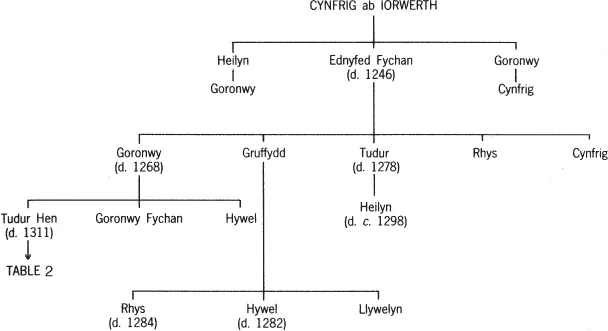
Cynfrig ab Iorwerth had had two other sons besides Ednyfed Fychan: Heilyn and Goronwy. They too appear to have served Prince Llywelyn and Prince David, though not with the brilliance of their brother. Their public actions seem to have been concentrated in the eastern part of Gwynedd, in the countryside of their ancestors, east of the Conwy. They and their descendants never won the prominence, repute or affection felt in North Wales for Ednyfed’s brood (Wyrion Eden).
Ednyfed Fychan had at least six – more probably seven – sons. The fact that every one of them followed their father in serving Gwynedd’s princes, often attaining positions that he had filled, is in part testimony to the high regard in which Ednyfed himself was held and the skill with which he advanced the careers of his relatives. We must recognise, too, that it may reflect their own capabilities. Goronwy and Gruffydd ab Ednyfed were old enough to join their father at Prince Llywelyn’s court, and to support Ednyfed in negotiations with the earl of Chester round about 1222. Gruffydd, however, perhaps through youthful indiscretion, deeply offended Llywelyn by making slanderous remarks about the prince’s wife, an illegitimate daughter of King John whom Llywelyn had married in 1204. Gruffydd was thereupon forced to flee to Ireland. In fact, he was the first member of the family known to have quarrelled with his prince. Despite Gruffydd’s disgrace, Ednyfed’s position was unchallenged, and his other sons reaped handsome rewards. Several of them reached manhood during the short reign of Prince David (1240–6). The young prince may have welcomed the opportunity to draw younger people close to him as well as to rely on his father’s old minister. Indeed, in negotiations with several marcher lords in 1241, Tudur ab Ednyfed was acknowledged to be the prince’s steward even during Ednyfed’s lifetime, though it may only have been a temporary promotion to strengthen his role as a negotiator. Ednyfed’s son Rhys was also in Prince David’s service by 1241.
The second breach in the loyalty of Ednyfed Fychan’s family to the princes of Gwynedd occurred ironically as a result of their service to the princes. In November 1245 Tudur ab Ednyfed was captured by Henry III in North Wales and he was sent as a hostage to the Tower of London, possibly as a guarantee of Prince David’s submission to the king. David’s own brother, Gruffydd, had also been a hostage in the Tower, but in 1244 he was killed while trying to escape. In the following year, Tudur was conveyed by stages to London, first by the Anglophile lord of Southern Powys, Gruffydd ap Gwenwynwyn, and then by John Lestrange, a Shropshire baron who had been the king’s justiciar of Chester until shortly before. He was then handed over to the sheriff of Oxfordshire’s men for the final stage of the journey under escort to the Tower, where he was placed in one of the inner buildings. When he was released in September 1246, the year in which both Prince David and Ednyfed died, he had to leave two of his sons as hostages in the Tower, though they do not seem to have suffered the worst rigours of imprisonment. As a further price of his release, Tudur was forced to swear fealty to Henry III, and he did homage to the king for his lands in North Wales which were now confirmed to him. He also received from the king gifts and more land, including the township of Maenan in the Perfeddwlad. Tudur ab Ednyfed had declared himself to be a loyal subject of King Henry III, an act which was bound to damage his relationship with the ruler of Gwynedd. Henry and his advisers were evidently eager to attract influential Welshmen to their side and in the years that followed Tudur received yet more property from the beneficent king. Indeed, Tudur was used as an envoy by King Henry in the truce negotiations in 1259–60 with Prince David’s nephew and successor, Llywelyn ap Gruffydd; and eventually Tudur’s son, Heilyn, was released from the Tower of London in February 1263.
This change of allegiance by Tudur ab Ednyfed meant that he broke the tradition of service in Gwynedd which his father and grandfather had begun half a century earlier. It may not have been conviction that induced Tudur to throw in his lot with the English king. Royal gifts and land grants were doubtless enticing, but the continued confinement of his sons in London was the most powerful factor. In any case, with the death of both Prince David and Ednyfed Fychan in 1246, an internal power struggle had begun for control of Gwynedd. This may have made the future of Ednyfed’s family seem less certain and a closer relationship with King Henry a sensible precaution. However that may be, after 1263, by which time Llywelyn ap Gruffydd had emerged as the undisputed master of North Wales (and Heilyn ap Tudur had been released from prison), Tudur ab Ednyfed felt able to resume his career in Gwynedd.
When Llywelyn ap Gruffydd (known as Llywelyn the Last after his death) established his personal ascendancy in Gwynedd in 1255, all of Ednyfed Fychan’s sons were old enough to enter his service and eventually they all did so. They became the agents of a régime which re-established a large Welsh principality extending from the Llŷn peninsula in the far west to the River Dee in the east, with client Welsh lordships to the south in Powys, Cardiganshire and Carmarthenshire, and conquests as far as Montgomery in the east and the borders of Glamorgan in the south. Territorially, Llywelyn exceeded even his grandfather’s achievement. He re-asserted Gwynedd’s claim to lordship over all other Welsh princes and by 1258 he was confidently styling himself Prince of Wales. In the Anglo-Welsh treaty concluded at Montgomery in September 1267, Henry III himself recognised and accepted Llywelyn’s position. The sons of Ednyfed Fychan had played a central part in it all. The eldest, Goronwy, had stepped into his father’s shoes as steward by 1258. He continued to fill this crucial office for another ten years, dispensing justice at the highest level, negotiating with the English king and with the marcher lords, the bishop of Bangor and other Welsh princes. Like his father before him, he led the armies of Gwynedd on campaign, and in February 1263 took them as far as Gwent against the great marcher lords of the south. When Goronwy died on 17 October 1268, one Welsh chronicler recalled his courage and distinction in arms, as well as his wisdom and integrity. Goronwy was a true son of his father and the grief which the chronicler felt at his passing was ill-concealed.
Table 1: Ednyfed Fychan and his sons
Ednyfed Fychan’s second son, Gruffydd, eventually returned from Ireland and disgrace. By 1247 he could be found in Prince Llywelyn ap Gruffydd’s company; he witnessed his charters, negotiated with Henry III in 1256, and perhaps he initially acted as steward to the new prince in preference to his elder brother Goronwy. As for Tudur ab Ednyfed, he resumed his career in North Wales, despite his enforced association with Henry III. After 1263, he not only witnessed Prince Llywelyn ap Gruffydd’s charters and assisted Llywelyn in disputes with the bishop of Bangor, with other Welsh princes and certain marcher lords; but after Goronwy’s death in 1268, he succeeded to the stewardship and for a further decade monopolised what was indisputably one of the most powerful positions in Llywelyn’s principality.
The two youngest of Ednyfed Fychan’s sons, Rhys and Cynfrig, followed divergent careers. Cynfrig, who had his paternal grandfather’s name, was also in Prince Llywelyn’s service by 1256, engaged in the same diplomatic and judicial work as his brothers. But Rhys, whose name recalls his maternal grandfather, seems to have fallen out with Prince Llywelyn. Although it is not possible to say that the descendants of Cynfrig ab Iorwerth monopolised the chief office of the princes of Gwynedd, the stewardship, without a break from at least 1216 to 1278, Ednyfed Fychan and several of his sons certainly controlled it for long stretches of that time. Their family steadfastly served Llywelyn ab Iorwerth and his two successors with distinction. Even the occasional rupture in relations with one prince or another hardly detracts from a record that was second to none among the dominant families of North Wales in the thirteenth century.
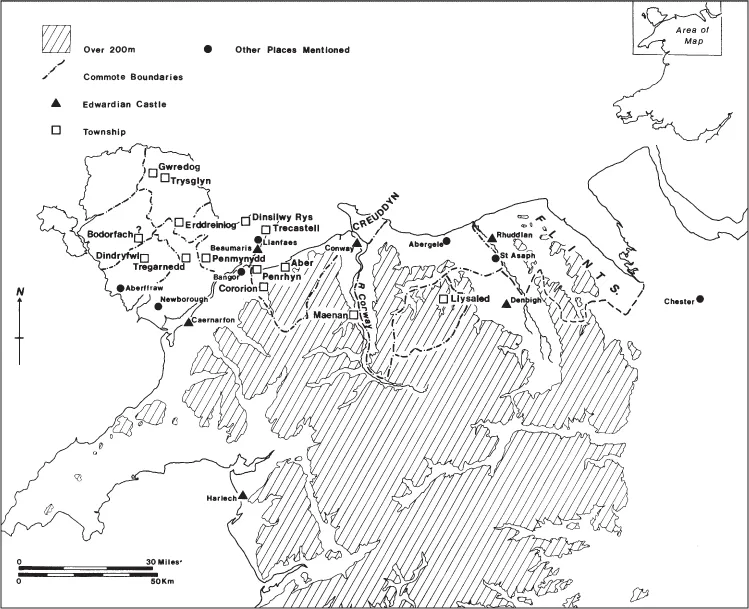
Outstanding service of this order merited rich rewards, and patronage was the surest way to attract and retain such loyalty. Our knowledge of the extensive grants of land which were made to members of Cynfrig ab Iorwerth’s progeny comes almost entirely from the fourteenth century, when townships and properties were still being identified by local administrators as once belonging to Ednyfed Fychan and held by him on the most generous of terms. His family’s homeland lay east of the River Conwy in modern Denbighshire. Most of the land granted to Ednyfed by the princes of Gwynedd was situated in Anglesey (especially at Penmynydd and Trecastell) and in Caernarfonshire west of the Conwy. These properties, which were granted to him and his heirs, had special rights and privileges attached to them, in place of traditional kinship obligations and customary services to the prince. It is likely that these lands were granted to Ednyfed Fychan before 1240 by Llywelyn the Great. In addition, Ednyfed bought other land in the Perfeddwlad (notably Rhos Fyneich), and he was also granted an estate in Cardiganshire. Ednyfed’s sons added to the family possessions in more modest ways; for example, at the time of his allegiance to Henry III, Tudur acquired estates in Flint and Dyffryn Clwyd. These scattered lands, akin to the estates of a nobleman in England, placed the family of Ednyfed Fychan among the wealthiest landowners of North Wales, with all which that implied in terms of local significance and influence.
Map A: Estates of Ednyfed Fychan and his sons in North Wales. The commotes shown are those in which the estates were situated.
As elsewhere in medieval Europe, the link between the Church and the State in North Wales was a direct one. The bishoprics of Bangor and St. Asaph lay entirely within the principality of Gwynedd at its widest extent, and therefore to some degree they were under the princes’ control. Moreover, those who served the princes in secular matters often had relatives who did so in the religious sphere. Yet another of Ednyfed Fychan’s sons can probably be identified with Hywel, bishop of St Asaph from about 1240 until his death in 1247. If so, the bishop’s nephew, Llywelyn, Gruffyd...