Although life in Tudor was ordered in a strict hierarchy, service was common for all classes, and servants were not necessarily the lowest stratum in society. This book looks at the servant life in the Tudor period. It examines relations between servants and their masters, peering into the bedrooms, kitchens and parlours of the ordinary folk.
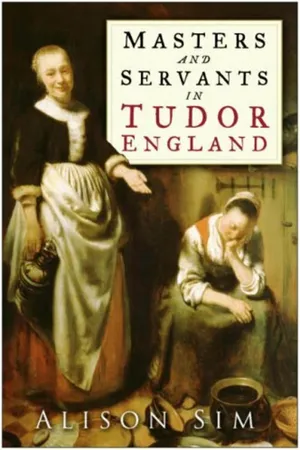
- 208 pages
- English
- ePUB (mobile friendly)
- Available on iOS & Android
eBook - ePub
Masters and Servants in Tudor England
About this book
Information
Notes
INTRODUCTION
1. Lawrence Stone, The Crisis of the Aristocracy, 1558–1641 (Oxford University Press, 1967), p. 101.
2. Ibid., p. 102.
3. Ibid., p. 103.
4. Anne Somerset, Elizabeth I (Phoenix Paperbacks, 1991), p. 345.
5. C.M. Barron, ‘Centres of Conspicious Consumption: The Aristocratic Town House in London 1200–1550’, London Journal 20 (1995).
6. Stone, Crisis of the Aristocracy, p. 251.
ONE: GOLDSMITHS, FULLERS AND DYERS
1. Mercers dealt in fine-quality fabrics, such as silks.
2. O. Jocelyn Dunlop, English Apprenticeship and Child Labour (T. Fisher Unwin, 1912), p. 70.
3. Walter Sherburne Prideaux (ed.), Memorials of the Goldsmiths’ Company 1335–1815 (Eyre & Spottiswoode, n.d.), p. 38.
4. Ibid., pp. 38 and 53.
5. J.R. Boyle and F.W. Dendy (eds), Extracts from the Records of the Merchant Adventurers of Newcastle-upon-Tyne (Surtees Society, 1895), vol. 1, p. 24.
6. Dunlop, English Apprenticeship and Child Labour, p. 37.
7. Ibid., p. 43.
8. Ibid., p. 45.
9. Sherburne Prideaux, Memorials of the Goldsmiths’ Company, p. 28.
10. Dunlop, English Apprenticeship and Child Labour, p. 45.
11. Ibid., p. 51.
12. Ibid., p. 57.
13. Ibid., p. 58.
14. Ibid., p. 46.
15. Anne Daly (ed.), Kingston upon Thames Apprentices 1563–1713 (Surrey Record Society, 1994).
16. For more information see Sylvia L. Thrupp, The Merchant Class of Medieval London (University of Michigan Press, 1977), p. 164.
17. Boyle and Dendy (eds), Merchant Adventurers of Newcastle-upon-Tyne, vol. 1, p. 20.
18. For examples of some Renaissance etiquette books, see F.J. Furnivall (ed.), The Babees Book (Chatto & Windus, 1923).
19. Sherburne Prideaux, Memorials of the Goldsmiths’ Company, p. 37.
20. Thrupp, Merchant Class of Medieval London, p. 166.
21. Dunlop, English Apprenticeship and Child Labour, p. 179.
22. For the full story, see Janet Arnold, Queen Elizabeth’s Wardrobe Unlock’d (W.S. Maney & Son, 1988), p. 159.
23. Sherburne Prideaux, Memorials of the Goldsmiths’ Company, p. 58.
24. Ibid.
25. Ibid., p. 48.
26. Dunlop, English Apprenticeship and Child Labour, p. 36.
27. Sherburne Prideaux, Memorials of the Goldsmiths’ Company, p. 94.
28. Dunlop, English Apprenticeship and Child Labour, p. 56.
29. Quoted from Barbara Winchester, Tudor Family Portrait (Jonathan Cape, 1955), p. 130. The original letters can now be found in The National Archives at Kew.
30. Ibid., p. 224.
31. Dunlop, English Apprenticeship and Child Labour, p. 47.
32. Daly (ed.), Kingston upon Thames Apprentices, pp. 10, 11 and 8 respectively.
33. Dunlop, English Apprenticeship and Child Labour, pp. 150–1.
34. Sue Wright, ‘Churmaids, Huswyfes and Hucksters. The Employment of Women in Tudor and Stuart Salisbury’, in C. Linsey and L. Duffen (eds), Women and Work in Pre-Industrial England (Croom Helm, 1985).
35. Sherburne Prideaux, Memorials of the Goldsmiths’ Company, p. 64.
36. Dunlop, English Apprenticeship and Child Labour, p. 146.
37. Ibid., p. 60.
TWO: JOHN BLANK COMES TO COURT
1. F.O. Shyllon, Black Slaves in Britain (Oxford University Press for the Institute of Race Relations, 1974), p. 2.
2. Calendar of State Papers Domestic, 1597, 7 April, 104.
3. Peter Fryer, Staying Power. The History of Black...
Table of contents
- Cover
- Title
- Dedicaiton
- Copyright
- Contents
- Introduction
- One: Goldsmiths Fullers and Dyers Learning your Trade in Tudor England
- Two: John Blank Comes to Court Black Servants in Sixteenth-century England
- Three: Housewives, Husbandmen and Ploughmen Domestic and Farm Servants
- Four: Lords and Ladies, Bishops and Princes Life in a Great Household
- Five: Yeomen, Scullions and Children Living in a Great Household as a Lower Servant
- Six: Henchmen, Honour and Hospitality Gentlemen Servants in a Great Household
- Seven: Stars in the Presence of the Sun Personal Servants to Royalty
- Notes
- Select Bibliography
Trusted by 375,005 students
Access to over 1.5 million titles for a fair monthly price.
Study more efficiently using our study tools.
Frequently asked questions
Yes, you can cancel anytime from the Subscription tab in your account settings on the Perlego website. Your subscription will stay active until the end of your current billing period. Learn how to cancel your subscription
No, books cannot be downloaded as external files, such as PDFs, for use outside of Perlego. However, you can download books within the Perlego app for offline reading on mobile or tablet. Learn how to download books offline
Perlego offers two plans: Essential and Complete
- Essential is ideal for learners and professionals who enjoy exploring a wide range of subjects. Access the Essential Library with 800,000+ trusted titles and best-sellers across business, personal growth, and the humanities. Includes unlimited reading time and Standard Read Aloud voice.
- Complete: Perfect for advanced learners and researchers needing full, unrestricted access. Unlock 1.5M+ books across hundreds of subjects, including academic and specialized titles. The Complete Plan also includes advanced features like Premium Read Aloud and Research Assistant.
We are an online textbook subscription service, where you can get access to an entire online library for less than the price of a single book per month. With over 1.5 million books across 990+ topics, we’ve got you covered! Learn about our mission
Look out for the read-aloud symbol on your next book to see if you can listen to it. The read-aloud tool reads text aloud for you, highlighting the text as it is being read. You can pause it, speed it up and slow it down. Learn more about Read Aloud
Yes! You can use the Perlego app on both iOS and Android devices to read anytime, anywhere — even offline. Perfect for commutes or when you’re on the go.
Please note we cannot support devices running on iOS 13 and Android 7 or earlier. Learn more about using the app
Please note we cannot support devices running on iOS 13 and Android 7 or earlier. Learn more about using the app
Yes, you can access Masters and Servants in Tudor England by Alison Sim in PDF and/or ePUB format, as well as other popular books in History & British History. We have over 1.5 million books available in our catalogue for you to explore.