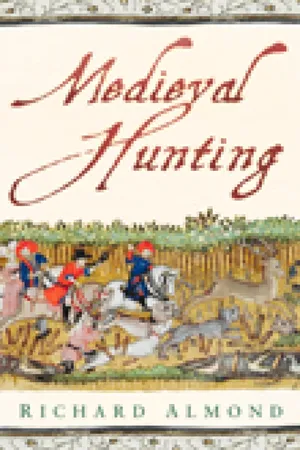
Hunting was a major economic and leisure activity throughout the later European Middle Ages, but while aristocratic practices have featured in studies of romantic and narrative literature, hunting in its wider sense across the social spectrum and with attendant male and female roles - has largely been ignored by modern medieval historians. Richard Almond's study brings vividly to life the universality and centrality of hunting to medieval societies, both as an economic necessity and as an expression of medieval humanity's almost atavistic sense of oneness with nature. Medieval Hunting dispels some of the myths and misunderstandings surrounding hunting, including the persistent views that it was exclusively an aristocratic, male pursuit. Using a wide variety of contemporary textual and art historical evidence, Richard Almond shows that hunting, including fishing and poaching, was enjoyed by women as well as men.
- 224 pages
- English
- ePUB (mobile friendly)
- Available on iOS & Android
eBook - ePub
Medieval Hunting
About this book
Information
Notes
The following abbreviations have been used:
Birrell: Jean Birrell, ‘Peasant deer poachers in the medieval forest’, in Richard Britnell and John Hatcher (eds), Progress and Problems in Medieval England (Cambridge, 1996), pp. 68–88.
BSA facsimile edn: Dame Juliana Berners, The Boke of Saint Albans, 1486, facsimile edition (London, 1899).
Dalby: David Dalby, Lexicon of the Mediaeval German Hunt (Berlin, 1965).
H & H: John Cummins, The Hound and the Hawk, The Art of Medieval Hunting (London, 1988).
Ldc, 616: Paris, Bibliothèque nationale, Livre de chasse, MS fr. 616.
Ldc, Tilander: Gaston Phébus, Livre de chasse, ed. Gunnar Tilander, Cynegetica, XVIII (Karlshamn, 1971).
MG, 1904: Edward, Duke of York, The Master of Game, ed. W.A. and F. Baillie-Grohman (London, 1904).
MG, 1909: Edward, Duke of York, The Master of Game, ed. W.A. and F. Baillie-Grohman (London, 1909).
Modus: Gunnar Tilander, (ed.), Les Livres du roy Modus et de la royne Ratio, Vol. 1, Société des Anciens Textes Français (Paris, 1932).
Pisanello: Luke Syson and Dillian Gordon, Pisanello, Painter to the Renaissance Court (London, 2002).
PTA: M.Y. Offord, (ed.), The Parlement of the Thre Ages, Early English Text Society No. 246 (London, 1959; repr. 1967).
Tristan: Gottfried von Strassburg Tristan, trans. and ed. A.T. Hatto (London, 1960; repr. 1967).
Introduction
1. Nicholas Orme, Medieval Children (New Haven and London, 2001; repr. 2002), pp. 133 and 155.
2. Linda Colley, Britons, Forging the Nation 1707–1837 (New Haven and London, 1992), pp. 170–1.
3. Marcel Thomas and François Avril, The Hunting Book of Gaston Phébus, Commentary by Wilhelm Schlag (London, 1998), p. 18.
4. Roger B. Manning, Hunters and Poachers (Oxford, 1993), p. 116.
5. Ralph Whitlock, Historic Forests (Bradford-on-Avon, 1979), pp.18 and 21.
6. H & H, pp. 57–9.
7. The author is grateful to Professor Anthony J. Pollard for access to, and use of, his unpublished conference paper ‘The 1390 Game Law’.
8. J. Langton and G. Jones (eds.) Forests and Chases of Medieval England and Wales, c.1000–c.1500 (St John’s College Research Centre, Oxford, 2010).
9. Whitlock, Historic Forests, p. 21.
10. Anne Rooney, ‘Hunting in Middle English Literature, 1300–1500’ (Ph.D. dissertation, Trinity College, Cambridge, 1985), p. 3.
11. Richard, Almond, and A.J. Pollard, ‘The Yeomanry of Robin Hood and Social Terminology in Fifteenth-Century England’, Past & Present, No. 170, February 2001, pp. 52–77.
12. J.N. Bartlett, ‘The Expansion and Decline of York in the Later Middle Ages’, Economic History Review, 2nd Series, Vol. XII, 1959–60.
13. H & H, p. 2.
14. Ldc, Tilander, p. 55, fol. 4v. ll. 35–7.
15. PTA, Prologue, p. 1, ll. 7–14.
16. Ldc, Tilander, p. 51, fol. 3, ll. 3–6.
17. William Langland, Piers Plowman, the C-text, ed. Derek Pearsall (London, 1978), Passus IX, p. 170, l. 223.
18. MG, 1904, p. 161.
19. Marcelle Thiébaux, The Stag of Love: The Chase in Medieval Literature (Ithaca and London, 1974), p. 22.
Chapter One
1. Marcel Thomas and François, Avril, The Hunting Book of Gaston Phébus (London, 1998), p. 5.
2. Ldc, Tilander, p. 51, fol. 3, ll. 3–6.
3. John of Salisbury, Policraticus, Bk 1, trans. Joseph B. Pike (London, 1938), pp. 22–5.
4. Ibid., p. 18.
5. MG, 1904, p. 4.
6. Ibid., p. 5.
7. Ibid., p. 69.
8. Nicholas Orme, From Childhood to Chivalry (London, 1984), p. 82.
9. Tristan, pp. 68–71.
10. Orme, From Childhood to Chivalry, p. 84.
11. Ibid., p. 84.
12. Ibid., p. 191.
13. Ibid., p. 193.
14. Marion Wynne-Davies, Bloomsbury Guide to English Literature (London, 1989; repr. 1992), pp. 399–400.
15. Ldc, 616: Reading and learning the names of hounds from scrolls, Ch. 22, fol. 51v. and Practising blowing horns and holloaing, Ch. 26, fol. 54.
16. Orme, From Childhood to Chivalry, p. 41.
17. Nicholas, Orme, Medieval Children (New Haven and London, 2001; repr. 2002), p. 280.
18. Orme, From Childhood to Chivalry, pp. 118 and 191.
19. H & H, p. 176; A.C., Spearing, The Gawain Poet: A Critical Study (Cambridge, 1970), p. 10.
20. William, Langland, Piers Plowman, the C-text, ed. Derek Pearsall (London, 1978), Passus VIII, p. 147, l. 24.
21. Ibid., p. 147, ll. 28–31.
22. Robert P. Miller, (ed.), Chaucer: Sources and Backgrounds (Oxford, 1977), pp. 180 and 182.
23. Philippe Contamine, War in the Middle Ages, trans. Michael Jones (Oxford, 1984), p. 215.
24. Pisanello, p. 85.
25. Spearing, The Gawain Poet: A Critical Study, p. 9.
26. Langland, Piers Plowman, ed. Derek Pearsall, Passus IX, p. 172, l. 264.
27. London, British Library, The Luttrell Psalter, Add. MS 42130, fol. 31.
28. Derek Brewer, Chaucer in his Time (London, 1963), p. 187.
29. William Twiti, The Art of Hunting, 1327, ed. Bror Danielsson (Stockholm, 1977), p. 21.
30. MG, 1904, pp. 202–3.
31. London, British Library, MS Egerton 1146, Calendar for April, fol. 5v.
32. Ldc, 616: Making nets and snares from cord with the aid of a rop...
Table of contents
- Cover
- Title
- Dedication
- Copyright
- Contents
- Acknowledgements
- Foreword
- Introduction
- One: ‘Delite’ and Other Functions
- Two: ‘Lordes to Honte’
- Three: ‘Bestis’ and ‘Crafte’
- Four: Everyman
- Five: Crossing the Barriers
- Six: Medieval Dianas
- Seven: Conclusions
- Notes
- Bibliography
Trusted by 375,005 students
Access to over 1.5 million titles for a fair monthly price.
Study more efficiently using our study tools.
Frequently asked questions
Yes, you can cancel anytime from the Subscription tab in your account settings on the Perlego website. Your subscription will stay active until the end of your current billing period. Learn how to cancel your subscription
No, books cannot be downloaded as external files, such as PDFs, for use outside of Perlego. However, you can download books within the Perlego app for offline reading on mobile or tablet. Learn how to download books offline
Perlego offers two plans: Essential and Complete
- Essential is ideal for learners and professionals who enjoy exploring a wide range of subjects. Access the Essential Library with 800,000+ trusted titles and best-sellers across business, personal growth, and the humanities. Includes unlimited reading time and Standard Read Aloud voice.
- Complete: Perfect for advanced learners and researchers needing full, unrestricted access. Unlock 1.5M+ books across hundreds of subjects, including academic and specialized titles. The Complete Plan also includes advanced features like Premium Read Aloud and Research Assistant.
We are an online textbook subscription service, where you can get access to an entire online library for less than the price of a single book per month. With over 1.5 million books across 990+ topics, we’ve got you covered! Learn about our mission
Look out for the read-aloud symbol on your next book to see if you can listen to it. The read-aloud tool reads text aloud for you, highlighting the text as it is being read. You can pause it, speed it up and slow it down. Learn more about Read Aloud
Yes! You can use the Perlego app on both iOS and Android devices to read anytime, anywhere — even offline. Perfect for commutes or when you’re on the go.
Please note we cannot support devices running on iOS 13 and Android 7 or earlier. Learn more about using the app
Please note we cannot support devices running on iOS 13 and Android 7 or earlier. Learn more about using the app
Yes, you can access Medieval Hunting by Richard Almond in PDF and/or ePUB format, as well as other popular books in History & Social History. We have over 1.5 million books available in our catalogue for you to explore.