There have been more prisons in London than in any other European city. Of these, Newgate was the largest, most notorious and worst. Built during the twelfth century, it became a legendary place - the inspiration of more poems, plays and novels than any other building in London. It was a place of cruelty and wretchedness, at various times holding Dick Turpin, Titus Oates, Daniel Defoe, Jack Sheppard and Casanova. Because prisons were privately run, any time spent in prison had to be paid for by the prisoner. Housing varied from a private cell with a cleaning woman and a visiting prostitute, to simply lying on the floor with no cover. Those who died inside - and only a quarter of prisoners survived until their execution day - had to stay in Newgate as a rotting corpse until relatives found the money for the body to be released. Stephen Halliday tells the story of Newgate's origins, the criminals it held, the punishments meted out and its rebuilding and reform. This is a compelling slice of London's social and criminal history.
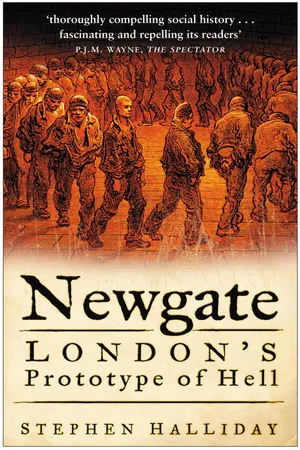
- 288 pages
- English
- ePUB (mobile friendly)
- Available on iOS & Android
eBook - ePub
About this book
Information
Notes
Chapter One
1. Gordon Home, Roman London, London, Benn, 1926, has a good account of the Roman gates of London.
2. John Stow, Survey of London, 1603 edn., Oxford, 1971, p. 35.
3. The term ‘Lord Mayor’ was not used before the sixteenth century; Edward III’s concession is recorded in Liber Albus, compiled by John Carpenter in 1419, 1861 edn., London, p. 357.
4. W.J. Loftie, History of London, London, Edward Stanford, 1884, vol. 1, p. 437.
5. John Stow, Survey of London, p. 36.
6. Ibid., p. 50.
7. Ibid., p. 36.
8. A. Marks, Tyburn Tree, London, Brown Langham, 1908, p. 104.
9. A. Griffith, Chronicles of Newgate, 1987 edn., London, Bracken Books, 1883, pp. 17–22.
10. These cases and those that follow are to be found in Memorials of London Life in the 13th 14th and 15th Centuries, ed. H.T. Riley, London, Longmans Green, 1868, pp. 229, 470, 562.
11. A. Babington, The English Bastille, London, Macdonald, 1971, pp. 26 et seq.
12. Sir Thomas Skyrme, History of the Justices of the Peace, Chichester, Barry Rose Publishers, 1991, vol. 1, p. 174.
13. See Chapter 6 for an account of Elizabeth Fry’s work.
14. Sir Thomas Skyrme, History of the Justices of the Peace, vol. 1, p. 174.
15. A. Babington, The English Bastille, p. 27.
16. John Stow, Survey of London, p. 191.
17. British Mercury, London, 1790, pp. 336–7.
18. Sir Thomas Skyrme, History of the Justices of the Peace, vol. 1, p. 173.
19. A. Griffith, Chronicles of Newgate, p. 24.
20. Sir Thomas Smith, De Republica Anglorum, London, 1583, Chapter 23.
21. A. Babington, The English Bastille, p. 30.
22. John Stow, Survey of London, p. 37.
23. R. Sharpe, Memorials of Newgate and the Old Bailey, London, Blades, 1907, p. 4.
24. Memorials of London Life in the 13th 14th and 15th Centuries, H.T. Riley, ed., p. 673.
25. The expression ‘Lord Mayor’ did not come into use until Tudor times, a century after Whittington.
26. Hard to translate into twenty-first century terms, but certainly the equivalent of a multi-millionaire.
27. John Stow, Survey of London, p. 35.
28. A. Babington, The English Bastille, p. 18.
29. Ibid., p. 23.
30. See Chapter 2 for an account of later sponging houses.
31. A. Babington, The English Bastille, p. 20.
32. Ibid., p. 6.
33. P. Ackroyd, London, the Biography, London, Vintage, 2001, p. 247.
34. John Stow, Survey of London, p. 351.
35. P. Ackroyd, London, the Biography, p. 248.
36. There are many editions of Foxe’s famous book; these extracts quoted are taken from a version available on the Internet at www.bible.crosswalk.com/Historey/Ad/FoxsBookofMartyrs
37. Yale edition of the complete works of More, Yale University Press, 1963, vol. 8, p. 21.
38. A. Griffith, Chronicles of Newgate, p. 45.
39. Luke Hutton, The Discovery of a London Monster Called the Black Dog of Newgate, London, 1612.
40. A. Griffith, Chronicles of Newgate, p. 41.
41. Ibid., p. 63.
42. Ibid., p. 67.
43. Ibid., p. 67.
44. Journal of the House of Commons, vol. 2, 1641, p. 394.
45. A. Griffith, Chronicles of Newgate, p. 123.
46. D. Lupton, London Carbonadoed, 1632, p. 70, Guildhall Library Ref. 2464ii.
Chapter Two
1. For an account of the New River Company see S. Halliday, Water: A Turbulent History, Stroud, Sutton Publishing, 2004.
2. Henry Chamberlain, History and Survey of the Cities of London and Westminster, London, 1770, p. 120; a similar account is found in William Maitland, FRS, History of London from its Foundation to the Present Time, London, 1775, p. 950.
3. Pennant’s Tour of London, 1805, Guildhall Library ref. SL 84.
4. A. Babington, The English Bastille, London, Macdonald, 1971, p. 56
5. B.L., London, An Accurate Description of Ne...
Table of contents
- Cover
- Title
- Copyright
- Dedication
- Contents
- Preface: Newgate in the English Penal System
- One: The Heinous Gaol of Newgate
- Two: An Abode of Misery and Despair
- Three: The Bloody Code
- Four: Catching the Criminals
- Five: After the Riots
- Six: The Reformers
- Seven: Newgate in Literature: Final Days
- Notes
- Bibliography
Trusted by 375,005 students
Access to over 1.5 million titles for a fair monthly price.
Study more efficiently using our study tools.
Frequently asked questions
Yes, you can cancel anytime from the Subscription tab in your account settings on the Perlego website. Your subscription will stay active until the end of your current billing period. Learn how to cancel your subscription
No, books cannot be downloaded as external files, such as PDFs, for use outside of Perlego. However, you can download books within the Perlego app for offline reading on mobile or tablet. Learn how to download books offline
Perlego offers two plans: Essential and Complete
- Essential is ideal for learners and professionals who enjoy exploring a wide range of subjects. Access the Essential Library with 800,000+ trusted titles and best-sellers across business, personal growth, and the humanities. Includes unlimited reading time and Standard Read Aloud voice.
- Complete: Perfect for advanced learners and researchers needing full, unrestricted access. Unlock 1.5M+ books across hundreds of subjects, including academic and specialized titles. The Complete Plan also includes advanced features like Premium Read Aloud and Research Assistant.
We are an online textbook subscription service, where you can get access to an entire online library for less than the price of a single book per month. With over 1.5 million books across 990+ topics, we’ve got you covered! Learn about our mission
Look out for the read-aloud symbol on your next book to see if you can listen to it. The read-aloud tool reads text aloud for you, highlighting the text as it is being read. You can pause it, speed it up and slow it down. Learn more about Read Aloud
Yes! You can use the Perlego app on both iOS and Android devices to read anytime, anywhere — even offline. Perfect for commutes or when you’re on the go.
Please note we cannot support devices running on iOS 13 and Android 7 or earlier. Learn more about using the app
Please note we cannot support devices running on iOS 13 and Android 7 or earlier. Learn more about using the app
Yes, you can access Newgate by Stephen Halliday in PDF and/or ePUB format, as well as other popular books in Social Sciences & British History. We have over 1.5 million books available in our catalogue for you to explore.