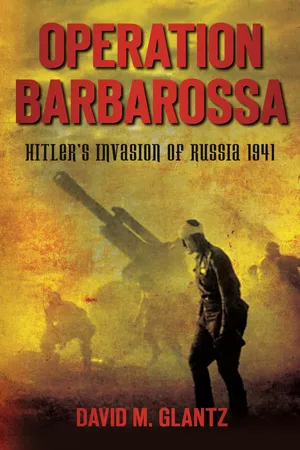
On 22 June 1941 Hitler unleashed his forces on the Soviet Union. Spearheaded by four powerful Panzer groups and protected by an impenetrable curtain of air support, the seemingly invincible Wehrmacht advanced from the Soviet Union's western borders to the immediate outskirts of Leningrad, Moscow and Rostov in the shockingly brief period of less than six months. The sudden, deep, relentless German advance virtually destroyed the entire peacetime Red Army and captured almost 40 percent of European Russia before expiring inexplicably at the gates of Moscow and Leningrad. An invasion designed to achieve victory in three to six weeks failed and, four years later, resulted in unprecedented and total German defeat. David Glantz challenges the time-honoured explanation that poor weather, bad terrain and Hitler's faulty strategic judgement produced German defeat, and reveals how the Red Army thwarted the German Army's dramatic and apparently inexorable invasion before it achieved its ambitious goals.
- 305 pages
- English
- ePUB (mobile friendly)
- Available on iOS & Android
eBook - ePub
About this book
Information
1
PLANS AND OPPOSING FORCES
Plan ‘Barbarossa’
In the year of our Lord 1189, Frederick I Barbarossa (Red Beard), Emperor of Germany and self-styled Holy Roman Emperor, took up the cross and led the Third Crusade against Saladin’s Muslim armies that had just captured Jerusalem. Led by ironclad knights, the armies of Frederick’s First Reich swept eastward through Hungary, the Balkans and Asia Minor, intent on liberating Christianity’s holy places from infidel control. Over 700 years later, Adolf Hitler, Führer of his self-styled German Third Reich, embarked on a fresh crusade, this time against the Soviet Union, the heartland of hated Bolshevism. Inspired by historical precedent, he named his crusade Operation Barbarossa. In place of Frederick’s ironclad knights, Hitler spearheaded his crusade with masses of menacing panzers conducting what the world already termed Blitzkrieg (‘lightning war’).
When Hitler began planning Operation Barbarossa in the summer of 1940, Germany had been at war for almost a full year. As had been the case throughout the late 1930s, Hitler’s diplomatic and military audacity had exploited his foes’ weaknesses and timidity, producing victories that belied the real strength of the Wehrmacht (Armed Forces) and Luftwaffe (Air Force). Before the Second World War began on 1 September 1939, Hitler’s fledgling armies had reoccupied the Rhineland (1936), annexed Austria (1938), dismembered Czechoslovakia (1938) and annexed Memel’ (1939), all bloodlessly and with tacit Western approval. Once the war began, Hitler’s armies conquered Poland (September 1939), seized Denmark and Norway (April 1940) and vanquished the West’s finest armies to occupy the Netherlands, Belgium and France (May-June 1940), driving the British Army from the continent at Dunkirk in utter defeat. Protected by its formidable moat, the English Channel, and its vaunted High Fleet, Britain survived Hitler’s vicious and sustained air attacks during the ensuing Battle of Britain, but only barely.
It was indeed ironic, yet entirely characteristic of Hitler, that military failure in the Battle of Britain would inspire him to embark on his crusade against Soviet Bolshevism. Even though defeat in the skies during the Battle of Britain frustrated his plans to invade the British Isles in Operation Sea Lion, Hitler reverted to his characteristic audacity. Inspired by his army’s unprecedented string of military successes, he set out to achieve the ambitious goal he had articulated years before in his personal testament Mein Kampf, the acquisition of ‘living space’ (lebensraum) to which he believed the German people were historically and racially entitled. Conquest of the Soviet Union would yield that essential living space and, at the same time, would rid the world of the scourge of Bolshevism.
Militarily, however, the ground invasion and conquest of the Soviet Union was a formidable task. The German Wehrmacht had achieved its previous military victories in Western Europe, a theatre of operations that was well developed and distinctly limited in terms of size. It had done so by employing minimal forces against poorly prepared armies that were utterly unsuited to counter or endure Blitzkrieg and whose parent nations often lacked the will to fight and prevail. The conquest of the Soviet Union was an entirely different matter. Plan Barbarossa required the Wehrmacht to vanquish the largest military force in the world and ultimately advance to a depth of 1,750 kilometres (1,050 miles)* along a front of over 1,800 kilometres (1,080 miles) in an underdeveloped theatre of military operations whose size approximated all of Western Europe. Hitler and his military planners assumed that Blitzkrieg would produce a quick victory and planned accordingly.
To achieve this victory, the Germans planned to annihilate the bulk of the Soviet Union’s peacetime Red Army before it could mobilize its reserves, by conducting a series of dramatic encirclements near the Soviet Union’s new western frontier. Although German military planners began contingency planning for an invasion of the Soviet Union in the summer of 1940, Hitler did not issue his Directive 21 for Fall [‘case’ or ‘operation’] Barbarossa until 18 December (see Appendix I). When he finally did so his clear intention was to destroy the Red Army rather than achieve any specific terrain or political objective:
The mass of the [Red] army stationed in Western Russia is to be destroyed in bold operations involving deep penetrations by armoured spearheads, and the withdrawal of elements capable of combat into the extensive Russian land spaces is to be prevented. By means of rapid pursuit a line is then to be reached from beyond which the Russian air force will no longer be capable of attacking the German home territories.1
Two weeks before, in one of many planning conferences for Barbarossa, Hitler had noted that, in comparison with the goal of destroying the Soviet armed forces, ‘Moscow [is] of no great importance.’2 Both he and his military advisers were confident that, if his forces did destroy the Red Army, Stalin’s communist regime in Russia would collapse, replicating the chaos of 1918. This assumption, however, woefully underestimated the Soviet dictator’s control over the population and the Red Army’s capacity for mobilizing strategic reserves to replace those forces the Germans destroyed in its initial vital encirclements. Only later in 1941, after the Red Army and Soviet government displayed resilience in the face of unmitigated catastrophes, did the Germans began believing that the capture of Moscow was the key to early victory.
To destroy the Red Army, Hitler massed 151 German divisions (including 19 panzer and 15 motorized infantry divisions) in the east, equipped with an estimated 3,350 tanks, 7,200 artillery pieces and 2,770 aircraft.3 The Finns supported Barbarossa with 14 divisions and the Rumanians contributed4 divisions and 6 brigades to the effort, backed up by another 9 divisions and 2 brigades.4 The German Army High Command [Oberkommando des Heeres – OKH] controlled all Axis forces in the Eastern Theatre. The OKH, in turn, subdivided these forces into an Army of Norway operating in the far north and Army Groups North, Centre, and South, with four panzer groups deployed from the Baltic Sea southward to the Black Sea. A German air fleet supported each of these four commands. Plan Barbarossa tasked Field Marshal Fedor von Bock’s Army Group Centre, which included two of the four panzer groups (the Second and Third), with conducting the main offensive thrust. Advancing precipitously along the flanks of the Belostok salient, Bock’s two panzer groups were to link up at Minsk to create the campaign’s first major encirclement. Thus, the mass of German offensive power was located north of the Pripiat’ Marshes, the almost-impassible ground that effectively divided the theatre into northern and southern regions.
German military planners sought to exploit Russia’s lack of decent roads and railroads laterally across the front and into the depths to prevent the mass of Soviet troops from regrouping from one sector to another or withdrawing eastward before they were surrounded. However, German intelligence overestimated the degree of Red Army forward concentration and was totally unaware of the groups of reserve armies that the Soviets were already deploying east of the Dnepr river. Once the border battles had ended, Plan Barbarossa required the three German army groups to advance along diverging axes, Army Group North towards Leningrad, Army Group Centre toward Moscow and Army Group South toward Kiev. Thus, from its inception, Plan Barbarossa anticipated dangerously dissipating the Wehrmacht’s military strength in an attempt to seize all of Hitler’s objectives simultaneously.
Soviet War Planning: The Answering Strike
Ironically, the Ribbentrop-Molotov Non-Aggression Pact, which Stalin and Hitler negotiated in August 1939, actually contributed to the catastrophic defeat the Red Army suffered during the initial stages of Operation Barbarossa. By signing the infamous agreement, Stalin hoped to forestall possible German aggression against the Soviet Union and, while doing so, create a buffer zone by seizing eastern Poland and the Baltic States. However, the Soviets’ subsequent occupation of eastern Poland in September 1939 and the Baltic States a year later brought the Soviet Union into direct contact with Germany and forced the Red Army General Staff to alter its war plans fundamentally. Beginning in July 1940, the Red Army General Staff developed new war plans identifying Germany as the most dangerous threat and the region north of the Pripiat’ River as the most likely German attack axis.5 Stalin, however, disagreed with these assumptions and in October 1940 insisted his General Staff prepare a new plan based on the assumption that, if it attacked, Germany would likely strike south of the Pripiat’ River into the economically vital region of the Ukraine.6 With minor modifications, this plan became the basis for Mobilization Plan (MP) 41 and associated Red Army operational war plans.
Ordered by Stalin and prepared in early 1941 by G.K. Zhukov, the new Chief of the General Staff, State Defense Plan 1941 (DP 41) reflected the assumption ‘that the Red Army would begin military operations in response to an aggressive attack.’7 Therefore, while defensive in a strategic sense, the plan and the military thought that it echoed was inherently offensive in nature. DP 41 and its associated mobilization plan required the Red Army to deploy 237 of its 303 divisions in the Baltic Special, Western Special and Kiev Special Military Districts and the 9th Separate Army, which, when war began, would form the Northwestern, Western, Southwestern and, ultimately, Southern Fronts.8 As a whole, Red Army forces in the western Soviet Union were to deploy in two strategic echelons. The first was to consist of 186 divisions assigned to four operating fronts, and the second was to include 51 divisions organized into five armies under High Command (Stavka) control. In turn, the four operating fronts were to deploy their forces in three successive belts, or operational echelons, arrayed along and behind the new frontier. The first operational echelon formed a light covering force along the border, and the second and third echelons, each of roughly equal size, were to add depth to the defense and conduct counterattacks and counterstrokes.
Mobilization difficulties in early 1941, however, precluded full implementation of DP 41. Consequently, on 22 June 1941 the first strategic echelon’s three operational belts consisted of 57, 52 and 62 divisions, respectively, along with most of the Red Army’s 20 mechanized corps deployed in European Russia.9 The five armies deployed in the second strategic echelon under Stavka control, which ultimately consisted of 57 divisions assembling along the Dnepr and Dvina rivers, was virtually invisible to German intelligence. Its mission was to orchestrate a counteroffensive in conjunction with the counterattacks conducted by the forward fronts. However, by 22 June 1941 neither the forward military districts nor the five reserve armies had completed deploying in accordance with the official mobilization and deployment plans.10 As in so many other respects, the German attack on 22 June caught the Soviets in transition. Worse still, Soviet war planners had fundamentally misjudged the situation, not only by concentrating their forces so far forward, but also by expecting the main enemy thrust to occur south of the Pripiat’ Marshes. Thus the Red Army was off-balance and concentrated in the southwest when the main German mechanized force advanced further north.11
The German Army and Luftwaffe
Even though the German Army seemed at the height of its power in June 1941 by virtue of its stunning victories in 1939 and 1940, it was by no means invincible. The German officer corps had traditionally prided itself on its doctrine, a unity of training and thought that allowed junior officers to exercise initiative because they understood their commander’s intentions and knew how their peers in adjacent units would react to the same situation. Although disagreements about the correct employment of armour had disrupted doctrinal unity in the mid-1930s, subsequent victories vindicated the minority of younger German theorists’ faith in mechanized warfare. The Wehrmacht’s panzer forces clearly demonstrated that massed mobile offensive power could penetrate enemy defenses in narrow front sectors, exploit to the rear, disrupt enemy logistics and command and control, and encircle large enemy forces. While follow-on infantry then destroyed the encircled forces, the panzers could continue to exploit success deep into the enemy rear area.
In practice, however, earlier campaigns also demonstrated that the enemy could often escape from these encirclements if the infantry failed to advance quickly enough to seal the encirclement. This occurred because Germany never had enough motor vehicles to equip more than a small portion of its infantry troops. The vast majority of the German Army throughout the Second World War consisted of foot-mobile infantry and horse-drawn artillery and supplies, sometimes forcing the mechanized and motorized spearheads to pause while their supporting units caught up by forced marches.
Since panzer forces were vital to the implementation of German offensive doctrine, Hitler created more of them prior to Barbarossa by reducing the number of tanks in existing and new panzer divisions. The 1941 panzer divisions consisted of two to three tank battalions each with an authorized strength of 150 to 202 tanks per division (in practice, an average of 125 operational tanks). In addition, the panzer division included five infantry battalions, four truck-mounted and one on motorcycles. Few of these motorized infantry units were equipped with armoured personnel carriers; hence the infantry suffered higher casualties. The panzer division, which also included armoured reconnaissance and engineer battalions, three artillery battalions equipped with guns towed behind trucks or tractors, and communications, antitank and anti-aircraft units, totalled roughly 17,000 men. The slightly smaller motorized infantry divisions consisted of one tank battalion, seven motorized infantry battalions and three or four artillery battalions.12 The organization of the first four Waffen (combat) SS divisions was identical to that of regular army motorized infantry divisions, although they later evolved into lavishly equipped panzer divisions. The 1941 motorized (panzer) corps consisted of two panzer and one motorized infantry division, while two to four of these motorized corps formed a panzer group. During Barbarossa, several panzer groups, augmented by the addition of army (infantry) corps, were renamed panzer armies.
Since German operations in 1939 and 1940 were predominantly offensive, defensive doctrine was based largely on 1918 practices. Defending infantry relied on deep and elaborate prepared defenses, kept the bulk of forces in reserve and relied on elastic defense and rapid counterattacks to defeat the attacker. Defensive doctrine rested on three assumptions, all of which proved invalid in Russia. The assumptions were that sufficient infantry would exist to establish defenses in depth, that the enemy would make his main attack with dismounted infantry, and that German commanders would be allowed to chose where to defend and be permitted to defend flexibly as the situation required. The typical German infantry division consisted of three regiments each of three infantry battalions, plus four horse-drawn artillery regiments, with a strength of 15,000 men. Since the division’s principal infantry antitank weapon, the 37mm antitank gun, had already proven inadequate against French and British heavy armour, infantry divisions had to employ their 100mm or 105mm medium artillery battalion and the famous 88mm anti-aircraft guns aga...
Table of contents
- Cover
- Title Page
- Contents
- List of Illustrations
- Preface
- 1 Plans and Opposing Forces
- 2 The Border Battles, 22 June–9 July
- 3 The Soviet Response
- 4 The Battle for Smolensk, 10 July–10 September
- 5 The Battle for Leningrad, 10 July–30 September
- 6 The Battle for Kiev, 10 July–30 September
- 7 Viaz’ma, Briansk, Tikhvin and Rostov, 30 September–30 October
- 8 To the Gates of Moscow, November
- 9 Barbarossa Contained, December
- Conclusions
- Maps and Tables
- Notes
- Selected Bibliography
- I German planning documents associated with Operation Barbarossa
- II Soviet planning documents associated with Operation Barbarossa
- III Summary orders of battle, 22 June 1941
- IV Detailed opposing orders of battle, 22 June 1941
- Plate Section
- Copyright
Trusted by 375,005 students
Access to over 1.5 million titles for a fair monthly price.
Study more efficiently using our study tools.
Frequently asked questions
Yes, you can cancel anytime from the Subscription tab in your account settings on the Perlego website. Your subscription will stay active until the end of your current billing period. Learn how to cancel your subscription
No, books cannot be downloaded as external files, such as PDFs, for use outside of Perlego. However, you can download books within the Perlego app for offline reading on mobile or tablet. Learn how to download books offline
We are an online textbook subscription service, where you can get access to an entire online library for less than the price of a single book per month. With over 1.5 million books across 990+ topics, we’ve got you covered! Learn about our mission
Look out for the read-aloud symbol on your next book to see if you can listen to it. The read-aloud tool reads text aloud for you, highlighting the text as it is being read. You can pause it, speed it up and slow it down. Learn more about Read Aloud
Yes! You can use the Perlego app on both iOS and Android devices to read anytime, anywhere — even offline. Perfect for commutes or when you’re on the go.
Please note we cannot support devices running on iOS 13 and Android 7 or earlier. Learn more about using the app
Please note we cannot support devices running on iOS 13 and Android 7 or earlier. Learn more about using the app
Yes, you can access Operation Barbarossa by David M Glantz in PDF and/or ePUB format, as well as other popular books in History & Military & Maritime History. We have over 1.5 million books available in our catalogue for you to explore.