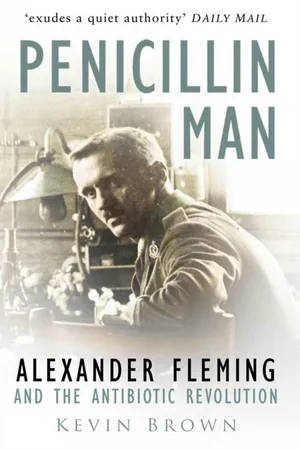
Penicillin revolutionized healthcare and turned the modest, self-effacing Alexander Fleming into a world hero. This book tells the story of the man and his discovery set against a background of the transformation of medical research from 19th-century individualism through to teamwork and modern-day international big business.
- 288 pages
- English
- ePUB (mobile friendly)
- Available on iOS & Android
eBook - ePub
About this book
Information
ONE
‘That’s funny!’
It was the bane of many a bacteriologist’s life – the contamination of a culture plate by a fungus. Yet this mysterious mould was destined to change the world and to revolutionise medicine in a way the scientist who noticed it could never have predicted that early September day. It would also change his own life and bring him the fame and public attention he would never have intentionally sought for himself. Forty-seven-year-old Alexander Fleming had only just returned from holiday that Monday morning, 3 September 1928, after spending August with his wife and 4-year-old son at their country home in Suffolk. His appointment as Professor of Bacteriology at St Mary’s Hospital Medical School, part of the University of London, had commenced on Saturday 1 September, but, whatever pride he may have had in his new status, he was really returning to a department he had worked in for over twenty years and he did not expect too many changes to his way of working. If anything, he was more interested in the research that had absorbed his attention before he went away.
Before him on the bench of his cramped laboratory, crowded with the tools of his bacteriologist’s trade, were some discarded petri dishes containing Staphylococcus aureus, a fairly common bacterium which can cause nasty though not lethal abscesses and boils. He had finished working on these cultures before his holiday and now had no further use for them, but settled down to examining them for one last time before asking his laboratory technician to sterilise them so that the glass plates could be reused. The culture plates were stacked in an overflowing shallow enamel tray for examination and after inspection would be transferred to an adjacent tray, containing lysol, a strong disinfectant.1 Many bacteriologists liked to dispose of their discarded culture plates as soon as they had finished with them, but not Fleming. His usual practice was to leave them for a few weeks until the bench was overcrowded with forty or fifty cultures just to see what, if anything, might have happened. He teased any of his more orderly colleagues with the charge of excessive tidiness if they cleared their benches and discarded test tubes and culture plates for which they had no further use at the end of each day.2 Fleming’s approach was about to be vindicated.
He was busy examining his plates under a hand-held magnifying glass when a visitor popped his head around the always open door of the laboratory. Merlin Pryce, then a research scholar, had helped Fleming with his earlier work on Staphylococcus aureus, but had left the laboratory in February 1928 to work as a pathologist in the Department of Morbid Anatomy at St Mary’s, leaving Fleming to continue with the work himself. Fleming, ever anxious to encourage the careers of younger associates, indeed wished to make him co-author of the resultant publication, but Pryce refused as he believed he had not contributed enough to the work on staphylococci to merit such distinction. Fleming continued to sort through the plates, a number of them contaminated with colonies of yeasts and moulds, as he chatted to his visitor, chiding him for having left him to do all this work himself and occasionally pulling out an interesting specimen at random to show to his colleague. Indeed he had come very close to discarding the culture plates without inspecting them when his visitor arrived, but Pryce urged him to continue to look at them.3 Suddenly, Fleming noticed something unusual and paused to examine much more closely one of the plates he was about to hand to Pryce. ‘That’s funny!’ he said. He had discovered penicillin.4
Fleming showed Pryce what had interested him. Colonies of staphylococci cluster together like bunches of grapes and the plate should have been densely covered with these colonies on nutrient agar jelly. What the two men saw was that the plate had become contaminated by a mould. There was nothing unusual in that, as contamination was an occupational hazard. It would have been easy to have glanced at the contamination and immediately set the culture aside without a further glance.5 However, Fleming had noticed something that caught his attention much more than the big blob of mould. There were no staphylococci growing close to the fungus and beyond this zone of inhibition there were signs that the bacteria were being lysed or dissolved. The fungus was producing a substance capable of inhibiting the bacteria. That substance Fleming at first called ‘mould juice’.
Indeed it was the signs of lysis that perhaps interested Fleming more than anything. Pryce confessed himself to have been unimpressed by the plate that had so excited Fleming: ‘I didn’t know what was going through his mind, but for my own part I thought that the lysis was due to acids produced by the mould . . . But pandering to the great man, I actually said “That’s how you discovered lysozyme.” He made no comment, but with automatic hand he took his platinum loop and subcultured the mould into a tube of broth.’6 Unconsciously, Pryce had hit upon the very factor which had attracted Fleming’s interest. The circumstances in which he had made the first of his great discoveries, that of the body’s own antiseptic lysozyme, almost seven years earlier, were very similar to the discovery of penicillin. In both discoveries, a chance observation of a natural phenomenon on a petri dish was the starting point. Fleming was always to claim that much of his best work had been done on lysozyme but its therapeutic value was limited. Now here was another substance with lytic activity, one that was perhaps more potent than lysozyme. Certainly, in attacking Staphylococcus aureus it had shown itself capable of destroying a common pathogenic organism. It was well worth pursuing.
An acute observer of natural phenomena, Fleming at once took action and subcultured a minute sample of the fungus from the culture plate into a liquid growth medium rather than the solid agar of the petri dish. The test tube in which he placed his specimen was filled with Sabouraud’s medium, a mixture of peptone–agar used for culturing fungi, though he later found that an ordinary meat broth would have done just as well. He also took pains to preserve the original plate, photographing it and exposing it to formalin vapour both to kill and to fix the mould and the bacteria. He was to keep this original plate for many years, even when there were few people who believed that penicillin would prove to be anything more than an interesting phenomenon or useful laboratory tool. Dried up and brittle, it is now a national treasure in the British Library, where it was deposited in 1965 with Fleming’s papers.7 It was obvious that, from the beginning, Fleming considered the plate interesting and important enough to be preserved.
He also thought it worth sharing with his colleagues. It was shown to anyone who called into his laboratory that day, including E.W. Todd, who had just returned from New York, Hurst Brown, a Canadian Rhodes scholar, and C.J. La Touche, an Irish mycologist who occupied the laboratory immediately below his own. They were politely interested but no more. He even took it to the main laboratory up the stairs from his own room and, standing in front of the open fire with the ever-present cigarette dangling from his lip, proudly showed his colleagues the plate. Once again it was greeted without any enthusiasm. Everyone dismissed it as another of Fleming’s interesting curiosities of bacteriology that they had seen so many times before and that were without much significance. Almost as soon as they had seen the plate, they forgot about it. Thirteen years later, when the clinical importance of penicillin had been truly established, they were all to remember this moment.8
With hindsight it may have been a Eureka moment, but Fleming was not by nature a very demonstrative man nor one to show excitement. His laconic comment on making the observation that it was funny was typical of a man given to few words. Affectionately nicknamed ‘Flem’ by his colleagues, Alexander Fleming was considered by many to be the typical dour Scot, revealing little of what he actually thought. One of his research assistants, Frederick Ridley, was to say that ‘in seeking to recapture something of Fleming’s personality, one is up against almost a brick wall’.9 Fleming’s biographer André Maurois was to describe him as a shy man, but Ernst Chain, the biochemist who was to contribute so much to bringing penicillin into clinical use, disputed this: ‘I knew him sufficiently well to say with certainty that he was anything but shy . . . he was a taciturn Scot, and small talk did not come easy to him. He was oligophasic.’10 It is something of an overstatement, but it is true that, fond as he was of company, he was always a better listener than a talker. His favourite snooker partner at the Chelsea Arts Club, the artist Vivian Pitchford, was stone deaf, rendering small talk unnecessary.11 A conversation with him was ‘like playing tennis with a man who, when he received a service, put the ball in his pocket’.12 Fleming was equally comfortable with silence and could stand staring at someone without exchanging a word and without showing the slightest embarrassment or discomfort, making his conversations ‘masterpieces of brevity’.13 Taciturn though he may have been, he was sociable and generally ready to attend scientific meetings, give lectures and socialise with his colleagues, visiting scientists and his friends outside work. Ever accessible, he invariably left his laboratory door open. Visitors were always welcome. If no one called in on him and he felt like some company, he would wander into the main laboratory, often doing little more than watch what was going on. Occasionally, he would make some comment on the state of the stock market, the marriage of a colleague or some scandal in the scientific world, but generally he was not given to gossip and he had no time at all for the smutty stories of the locker room.14 Nor was this practical and down-to-earth man likely to inspire his colleagues with the excitement of his discovery.
He was a small man, only 5ft 6in in height, with blue eyes and greying hair, once fair and now well on its way to being white.15 He was very conscious of his lack of stature and sensitive to the disadvantages of being small and of needing to prove himself. He once commented to his friend and stockbroker Anthony Ritchie that Ritchie’s son Brian ‘doesn’t need to bother about exams – he’s tall and tall people can do anything, go anywhere’.16 Yet, despite his stature, his head was large and dominated by a boxer’s bent nose that had been broken when he was a boy and by the intensity of his stare through large and noticeable searching blue eyes, features that were often remarked on.17 He had a disconcerting habit of keeping his eyes closed when talking and then suddenly opening them, only to stare at the person he was talking with.18 Although he had lived in London since the age of 16, he had never lost the soft lilt of his Ayrshire accent and had a slight speech impediment when pronouncing his ‘r’s.19 Often he would sing at his work.20 There was a ‘swing in his walk, almost a jaunty lift of the shoulder’, and, while attractive to women, he was considered ‘very much a man’s man’.21 His one affectation of individuality in dress was always to wear a brightly coloured bow tie.22 Very rarely was he seen without a cigarette in his mouth. He smoked sixty cigarettes, which he often rolled himself, during a working day alone, and on his lab bench there was always to be seen an upturned glass petri dish pressed into use as an ashtray, overflowing with cigarette butts and ash.23
By modern twenty-first-century standards his laboratory was primitive in the extreme. He had shared it with his colleague E.W. Todd since his return in 1919 from the First World War, and, though it was small, no more than 12ft by 10ft, the two men had appreciated being able to work with little or no disruption from their colleagues in the larger open-plan laboratory.24 Fleming sat facing three windows, which covered one entire south-facing wall of the laboratory, giving him a good source of the natural light he needed. If he needed extra light, he used an electric light improvised from a low-powered bulb covered by a cigarette tin with a hole cut in it. He used an old monocular Beck microscope, which was not much use for any photographic purposes. Much of the equipment was either handmade or improvised by Fleming or the laboratory boys. Pipettes and other delicate items of glassware were hand blown and Fleming would often teach the new lab boys the art of glass blowing.25 Indeed one of Fleming’s party tricks for children was to use his glass-blowing skills to make little animals for them. The laboratory would have been cramped enough even without Fleming’s craze for hoarding things that might come in useful at some time or other, including string, elastic bands, old cigarette tins and blackened cotton-wool plugs. On the bench was a clutter of oil baths, copper water baths, an opsonisation bath for estimating the activity of leucocytes, hand-drawn pipettes, test tubes plugged with different coloured cotton wools to indicate their contents, conical flasks, culture plates, staining bottles, jars of reagents, Wright’s capsules for separating blood cells from serum, medical flats (flat-bottomed flasks) in which bacteria were grown in meat broth, a bench-top incubator, an asbestos Seitz filter and all the other paraphernalia Fleming needed for his experiments. It may have seemed a jumble, but Fleming, who had a remarkably sterile technique as a bacteriologist, knew where to lay his hands on anything he required and he liked everything to be handy on his crowded mahogany work bench. It was only when he went away on holiday that Dan Stratful, his laboratory boy (as the technicians were then called irrespective of age) since 1921, could tidy the bench and completely clean it by wiping it down with a disinfectant.26
The laboratory, with its walls half-tiled with plain yellow tiles that were easy to wipe down and that were crowned with a dado of floral-patterned green tiles, was on the second floor of a turret of the Clarence Memorial Wing of St Mary’s Hospital and had never been designed to house a laboratory. The wing had been planned in 1892 as a memorial to Queen Victoria’s grandson the Duke of Clarence, who had been attended in his last illness by a St Mary’s physician, Sir William Broadbent, and nursed by two of the hospital ward sisters. The intention had been to give St Mary’s a grand public frontage onto the main thoroughfare of Praed Street, Paddington. The hospital, founded in 1845, had suffered from obscurity in facing a mean back street and it was even claimed that the usually omniscient London taxi drivers could rarely locate it. The foundation stone was laid in a great flurry of publicity by the Prince of Wales on 17 December 1892, and his surviving son, the Duke of York, whose life had been saved from typhoid by the same team from the hospital that had tended the Duke of Clarence in his last illness, became President of the Hospital. Unfortunately, the name of the late Duke of Clarence was not the fundraising draw the hospital had hoped and by 1898, when the basement of the wing was opened as a new Outpatients Department, the money had run out for further building work. Irreverently named the ‘amputation stump’ by the students, this much truncated building had a roof that was let out as a stand for spectators watching the return of the City Imperial Volunteers from the Boer War in 1900. A bequest of £25,000 on condition that the hospital could find an equivalent amount within six months enabled the building’s completion by 1904. The only problem was that the hospital could not afford to open any of the wards until 1907. Sir Almroth Wright, founder of the Inoculation Department in which Fleming worked, had seized the opportunity to expand his own empire by leasing space for laboratories and a research ward in the Clarence Wing using privately raised funds.27
Old-fashioned as it was, it was perhaps only in that small, cramped, musty and dusty laboratory that Fleming could have discovered penicillin, or so he himself thought. Years later at the end of the Second World War, when shown around the modern, state-of-the-art Pfizer plant at Brooklyn, Fleming was asked by a journalist what he thought of the laboratory facilities. The expected answer was what marvellous work Fleming could have done with the most sophisticated of facilities compared with what had actually been available to him in 1928 in his old-fashioned laboratory back at St Mary’s. However, that was not how he saw it at all: ‘I could never have discovered penicillin here. Everything is much too clean and tidy.’28 His lab boy may not have appreciated this casual dismissal of his best efforts at keeping the laboratory free of the dust an...
Table of contents
- Cover
- Half Title
- Dedication
- Title
- Copyright
- Contents
- List of Illustrations
- Preface
- 1 ‘That’s funny!’
- 2 Doctor in the Making
- 3 Republic of Science
- 4 Into Battle
- 5 ‘Purge me with hyssop’
- 6 Oxford Breakthrough
- 7 Disputed Laurels
- 8 Challenge for America
- 9 World Ambassador
- 10 Miracle Cure
- 11 Living Legend
- Honours Awarded to Sir Alexander Fleming
- Glossary
- Notes
- Bibliography
- Photo Section
Trusted by 375,005 students
Access to over 1.5 million titles for a fair monthly price.
Study more efficiently using our study tools.
Frequently asked questions
Yes, you can cancel anytime from the Subscription tab in your account settings on the Perlego website. Your subscription will stay active until the end of your current billing period. Learn how to cancel your subscription
No, books cannot be downloaded as external files, such as PDFs, for use outside of Perlego. However, you can download books within the Perlego app for offline reading on mobile or tablet. Learn how to download books offline
Perlego offers two plans: Essential and Complete
- Essential is ideal for learners and professionals who enjoy exploring a wide range of subjects. Access the Essential Library with 800,000+ trusted titles and best-sellers across business, personal growth, and the humanities. Includes unlimited reading time and Standard Read Aloud voice.
- Complete: Perfect for advanced learners and researchers needing full, unrestricted access. Unlock 1.5M+ books across hundreds of subjects, including academic and specialized titles. The Complete Plan also includes advanced features like Premium Read Aloud and Research Assistant.
We are an online textbook subscription service, where you can get access to an entire online library for less than the price of a single book per month. With over 1.5 million books across 990+ topics, we’ve got you covered! Learn about our mission
Look out for the read-aloud symbol on your next book to see if you can listen to it. The read-aloud tool reads text aloud for you, highlighting the text as it is being read. You can pause it, speed it up and slow it down. Learn more about Read Aloud
Yes! You can use the Perlego app on both iOS and Android devices to read anytime, anywhere — even offline. Perfect for commutes or when you’re on the go.
Please note we cannot support devices running on iOS 13 and Android 7 or earlier. Learn more about using the app
Please note we cannot support devices running on iOS 13 and Android 7 or earlier. Learn more about using the app
Yes, you can access Penicillin Man by Kevin Brown in PDF and/or ePUB format, as well as other popular books in History & Historical Biographies. We have over 1.5 million books available in our catalogue for you to explore.