![]()
1
Introduction
This book is a companion to Tropical dairy farming (Moran 2005) which details the production technology of smallholder dairy farming. This second book discusses the farm business management (FBM) skills required to ensure such systems can remain financially sustainable.
The first book addresses the management of the farm’s natural and biological resources to produce quality milk, these being the climatic environment, soils, forages, concentrates, the livestock. This second book concentrates more on the human side of smallholder dairy farming, that is, the farming family and their support structures. These include the village communities, cooperatives, marketing and government agencies and other service providers, and importantly, the consumers. The aim is to ensure such farming systems remain profitable and sustainable into the future.
During the last three to four decades, governments throughout Asia have established smallholder dairy farming as part of their social welfare and rural development schemes, to provide a regular cash flow for poorly resourced and often landless farmers. Now these have become accepted rural industries. The need is for a more business-minded approach to management decisions on each farm. Dairy farmers across the world, including the Asian smallholder mixed farmer with only one or two cows, milk cows to make money. As the dairy value chain becomes more liberalised, and farmers become more exposed to the pressures of global markets, their daily farming decisions must become based on changes to their farm profitability.
Figure 1.1 Farmer participants at a FBM training course in Binh Duong province, Vietnam
Dairy farmers are business managers, irrespective of the size of their milking herd. A successful business is based on a good understanding of the technology underlying the production of the end product, in this case raw milk, and the ability of the manager to run the day-to-day operations at a profit and to make astute decisions regarding investments in its sustainable future. The scale of operation is generally limited by personal asset worth, but even smallholder farmers can make good financial returns on their dairy enterprise.
Every day we intuitively manage our personal assets when we make household business decisions at the shops, schools and in the wider community. It is the same with the smallholder dairy farmer when deciding on today’s livestock feeding program, next week’s crop agronomy program or the optimal herd size for next year’s likely farm gate milk price. Such decisions are based on the elementary frameworks of farm business management.
Most farmers intuitively think about farm costs and returns. However, greater use should be made of ways to make them become aware of the relative importance of all their financial inputs, in terms of their contribution to the cost of production (COP) per kilogram of milk produced on the farm. In addition, when contemplating changes in their routine farm practices, such as those discussed in detail by Moran (2005), proposed changes should be appropriately costed to allow farmers to make more meaningful and timely decisions.
The performance and sustainability of any dairy value chain in the tropics depends on the continued supply of raw milk from the smallholder farmers. Economic pressures, such as those experienced by dairy industries throughout South and East Asia, require each farmer to be more aware of their individual COP. Without such skills, farmers cannot prioritise their management decisions to address the high cost items of their production systems.
In addition, better knowledge of farm business management allows support organisations to more clearly define the key drivers of profit on smallholder farms. This information can be used to develop regional and national strategies for government departments and national dairy organisations, such as those overseeing the producerdriven dairy cooperatives, to routinely evaluate and update their industry policies.
1.1 Aims of the manual
This manual assists smallholder (and large-scale) dairy farmers to identify the most important physical, financial and human issues affecting their business and it looks at ways of ensuring sustainable profitability. It allows farmers to understand where their business is currently positioned, what opportunities exist for them to move forward and improve its performance.
When used as part of the reviewing process, together with their dairy cooperative, government or milk processor adviser, the regular FBM sessions can engage farmers in discussion, assessment and recognition of their current situation and future options. It provides a framework to structure discussions with trusted, credible advisers who have a solid understanding of farm management and local dairy industry issues. Following through such discussions can help farmers to more quickly and easily identify their weaknesses or opportunities using agreed physical and financial indices. These may even be previously unidentified features of the dairy enterprise that place the operation at risk.
This book does not provide detailed guidelines on how to develop farm cash books or farm financial records although examples of such statements are presented in Appendix 6. It concentrates on developing an understanding of what exactly farm costs and income are on a smallholder dairy farm in the tropics and how they can influence ‘the bottom line’, namely farm profit.
This book provides a framework for farmers to develop new skills to become more astute business managers. Many smallholder dairy farmers have mixed enterprises, such as cash cropping and various types of livestock of which dairying may be just one. Mixed farmers must be able to separate out the inputs and outputs from their dairy enterprise, to be able to manage that enterprise within their whole farm business. They should be able to budget their cash inputs to match their cash outflows during different seasons of the year, and also invest wisely in improving their herd size, cattle housing and other farm infrastructure and of most importance, their feed management systems.
1.1.1 Some key points about this book
- Dairy farmers, whether they run five or 100 cows, milk cows to make money.
- Farmers’ concepts of costs, returns and hence profit, vary considerably and this can have a dramatic effect on their long-term viability.
- Ideally, farmers should make farm management decisions based on their profitability.
- In many cases they do not take all the costs of dairy farming into account, for example imputed costs such as family labour or depreciation.
- Family labour is not free, particularly if it can generate income off the farm. In other words, family labour should be considered as an opportunity cost of dairying.
- Profit can be categorised into three types; cash, efficiency (of utilisation of existing resources) and wealth (creation).
- The relative importance of these three types of profit will vary with the type of dairy industry existing in that country.
- This book presents a framework to determine COP.
- This book also presents concise summaries of various key aspects of production technology, such as feed and herd management, which could be considered the ‘raw materials’ of FBM.
1.2 Outline of the manual
This book is written primarily for the stakeholders of smallholder dairy production in the tropics. Smallholders are the major suppliers of milk in the tropics. However, many larger farms with up to one thousand milking cows, using intensive feedlot or less intensive grazing systems, have been established throughout South and East Asia in recent years, to satisfy the increasing demand for fresh milk. These farmers and their advisers will also gain much from this manual. In addition, the book provides relevant key information to research scientists on aspects of tropical dairy production and business management, such as forage production, herd and feeding management. Policy makers and senior managerial personnel would also benefit from reading selected chapters.
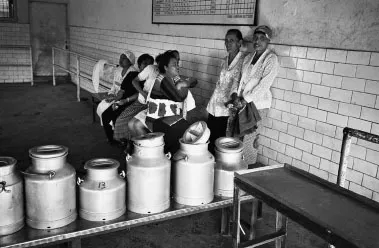
Figure 1.2 Smallholder farmers waiting to deliver their milk at the Milk Collection Centre (East Java, Indonesia)
Most tropical countries have pro-active programs to increase local supplies of milk, which require increasing numbers of well trained workers to service the dairy industry. Consequently, educators from agricultural schools, universities and technical colleges need to be kept abreast of the latest technical developments and applications in dairy farming. This manual also serves this purpose. Table 1.1 on page 9 presents suggested structured training programs that can be developed from the manual.
Geographers categorise the humid (or rainy) tropics as areas with at most one or two dry months and no winter, with the coolest month above 18°C mean temperature. Other tropical zones are:
- Wet and dry tropics, having a well developed dry season, with one or two rainy seasons
- Semi arid tropics, with light rainfall and high evaporation
- Hot arid tropics, with negligible rainfall and high evaporation.
My first book, Tropical dairy farming (Moran 2005) limited its scope to the humid tropics of South-East (SE) Asia. This book extends its scope to all the above zones within tropical Asia, although dairying is more likely to be restricted to just th...