![]()
1
Introduction
Stud breeding or the seedstock industry has long been looked upon as the yardstick by which a breed’s success is initially judged. We have all seen the photos of ribbon-clad sheep around show time and our image of particular breeds is influenced by these photos. And why not, after all, it is these sheep that are predominantly used to produce the next generation of genetics that will ultimately find their way onto commercial properties around the sheep districts of our farming areas. It is also true that these sheep in show condition tend to give their particular breed exposure and appeal to a wide range of potential users and this can often create an image that does not exactly fit what really happens in the commercial world. We have all seen the majestic photos of Merino rams in full show condition, or the maternal or terminal sires with washed faces, immaculately trimmed and not a sign of dirt anywhere, and have been impressed with their size and conformation. However, after the initial impression, we justify our amazement by saying ‘but they are show sheep, nothing like we have in the paddock at home’. This image of sheep in show condition is, however, one of the reasons why many breeders are attracted to breeding stud livestock. It is not the only reason and is probably one of the least important reasons why prospective breeders should become involved in the seedstock industry. The stud industry and agricultural shows go hand in hand. It is the exposure that attracts new breeders and new ideas into what ultimately should be a commercially orientated industry, not one based on producing sheep for shows.
It is difficult to determine what possesses those involved in the livestock industry to make the decision to take the extra step and breed stud animals in preference to the relative security of a commercial breeding operation. For many it is the continuation of a family tradition that had its origins many years ago. For these studs it is not difficult to justify the continuation of what is usually a well-established and respected stud operation. For those who are new to the seedstock industry, the reasons for becoming involved at this more specialised level are varied. Some stud breeders begin with very small flocks, breeding a few rams for their own use and perhaps selling a few to a relative or neighbour and they are satisfied to continue at this level. Others, having been involved at a commercial level for a period of time, make a decision to expand or diversify their operation and look at a seedstock breeding operation as adding diversity and, potentially, some financial gains to their operation. Many agricultural schools today have livestock studs as part of their practical skills programs so the students that come through these schools have already had exposure to stud breeding and are often keen to develop these skills once they leave school. Some breeders just have the urge to do something different either through the introduction of a new breed or because they have identified a need in their area that is currently not being catered for.
Whatever the reason for deciding to initiate a stud breeding program, you will already have some preconceived ideas on what you want to achieve and how you are going to realise them. Perhaps now is the time to sit down, take a deep breath and ensure that the ‘dreaming’ phase has passed and you are being realistic about what you want to gain from your efforts. There are plenty of stud breeding operations in all livestock industries and not all are as successful as those you may be modelling your decision upon. Ensure that your expectations are realistic and you are aware of just what is required to guarantee your efforts are successful, not only from a breed perspective, but also from an environmental or regional aspect. It is pointless producing more of a product that is already oversupplied in your area simply because it looks nice and appeals to you – this will end up being a hobby, and an expensive one.
Now you have convinced yourself that you want to develop a stud breeding enterprise. Let’s get started then.
Perhaps the first and potentially the best decision you can make is to contact the breed society governing your selected breed. There are breed societies for virtually every sheep breed, some large, some with only a few members, but all are an integral part of the development and success of the breed they administer. The cost of joining a breed society is relatively small when compared to the benefits that will be gained from your membership of a cohesive breed society.
The breed society is much more than just a facility that governs registration and the transfer and recording of registered stock between individuals. Most breed societies provide members with plenty of background material, as well as brochures and regular newsletters that inform members of developments in areas such as breed promotion, recent highlights and amendments to breed direction. They also provide a good avenue of promotion for members. If you are a new stud breeder, just reading the newsletters and material available from your breed society will provide you with a good understanding of how the breed has developed and what is required to establish a quality sheep stud. Through the breed society and its activities, you will become familiar with many of the established breeders within the breed and consequently gain some insight into the leading sires that are currently being well used. If you are intending to show sheep, you will need to be a financial member of your relevant breed society.
Breed societies are also responsible for setting breed standards and encouraging members to adhere to these standards for the overall benefit of the breed. They often undertake their own research and development or cooperate with authorities who are working to improve the standard of the products associated with individual breeds, and they also help develop new areas of marketing. By representing the collective interests of all members, they are able to both protect and promote the interests of all breeders and facilitate the expansion of the breed’s elite genetics both domestically and overseas.
Above all, they provide a united group that generally have common objectives and are prepared to work together and share information between breeders. Membership of your sheep breed society is the most effective means of getting to know and meet other like-minded breeders and provides you with the opportunity to learn from other member’s experiences.
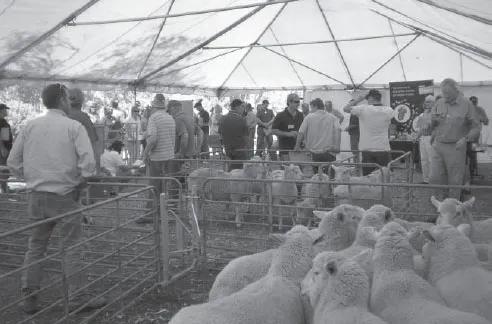
Conferences and field days create ideal opportunities for discussion and learning.
Conferences and field days organised by the breed society play an important role for not only established breeders, but also new breeders. They provide a chance to learn the necessary skills you will need to succeed in your new venture, and give you an ideal opportunity to meet high-profile breeders and make important personal contacts you can speak to should you have any questions as you develop your stud breeding enterprise. These events are usually structured around making new members feel welcome and at the same time providing information and some ‘hands on’ activities related to stud breeding and its associated commercial industry. Most of these events also include some degree of forward planning by the breed association, which will provide good insight into the direction both you and the breed itself are heading in the foreseeable future.
The breed society’s annual flock book will not only provide you with a record of the current and new registered sires within the breed, but also contact details of all members and the sires they are currently using. This provides a good starting point for your next step, purchasing the sheep that will be the foundation of your stud.
![]()
2
Getting started
Setting up
You have now reached the stage where you can plan how you are going to set up your stud. Your initial investment should be to purchase some ewes; however, this is where the first big mistake, and the most expensive one, can happen. Let’s go back one step before we look at any ewes.
You need to make sure the sheep you are intending to breed are suited to your area, not only from an environmental and regional suitability perspective but also from the point of view of developing a successful, well-supported business. It would be pointless to begin breeding sheep that are genetically not suited to your area as subsequently the likelihood of significant ram sales would be limited. It would also be a frustrating exercise to breed sheep that, although suited to the climatic conditions and management constraints of your area, are not the preferred breed for your area or would create marketing problems for producers in your area. Conversely, your region or the market may be looking for something new and different and the right sheep could be a breed that has previously not been considered for your area. Do your research on the studs that are currently within your region, look at how well their rams sell and what their clients are looking for. Once again if the situation is already over supplied, then unless you are planning a very good alternative, the risk of failure is greatly increased. You need to make sure that the type of stud enterprise you are about to undertake has a very good chance of success given that you are embarking on something new, as you will be in the market with other stud breeders in your area who may have been involved in the practiceof stud breeding for many years. Set objectives clearly in your mind, make sure they are achievable and that you can deliver a product that is saleable within your area and that is acceptable to commercial producers and their markets.
There are a number of other factors that need to be considered before any stud sheep are brought onto the property. Breeding stud sheep is much more labour intensive than commercial sheep production and a lot more costly so there are increased financial risks involved. With any stud breeding operation there is a responsibility for disease control, and the greatest risk of infection from pests and diseases is from both introduced sheep and neighbouring flocks. Boundary fences are particularly important.
Stud sheep, especially terminal sire breeds, are often heavier and stronger than commercial sheep and will put greater pressure on fencing, especially during dry times, so ensure the boundary fencing around your property is adequate to prevent your sheep straying. Double boundary fences are a good insurance if you are uncertain of what is over the fence and should make it very difficult for strays to enter your property or for your sheep to escape. Know all your neighbour’s sheep operations and, particularly, whether they are continually introducing outside sheep onto their property from areas known to be at risk from certain notifiable diseases. Make sure you know their ram supplier and their disease status, especially with regard to brucellosis. Remember you are going to be supplying rams to properties outside yours and the purchaser will require an assurance that the rams are disease and parasite free. Internal fences, while not as critical as boundary fencing, are important from the point of view of ensuring that your sheep stay where they are supposed to be, both at joining and lambing. It is essential that pedigree problems are not as a result of internal fencing problems.
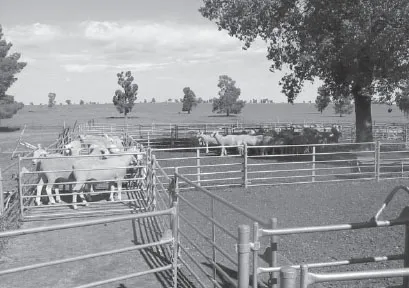
A good set of yards with plenty of shade and small holding pens will make working sheep an enjoyable experience.
Your yards and shearing shed are the next farm structures you need to check before purchasing any ewes. As with boundary fences, stud sheep inevitably place more pressure on yards and the associated shearing shed. Because of the increased amount of time that will be spent with the sheep in the yards, it is important that the yards be strong and functional so that each day spent working there is not one that you are continually dreading. If you are intending to sell rams on farm then you are going to require yards that enable your clients to move sheep around and isolate those that they select. A good set of scales and a strong and sturdy classing race will be invaluable as well as some small holding yards that enable easy handling of small groups of sheep. Ensure you have a good quality loading race, preferably one that is easily adjusted to the differing vehicle heights that will be transporting your rams. The setup of your yards should allow easy and safe movement of selected rams to the loading race. If you are selling sheep at an on-farm auction, a specialised set of pens and sale ring will have to be used. You will be spending more time working with smaller mobs of sheep and lambs, both classing sheep and selecting preferred joining groups, and the setup of your sheep handling structures should facilitate this task.
As you will be selling rams to commercial clients, management of your flock takes on an even greater significance. Apart from disease and parasite issues, there are nutritional needs that will have to be met for stud sheep, which are usually larger than commercial sheep and therefore require greater volumes of feed. Rams that are designated for sale will have to be prepared to a condition that shows them at their best come sale time, and the nutrition of ewes and their lambs has to be sufficient to allow them to grow to their potential. Supplementary feeding or good pasture development programs are an important part of any good stud operation. It is also handy to have several small paddocks close to the sheds as these will come in handy at lambing and ram sale time.
While all these structures do not have to be in place before you begin developing your stud, it is important that boundary fencing and yards are the number one priority. All the initial financial investment in the sheep, as well as enthusiasm, can be lost very quickly if your new stud flock becomes infected with disease or your ewes are accidentally joined to the neighbour’s mongrel bred sire.
The sheep
Perhaps the most exciting step, and one you will have been looking forward to since you first contemplated the idea of establishing a stud, is the purchase of your first ewes.
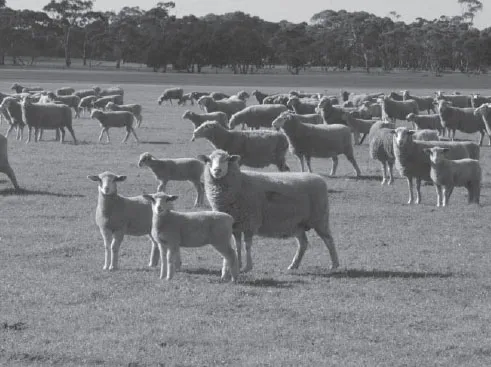
Perhaps the most important initial purchase, your ewes.
There are a number of ways you can go about this; some will be more costly than others and have advantages and disadvantages. You will have already made a decision as to the number of ewes you are going to start with. This number should have been calculated with some degree of caution and not be beyond your financial means. Remember you are venturing into an industry that has a high initial capital cost and requires a period of time to learn the skills that will ensure your success in the future.
Dispersal sales
This is often the best way to obtain some of the best genetics that any stud has to offer. At a dispersal sale, all sheep within the stud across all age groups are sold. You are assured that, if the stud has been successful, the sheep are of a good quality. This means they have provided genetics that have been accepted and widely used within the breed, and they have been proven suitable for your area.
Dispersal sales can be in two forms: the sale of all sheep as a total flock or individual sheep sold as singles or smaller groups. If you are buying the complete flock, all ewes, sires and often young sheep are included at a set price or sometimes a tendering system is used to determine the value of the flock. If purchasing your initialsheep in this manner, you are ready to go and, if the stud has a good reputation, much of the initial groundwork has already been done. Some breed societies will allow the name of the original stud to be transferred to the new owner if all sheep have been sold in a single transaction.
The other approach to conducting a dispersal sale is to sell the ewes individually through an auction which gives you the opportunity to select only those ewes you want. The disadvantage with dispersal sales is that it is often the most expensive way to obtain ewes because other sheep breeders attending will also know the merits of some of the genetics and therefore will be competing against you. However, many of the highest prices at a dispersal sale are for the younger ewes and, as ewes of all ages are usually sold, there will be plenty of older ewes later in the sale that will be just as good and better value for money. Obtain a sale catalogue well in advance of the sale date and study it. Familiarise yourself with the sires that have been used and the pedigrees of some of the younger ewes in the catalogue. Chances are there will be some older ewes that have consistently bred progeny that have performed well in the stud over a number of years. Any ewe that has retained its place in a stud for more than four or five years must be producing good progeny and therefore will be a good foundation for any new stud breeder – and often cost less than the younger ewes at the top of the catalogue.
If you notice a dispersal sale advertised, do some homework, as it could save you a lot of m...