![]()
1
Introduction
Sheep farming is a very satisfying and challenging occupation, interest or hobby. Choosing the right sheep enterprise and starting with the necessary information are essential to success and enjoyment.
Preparation and understanding are the keys to successful sheep farming. This book provides the information you need to make the right choices about getting started as a sheep grazier. The step-by-step approach will prepare you for each procedure and event on a sheep farm. No matter how little or great your experience with sheep and wool, this book will explain, in understandable terminology, the main aspects of establishing and successfully managing a small flock of sheep in Australia. Whether you own a single pet sheep, a small commercial flock, prime lamb or wool producers, or just lawn mowers, the following pages will prove an invaluable guide.
Running a Small Flock of Sheep is best read from cover to cover for a broad understanding, then it can be kept handy as a ready reference. The Contents pages and Index will allow you to find the information you need quickly. Chapter 12, on management, provides a quick checklist of all operations and events. The glossaries of sheep and wool terminology will ensure that you are not left in the dark when talking to other farmers or reading farming literature.
![]()
2
Sheep in Australia
A woolly heritage – setting the scene
Sheep are not native to Australia but intensive selection has developed lines of sheep that are well adapted to conditions in the various regions of the country.
The first sheep to arrive in this country came with the first fleet in 1788 but they failed to survive. Merino sheep from the Royal Spanish bloodline were introduced in 1797 from the Cape of Good Hope. Fine wooled Saxon Merinos were introduced from Germany and they have, to a large degree, been responsible for Australia’s superior fine-apparel wools. The fine wool industry that developed in Tasmania strongly influenced the establishment of a wool industry in the Western District of Victoria during the 1830s. In the 1860s, a larger, stronger, Merino strain called the Peppin was developed to suit the harsher inland areas and this strain still predominates in those areas.
The upheaval of the goldrush period put an end to the practice of shepherding and created a large demand for meat to feed the rapidly expanding population. British breeds of sheep were introduced as they produced more meat than the Merino breeds. A number of British breeds have influenced the meat producing side of the sheep industry, primarily by cross-breeding to produce prime lambs from dual purpose Merino/British cross-bred ewes.
By cross-breeding Lincolns and Merinos, two Australian breeds were established. The Corriedale is a dual purpose sheep that produces a heavy fleece of stronger wool and a large carcase, while the Polwarth is a robust wool producer that suits colder areas. The Comeback sheep, while not a specific breed, is the result of cross-breeding and then breeding back towards the Merino to produce medium to fine wools. The Perendale, a New Zealand breed, is the most notable of other dual purpose breeds in Australia.
From the late 1900s a number of new breeds were introduced, some with leaner and larger bodies to satisfy healthy eating and easy preparation preferences, others for new markets in the Middle East and most to provide an alternative to declining wool returns. These new breeds included the South African Meat Merino, White Suffolk, Finn, Damara and Dorper sheep.
The coarse wool required for carpet manufacture has led to the development of breeds such as Elliotdale, Tukidale and Drysdale.
Advances in breeding technology have allowed rapid changes and improvement in breeds and importing of exotic breeds by the use of artificial insemination and embryo transfer techniques in stud flocks. This end of the sheep farming continuum is very high-tech, innovative and expensive for those who have the dollars and inclination to be industry leaders.
The sheep industry today – an overview
Wool industry
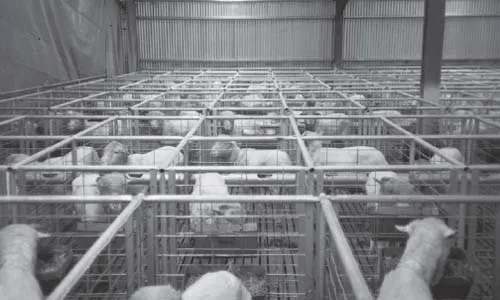
Today the wool industry primarily uses Merinos, Polwarths, Corriedales, Comebacks and their crosses. The Merinos, which predominate, are generally classified as strong, medium or fine; this traditionally reflected their body size and wool type, although recent advances are breaking this correlation. The stronger sheep are large and robust and are often referred to as ‘South Australian’ type Merinos but are found throughout the dryer regions of Australia. The fine wooled sheep are traditionally more delicate and require more intensive management; the quantity of wool cut is smaller but usually brings premium prices. Recent breeding advances are now producing large-framed, fine wooled Merinos. The finer end of this group is called super-fine, or, if they are kept in sheds and on controlled diets, Sharlea. Medium-type Merinos are most common in southern areas where more intensive farming and reliable pastures exist.
Sharlea (shedded), super-fine sheep.
Meat industry
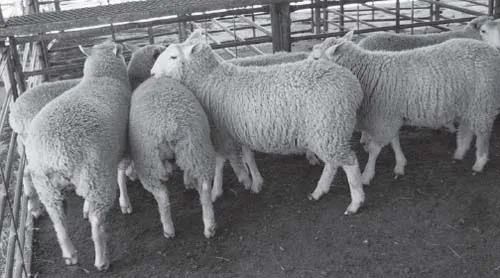
For prime lamb production, breeders cross a large-framed ram, such as the Border Leicester, Dorset or Romney Marsh, with a Merino ewe producing a first-cross ewe or prime lamb mother. The dual purpose first-cross ewe produces a large cut of medium to coarse wool, is robust, milks prolifically and breeds easily with many multiple births. These first-cross ewes are mated to British breed rams such as the Poll Dorset, Dorset Horn, South Down, Suffolk, South Suffolk, Hampshire Down, Finnsheep, White Suffolk, Texel or Perendale and produce a second-cross prime lamb. First-cross Merino lambs can also be targeted for the prime lamb trade when demand is strong and large-framed ewes are joined to large-framed terminal sires (rams with meat trade qualities).
Prime second-cross lambs.
Export prospects sometimes create an opportunity for a specific carcase requirement. These markets may be longer term or for special cultural occasions and festivals.
Prime lamb producing flocks are run where reliable pastures or crops can grow to rapidly finish the lamb ready for market. This is usually in the higher rainfall areas or on irrigated land and some cropping areas. In lower rainfall areas breeders will produce store or unfinished lambs for on-selling to farms with the capacity to finish growing the weaned lamb ready for market.
Mutton, from older animals than lambs, is also an important meat product that comes from sheep sold because they are aged, surplus or have faults; mutton is mostly used for processing.
Live sheep export
Export of live sheep for meat purposes has a significant influence on the sheep industry. Wethers of various ages and higher weights make up the majority of live sheep exported, but some lambs, ram lambs and rams are also sold to the exporters. Specific market demands for particular types of sheep also create niche marketing opportunities, such as with ‘fat tailed’ lambs for the Middle East. These sheep are usually purchased on condition of delivery to the pre-embarkation feedlot and are subject to health checks, very specific size, weight and age requirements, and pre-treatments such as scabby mouth vaccination.
Live sheep ship.
Specialist industries
Carpet wool is produced in a small number of flocks mostly in the more fertile areas. Milking sheep for cheese manufacture is a very small industry in high rainfall areas. The skins of Damara sheep, in particular, are used in high fashion fine leather clothing and accessories.
Damara leather clothes.
![]()
3
Sheep enterprises
There are different types of sheep and end products and each requires different methods of management. While most sheep produce both wool and meat, the primary purpose of most farmers is to produce either wool or meat, although some enterprises are dual purpose and many farmers breed sheep for other farmers to buy.
Wool (non-breeders, wethers)
This enterprise mostly uses Merino wethers to produce special lines of wool. Wethers are de-sexed male sheep that are either bred or purchased at 6–18 months of age and then sold at four to five years. Selection of good wool producers is essential, along with proper preparation and marketing of the wool. Routine animal health treatments prevent common problems, close supervision during flystrike waves is needed and lower quality feed is usually adequate.
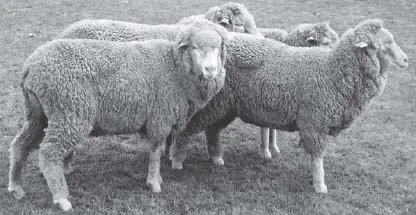
Merino wethers.
Wool breeders
Merino, Polwarth, Corriedale and their crosses are kept primarily for quality wool production. Rams are usually purchased from studs. Ewes are either purchased at 6–18 months or bred on the farm; the latter is called a self-replacing flock. Correct selection of ewes and rams and skilled classing of breeders is critical.
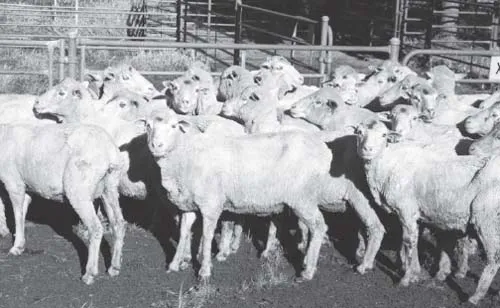
Merino ewes (shorn).
Ewes may be mated to rams of t...