![]()
1
Horse characteristics
This chapter describes the main physical and behavioural characteristics shared by domesticated horses and horses that live in the more natural environment. Given the opportunity or circumstances, domestic horses can and will revert to natural behaviour. In many countries, domestic horses that have escaped or been released have been able to survive and thrive largely because they still possess natural behavioural characteristics. When living in a herd situation, domesticated horses interact with each other the same way that they would in the wild. The main difference is that wild horses that have not had contact with humans or that have had only bad experiences with humans act instinctively. Most domesticated horses have been habituated to accept humans and various human-related sights and sounds and have been trained, to a lesser or greater degree, to override their instincts when being handled and ridden. Domesticated horses can and often do, however, revert to instinctive behaviour in some circumstances depending on their individual behavioural characteristics and their level of training. Even a well-behaved and well-trained horse can react instinctively from time to time when the stimulus is strong enough. Therefore, it is important that people who deal with horses understand horse characteristics.
This chapter describes the horse characteristics that may affect your safety when associating with them. Later chapters explain how to make interactions with horses safer, by taking these characteristics into account.
Physical characteristics
Horses are large, grazing, herd-living herbivores. Domestic horses have been bred to range in size from less than a metre to 1.8 metres at the withers. A large horse can weigh 1000 kg; even an average size (15hh) horse usually weighs around 500 kg. A foal weighs around 50 kg. Apart from size, all horses share the same characteristics.
A horse has very sensitive skin, which is necessary for detecting flying pests and parasites. It can twitch the skin in many areas of its body and will even kick forwards with a back leg if it feels the light touch of an insect or something it perceives to be an insect.
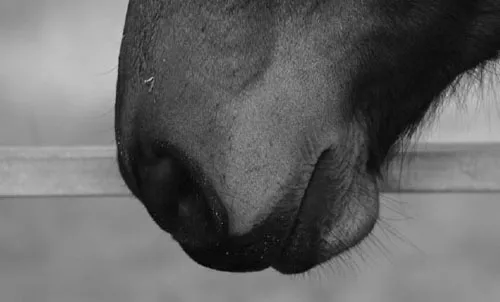
Some parts of the horse are even more sensitive than others. These include the top lip, muzzle, ears, feet, legs and flanks. The top lip has many nerve endings and is highly mobile, allowing the horse to investigate, feel and select with it. The muzzle is covered in whiskers that help the horse to ‘feel’ in much the same way as a cat.
A horse has many whiskers around its muzzle that it uses to feel with
The eyes, ears, feet and legs of a horse are essential to its survival and a horse will endeavour to protect there areas when under threat. In some mares the flanks are sensitive to the extent of being ticklish, as the flanks are sniffed by a stallion prior to mating to test the mare’s receptiveness. A horse has a strong sense of smell. It uses this when assessing a potentially dangerous situation.
The teeth are sharp and the jaws are extremely strong. In addition, a horse’s long neck makes it easy to swing the head from side to side or reach out to bite. A bite from a horse causes a crushing rather than a tearing injury (as is the case with a dog bite). Horses bite or nip each other frequently when playing or asserting themselves.
A horse’s hoof is relatively small and light, compared to a human foot, on the end of leg that is concertinaed to allow a lot of extension when running and kicking. This means that very little energy is required to move it and it can move very quickly. It also means that a horse can kick with accuracy and strength. A horse can move this relatively lightweight hoof quickly and easily and, because there is a small area of contact, like stiletto heels on a soft floor it can cause a lot of damage.
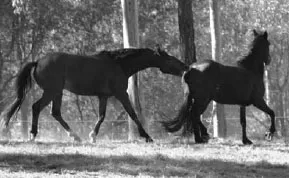
Horses bite when playing or asserting themselves
A horse is capable of striking forwards with a front leg. In the wild, a horse that is surrounded by predators will strike at them with a front leg or rear to use both front legs to strike and stamp if necessary.
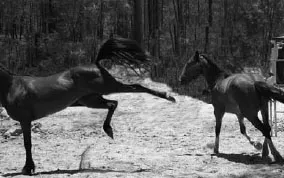
Horses can kick out with one back leg …
or with both back legs
A horse’s eyes are on the side of the head, which makes it difficult to see straight forward
A horse’s eyes are situated on the sides of its head so that it has very good all-round vision at the expense of sharp forward-focusing vision. The horse can detect moving objects in the distance that we would struggle to see. A horse also notices when there are unfamiliar objects in a familiar place, because horses take the whole situation into account when looking for potential dangers. A horse can’t focus on objects as quickly as we can, and this lack of sharp focusing can cause it to be anxious about an object until it has time to see the object better and identify it. If the horse can’t very quickly ascertain what the object is, it prepares for flight.
When its head is in the grazing position the horse can see along either side of its legs and, with small movements of the head, can see directly behind and in front. If the horse identifies a possible danger it immediately raises its head above its body, where it can again see all round by moving its head slightly. The only time a horse is unable to see behind it is when the head is level with the body. At all times, a horse has a blind spot directly in front of its face and it can’t see the area below and behind its chin.
A horse can listen forwards and backwards at the same time
The horse’s ears are on top of the head and are serviced by numerous muscles. This means that each ear can swivel 180°, giving potential for all-around 360° hearing without having to move the head. The ears work independently – a horse can have one ear facing forwards and one backwards at the same time. This lets it hear very well indeed – a horse can hear things approaching from behind well before we can. When riding, you can tell, what direction the horse is looking by looking at the ears. The ears also form part of the horse’s body language.
Many horses are unsettled in windy weather. One of the reasons for this is because the wind distorts and adds to the normal noise level, making it more difficult for the horse to detect potential danger. In addition, horses do not like wind and rain together and will turn their rump into the wind to protect the head.
Behavioural characteristics
Flight response
Horses utilise the ‘flight response’ if they are frightened, because they are prey animals rather than predators. Horses are highly reactive compared to other prey animals, some of which are adapted to defend first and then, if that fails, flee from danger. Horses resort to defence only if they are captured or cornered, such as being caught by predators or in a confined area. The physical and behavioural characteristics of horses ensure that they act on instinct, to run away from danger or defend themselves if trapped. They will kick, strike or bite if they can’t get away from a perceived danger.
A horse is either in an alert state or can become alert very quickly. Even a dozing horse can switch to being alert in an instant if an unfamiliar noise or movement occurs or if other horses nearby become alert. This is part of the natural behaviour of an animal that is hunted by other animals.
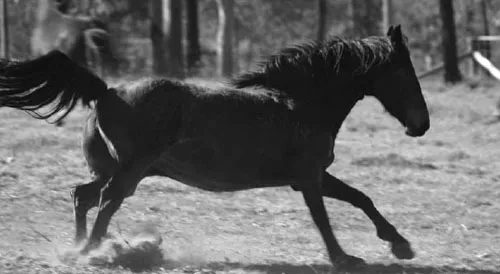
Horses run away from danger as their primary reaction to being startled
When you are riding or handling a horse you must have its attention, but when a horse is in a highly alert state it doesn’t listen to its rider or handler. A horse is most dangerous when it is frightened because it won’t respond to cues as it will when calm. There is a real danger that the horse may panic, spin away from the perceived danger, and run. Good training results in the handler or rider being able to take control of the horse before it becomes highly alert. Good training also ‘habituates’ the horse to many situations so that it does not become highly alert (see Chapter 8) as easily.
Herd behaviour
A fact about horses that cannot be ignored is that they are herd animals with a strong herd instinct that drives their behaviour, because it is highly instinctive for horses to want to be together. Living in a herd means safety in numbers: it means that each animal reduces its chances of being caught by a predator and there are many eyes and ears looking for predators. As horses spend a lot of time grazing with their head down in the grass, which reduces visibility, this point is very important. A horse on its own in the wild is much more likely to be caught by a predator and it expends too much nervous energy having to remain in an alert state. Horses that live in herds can take it in turns to be alert, to eat and to rest.
When allowed to live as a herd, domestic horses, like their more natural-living cousins, have a rich social life which includes such behaviours as mutual grooming sessions, playing, grazing and simply standing around together.
The fact that horses are herd animals rules their behaviour and can cause them to do things that seem irrational to us, such as panic if they get separated from other horses.
Social hierarchy and aggression
The social hierarchy within a herd is maintained with a whole array of body language and interactive behaviours, for example small gestures such as ears back and head thrusts which usually result in the subordinate horse moving aside. This behaviour maintains order in the group and is why herd or pack animals are much easier to train than animals that are solitary by nature. Herd animals are used to and feel secure in a structured environment, where their role within the group is directed by a social hierarchy.
A horse that is confident in its dominance can move other horses using as little effort as possible. If you watch horses in group situations you will see that small gestures can get big results. Generally, on...