![]()
BARONESS THATCHER
INDOMITABLE PRIME MINISTER WHOSE UNSWERVING BELIEF IN FREE ENTERPRISE TRANSFORMED THE POLITICAL AND SOCIAL LANDSCAPE
APRIL 9, 2013
Margaret Thatcher was one of the greatest British politicians of the 20th century. The first woman prime minister in Europe, she held the job for 11 years. In the 20th century no other prime minister had been in office for such a long unbroken period, and no one since Lord Liverpool (1812-27) had had such a long continuous run as Prime Minister.
She led the Conservative Party for 15 years, won three general elections in succession, and never lost a significant vote in the House of Commons. Since Walpole in effect invented the role, only six men have served for longer than her as prime minister: Walpole himself, Pitt, Lord Liverpool, Lord Salisbury, Gladstone and Lord North. She fully earned her place in this company.
Thatcher set out, first as party leader and then as prime minister, to overturn the consensus that had shaped postwar British politics and to replace it with a more competitive ethos of free enterprise.
She wanted to rescue Britain from the debilitated state to which she believed it had been reduced by socialism and, in the words of her last bravura speech as Prime Minister to the House of Commons, to give back “control to people over their own lives and over their livelihood”.
It was a paradox of British politics that Thatcher, suspicious of government, made activist government possible again after a decade or more in which it seemed that the abuse of union power had rendered Britain ungovernable. A country that had become resigned to genteel decline was for a time imbued by Thatcher with a confidence in its ability to succeed economically and to take a leading role in the defence of the West.
Thatcher did not succeed in all her objectives. Argument will continue to focus on the extent of the improvement in Britain’s underlying economic performance under her premiership, on the marginalisation of Britain within the European Union, and on the divisiveness occasioned by her abrasive approach to social policy and, indeed, to politics as a whole. But the scale and permanence of her impact on British politics can be judged by the move of the Labour Party under three successive leaders — Kinnock, Smith and Blair — back into the centre ground, and by the moderate, market-orientated and fiscally cautious policies of the Blair administration elected in 1997. Her opponents attacked her furiously even while implicitly accepting much of her reshaping of the country’s political landscape. It was a tribute she accepted with ironic satisfaction.
Thatcher was immensely hard-working and highly intelligent without being intellectual. In practice her ideological attachments and prescriptions owed more to her gut feelings than to any works of political philosophy, although one aspect of her occasional vulnerability was her determination that what she stood for should always be invested with appropriate academic seriousness. She was familiar with the classics of economic theory, and would often produce from her capacious handbag fragments of philosophy and literature to buttress her arguments. She enjoyed the company of academics and intellectuals, particularly when it offered the prospect of a good row about first principles.
Unlike any of her predecessors, she saw her name become attached to the policies she pursued. “Thatcherism” and “Thatcherite” became terms of bitter abuse or warm approbation. But “Thatcherism” did not encapsulate a wholly coherent political approach that could be passed inviolate to future generations.
Thatcher believed in thrift, hard work, personal responsibility and market forces, but would not push these ideas so far as to weaken her base of middle-class support. She was often radical in language and design, but invariably cautious and suspicious of change when it came to action. Her dislikes — as important as spurs to action as her beliefs — included trade unions, corporatism, the political left, local government, the BBC and what she regarded as the enfeebling consequences of a welfare state out of touch with its original purposes.
Thatcher had no time for those who espoused a traditional, moderate Toryism. They were in her view “wet”, and she often ascribed their concern for the social results of tough economic policies to the guilty feelings of the well-off. In her attitude to foreign and defence policy, she saw herself as a simple patriot, instinctively Atlanticist and suspicious of the European Union. She gained much political credit at home — and opprobrium abroad — for standing up for what she perceived to be Britain’s interests, however much offence this might cause to foreigners.
In her early political life, Thatcher undoubtedly felt an outsider in a man’s world. The “clubbiness” of parliamentary life meant nothing to her, and while as leader she assiduously cultivated her links with the parliamentary party, she never much liked the Commons as an institution. She had a tendency to be the “odd one out” in any discussion, and once described herself as the rebel in her own Cabinet. She was suspicious of pressures to arrive at a consensus as the basis for making policy; which of the prophets, she used to ask, had sought a consensus before charting the way ahead? In her early days of leadership, men often underestimated her talents, and throughout her career many of her colleagues seemed uncertain how to treat a woman in authority.
Thatcher possessed most of the important political skills. While not a persuasive or emollient public speaker, she had an effective combative style and was rarely worsted in debate inside or outside Parliament. She was one of the best campaigners in modern electoral politics, with a keen awareness of the techniques and requirements of the television age, in which she was schooled by her long-time adviser, Sir Gordon Reece.
But her greatest attributes as a political leader were courage and luck, both shown in full measure during the Falklands War of 1982. At almost every turn in her political career she was braver than her foes — sometimes to a point which seemed reckless — and she rode her good fortune hard. She was lucky in those who opposed her — Galtieri and Scargill, Foot and Kinnock; lucky to lead her party at a time when the political forces against her were split; lucky to be at the helm as the Soviet Union and its European empire began to disintegrate; and lucky to be Prime Minister in a decade when North Sea oil revenues were at their highest.
Public opinion was warmed by her courage and cooled by her obstinacy. Though personally considerate and generous to her friends (sometimes to a political fault), she acquired somewhat unfairly a reputation for being mean-spirited and narrow-minded. She was admired and hated, both (for a democratic politician) in rather alarming measure.
From Thatcher’s earliest days as Prime Minister, the Cabinet acquired something of a ceremonial character and real political argument — when there was any — took place in smaller, ad hoc groups. Thatcher towered over her political colleagues, and suffered from being isolated from the rest of the political world by a personal staff who often confused loyalty with servility. Her style of government and her lack of candid friends led directly to the Westland political crisis in 1986 and to the introduction of the hated poll tax, which played a substantial part in her fall.
Thatcher was the first leader of the party for many years who felt instinctively in tune with the simplest views of her supporters. For their part, they responded enthusiastically to a woman who showed such evident contempt for hand-wringing defeatism and who regularly rode out to slaughter the dragons they had learnt to loathe. By the tests of party politics, Thatcher was indisputably a champion.
Margaret Hilda Roberts was the second daughter of Alfred and Beatrice Roberts of Grantham, in the heart of middle England. Like Edward Heath, she came from a modest background; one grandfather was a shoemaker, the other a railway cloakroom attendant. Alfred Roberts kept a corner grocer’s shop in which both of his daughters helped out. Margaret was often to cite in later years the lessons she had learnt from this small business background and what her father taught her about responsibility, self-reliance and hard work. “I owe almost everything to my father,” she once said. In particular she was grateful for what he had taught her about integrity. “[You] first sort out what you believe in. You then apply it. You don’t compromise on things that matter.” Her mother appeared to have made no similar impression on her outlook and attitude.
Alfred Roberts was intelligent, energetic and self-educated. He was a Methodist lay preacher, much interested in current affairs. Originally a Liberal, he turned to the Conservatives after the First World War but sat for 25 years as an Independent, Chamber of Trade representative on the borough council. He became Mayor of Grantham and an alderman. He was ambitious for his children and at the age of 10 Margaret lived up to his expectations by winning a scholarship to Kesteven and Grantham Girls’ School. She narrowly obtained a place in 1943 at Somerville College, Oxford, to read chemistry, taking coaching in Latin to meet the university’s entrance requirements. With the help of bursaries and some last-minute elocution lessons, she went up to Oxford in the autumn of that year.
She threw herself enthusiastically into politics. Though the mood in her college was left-wing, Thatcher was a committed Conservative. In her third year she became president of the University Conservative Association, the first woman elected to the post. It was a tribute to her assiduous political work.
In January 1985, however, after the university’s Hebdomadal Council had proposed to grant Thatcher an honorary degree, the Congregation refused it, by 738 votes to 319; although the previous six Oxford-educated postwar Prime Ministers had all been granted the honour, many dons were protesting against a reduction in funding in higher education.
She gained an adequate second-class degree and took a job as a research chemist with J. Lyons and Company and became the prospective Conservative candidate for the Kent industrial seat of Dartford, whose Labour incumbent had a majority of nearly 20,000. She fought the 1950 and 1951 elections with great vigour but no success. At the same time she married Denis Thatcher, a business manager ten years older than herself whose previous wartime marriage had been dissolved before he met her.
The marriage was to prove long and happy, with Denis — a man of bluff, right-wing views — playing a loyal supportive role as his wife’s career prospered. Margaret gave birth to twins, Mark and Carol, in August 1953. Mark was to become a businessman, Carol a journalist.
On her marriage, Thatcher gave up her job as an industrial chemist to read for the Bar and to keep house for her new husband. After passing her Bar finals, she specialised in tax law. She continued to pursue her parliamentary interests and missed selection in several constituencies until eventually, in 1959, she was chosen as Conservative candidate in Finchley, North London.
She won the seat at the subsequent general election and retained it for the rest of her parliamentary career. She was a conscientious and popular constituency member, continuing to devote much time and attention to her constituents’ affairs even when Prime Minister. Many Jewish families live in Finchley, and through them she developed her first contacts and friendships with the Jewish community at home and abroad.
Thatcher was not slow to make her mark in the House of Commons, piloting through Parliament a Private Member’s Bill to open council meetings to reporters. This was less the result of a passion for press freedom than an attack on those Labour councils which had excluded journalists who worked for papers that had used strike-breaking labour during the newspaper dispute of 1958.
In 1961 Harold Macmillan appointed her Parliamentary Secretary at the Ministry of Pensions and National Insurance, a post which she retained in the Douglas-Home administration.
In the years of Opposition after 1964, she held a wide range of Shadow responsibilities, impressing her colleagues by her rapid mastery of the subjects she was covering and by her competence at the Dispatch Box. When the 1970 election came she was covering education, and after the Conservative victory Edward Heath invited her to run that department because (in his words) she had shadowed it so effectively. Thatcher found the constraints of the department (described by Harold Wilson as “a post box”) irksome, and the attitudes of her civil servants and the educational establishment provocatively hostile. She got off to a bad start with the educational press and with public opinion over the decision to end free school milk for 7 to 11-year-olds at a saving of £8 million a year. The controversy — which earned her the nickname, “Milk Snatcher” — was out of proportion to the size of the issue. She also presided over a policy that she did not like, namely the comprehensivisation of secondary schools.
Despite her difficult start and her distaste for much of what she had to do, she gradually earned the grudging respect of her civil servants and many in the educational world for her hard work and her success in winning resources for her department. Education spending reached 6.5 per cent of gross national product, exceeding for the first time the proportion spent on defence. She was keen to ensure that much of this increase in spending went to develop nursery education.
During her three years as Secretary of State for Education, Thatcher was never a member of Heath’s inner group of ministers and was not closely involved in the major policy issues of that period. Her range of government experience was therefore narrow. If she disapproved of the twists and turns of economic policy, she was cautious about demonstrating it. Nevertheless, the Heath Government’s record of economic interventionism, and its attempts to run a statutory pay and prices policy, confirmed her growing conviction that Conservatives should put their trust in market economics. She was to draw a direct connection between the shifting policies pursued by the Heath administration and her own later approach as Prime Minister.
The surprising and calamitous defeat of the Conservative Government in the February 1974 “Who Governs Britain?” election (brought on by the miners’ strike) called Heath’s position into question. Pressure for his replacement was inhibited between the February and October elections by the certainty that the fine balance of the parties in the Commons would sooner or later lead on to a second election. In the event, the Conservative Party fought a surprisingly successful defensive campaign and the Wilson Government was re-elected by only a slender majority. But criticism of Heath mounted, and he was forced to concede an election for the leadership.
Of all the candidates Thatcher seemed at the outset the least likely winner. However, several factors played into her hands and she seized every opportunity with verve and courage. First, she gained prominence in the October election campaign as the party’s environment spokesman, promulgating campaign promises to abolish domestic rates and to establish a ceiling for mortgages of 9.5 per cent “by Christmas”. The Nuffield study of that campaign suggested that Thatcher gained more sympathetic coverage for these policies (neither of which she much cared for) than had been attracted by any similar electoral initiative since the war.
Secondly, she was then able to demonstrate her talents in the Commons. As number two to Robert Carr in the Shadow Treasury team with special responsibility for financial legislation, she made as much of a mark in this job as Heath himself had in leading the opposition to the 1965 Finance Bill. In particular, she earned much credit from a withering attack on the Labour Chancellor, Denis Healey: “Some Chancellors are micro-economic, some Chancellors are fiscal. This one is just plain cheap. If this Chancellor can be a Chancellor, anyone in the House of Commons could be Chancellor.”
Thirdly, the leading intellectual critic of Heath’s policies, Sir Keith Joseph, scratched himself from the race after he had attacked the Keynesian consensus in an embarrassingly timed speech at Preston just before the October election. Thatcher was close to Joseph and regarded him as the intellectual standard-bearer of her brand of Conservatism.
In the first ballot Thatcher secured 130 votes to Heath’s 119. Heath immediately resigned, and in the second ballot Thatcher easily defeated William Whitelaw, by 146 votes to 79. Her triumph was a tribute to her daring and to her ability to rise to the occasion. She also benefited from the advice of a shrewd campaign manager, Airey Neave, the MP for Abingdon and a former escaper from Colditz. One of many Conservative MPs with personal cause for disliking Heath, he became Thatcher’s most trusted lieutenant until his murder by Irish terrorists in March 1979.
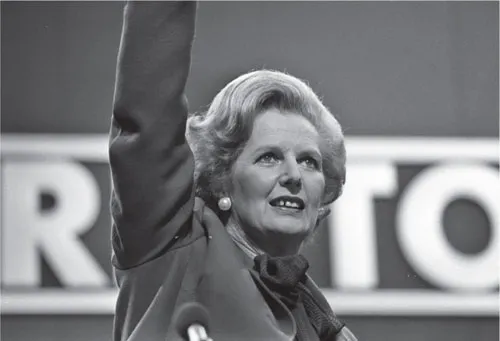
Margaret Thatcher acknowledging a five-minute standing ovation after making her “The lady’s not for turning” speech at the Tory conference in 1980
Thatcher’s first task was to consolidate her position and unite her party. Four of the contestants in the leadership election agreed to serve under her: William Whitelaw, as deputy leader, James Prior, Sir Geoffrey Howe and John Peyton. Former ministers such as Sir Ian Gilmour accepted Shadow appointments in her team. Her exclusion of Peter Walker was rectified when she formed her first administration. Reginald Maudling was brought back as Shadow Foreign Affairs spokesman, though his relationship with Thatcher was never easy and she replaced him the following year. She bowed to advice not to appoint Sir Keith Joseph as Shadow Chancellor, on the ground that his known views would make this too controversial a move. She turned instead to Howe, who was to serve her loyally in and out of government in economic and foreign policy. She also cultivated her contacts with backbench MPs, a job which she was always to regard as important.
Caution also played a part in her political tactics. She steered the party through the parliamentary arguments over the Labour Government’s devolution proposals. Despite her instincts, the party did not oppose the Government’s rescue of the British Leyla...