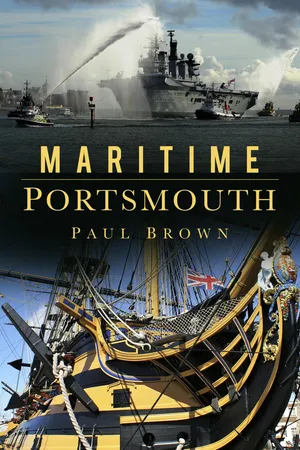
For three centuries Portsmouth has been the leading base of the Royal Navy but the naval heritage of its port can be traced back to the Roman invasion of Britain. From the Roman walls of Portchester to the best-preserved Georgian dockyard in the world and the illustrious HMS Victory, Portsmouth is amongst the most important naval sites in the world. This fascinating book, in its new and fully revised edition, focuses on the history and present status of Portsmouth Historic Dockyard as well as the magnificent ships Victory, Warrior and Mary Rose that have been preserved and are now on display at Portsmouth. Drawing on impressive original research and illustrated by a host of colourful photographs, author Paul Brown has created a concise and helpful guide to the key maritime attractions in Portsmouth and Gosport, including the Submarine Museum, the sea forts, the Gunwharf and the commercial port.
- 192 pages
- English
- ePUB (mobile friendly)
- Available on iOS & Android
eBook - ePub
Maritime Portsmouth
About this book
Information
Subtopic
Ingeniería civil1
THE FIRST DOCKYARD
Portsmouth Harbour is a natural sheltered harbour that has for many centuries provided a haven for the navy and a port of embarkation for successive armies. It is complemented by the anchorage at Spithead which, like the harbour entrance, is shielded by the Isle of Wight from the prevailing south-westerly winds. These advantages have led to 2,000 years of maritime activity there, and to Portsmouth’s role as Britain’s most important naval port during crucial periods in its history.
The Romans built a stronghold at Portchester in the third century, as part of a chain of forts from Brancaster (in Norfolk) to Portchester. They kept ships there to repel Saxon raiders. Portchester was then known as Portus Adurni and, around ad 286, the Roman emperor Maximian appointed a Count of the Saxon Shore to take charge of operations against the raids by the Teutonic tribes of the Saxons and Franks. This man, Caius Carausius, was a Belgian sailor and he became rich and powerful through captured booty and proclaimed himself Emperor of Britain. Maximian and his brother Constantius retaliated by sending a fleet to fight Carausius. Before they could land, Carausius was killed in York in ad 293 by a fellow commander, Allectus. Allectus then assembled a large fleet at Spithead, which sailed to intercept the fleet of Constantius. However, the two fleets passed each other in thick fog and no battle took place. Allectus was later killed by Roman soldiers but his men seized London. Part of the Roman fleet arrived on the Thames and quashed the rebellion, rounding up and butchering Allectus’ men.
Portchester has the most complete Roman walls in northern Europe. They are 20ft thick, and the front face contains bastions which accommodated ballista (Roman catapults). By ad 501 the Roman occupation had declined and a Danish Saxon named Port came with two ships to ‘Portsmutha’ and seized land from a noble Briton. Other raids and invasions by Danes and Teutonic Saxons followed in the ensuing centuries. Portchester was used by the Saxons, probably as a defence against Viking attacks, until some control was gained by the ships of King Alfred and his successors in the late ninth and tenth centuries. However, Saxon kings were to rule England in the early eleventh century and Harold Godwinson sent his fleet to Spithead and the Solent in the summer of 1066, expecting an invasion by William of Normandy. After six months the fleet dispersed, many of the ships returning to London, and William landed at Pevensey.
Henry I built a castle within the Roman walls at Portchester and embarked from Portsmouth on several occasions for Normandy, as did his grandson, Henry II, in 1174. After Henry II’s death in 1189 his eldest surviving son, Richard the Lionheart, landed at Portsmouth as King of England. In 1194, King Richard I ordered the building of a dock in the area called the Pond of the Abbess, at the mouth of the first creek on the eastern side of the harbour, which was later to become the site of the gunwharf. Here ships could anchor, and on the creek’s mudflats they could be hauled out of the water for repair or cleaning. The dock was enclosed by order of Richard’s brother, King John, in 1212 and Portsmouth became a principal naval port, superseding the Cinque Ports. John directed the sheriff of Southampton to ‘cause the docks at Portsmouth to be enclosed with a strong wall for the preservation of the king’s ships and galleys’. It is believed that a lock was built near the high-water mark, which was blocked with timber, brush, mud and clay walls at low tide, with a wooden breakwater and a stone wall to protect it, and penthouses were built to store sails and ships’ equipment. The lock may have been built of stone and probably led into a wet dock or basin. A fleet led by the king sailed early in 1214 for La Rochelle and Bordeaux in an unsuccessful attempt to regain lost territory in France. Around 1228, but not for the first time, the dock was badly damaged by storms and high spring tides. It may have been this that caused Henry III in 1228 to command the constable of Rochester ‘to provide wood to fill up the basin and to make another causeway there, notwithstanding that King John had caused walls to be built close by for the protection of his vessels from storms’. The dock was abandoned and in 1253 Henry III demolished the wall and reused the stone to repair his town house. It seems that, given the paucity of sea defences at that time, the dock had not been well sited and subsequent naval docks were to be built further up-harbour.
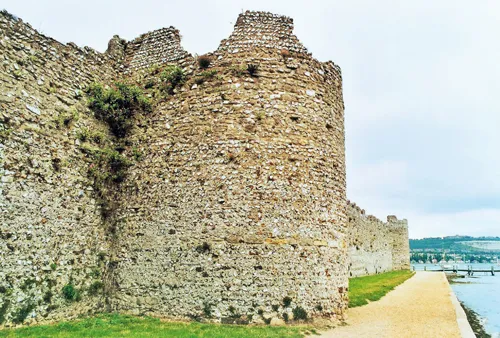
The walls of Portchester Castle are the most complete Roman walls in northern Europe, and surrounded the ‘Saxon Shore’ fort built in the late third century. Within them now is a medieval castle, probably founded in the late eleventh century, which was a baronial castle taken under royal control in 1154. In the medieval period Portchester was an important port and the castle saw the embarkation of several campaigns to France led by England’s kings.
Despite the lack of enclosed docks, Portsmouth was used to prepare expeditions to France by Henry III, and in 1346 Edward III sailed from the port with a fleet for Normandy and victory at the Battle of Crécy. In 1415, King Henry V assembled his fleet at Portsmouth and Southampton and, embarking from Portchester Castle, sailed for France and the Battle of Agincourt. On his return, he ordered the building of the Round Tower, beginning the construction of the port’s defences. He also purchased land to the north of the old docks for the construction of ‘The King’s Dock’ but, as a result of his death in 1422, it was not built and most of the king’s ships were sold.
The Tudor Dockyard
The next, and highly significant, event was the ordering, in 1495 by King Henry VII, of what is usually said to be the country’s first dry dock. This was to be built on the land that Henry V had bought, in the area now occupied by No. 1 Basin. It was built to accommodate the new Sovereign and Regent which were bigger than their predecessors. The timber-lined dock was first used by the Sovereign, which entered in May 1496. Once in the dock, after gravity drainage at low tide, the entrance was sealed with wooden gates and clay, and the remaining water was then pumped out using horse-driven pumps. In 1497 the first ship was built at the new dockyard. She was the Sweepstake, of 80 tons, and was later renamed Katherine Pomegranate by Henry VIII in honour of Katherine of Aragon (the pomegranate was part of the coat of arms of the city of Granada). Shipbuilding temporarily became a more important part of the dockyard’s work when Henry VIII was on the throne, with the construction of the Mary Rose and Peter Pomegranate helping to establish a permanent navy. Henry VIII is often seen as the founder of the Royal Navy since he commissioned the first ships that had an offensive role rather than primarily being transports for the army. Thus the Mary Rose can be considered to be the first true English warship. The dockyard was expanded due to its strategic importance under the threat of French invasion and incursions such as that in 1545 when the Mary Rose sank. During this period the navy grew from having only twenty-one ships in 1517 to fifty-eight in 1546. Thereafter the dockyard went into relative decline, and the navy contracted so that by 1578 there were only twenty-four ships – rising to thirty-four in 1588, the year of the Spanish Armada. Though small, the Elizabethan navy was very successful, and for the first time came to national prominence through the exploits of Drake, Frobisher, Grenville, Hawkins, Howard and Raleigh. They used both the queen’s ships and privateers, but their forward anchorage was Plymouth. In 1623 Portsmouth’s original dry dock was filled in.
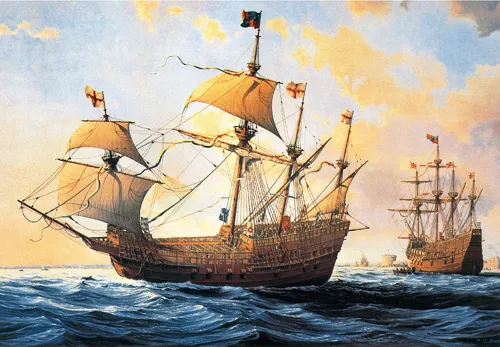
An artist’s impression of Mary Rose leaving Portsmouth in 1545. This illustration is influenced by design evidence from the recovered hull. (The Mary Rose Trust)
Apart from the construction of one small ship in 1539, there had been no further shipbuilding at Portsmouth since the Peter Pomegranate in 1510. Shipbuilding resumed in 1649, under the Commonwealth, with the Fourth Rate Portsmouth and thereafter became a more or less continuous activity for 300 years. Portsmouth had been loyal to Parliament and prospered under the Commonwealth. Also, war had broken out with the Dutch and investment in the dockyards and the navy was at a high level. The navy grew rapidly to have 102 ships in 1652, when the first Dutch war started, and 173 ships in 1688. By 1656, when a new double dry dock was ordered, the yard at Portsmouth had a new ropery, a slipway and a surrounding brick wall of over 400 yards in length, as well as numerous workshops and storehouses. The dry dock was completed in 1658 but the dockyard’s growth was slow compared to Chatham which, like Deptford and Woolwich, benefited during the Dutch Wars from its geographical position. During the final years of King Charles II’s reign, Portsmouth received a mast house (1685), and, under King James, a further dry dock and twenty new storehouses were authorised. James’ successor in 1688 was King William III who recognised the importance of sea power and was to initiate a high level of expenditure on the navy and the development of the dockyards that is exemplified by the Historic Dockyard at Portsmouth.
2
THE GEORGIAN DOCKYARD
In 1689, William III embarked on a war with France. Because of its Channel position Portsmouth experienced a period of renaissance and was second in importance to Chatham. A large ropery, mast pond, numerous stores and workshops, and dockyard officers’ houses had been built. Two new wet docks and two dry docks (later known as Nos 5 and 6 Docks) were constructed on reclaimed marshland to the north of the existing yard. By 1698, when the wet dock which became known as the Great Basin in the nineteenth century was opened, Portsmouth had again become the most important dockyard, serving a navy that had expanded rapidly during the eight years of war. By 1697 the fleet contained 323 ships, including 112 with fifty guns or more. The area now known as the Historic Dockyard is mainly of Georgian origin.
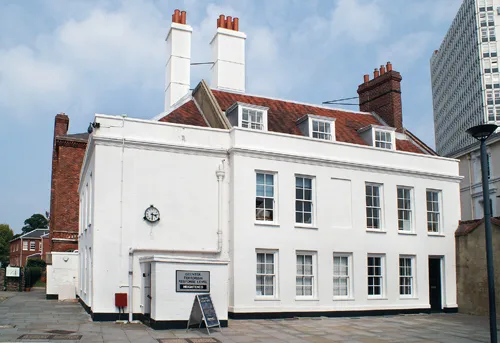
The Porter’s Lodge (1708) is the oldest remaining building in the dockyard. The dockyard porter lived there and guarded the boundaries, prevented theft by dockyard workers and rang the muster bell, closing the gate against latecomers. He also sold beer to the workers ‘to enable them to carry on their labour and not to distemper them’.
The dockyard includes, as its oldest buildings, a number built in the early eighteenth century, including the Porter’s Lodge (1708), the adjacent Main Gate (now known as the Victory Gate) and Dockyard Wall (1711), the elegant Dockyard Officers’ Houses in Long Row (1717) and the impressive Royal Naval Academy (1733). In 1717, new gates were fitted to the Great Basin (now known as No. 1 Basin, adjacent to the dry dock now occupied by the Victory). Two of the dry docks (Nos 5 and 6) in this area were built in 1698 and 1700 respectively and are the oldest remaining dry docks at Portsmouth. No. 5 Dock and a similar one constructed at Plymouth were the first stone-sided dry docks in Britain, though the floor of each dock was still made of wooden planks positioned on piles. Previously dry docks had had timber sides, and the new stone construction gave greater strength and water-tightness, as well as making it easier to shore up a vessel with timber baulks. No. 6 Dock was originally constructed of wood but was rebuilt with stone sides in 1741. The other dry docks (Nos 1–4) adjoining the Great Basin had stone sides and masonry floors, and were complete by 1803.
The early part of the eighteenth century saw battles with Franco-Spanish fleets during the War of Spanish Succession, and other wars with the French ensued, culminating in the Seven Years War of 1756–63. A large navy was maintained – in 1756 there were 320 ships, including 142 ships-of-the-line (First to Fourth Rates). Following peace, expansion and development of the dockyard continued, with an ambitious plan which took in new ground to the north and south-east, and made extensions to docks and slipways. No. 5 Dock, originally known as the Great Stone Dock, was altered in 1769 by moving it a little to the east so that the Great Basin could be extended. This allowed the basin to berth twelve ships-of-the-line for repairs afloat. When the Basin was enlarged, the original 1495 dry dock was uncovered. The other wet dock (the Upper Wet Dock) was converted into a vast reservoir into which the dry docks could drain, and from where water could be pumped. This reservoir still lies underneath the Block Mills. In 1770 the yard had a workforce of 2,155, compared to 1,080 in 1728.
The Great Ropehouse, some 1,030ft in length, was built in 1770. The upper floors were used for spinning yarn and on the ground floor this was twisted into rope as the forming machine travelled the length of the laying floor. Spinning and forming were manual operations but steam assistance was introduced to ropemaking in the early nineteenth century. Also remaining are the Hatchelling House, the Hemp House and the Hemp Tarring House (all built in 1771). Hemp stored in the hemp house was taken for hatchelling – straightening and untangling the fibres by drawing them across rows of spikes on boards. It was then transferred to the spinning lofts via a covered bridge. Some of these buildings replaced those lost in two disastrous fires in 1760 and 1770. There was another fire in 1776, started by the arsonist Jack the Painter, who was sympathetic to the American Independence cause. Because it was built of brick rather than wood, the new ropehouse survived but the interior had to be rebuilt. Jack the Painter was hanged on 60ft-high gallows at the dockyard gate and his remains were suspended in chains at Fort Blockhouse for several years as a warning to others. With the advent of the steam navy, demand for rope reduced and the ropery ceased production in 1868; the buildings were then used as storehouses. So effectively had the ropery split the dockyard in two that the opportunity was taken to drive an archway through it.
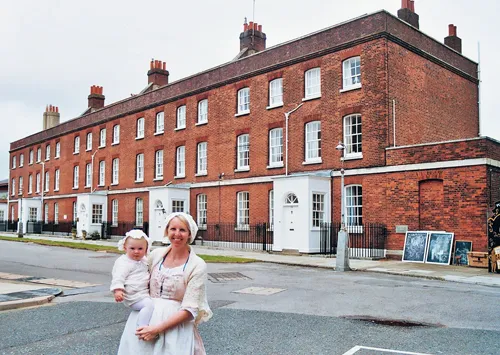
Short Row (1787) was a terrace of four houses for dockyard officers: the surgeon, the clerk of the ropeyard, the master ropemaker and the boatswain. It supplemented the earlier Long Row, which housed nine other dockyard officers.
Other buildings still surviving from this period include the three Great Storehouses (1763, 1776 and 1782), which can be seen on the left of the road between the Victory Gate and HMS Victory. Originally they stood on the water’s edge and there was a jetty on the harbour side of the buildings allowing boats to come and collect gear and stores, often for transfer to ships lying at Spithead, since sailing ships would usually avoid the tricky business of getting in and out of the harbour unless they were going into dock for repairs. The rudimentary jetty became part of the Camber...
Table of contents
- Cover
- Title
- Contents
- Introduction
- 1 The First Dockyard
- 2 The Georgian Dockyard
- 3 The Victorian Dockyard
- 4 The Edwardian Dockyard
- 5 The Dockyard in the First World War
- 6 The Dockyard in the Interwar Years 1919–39
- 7 The Dockyard in the Second World War
- 8 The Post-War Dockyard
- 9 The Run-Down of the dockyard
- 10 Portsmouth Naval Base
- 11 Mary Rose
- 12 HMS Victory
- 13 HMS Warrior
- 14 HM Monitor M33
- 15 Steam Pinnace 199
- 16 Portsmouth’s Shore Establishments
- 17 Fort Blockhouse and HMS Dolphin
- 18 HMS Alliance
- 19 Other Submarines
- 20 HMS Hornet
- 21 Historic Military Powerboats
- 22 Gosport’s Naval Support Establishments
- 23 Old Portsmouth
- 24 The Spithead Sea Forts
- 25 The Commercial Port
- 26 Maritime Museums and Exhibitions
- Select Bibliography
- Copyright
Trusted by 375,005 students
Access to over 1.5 million titles for a fair monthly price.
Study more efficiently using our study tools.
Frequently asked questions
Yes, you can cancel anytime from the Subscription tab in your account settings on the Perlego website. Your subscription will stay active until the end of your current billing period. Learn how to cancel your subscription
No, books cannot be downloaded as external files, such as PDFs, for use outside of Perlego. However, you can download books within the Perlego app for offline reading on mobile or tablet. Learn how to download books offline
Perlego offers two plans: Essential and Complete
- Essential is ideal for learners and professionals who enjoy exploring a wide range of subjects. Access the Essential Library with 800,000+ trusted titles and best-sellers across business, personal growth, and the humanities. Includes unlimited reading time and Standard Read Aloud voice.
- Complete: Perfect for advanced learners and researchers needing full, unrestricted access. Unlock 1.5M+ books across hundreds of subjects, including academic and specialized titles. The Complete Plan also includes advanced features like Premium Read Aloud and Research Assistant.
We are an online textbook subscription service, where you can get access to an entire online library for less than the price of a single book per month. With over 1.5 million books across 990+ topics, we’ve got you covered! Learn about our mission
Look out for the read-aloud symbol on your next book to see if you can listen to it. The read-aloud tool reads text aloud for you, highlighting the text as it is being read. You can pause it, speed it up and slow it down. Learn more about Read Aloud
Yes! You can use the Perlego app on both iOS and Android devices to read anytime, anywhere — even offline. Perfect for commutes or when you’re on the go.
Please note we cannot support devices running on iOS 13 and Android 7 or earlier. Learn more about using the app
Please note we cannot support devices running on iOS 13 and Android 7 or earlier. Learn more about using the app
Yes, you can access Maritime Portsmouth by Paul Brown,Dr Paul Brown in PDF and/or ePUB format, as well as other popular books in Tecnología e ingeniería & Ingeniería civil. We have over 1.5 million books available in our catalogue for you to explore.