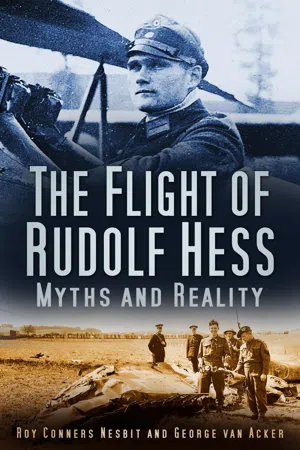
On 10 May 1941, Rudolf Hess - Deputy Fuhrer of the Third Reich - embarked on his astonishing flight from Augsburg to Scotland. At dusk the same day, he parachuted on to a Scottish moor and was taken into custody. His arrival provoked widespread curiosity and speculation, which has continued to this day. Why did Hess fly to Scotland? Had Hitler authorized him to attempt to negotiate peace? Was British Intelligence involved? What was his state of mind at the time? Drawing on a variety of reliable archive and eyewitness sources in Britain, Germany and the USA, authors Roy Conyers Nesbit and Georges van Acker have written what must be the most objective assessment of the Hess' story yet to be published. Their compelling narrative not only dispels many of the extraordinary conspiracy theories, but also uncovers some intriguing new facts.
- 192 pages
- English
- ePUB (mobile friendly)
- Available on iOS & Android
eBook - ePub
About this book
Trusted by 375,005 students
Access to over 1.5 million titles for a fair monthly price.
Study more efficiently using our study tools.
Information
CHAPTER ONE
Student, Soldier and Aviator
For several months in early 1941 Hess had been poring over maps of north-west Europe, the boundaries of the North Sea, the northern sector of Northumberland and the south of Scotland. He had been living in a world of aircraft instruments and piston pressures, cooling water temperatures and oxygen supplies, aircraft performance figures and synoptic charts – not to mention all the other details studied by aircrew preparatory to a long-distance flight. Now he was on his way at last, convinced that the most important mission of his life would succeed.
The German weather forecast was favourable, indicating a large anti-cyclone to the west of Britain, with light westerly winds over Germany and the Low Countries veering northerly over the North Sea. Cloud was scattered and visibility was good. Unknown to Hess, the British forecast indicated light variable winds over north-east England and south-west Scotland, where conditions were expected to be mainly cloudy with a few showers. Hess had chosen an excellent day.
Hess was justifiably proud of his skill in making the historic solo flight from Bavaria to Scotland. Some weeks later while in captivity, he wrote a long letter home to his son ‘Buz’, knowing that its contents would be read aloud to the boy by his wife Ilse, who might also pass the information on to those competent enough to understand his methods and admire his achievement. But even if Ilse kept the information to herself for the time being, Hess was recording his daring flight for posterity.
Rudolf Hess was kept incarcerated for another forty-six years, a hapless pawn in the relentless Cold War game of chess between East and West until, in 1987, he took his own life in Berlin’s Spandau prison. His body was eventually laid to rest in the family plot at Wunsiedel where the simple headstone bears the inscription ‘Ich Hab’s Gewagt’, which translated means ‘I dared’.
Rudolf Walter Richard Hess was born on 26 April 1894 in Ibrahimieh, an eastern suburb of Alexandria in Egypt. The villa was not far from Aboukir, the scene of Nelson’s victory over the French fleet on 1 August 1798 which established the Royal Navy’s domination of the Mediterranean. Rudolf’s father was Fritz Hess, a wealthy merchant who owned the trading firm of Hess & Co. This company had been established by Rudolf’s grandfather Christian Hess, who married Margarete Bühler and emigrated to Egypt in 1865 together with their son and two daughters.1 The Hess family originated from Wunsiedel, about 95 km north-west of Nuremberg, in the Fichtelgebirge. Fritz also owned a house in Reicholdsgrün, about 10 km north-west of Wunsiedel. His wife was Klara Münch, the daughter of a textile manufacturer. Rudolf was the eldest of their three children, his brother Alfred being born in 1897 and his sister Margarete in 1908.2
The family lived in a large and beautiful three-storey villa, surrounded by a magnificent garden. The desert stretched eastwards from the garden wall, while to the west was the fairy-tale city of Alexandria with its port, splendid buildings and bazaars. To the north, a golden beach fringed the turquoise waters of the Mediterranean. Life for the family was very comfortable and even idyllic in some respects. The parents gave parties from time to time, their guests usually being members of the German colony in Alexandria, but for the most part their private life was centred on their children.3
The two boys attended the German Protestant School in Alexandria, Rudolf from 1900 to 1906. From 1900 the family travelled to Germany every year during the summer, where they spent several weeks in their house in Reicholdsgrün. After initial schooling, the two brothers received private tuition from an Egyptian tutor, Abdul Aziz Effendi (Master), but they never learnt to speak Arabic. Much to the disappointment of their father, neither boy showed any interest in the family firm or any desire to take over its management. Rudolf was sent to Germany in 1908 and from 15 September of that year attended the Evangelical School in Bad Godesberg. Although his father still expected him to take over the family firm, he showed more interest in mathematics and science. This did not deter his father from sending him in 1911 to the Ecole Supérieur de Commerce at Neuchâtel in Switzerland. Rudolf left that school after a year and began an apprenticeship with a business firm in Hamburg.
By 1914 the population of the German Reich numbered 68 million, about 60 per cent more than when it was founded on 9 December 1870. Unemployment was low, there was little social need, and industries were thriving. Germany was becoming a very wealthy nation and in military terms was the most powerful in the world, with a large and well-equipped army as well as a modern navy which was regarded anxiously by both Britain and France, especially since Germany was casting covetous eyes on their overseas empires. The Triple Alliance of Germany, Austria-Hungary and Italy was confronted by the Triple Entente of Britain, France and Russia. Signs of an impending war were becoming more visible each day.
The event which sparked off the immense conflict was the assassination of the Archduke Franz Ferdinand of Habsburg-Este, heir to the throne of Austria-Hungary, and his consort Sophie Chotek, the duchess of Hohenburg, in Sarajevo in the morning of 28 June 1914.
The man who fired the revolver shots was Gavrilo Princip, a twenty-year-old member of a Serbian secret society known as the Black Hand which opposed the projected incorporation of Serbia into the Austro-Hungarian Empire.4 On 28 July Austria-Hungary declared war on Serbia. Russia, which regarded Serbia as an ally, began to mobilize. Germany declared war on Russia on 1 August, and entered Luxembourg the following day to seize the railways needed for the passage of troops for an invasion of neutral Belgium. On 3 August Germany declared war on France and Britain declared war on Germany the following day. On 6 August Austria-Hungary was at war with Russia. The First World War had begun. Italy remained neutral at first but decided to come in on the side of the Triple Entente on 23 May 1915.
In August 1914 all the members of the Hess family were in their summer residence in Reicholdsgrün except the twenty-year-old Rudolf, who was still serving his apprenticeship in Hamburg. He left this position a few days later and joined his family. Against his father’s wishes, he then travelled to Munich to join the ranks as a volunteer and on 20 August 1914 enlisted in the 7th Bavarian Field Artillery Regiment. After some initial training Infanterist (Private) Rudolf Hess was posted on 18 September to the 3rd Supplementary Company, 1st Supplementary Battalion, 1st Infantry Regiment.5 This was stationed on the Western Front, opposite the British Expeditionary Force on the Somme.
Towards the end of October 1914 the Belgians had succeeded in inundating large areas on both sides of the River Ijzer (Yser), between Nieuwpoort and Bikschote. These defensive measures caused the Germans to withdraw from the region and the fighting came to a temporary halt. The Germans attacked again on 30 October, on a narrower front from the Messines Ridge to Gheluvelt, 5 miles east of Ieper (Ypres). It was here that Rudolf Hess received his baptism of fire against the seasoned soldiers of the British I Corps.
The German forces included numerous recruits who were the flower of the country’s youth, mostly students burning with zeal and patriotism. Waves after waves of these young men were thrown against British regular soldiers, who were trained in rapid fire with their bolt-action rifles. The young volunteers could be heard singing patriotic songs amid the din of fire from rifles, machine-guns and field guns, but they were mown down in their thousands. Nevertheless the Germans broke through at Gheluvelt and were only driven out by a fierce counter-attack from mixed battalions. They broke through again in places and the confused fighting continued for several days, with the outcome remaining in the balance until the attackers withdrew from exhaustion and enormous losses. The British lost about 50,000 men killed, wounded or missing in the battle, including a large part of their regular army. To their south the French lost a similar number. The German losses have never been released but must have been far greater. They described the battle as Der Kindermord von Ypern, which may be translated as ‘The Massacre of the Innocents at Ypres’.
Rudolf Hess survived this slaughter, although the experience must have left a deep and lasting impression on him. Another participant was Adolf Hitler, who had enlisted as a volunteer in the 16th Bavarian Infantry Regiment, although the two men did not meet at this stage. Hitler’s unit also suffered very severe casualties, and the future German Chancellor was recommended for the Iron Cross, Second Class, which was awarded to him on 2 November 1914, in the course of the fighting. The First Battle of Ypres ended the period of open warfare and the two sides dug into entrenched positions until the Germans made their final and unsuccessful push in 1918.
On 9 November 1914 Hess was transferred to the 1st Company of the 1st Infantry Regiment, which was stationed near Arras in the Artois province of France.6 He was promoted to Gefreiter (Corporal) on 21 April 1915 and six days later was awarded the Iron Cross, Second Class, for his bravery in the field. For six weeks from the end of August 1915 Hess underwent courses at the Army Training School at Munsterlager, where he attained the rank of Vizefeldwebel (Lance-Sergeant). On 22 October he received the M.V.K. (Militärisches Verdienst Kreuz, or Military Merit Cross) awarded by the Kingdom of Bavaria. Newly promoted and additionally decorated, he returned to his unit in the front line on 20 November, where he saw more action in the Artois sector. In early 1916 he participated in the battles for Neuville St Vaast, which was completely destroyed. Then a throat infection took him behind the lines on 20 February 1916 for more than two months. On 1 May he returned to his unit once more and took part in the gruesome Battle of Verdun.
The Germans had launched their offensive against the French lines in this sector on 21 February 1916. Their attacks had been successful at first, particularly in the area east of the River Maas, but the French resistance stiffened gradually and the battle became one of attrition, with terrible casualties on both sides. Towards the end of the month, the Germans captured the fort of Douaumont, which resembled a giant ruin when seen from the air. Nevertheless by April General Von Falkenhayn admitted that the German assault on Verdun was becoming a failure. In spite of this admission, he continued a series of pointless attacks.
On 12 June, while near Thiaumont village in the vicinity of Douaumont, Hess was wounded in the left hand and upper arm by splinters from an exploding shell, and sent to the Reserve Lazarett (reserve hospital) at Bad Homburg. He was transferred to the Reserve Lazarett at Ilsenburg on 28 June and remained there until 13 July, when he returned to his unit once more.7 Von Falkenhayn called off his offensive in mid July, by which time the losses of all ranks amounted to 362,000 German and 336,800 French.
On 25 December 1916 Hess was posted to the 18th Bavarian Reserve Infantry Regiment and was appointed a platoon leader of the 10th Company. This unit was stationed in Romania, which had declared war on the Central Powers on 27 August 1916 in the hope of territorial gain in Transylvania. The move proved unwise, for her poorly officered troops were held in check while a force of Germans, Bulgarians and Turks attacked from the south, gaining control of much of the country including the capital, Bucharest. Hess took part in the Battle of Rimnicu Sârat, a town some 120 km north-north-east of Bucharest. On 23 July 1917, while at the Oituz Pass, he was hit once more in the left arm by another shell splinter.8 On this occasion the wound was not considered serious enough to require hospital treatment. He remained with his unit, receiving treatment at a field dressing station. However, another wound he received on 8 August 1917 was far more serious and even life-threatening. At the storming of the Ungüreana, a small hill in the Carpathians near Focsani, 150 km north-north-east of Bucharest, he was shot through the body by a Romanian soldier.9
Hess arrived the following day at Kriegslazarett (Military Hospital) 21C at Bezdivasarhely in Hungary. On 11 August this hospital recorded that the bullet had entered the front of his chest near the left armpit, leaving a ‘pea-sized’ hole surrounded by puckered skin. It had passed through the lung and exited near the spinal column by the 4th vertebra, below the shoulder blade, leaving a ‘cherry stone-sized’ hole. The patient was spitting blood and there was some respiratory noise, but the wounds looked clean.
It is evident that Hess had been shot by a small calibre rifle bullet, probably while advancing in a crouched attitude. Luckily for him the bullet had passed through his body without piercing the heart or striking any bones. On 20 August the hospital recorded that the spitting of blood had ceased and that on the whole the situation looked good. Four days later his fever had subsided, he was almost free of sweating and had regained his strength. It was considered that he should go back to the Fatherland, but on 26 August he was taken to Kriegslazarett 21B at Sepsiszentgyörgy, also in Hungary, for further medical treatment. He continued to make progress, with no coughing, no excess saliva and no problems with his heart, but with rather shallow breathing. This hospital also confirmed that, since his convalescence would last more than six weeks, he should be sent back to the Fatherland.
On 11 September Hess began his journey to Germany in Hospital Train no. 9. From 17 September to 23 October he was a patient at the Reserve Lazarett Meissen, 20 km west-north-west of Dresden. During this period, on 8 October, he was commissioned as a Leutnant der Reserve, officially confirmed a fortnight later. He was also recommended for the Iron Cross, First Class, although he never received this decoration. His father Fritz Hess had written to Meissen on 30 September asking for his son to be transferred to the hospital at Alexandersbad, since it was nearer the family home at Reicholdsgrün. This request was granted and on 25 October Hess arrived at the Reserve Lazarett Alexandersbad, 48 km north of Bayreuth, where he was again medically examined while recuperating from his wound. He was found to be in generally good health, with a regular pulse and improved breathing, but he frequently complained about his health and was considered to have a tendency towards hypochrondria.
The medical officers decided that he could be discharged from hospital as a Kriegsverwendungsfähige (fit for active service) in the 1st Supplementary Infantry Leib Regiment, Munich. However, during his convalescence, on 29 November, he put in a formal application for transfer from this unit:
I request to be posted to pilot training after the end of my cure, which terminates on 15 December 1917. I should have been posted to the Air Service in August of this year if I had not been wounded at this time. According to my doctor, my wound has healed to the point where I am fit again for flying duties. According to the enclosed testimony from my Company Commander, my nerves are equal to all demands. Also my eyes are first class. With regard to my initial training, I am familiar with the engines of motor bicycles and motor cars. So far as possible, I have prepared myself by reading technical books about flying.10
We do not know Hess’s motives for pursuing this application for a transfer to the Air Service, but it is possible to make some informed guesses. He had spent three years in the infantry, much of this time in the front line, and had endured squalor, stench, poor food and constant shelling, while many of his comrades had been killed and he had been wounded three times. The expectation of life in the Air Service was even shorter, with heavy losses in combat and flying accidents, but there were some compensations. The men lived behind the lines in reasonably comfortable conditions and with better messing facilities. Military aviation was only a few years old, but its circumstances were fascinating, with the rapid advance of technology and the thrill of flying. All pilots were esteemed by the general public and fighter aces became popular heroes. There was still an element of chivalry in their operations. Although the general practice was to manoeuvre so as to shoot an opponent in the back, the pilots retained much respect for their enemies. It was even a common practice to drop messages on enemy airfields, giving news about those shot down behind their lines and asking for information of their own missing pilots.
Hess was granted convalescent leave on 11 December, which he spent at the family home in Reicholdsgrün until the last day of 1917. There was a strange coincidence in his life in January 1918, according to the woman he later married. While presumably on light duties following his return from convalescent leave, he was ordered to escort the List Regiment to the Western Front, where he reported to Oberstleutnant Anton, Freiherr von Tuboeuf. He noticed a Gefreiter standing near this officer. Although the two men did not speak to each other and Hess did not know the name of the corporal, he realized several years later that the man was Adolf Hitler.11
Meanwhile, on 6 April 1917 the USA had declared war on Germany, although American contingents did not reach the front line in France in any strength for over a year. Another event that was to have a major effect on the war was the Bolshevik Revolution in Russia in October 1917, which led to the Russo-German Armistice of 15 December and ultimately to a peace treaty that was ratified on 29 March 1918. Without her ally, Romania had to make peace with the Central Powers ten days later.
In January 1918 Hess went to Munich, where he passed the aptitude and medical tests for the Air Service, and on the 22nd of that month began a fortnight’s leave at home. On 15 March he began a three-month course which commenced with ground instruction at Fliegerschule 1 (Flying School 1) at Schleissheim, 12 km north of the centre of Munich. Such instruction normally included the theory of flight, the internal combustion engine, air navigation, aircraft armament, bombing procedures and meteorology. After a couple of months he began his ab initio flying training at Fliegerschule 4, based at Lager (Camp) Lechfeld, south of Augsburg. The type of elementary trainer he flew remains uncertain, but we know that it was a two-seater and that he crashed on his first solo cross-country flight, in a meadow near Ried am Ammersee, 35 km west-south-west of Munich. Much later, while in Spandau prison, he wrote a letter dated 20 September 1953 to his son Wolf Rüdiger which included the following: ‘Luckily such a trainer had the pilot’s seat at the back. If I had been sitting in the front seat it would have ended my career for this was rammed into the ground on impact.’ The aircraft was a total loss but Hess escaped without injury.12
After completion of this initial training, somewhat delayed as a result of his crash, Hess was posted on 1 October to a Luftpark (Aircraf...
Table of contents
- Cover
- Title
- Copyright
- Contents
- Acknowledgements
- Foreword
- Introduction
- 1. Student, Soldier and Aviator
- 2. Politician and Aviator
- 3. Preparations for the Flight
- 4. The Flight
- 5. The Next Ten Days
- 6. Hess’s Messerschmitt
- 7. Prisoner for Life
- 8. Some of the Myths
- Notes
- Appendices
- Bibliography
Frequently asked questions
Yes, you can cancel anytime from the Subscription tab in your account settings on the Perlego website. Your subscription will stay active until the end of your current billing period. Learn how to cancel your subscription
No, books cannot be downloaded as external files, such as PDFs, for use outside of Perlego. However, you can download books within the Perlego app for offline reading on mobile or tablet. Learn how to download books offline
Perlego offers two plans: Essential and Complete
- Essential is ideal for learners and professionals who enjoy exploring a wide range of subjects. Access the Essential Library with 800,000+ trusted titles and best-sellers across business, personal growth, and the humanities. Includes unlimited reading time and Standard Read Aloud voice.
- Complete: Perfect for advanced learners and researchers needing full, unrestricted access. Unlock 1.5M+ books across hundreds of subjects, including academic and specialized titles. The Complete Plan also includes advanced features like Premium Read Aloud and Research Assistant.
We are an online textbook subscription service, where you can get access to an entire online library for less than the price of a single book per month. With over 1.5 million books across 990+ topics, we’ve got you covered! Learn about our mission
Look out for the read-aloud symbol on your next book to see if you can listen to it. The read-aloud tool reads text aloud for you, highlighting the text as it is being read. You can pause it, speed it up and slow it down. Learn more about Read Aloud
Yes! You can use the Perlego app on both iOS and Android devices to read anytime, anywhere — even offline. Perfect for commutes or when you’re on the go.
Please note we cannot support devices running on iOS 13 and Android 7 or earlier. Learn more about using the app
Please note we cannot support devices running on iOS 13 and Android 7 or earlier. Learn more about using the app
Yes, you can access The Flight of Rudolf Hess by Roy Conyers Nesbit,Georges van Acker in PDF and/or ePUB format, as well as other popular books in History & Military & Maritime History. We have over 1.5 million books available in our catalogue for you to explore.