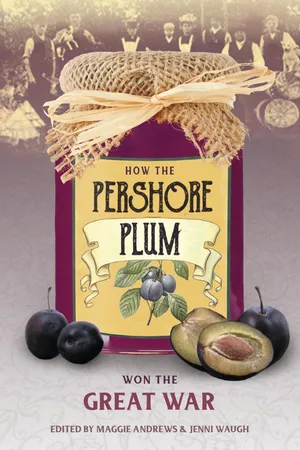
The First World War was won not just on the battlefields but on the Home Front, by the men, women and children left behind. This book explores the lives of the people of Pershore and the surrounding district in wartime, drawing on their memories, letters, postcards, photographs, leaflets and recipes to demonstrate how their hard work in cultivating and preserving fruit and vegetables helped to win the Great War. Pershore plums were used to make jam for the troops; but ensuring these and other fruits and vegetables were grown and harvested required the labour of land girls, Boy Scouts, schoolchildren, Irish labourers and Belgian refugees. When submarine warfare intensified, food shortages occurred and it became vital for Britain to grow more and eat less food. Housewives faced many challenges in feeding their families and so in 1916 the Pershore Women's Institute was formed, providing many women with practical help and companionship during some of Britain's darkest hours in history.
eBook - ePub
How the Pershore Plum Won the Great War
- 128 pages
- English
- ePUB (mobile friendly)
- Available on iOS & Android
eBook - ePub
How the Pershore Plum Won the Great War
About this book
Information
1
WAR COMES TO PERSHORE
Emily Linney and University of Worcester
History Students

The First World War began on 4 August 1914 and according to the Evesham Journal, Europe was faced with the ‘most tremendous war in the history of the world’, which meant that ‘she has been forced to take up arms’. The consequences of the conflict were felt immediately in the town: Pershore Horticultural Show was abandoned and, at the Abbey Church, special prayers were offered for peace at the Sunday service. A round-up of local news reported:
POSITION IN PERSHORE
Preparations are making rapid strides to provide for families whose breadwinners are serving in the war. It is a noticeable fact that considering the size of the town, an unusually large number of men have gone to serve their King and country. They include members of the outdoor staff of the Post Office who were on reserve, a police officer, several men from the Atlas Works and a large number of market gardeners. Many are holding themselves to be called upon at any moment, and others from local banks have volunteered for various branches … Many ladies are busily preparing themselves to go as nurses under the Red Cross Association being members of the local First Aid Detachments. Other ladies are assisting in making shirts and other garments for the soldiers.
Worcester Herald, 15 August 1914
Recruitment
Until conscription was introduced in 1916, the men in the armed forces who were sent to fight had all volunteered to join.1 During August and September 1914, a number of recruitment drives took place in earnest in Pershore, intended to increase their number. Lord Coventry, who had been appointed Lord Lieutenant of the county in 1891 and Honorary Colonel of the Worcestershire Regiment in 1900, took an interest in all matters military. On the day war was declared, he took part in an ‘interesting ceremony at Croome Park’:
NEW COLOURS FOR WORCESTER REGIMENT
Lord Coventry, the honorary colonel, presented new colours on Tuesday to the 5th Battalion of the Worcestershire Regiment, who have for some time been in camp on his lordship’s estate, Croome Park. The ceremony was shorn of much of its effectiveness by the weather, heavy downpours occurring during the parade and on the return march to camp …
The new colours presented on Tuesday were dedicated by the Rev. W.W. Veness. and were handed to the officers by Lord Coventry, who was accompanied by the Countess of Coventry, Viscount Deerhurst and the house party.
He addressed the battalion, stating […] the record of the regiment’s service was one of which the county might well be proud … They all hoped sincerely that recruiting might be helped.
Gloucestershire Echo, 5 August 1914
In the days following this ceremony, soldiers already enlisted drilled in the town, and were inspected by Lord Coventry, in the hope that this would ‘stimulate’ many young fellows to ‘offer themselves for their country’. It was envisaged that once the harvests had been gathered more young men would be free to join up. Veterans of the Boer War, such as Mr Hugh Mumford, volunteered again for service. A large recruitment meeting was held at the Music Hall, source of much of the popular entertainment in the town, where, only months earlier, German pianist Isabel Hirschfeld had been welcomed to play a benefit concert for the Boy Scouts.
RECRUITMENT MEETING AT PERSHORE
A meeting was held at the Music Hall on Tuesday evening being called by the joint Parish Councils of Holy Cross and St Andrew’s for the purpose of aiding recruitment in the district. The room was packed … The platform was perfectly decorated with flags. Lord Deerhurst [Lord Coventry’s eldest son and a serving soldier] was greeted with applause, said they were meeting to get recruits for Lord Kitchener’s Army. For years we had been proud to think we had a voluntary system (hear, hear). We said if England wanted men there were millions who would lay down their lives for her. It was up to people to demonstrate that this was a fact. The country was in need of young men …
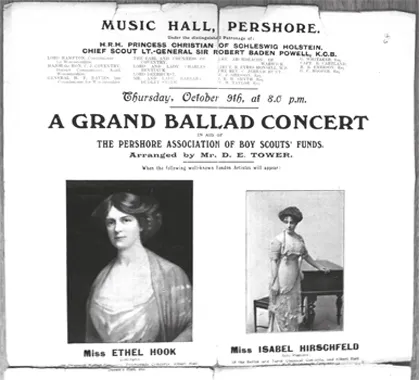
Poster for the Isabel Hirschfield concert at the Music Hall. (Jenni Waugh)
Admiral Cuming in a rousing speech said the war was the greatest ever known. We have been forced into it to protect a weaker nation like Belgium, and England was calling every man must do his duty.
Mr T.W. Parker said that as a man who took part in the public life of the district he would like to say a few words. He did not think they needed words, for he had good faith in the young men of Pershore and district. He appealed to the young men to come forward and join.
Col A.H. Hudson said he was sure Pershore men would respond to the appeal for recruits. There had been more than 90 recruits from Pershore district during the last few days … The Rev. F.R. Lawson, Rector of Fladbury, said he would ask the forgiveness of the speakers on the platform when he said they should honour not so much the men who made great speeches as the lad who went and fought for his country and mother who let him go. (Applause). At the close of the meeting, a large number gave in their names to enlist in the various branches of the Army.
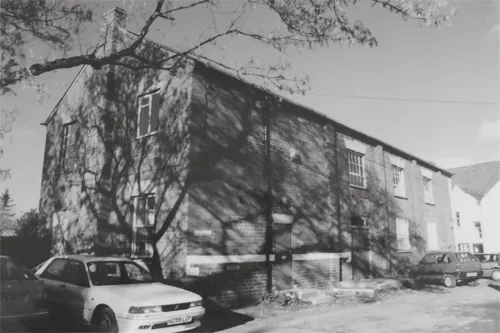
The Music Hall as it is today. (Roy Albutt)
EXCELLENT RESPONSE AT PERSHORE
A large number of able-bodied men have offered themselves for service. The Recruiting Officer, Sgt J.J. Cook, has been inundated … Batches of about 30 per day have been dispatched to Norton Barracks for transfer to various depots. The recruits have, with few exceptions, come up to the standard demanded, and have been conveyed to the railway station in motor cars kindly lent by gentlemen in the district.
Worcester Herald, 12 September 1914
By this point a number of young men had already joined up, nevertheless, in late November about 250 soldiers of Captain Warren Hudson’s company visited Pershore on a route march to stimulate further recruitment. Just as these young men of Pershore set off to war, so Belgian refugees, victims of the conflict, began to arrive in the district.
Belgian refugees
Between the months of September and December 1914, 250,000 Belgian refugees entered Britain, fleeing the German invasion of their homeland. At the time, this was the largest flood of people that had arrived into Britain.2 Initially arriving in Folkestone, Kent, the refugees soon moved to accommodation in towns and villages across the country. In Worcestershire they were billeted in Pershore, Evesham and many of the surrounding villages, such as Eckington, Fladbury, Elmley Castle, Great Comberton and Defford.
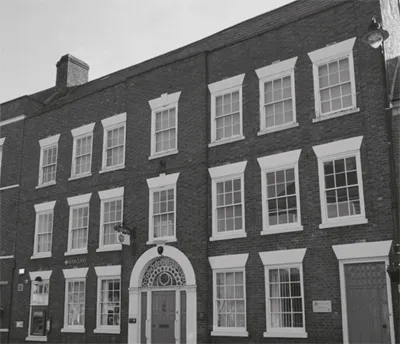
Laughern House in Pershore as it looks today. (Heather Greenhalgh)
The residents of Pershore and Evesham responded to the news that refugees would be brought to their area in a number of ways. Donations of money, furniture, and even houses were made to accommodate refugee families. The Revd Lawson of Fladbury sat up a Coordinating Committee at Pershore to provide hospitality in the area, on which Archdeacon Peile sat as Chairman. On 21 October 1914, during a well-attended public meeting to discuss the procedures for accepting Belgian refugees, the committee decided that thirty could be accommodated. Mr J.R. Lacy offered Laughern House for twenty refugees and undertook to be responsible for their maintenance.
REFUGEES AT PERSHORE
Great interest was shown by the townspeople in the arrival of the first batch of Belgian refugees. They came to Laughern House, in Bridge Street, the residence recently purchased by Mr J.R. Lacy, a Birmingham solicitor, who not only has granted free use of the spacious premises, but is also generously providing for their maintenance. The furniture has mostly been lent by townspeople, and the house is adequately and comfortably furnished for the accommodation of the visitors. Mrs Arthur Baker, with the assistance of Miss A. Matthews, has kindly consented to supervising the catering arrangements.
Flags were put up at some of the houses in the street, and a crowd awaited their arrival and greeted them with cheers. The refugees were conveyed from Defford station at five o’clock in the evening in Mr Burnham’s motor cars. Among those who went to meet them were the Rev. Father Norman Holly, of Pershore (who also has arranged to put up at his own house a Belgian journalist and his son and a Flemish priest).
Evesham Journal, 31 October 1914
The number of refugees under the charge of the committee varied, but in the first six months fifty-eight were maintained, including twenty in Pershore, fifteen in Eckington and ten in Fladbury. Initially, as the newspaper report suggests, these refugees were accorded a warm welcome in Pershore. A range of fund-raising activities were organised for the Belgian Relief Fund, including a social entertainment at Throckmorton. The Coordinating Committee stressed their gratitude to the many kind helpers, especially the women, who were looking after the refugees, whilst acknowledging the issues these volunteers were facing as many of the refugees spoke neither French nor English.
REFUGEES IN PERSHORE
Two Belgian victims of German ‘Kulture’ who after grave mental and physical suffering are finding hospitality and quiet rest at the home of Father Norman Holly, Roman Catholic Priest at Pershore, are a Flemish priest and his housekeeper.
The Rev. Vital Nichoul, a man of refined and gentle aspect, was rector of Hever, a village three miles from the ill-fated town of Malines. On 22 August, he having business to transact and his housekeeper having shopping to do they went together to Malines expecting to return in the afternoon. But news of the near approach of the Germans arrived, and the town was seething with excitement. With thousands of others they were compelled by the military authorities to flee. The rev[erend] gentleman has lost well nigh everything.
Evening Journal, 7 November 1914
Within two weeks, the Revd Vital Nichoul was recalled from this comfortable billet to Belgium by his bishop. Other refugees received a chillier welcome, as it was felt they could not contribute to the needs of agriculture in the locality:
PERSHORE AND THE BELGIANS
Not being of the class that was particularly asked for, neither proving themselves amiable to the necessary rules and regulations set up by the three Flemish sisters installed in Laughern House, the residence generously lent by Mr J.R. Lacy, the fifteen Belgian refugees who only arrived about ten days ago have been transferred to a colony of their own countrymen at Warwick. Application has again been made to the Birmingham Committee for a contingent consisting of agricultural labourers, and these it is thought will arrive in a few days.
Evesham Journal, 7 November 1914
A fortnight later the Evesham Journal reported that a family of nine had come to live in Laughern House: ‘a prominent business man of Antwerp, his wife and six children and a maid, a ruined famil...
Table of contents
- Cover
- Title
- Dedication
- Acknowledgements
- Contents
- About the Editors
- Introduction
- 1 War Comes to Pershore
- 2 Growing Food in the Market Gardens and Farms of Pershore
- 3 Who is Bringing in the Harvest?
- 4 How Women Kept the Home Fires Burning
- 5 Preserving Fruit and Making Jam
- 6 Not All Jam and Jerusalem: Pershore Women’s Institute
- 7 Pershore’s Children at War
- 8 Life Goes on in Pershore
- Further Reading
- Copyright
Trusted by 375,005 students
Access to over 1.5 million titles for a fair monthly price.
Study more efficiently using our study tools.
Frequently asked questions
Yes, you can cancel anytime from the Subscription tab in your account settings on the Perlego website. Your subscription will stay active until the end of your current billing period. Learn how to cancel your subscription
No, books cannot be downloaded as external files, such as PDFs, for use outside of Perlego. However, you can download books within the Perlego app for offline reading on mobile or tablet. Learn how to download books offline
Perlego offers two plans: Essential and Complete
- Essential is ideal for learners and professionals who enjoy exploring a wide range of subjects. Access the Essential Library with 800,000+ trusted titles and best-sellers across business, personal growth, and the humanities. Includes unlimited reading time and Standard Read Aloud voice.
- Complete: Perfect for advanced learners and researchers needing full, unrestricted access. Unlock 1.5M+ books across hundreds of subjects, including academic and specialized titles. The Complete Plan also includes advanced features like Premium Read Aloud and Research Assistant.
We are an online textbook subscription service, where you can get access to an entire online library for less than the price of a single book per month. With over 1.5 million books across 990+ topics, we’ve got you covered! Learn about our mission
Look out for the read-aloud symbol on your next book to see if you can listen to it. The read-aloud tool reads text aloud for you, highlighting the text as it is being read. You can pause it, speed it up and slow it down. Learn more about Read Aloud
Yes! You can use the Perlego app on both iOS and Android devices to read anytime, anywhere — even offline. Perfect for commutes or when you’re on the go.
Please note we cannot support devices running on iOS 13 and Android 7 or earlier. Learn more about using the app
Please note we cannot support devices running on iOS 13 and Android 7 or earlier. Learn more about using the app
Yes, you can access How the Pershore Plum Won the Great War by Maggie Andrews,Jenni Waugh, Professor Maggie Andrews,Jenni Waugh,Maggie Andrews in PDF and/or ePUB format, as well as other popular books in History & Social History. We have over 1.5 million books available in our catalogue for you to explore.