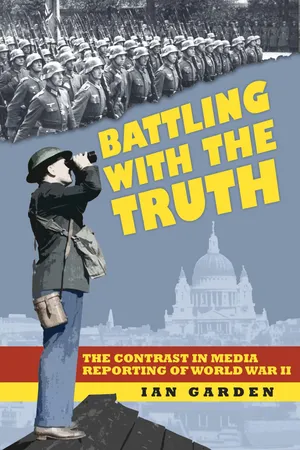
'Think of the press as a great keyboard on which the government can play.' – Joseph Goebbels, Reich Minister of Public Enlightenment and Propaganda Dunkirk, Stalingrad, the Dieppe Raid: there were many bloody and gruesome conflicts fought during the Second World War, yet there was one vital and aggressive battle in which no blood was directly shed – that of the warring nations' battle with the truth. In Battling With the Truth (a follow-up to The Third Reich's Celluloid War) Ian Garden offers fascinating insights into the ways by which both the Axis and Allies manipulated military and political facts for their own ends. By analysing key incidents and contemporary sources from both British and German perspectives, he reveals how essential information was concealed from the public. Asking how both sides could have believed they were fighting a just war, Garden exposes the extent to which their peoples were told downright lies or fed very carefully worded versions of the truth. Often these 'versions' gave completely false impressions of the success or failure of missions – even whole campaigns. Ultimately, Battling With the Truth demonstrates that almost nothing about war is as clear-cut as the reporting at the time makes out. From the past, we can learn valuable lessons about the continuing potential for media manipulation and political misinformation – especially during wartime.
- 256 pages
- English
- ePUB (mobile friendly)
- Available on iOS & Android
eBook - ePub
About this book
Trusted by 375,005 students
Access to over 1.5 million titles for a fair monthly price.
Study more efficiently using our study tools.
Information
1
THE CONTROL OF MEDIA CENSORSHIP DURING THE
SECOND WORLD WAR
INTRODUCTION
Hitler had always been jealous of the effectiveness of the British propaganda machine during the First World War and its portrayal of the Germans as a ruthless and dangerous adversary. In his book, Mein Kampf, he even went as far as to criticise the German hierarchy and press for having been so conciliatory as to suggest that the German nation shared responsibility for the outbreak of the Great War. Hitler would have laid the blame fairly and squarely on the British and French, and he was determined that once the Nazis assumed power in 1933, there would be no question of the German press reporting anything other than what was permitted by the newly founded Ministry for Public Enlightenment and Propaganda, led by Joseph Goebbels.
As for the British, having grown rather complacent because of the very success of their own propaganda initiatives during the First World War, the first thing they did after that war was to shut down their Ministry of Information. This was in the naïve belief that it was no longer required and, even if such a requirement did arise again in the future, that it would be able to be re-established without any great difficulty.
This introductory chapter explains how, despite their quite different methods of media censorship, both the Germans and the British were able to exercise relatively tight control over the output of their respective media throughout the war – ensuring that the maintenance of the morale of the general public and their armed forces was paramount at all times, even if this often meant the concealment or misreporting of the truth about the conduct of the Second World War.

Hitler was always jealous of Britain’s and Ireland’s more effective use of propaganda during the Great War – as can be seen in the nature of this Irish recruitment poster. Library of Congress (LOC) 2003668413
THE BRITISH MINISTRY OF INFORMATION
Structure
Despite the fact that General Ludendorff and Hitler had often complained that Germany’s defeat in the Great War was as a result of Britain’s superior use of propaganda, Britain actually had no official propaganda agencies in place in 1914. Instead, a hotchpotch of surprisingly successful propaganda organisations emerged which, rather ironically, were established in direct response to Germany’s use of propaganda. It was only in March 1918 that Lord Beaverbrook was handed responsibility for establishing a specific Ministry of Information (MOI) which would co-ordinate all Britain’s wartime propaganda activities. It was divided into three sections to provide complete control over domestic, military and foreign propaganda. Somewhat appropriately, it would seem, the foreign department was led by John Buchan, the prolific author whose most famous spy thriller, The Thirty-Nine Steps, had been published only three years previously.
Typically, however, as soon as peace was declared, the MOI was all but dissolved, and much of its former propaganda work reverted to the control of the Foreign Office.
It was not until 1935 that a government committee was formed for the purpose of preparing guidelines for the establishment of a new MOI in the event of the outbreak of another war. While it was agreed that its primary responsibility would be to issue official news and public announcements, it was also charged with generating propaganda that would not only sustain civilian morale within Britain but would also influence opinion overseas.
While the individual services’ departments were allowed to retain their own press officers, the MOI was certainly intended to be regarded as the primary centre for the distribution of all information relating to the war. Its personnel were to be accommodated in the University of London’s Senate House on Malet Street. The original plan was to allocate responsibility across five divisions but, by the spring of 1939, this number had increased to sixteen.
Prior to the commencement of war, the British Government had resolved that the press in the United Kingdom would not be required to submit material for censorship approval prior to publication but rather that the press would submit to a policy of voluntary censorship. Indeed, the press would be subject to the same restrictions as all other citizens and organisations in Britain in that its activities would be controlled by Defence Regulations.1

The Ministry of Information was housed in the University of London’s Senate House throughout the Second World War. Wikimedia Commons/An Siarach
The specific Defence Regulations of most relevance to the media were Regulation Nos. 3 and 39b.
Regulation No. 3 made it an offence for anyone to: obtain, record, communicate or publish […] any military or other information […] which would or might be directly or indirectly useful to the enemy.
Regulation No. 39b made it an offence for anyone to: endeavour, whether orally or otherwise, to influence public opinion […] in a manner likely to be prejudicial to the defence of the realm or the efficient prosecution of the war.
There is no doubt that, at the commencement of war, there were several government and services’ department officials who would have been quite happy if the reporting of everything to do with the war could have been banned. However, it was quickly recognised that this would have been a propaganda coup for the Germans and likely to undermine civilian morale. The press had to be allowed to keep the general public informed about the progress of the war and, to assist the press in understanding how this task could be legally fulfilled, a booklet called Defence Notices and Press Instructions was circulated to all newspaper editors and censors at the outbreak of war. It contained an extensive list of banned subjects about which it was decreed information should not be published without prior guidance from the appropriate government censorship department.
This booklet was of great benefit to news editors, who were only too willing to submit possibly contentious articles for censorship control since, if approved, they would be stamped as ‘Passed for Publication’ and, armed with such official authorisation, editors knew that they should be safe from prosecution for breaching any Defence Regulations.
It was not, however, of much help to censors, who were having to make instant decisions as to what information might or might not be of interest to the enemy. Hence, lists of additional banned subjects would be issued on almost a daily basis, in response to the latest developments, to give censors and editors further guidance as to what might or might not be acceptable.
Most of the Defence Notices were quite understandable, such as not reporting the success of, or any mishap to, or any movement of his Majesty’s forces, aircraft or ships of war. Other Notices were less clear as to when and how they might apply, such as one under the heading ‘Advertisements and Appeals’, which decreed: ‘special precautions should be taken to prevent the publication of letters or advertisements inviting officers and men to communicate with strangers.’
A couple of noteworthy points arise from the Press Instructions that prefaced the actual Defence Notices.
First, as has been mentioned above, the press was being asked to adhere to a process of self-censorship. However, there was obviously some concern that this voluntary arrangement might not succeed, as could be seen in the thinly disguised threat: ‘As in 1914–1918, the censorship of the press, other than of press telegrams, will, for the present, be on a voluntary basis. Power is, however, taken […] for the imposing by Order, of compulsory censorship either generally or in relation to particular matters.’
Second, it was made quite clear that the censors would only have the right to remove inappropriate material: ‘after the deletion of words or sentences which may in themselves be objectionable, additions to or further exclusions from the text are not made by the Ministry except to preserve the sense.’
In other words, there was a clear undertaking from the MOI that its censors would not be altering copy or massaging loss statistics for propaganda purposes. Of course, this still did not guarantee that the initial information, fed to the press from the individual services’ departments via the MOI, was accurate.
Likewise, the MOI seemed to find it necessary to protect its own position by declaring that: ‘Permission to publish constitutes no guarantee of the accuracy of the news passed. Each item of news is judged entirely from the point of view of its effect on the conduct of the war, irrespective of its truth or falsity.’
That is to say, censors may well have known that an item to be published was untrue or gave a false impression but as long as it did not fall foul of the Defence Regulations, it could still be published.
Day-to-day Operation
In practice, every London newspaper and every provincial newspaper with an office in London had one or more of its representatives based at the MOI in London. Their role was threefold. First, they had to inform their offices of official communiqués issued by Ministry officials. The newsroom was housed on the ground floor of the Senate Building and a large bell would be sounded to signal the release of each new press release.2 Second, they had to liaise with the censors regarding any copy that their editors had submitted for approval. Two drafts of proposed material would be sent to the censors in the basement via a system of pneumatic tubes. One copy would be returned with any changes marked in blue and bearing an official MOI stamp. The journalists would then phone or cable the amended copy to their head offices. Third, they had to interact with those representatives of other key Government departments who were in the best position to provide the press with additional information on any subject.
All the large news agencies such as the Press Association and Reuters also employed staff at the Ministry of Information. When it came to censorship, all the news agencies with their headquarters in Britain had secured an agreement with the Government whereby their incoming messages were not censored before delivery. This was agreed only in return for a guarantee from these agencies that they would submit for censorship all such incoming news from overseas that had to do with the war before it was circulated to individual newspapers for publication. Newspapers that received information from overseas directly were also spared pre-censorship, but they were left to make their own decisions as to whether such information needed to be submitted for censorship approval prior to publication.
Correspondents of overseas press were required to obtain prior censorship approval for all material going overseas, whether it was being communicated by mail, cable, wireless or telephone. This aroused a certain resentment among foreign correspondents, who were aware that the British newspapers had no such constraints and could export their newspapers overseas without prior censorship approval.
Operational Efficiency
Regrettably, in the early days of its creation, a large degree of tension not only existed between the MOI and the services’ departments but often also within the separate divisions of the MOI itself, since there was no clear definition as to where one division’s area of responsibility ended and another began.

The Newsroom in Beveridge Hall at the Ministry of Information. MOI Digital/Copyright University of London
Indeed, even after war was declared, there was still a considerable amount of uncertainty as to how the news should be controlled, not least because many of the new officials assigned to work at the MOI were ex-naval men who had little understanding of how media organisations worked.
At the outbreak of war, many censors even felt it was their duty to stop the flow of news about the war altogether. In his book, Blue Pencil Admiral, the Chief Press Censor, Rear Admiral George Thomson, was only too ready to admit the confusion that arose when the British Expeditionary Force (BEF) first landed in France, in September 1939. There had been initial landings as early as 4 September, and it was agreed that these should not be reported. However, following the main landing on 10 September, this news blackout seemed unnecessary, since the Germans were obviously already aware of this development, and by 12 September a Paris radio station had already broadcast the news to the wider world. Consequently, the censors agreed at 9 p.m. that evening that the press could report the simple fact that units of the BEF had arrived in France. However, the British general staff soon became alarmed that the press was creating human interest articles out of the news and that there was a real danger that details about the numbers of men involved and equipment they were taking with them would be of real benefit to the enemy. Consequently, the initial decision to allow publication was withdrawn two and a half hours later. Arrangements were made for any further publication of newspapers that evening to cease and for newspapers already in transit to be seized by the police at railway stations. Chaos ensued and, as it became evident that it would be impossible to prevent all the information being released, the proh...
Table of contents
- Cover
- Title
- Dedication
- Acknowledgements
- Contents
- Introduction
- 1 The Control of Media Censorship during the Second World War
- 2 Countdown to War
- 3 The Road to Dunkirk
- 4 The Battle of Britain
- 5 Saint-Nazaire – ‘the Greatest Raid Ever Made’
- 6 The Dieppe Raid
- 7 Operation Chastise – the Dambusters Raid
- 8 The Bombing of Cities
- 9 El Alamein and the Desert War
- 10 The Battle for Stalingrad
- 11 D-Day and Beyond – the Invasion of Mainland Europe
- 12 The Destruction of Convoy PQ17
- 13 The Massacre in Katyn Forest
- 14 The ‘V’ Rockets and the Bombing of Peenemünde
- 15 Operation Market Garden
- 16 The Battle of the Bulge
- 17 Conclusion
- Select Bibliography
- Copyright
Frequently asked questions
Yes, you can cancel anytime from the Subscription tab in your account settings on the Perlego website. Your subscription will stay active until the end of your current billing period. Learn how to cancel your subscription
No, books cannot be downloaded as external files, such as PDFs, for use outside of Perlego. However, you can download books within the Perlego app for offline reading on mobile or tablet. Learn how to download books offline
Perlego offers two plans: Essential and Complete
- Essential is ideal for learners and professionals who enjoy exploring a wide range of subjects. Access the Essential Library with 800,000+ trusted titles and best-sellers across business, personal growth, and the humanities. Includes unlimited reading time and Standard Read Aloud voice.
- Complete: Perfect for advanced learners and researchers needing full, unrestricted access. Unlock 1.5M+ books across hundreds of subjects, including academic and specialized titles. The Complete Plan also includes advanced features like Premium Read Aloud and Research Assistant.
We are an online textbook subscription service, where you can get access to an entire online library for less than the price of a single book per month. With over 1.5 million books across 990+ topics, we’ve got you covered! Learn about our mission
Look out for the read-aloud symbol on your next book to see if you can listen to it. The read-aloud tool reads text aloud for you, highlighting the text as it is being read. You can pause it, speed it up and slow it down. Learn more about Read Aloud
Yes! You can use the Perlego app on both iOS and Android devices to read anytime, anywhere — even offline. Perfect for commutes or when you’re on the go.
Please note we cannot support devices running on iOS 13 and Android 7 or earlier. Learn more about using the app
Please note we cannot support devices running on iOS 13 and Android 7 or earlier. Learn more about using the app
Yes, you can access Battling With the Truth by Ian Garden in PDF and/or ePUB format, as well as other popular books in History & World War II. We have over 1.5 million books available in our catalogue for you to explore.