![]()
Food, Drink and Fashion
Herbert Museum and Art Gallery, Coventry
28
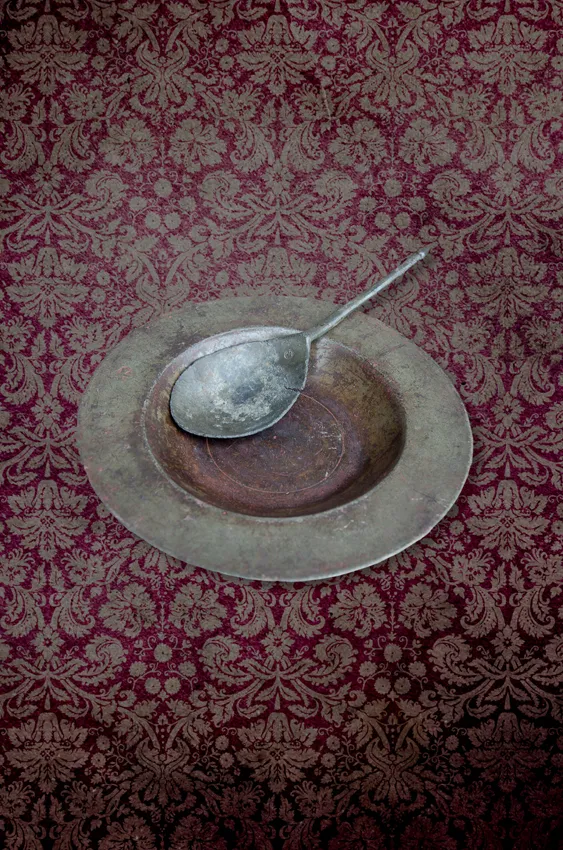
Pewter plate and spoon
Old men in Essex in the 1560s or early 1570s told the clergyman William Harrison how they could remember such poverty ‘that a man should hardlie find foure peeces of pewter … in a good farmer’s house’. Yet now, observed Harrison in 1577, a typical farmer or husbandman had a good reserve of cash, ‘beside a faire garnish of pewter on his cupboard … three or foure featherbeds, so many coverlids and carpets of tapistrie, a silver salt, a bowle for wine … and a dozen of spoones to furnish up the sute’. Clearly, an age of comparative affluence had dawned once more in England’s countryside, and in Tudor towns and villages alike the proud possession and display of pewter remained perhaps the primary domestic means of displaying the growing security and self-confidence of people of the ‘middling sort’. Even poorer folk, indeed, were steadily attempting to emulate their betters and saw pewter utensils as the ideal way of advertising the fact. Among a large sample of 441 wills, taken between 1532 and 1601 – including many estates of £5 or less – 95 per cent included pewter goods, while some individuals, like the two men hanged in 1600 for stealing two dozen dishes worth 10s from the house of a certain Thomas Patch, were even prepared to risk their very lives for it.
Used in the ancient world by the Egyptians, Romans and other civilisations, pewter is composed primarily of tin with varying quantities of antimony, bismuth, copper and lead, and although much harder than pure tin, it possessed the further advantage of a low enough melting point to make it easy for casting. Such was its popularity, moreover, that by 1473 the Worshipful Company of Pewterers had been granted its first charter by Edward IV, whereupon strict standards were laid down for the finer quality, known as ‘sadware’, and so-called ‘lay metal’, which contained a higher level of lead as a low-cost bulking agent for hollow-ware items, such as pots and measures. And in the meantime this simple tin alloy became the ultimate everyday status symbol for all but the wealthiest few, who had the means to opt for silver instead. As such, the humble plate and spoon pictured here speak eloquently of an important parallel between the Tudors and their modern-day successors – the former, in their own way, no less aspirational and materially minded, albeit on an altogether less affluent plane.
Chiswick Chap
The plate’s plain rim and gentle ‘bouge’ are typical of the period, though little Tudor pewter actually survives, since damaged or worn vessels were simply melted down and recycled. The spoon, too, is typical and another comparatively rare survivor from a time when knives and forks were still something of a rarity. When they were not eating with their fingers from communal plates, such spoons remained the cutlery utensil of choice for Tudor men and women throughout the period. They were, after all, the most flexible of utensils, with especial value when soups or stews were involved, and they came over time to adopt a special social significance in their own right. In Tudor England it became customary, for example, to give an ‘Apostle Spoon’ as a christening gift – a practice which was prevalent among all social classes and gave rise to a long-lasting tradition.
Cutlery knives, on the other hand, when used at all, were generally employed for spearing rather than cutting food, while forks, which were introduced from Italy during the reign of Henry VIII, were mainly used for serving and sweetmeats. First mentioned as an eating utensil for pasta in a cookbook from the reign of Robert of Anjou, who was King of Naples between 1309 and 1343, forks were actually objects of outright disapproval in some quarters and remained an oddity throughout Europe for a good deal of the seventeenth century too. ‘God in his wisdom has provided man with natural forks – his fingers’, St Peter Damian had written in the eleventh century. ‘Therefore it is an insult to Him to substitute artificial metallic forks for them when eating.’ And this particular prejudice proved surprisingly tenacious, for the first English source to mention forks did not do so until 1611 when the widely travelled Thomas Coryate noted how ‘the Italian cannot by any means endure to have his dish touched with fingers, seeing that all men’s fingers are not alike clean’.
But as hygiene was taking its first uneasy strides towards the Tudor dining table, was the widespread use of pewter meanwhile doing greater and rather more insidious harm to those who ate from it? Pewter’s lead content is now known to leach out upon contact with acidic foods, and especially tomatoes. At least in this latter respect, however, our sixteenth-century forebears appear to have been spared the worst potential side-effects of their eating habits, though more by good fortune than sound science. For although the Spanish and Italian peoples seem to have adopted tomatoes wholeheartedly after Cortès’s conquest of Mexico in 1521, they were rarely seen in England at all in the sixteenth century for fear that they were poisonous – albeit more because of their resemblance to belladonna and deadly nightshade than through any potential interaction with pewter tableware.
Herbert Museum and Art Gallery, Coventry
29
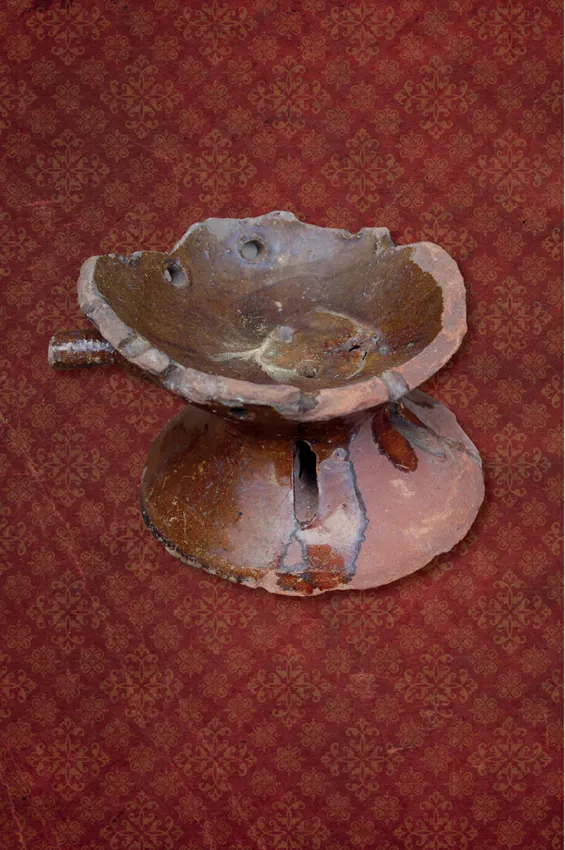
Chafing dish
A recipe for ‘fried toast of spinach’ in Thomas Dawson’s The Good Huswifes Jewel (1596) is only one of many demonstrating the importance of the chafing dish in Tudor cooking. ‘Take spinach and seethe it in water and salt’, the recipe begins:
When it is tender, wring out the water between two trenchers, then chop it small and set it on a chafing dish of coals. Put thereto butter, small raisins, cinnamon, ginger, sugar, a little of the juice of an orange, and two yolks of raw eggs. Let it boil till it be somewhat thick. Then toast your toast, soak them in a little butter and sugar and spread thin your spinach upon them. Set them on a dish before the fire a little while. So serve them with a little sugar upon them.
Used both to cook and to keep food warm, chafing dishes were filled with coals and usually perforated to keep the coals bathed with air and glowing. Like the skillet they seem to have been introduced around 1480, though they were clearly not an exclusively English invention since Hernán Cortès had seen them employed by the Aztecs in Mexico and mentioned them to Emperor Charles V in 1520 when reporting the manner in which Montezuma was served meals in the Aztec capital of Tenochtitlan.
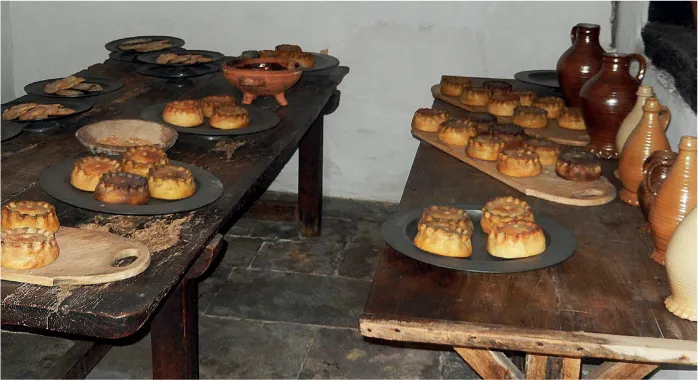
One of the more interesting recipe books to make reference to chafing dishes in this country, however, was the Propre Newe Booke of Cookerye, written by an anonymous author and first published in London in 1545. The recipes themselves, which include exotically named concoctions such as ‘a disshe full of snow’, ‘pan puffe’, ‘a tarte of borage floures’ and ‘eggs in moneshine’ are, of course, items of much interest in their own right, as are various instructions on how ‘to make pyes’ and ‘the order of meates and how they must be served at the table with sauces’. Yet the book’s broader interest lies not only in the fact that it was one of the first cookery books in English aimed at a specifically female audience but that it helped generate a steady growth in other similar publications, such as John Partridge’s The treasure of hidden secrets, commonlie called the good huswives closet of provision, for the health of her household (1596) which combined not only cooking suggestions but also a range of medical recipes, and various recommendations for removal of spots on silk, velvet, cloth ‘and a fewe other curious thinges’.
In almost all such books, moreover, the chafing dish continued to feature prominently, as did that most highly prized of Tudor novelties, sugar. ‘Take a dyche of rosewater and a dyshe full of suger,’ the Propre Newe Booke of Cookerye tells us:
And set them upon a chafyngdysh, and let them boyle, then take the yolkes of vii or ix egges newe layde and putte them therto everyone, and so let them harden a lytle, and so after this maner serve them forthe and cast a little synamon and sugar upon them.
In the 1575 version of the book, meanwhile, the reader is advised to:
Take a dozen apples and ether rooste or boyle them and drawe them thorowe a streyner, and the yolkes of three or foure egges withal, and, as ye strayne them, temper them wyth three of foure sponefull of damaske water yf ye wyll, than take an season it wyth suger and halfe a dysche of swete butter, and boyle them upon a chaffyndgdyshe in a platter, and caste byskettes or synamon and gynger upon them and so serve them forth.
Plainly, the ravenous Tudor sweet tooth seems to have nibbled endlessly, and it is no real surprise to find that sugar, which remained an expensive commodity long after its introduction in the Middle Ages when it was mainly used medicinally for the treatment of coughs and colds, was usually kept under lock and key by the lady of the sixteenth-century household. At the beginning of the period, when the average semi-skilled labourer was earning 4d a day, it cost 3d a pound. By the 1540s, however, it had gone up to 9d or 10d a pound – about one and a half times the daily pay of a skilled labourer such as a shipwright – at which time the courtier John Johnson is said to have paid 6s 6d for a sugar loaf for his wife Sabine. And in consequence the owner of a more humble chafing dish, like the earthenware example pictured here at the Herbert Art Gallery and Museum in Coventry, is likely to have employed it more sparingly than recipe books suggest, though imports from territories in the West and East Indies as well as from Persia, Morocco and Barbary would become more widely available as the century progressed. Used for dressing vegetables and preserving fruit, it was by then considered an aid to digestion and consumed increasingly at the end of meals, giving rise to the so-called ‘sweet’ and also, it must be said, dental devastation on an unprecedented scale. For, while the toothbrush is said to have been invented in China in 1498, it did not appear in England until the end of the seventeenth century.
Julia Smith, www.mudlarking.blogspot.com
30
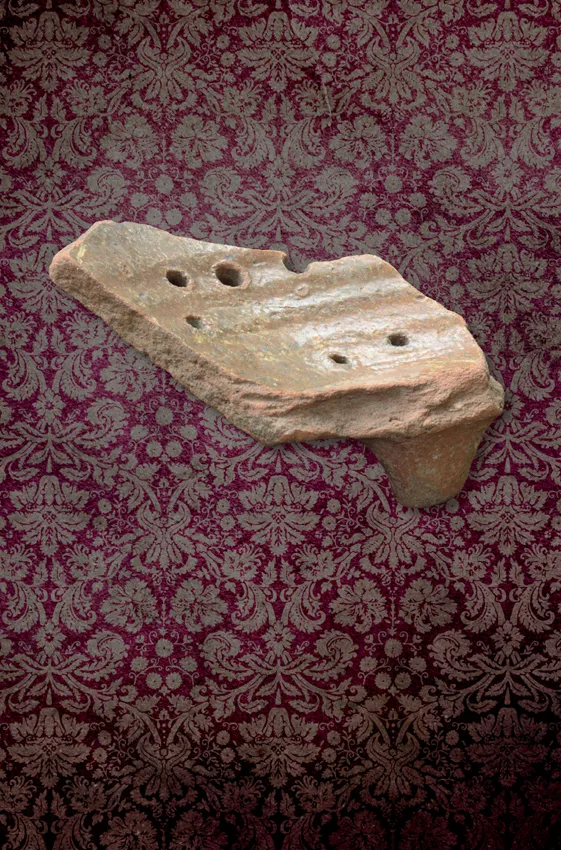
Colander shard
‘Mudlarking’ is the wonderfully evocative Georgian term for scavenging on the shore of a river in search of anything of value. In the London of Dr Johnson and Dickens it was an occupation for the poorest of the poor, usually children, who would sift through the rubbish thrown off boats in the hope of scraping enough together to buy a hunk of bread. Now, however, it is an increasingly popular hobby for a growing army of amateur historians, one of whom was both fortunate and skilled enough to rescue this earthenware shard from the Thames foreshore. Covering an area the size of a hand, its rough texture, shiny brown glaze on the inside and traces of a thin glaze on the outside suggest that it is redware, a type of terracotta deriving its colour from the concentration of ferrous oxide, which was produced by the local potteries at Woolwich, Deptford and elsewhere that made the great majority of everyday domestic pottery used in the homes of Londoners of all classes during the late sixteenth century. The holes and, above all, the leg suggest, however, that this particular object was a somewhat more unusual item – a type of colander employed for serving fish at table in one of the capital’s more affluent households, where freshwater fish, such as trout and salmon, was considered a particular delicacy. Used, too, for storing fish both before and after preparation, the holes seem to have been intended for ventilation rather than drainage.
In 1542 the physician Andrew Boorde suggested in his Compendyous Regyment or Dyetary of Health that different meats were suitable for different classes of person. Beef, he noted, was best for an upper-class Englishman whereas bacon was good for carters and ploughmen, ‘the which be ever labouring in the earth or dung’. But Boorde noted, too, that the country was well served by ‘sea-fysshe … fresh-water fysshe and … salt fysshe’, and although meat seems to have comprised some 75 per cent of the diet of those who could afford it, fish was indeed widely consumed by wealthier Tudors, not least of all due to pressure from both the clergy and government. Meat and poultry were proscribed during Lent, for instance, as well as on the so-called ‘fish days’ of Fridays and Saturdays – although more imaginative gourmands were able to take some consolation from the fact that beavers were also classified as fish at this time. Queen Elizabeth, meanwhile, encouraged fish-eating on Tuesdays, too, in order to develop the skills of English fishermen, who were considered essential to national defence in the absence of a full-time navy. And in August 1596, when dearth was widespread, the Privy Council extended the ban on meat to suppertimes on Wednesday.
In consequence, fish-eating became construed not only as a form of fasting, but as a kind of patriotic duty, notwithstanding the fact that wealthier families were able to eat every bit as heartily on these occasions as at any other time. For, while primitive transport conditions raised the problem of maintaining freshness, any family of sufficient means could buy not only freshwater fish but also small quantities of sea fish such as sole, flounder, plaice and whiting. At the same time much fish, bought salted for use in stews and other dishes, was far less expensive. Carp were kept in carp ponds, and those country estates boasting rivers enjoyed ready supplies of bream, roach, perch, tench and pike. Herrings and mackerel, too, were popular, along with eels and shellfish such as mussels. Even whalemeat, served boiled or well roasted, was available as a result of the plentiful supply of whales in the North Sea at this time, and the banquets of the Tudor elite frequently featured porpoise.
Even those unhampered by the need to make a living were intent, it seems, upon landing their catch. For by the end of the Tudor period the art of an altogether more genteel type of fishing was gaining ground. William Gryndall’s Hawking, Hunting, Fouling and Fishing (1596), for example, reflected the growing popularity of angling among both Tudor men and women of gentle birth, while William Samuel’s The Arte of Angling, published earlier in 1577, had become only the second fishing book to be written in English, following The Treatyse of Fysshynge wyth an Angle (1496). The Arte of Angling (1653), presented in the form of a fishing lesson given by a character called ‘Piscator’, foreshadows much of the advice given over seventy years later, though with little acknowledgement, in Walton’s The Compleat Angler. Nor, like his creator, were Piscator’s efforts fully recognised, since his fictional wife, Cisley, became the first English-speaking woman to have her complaints about her husband’s obsessional pastime committed to the printed page. ‘You men say that women be talkative,’ protests Cisley upon hearing the virtues of worms in ‘old black dung’ a...