Why is Caesar a giant? Because he effectively created the Roman Empire, and thus made possible the European civilization that grew out of it. As the People's champion against a corrupt and murderous oligarchy, he began transformation of the Roman republic into a quasi-monarchy and a military and fiscal system that for four centuries provided western Europe, north Africa and the Middle East with security, prosperity and relative peace. His conquest of Gaul and his successors' conquests of Germany, the Balkans and Britain created both the conditions for 'western culture' and many of the historic cities in which it has flourished.
- 128 pages
- English
- ePUB (mobile friendly)
- Available on iOS & Android
eBook - ePub
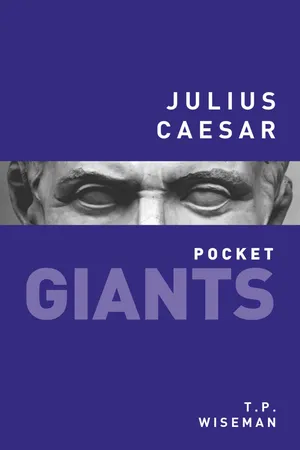
Julius Caesar: pocket GIANTS
About this book
Information
1
The People’s Thing
They are barbarians, but their system of government is admirable.
Eratosthenes of Cyrene (c. 285–194 BC),
Greek philosopher and polymath1
Greek philosopher and polymath1
Imagine a democratic state based on the rule of law. Citizens have equal rights, and contribute to the common wealth according to their means. Private extravagance is frowned upon, and legal safeguards protect the weak from the abuse of power. Now imagine a huge influx of wealth in the space of a single generation. Unprecedented economic inequalities follow. The rich get richer and come to believe that their interests and privileges are what the state exists to protect. Public assets are privatised, with legal safeguards and regulations ignored or evaded. Social tensions become acute. The old ideals of consensus and co-operation seem helpless against the greed and luxury of a powerful few.
That was the state of the Roman Republic when Gaius Julius Caesar was born in what we call 100 BC.
• • •
The Romans had been equals from the very beginning. They believed that Romulus, the founder of the city, had divided what little territory he then commanded into equal lots, and thus created ‘maximum equality for all alike’.2 Refugees came from elsewhere; no questions were asked, and to all who stayed he gave citizenship and an equal share in any new land won in war.3 As the years went by there was no shortage of that.
Romulus did not found a dynasty. His successors, like him, were chosen by election and ruled by popular consent – until the seventh in the sequence, Tarquin ‘the Arrogant’, seized power by murdering his predecessor and dominated the Romans by armed force. This exception proved the rule: Tarquin and his clan were driven out of the city by a popular rising in 507 BC. The leader of the liberation movement was called Lucius Brutus.
Because of Tarquin, the Romans swore they would never have another king. What they put in place was defined as ‘annual magistracies, and obedience not to men but to the laws’.4 We call it the Roman Republic, borrowing the Latin phrase res publica (originally res populica), which meant ‘the People’s thing’. But no sooner had one form of corrupt rule ended than another began.
By 500 BC Rome had become a prosperous city state but her egalitarian ethos was under threat. Some families now defined themselves as ‘patricians’, meaning roughly ‘those who know who their fathers were’, and this self-appointed aristocracy of birth claimed a monopoly on public office. Patrician magistrates failed to protect plebeians (as the rest were now known) from exploitation and even enslavement by patrician landlords and creditors. The plebeians’ response was to elect their own representatives, known as ‘tribunes’, who would protect individuals and veto any measure they considered abusive. The persons of the plebeian tribunes were declared ‘sacrosanct’: anyone offering violence to them would be regarded as an offender against the gods and therefore subject to summary execution.
A long stand-off followed, until in 367 BC the patricians’ political monopoly was ended in a power-sharing agreement. Greek observers were enormously impressed by the fact that it had been achieved without bloodshed. As one of them put it much later:
The People of Rome and the Senate were often in conflict with each other, both about legislation and about debt-cancellation, land-distribution or elections. But there was no civil violence, only lawful differences and arguments, and even those they settled honourably by making mutual concessions.5
What mattered was ‘equal freedom for all’,6 and the achievement of it was what made the Roman Empire possible.
Within four generations of the power-sharing deal, the Romans controlled, by conquest or treaty, the whole of Italy south of the Apennines. Throughout the peninsula, good farming land was divided up into equal lots for Roman settlers. Seven iugera (about 1.7 hectares) was the standard size, and, as one commander put it, wanting more than everyone else got was the sign of a bad citizen.7
Three generations later, after two long and terrible wars with Carthage, the Romans controlled the whole western Mediterranean. In the second war they had been up against Hannibal, second only to Alexander the Great as a military genius. The two commanders who did most to defeat him (Fabius and Scipio) were both patricians; but the plebeian historian of those great events made a point of not naming the commanders.8 It was the People’s achievement – and when Scipio, as consul in 194 BC, instituted privileged seats for senators at the theatre games, it was regarded as an infringement of ‘equal freedom’:
For 557 years [since the foundation of the city] the games have been watched by all together. What has suddenly happened to make senators not want to have plebeians among them in the auditorium? Why should a rich man object to a poor man sitting next to him? It’s just a new and arrogant self-indulgence.9
The Romans still thought of themselves as a community of equals and now they were challenging kings. The great powers of the eastern Mediterranean were the dynastic monarchies that succeeded Alexander’s short-lived empire: the Antigonids of Macedon, the Ptolemies of Egypt, the Seleucids of Syria, the Attalids of Pergamum. The first to fall was the oldest, Macedon.
The defeat and capture by the Romans of King Perseus, ninth in succession from Alexander himself, at the Battle of Pydna in 168 BC, was a truly epoch-making event. One indirect result of it was the presence in Rome of the Greek historian Polybius, who spent his years of exile writing a history to explain to his fellow countrymen:
by what means, and under what system of government, the Romans succeeded in less than 53 years [220–167 BC] in bringing under their rule almost the whole of the inhabited world, an achievement without parallel in human history.10
The ‘system of government’ was the key to understanding, and Polybius devoted a whole volume to describing the Roman republican constitution. Its excellence was demonstrated, he thought, by the citizens’ moral behaviour: they acted in concord for the public good; they sacrificed their own interests to the welfare of the community; in office, they kept their oaths and were scrupulous with public funds.11
Confirmation of that judgement comes from another external source, the Jewish chronicler who narrated the revolt of Judas Maccabaeus against the Seleucid king Antiochus. In 160 BC, he reports that Judas had heard about the Romans: although their military power could make and unmake kings:
not one of them made any personal claim to greatness by wearing the crown or donning the purple. They had established a senate where 320 senators met daily to deliberate, giving constant thought to the proper ordering of the affairs of the common people. They entrusted their government and the ruling of all their territories to one of their number every year, all obeying this one man without envy or jealousy among themselves.12
(In fact there were two consuls per year, but they held power in turn, alternating month by month.)
Together, Polybius and the author of I Maccabees provide an impressive testimonial to the virtues of ‘the People’s thing’, the res publica of Rome’s equal citizens, as late as the mid second century BC.
So what went wrong?
2
Greed and Arrogance
Greed destroyed honesty, integrity and all the other virtues, and taught instead arrogance, cruelty, neglect of the gods, and the belief that everything can be bought.
Gaius Sallustius Crispus (c. 86–35 BC),
Roman senator and historian13
Roman senator and historian13
Big money corrupts everything it touches, and it certainly touched the Roman Republic. Looking back a century later, in a time of civil war, Rome’s historians identified a moral crisis: frugality and self-discipline had made Rome great; luxury and self-indulgence had brought her to disaster. And it happened because the huge influx of wealth from the wars of conquest did not benefit all Romans equally.
‘To gain great wealth by honourable means’ was always a legitimate ambition for Roman citizens.14 Every five years they made a sworn declaration of the value of their property to the censores, senior magistrates whose duty it was to assess the financial, physical and moral health of the citizen body. That regular assessment was the basis of direct taxation: the richer you were, the more you contributed to the public treasury. But the appropriation of the King of Macedon’s treasure changed all that. In 167 BC the direct taxation of Roman citizens was abolished, and the link was broken between private property and the common wealth.
What corrupted the Republic was not wealth in itself but the extent of it, and the arrogance of those who had it. Now that Rome had overseas territories to administer and exploit, a career in elected public office might mean not only the successive responsibilities of financial stewardship, judicial authority and military command, but also a year or more as a provincial ...
Table of contents
- Cover
- Title
- Copyright
- Contents
- 1. The People’s Thing
- 2. Greed and Arrogance
- 3. A Young Man to Watch
- 4. The Ladder of Office
- 5. The Body Politic
- 6. To the Ocean and Beyond
- 7. Disasters
- 8. Civil War and Moral Philosophy
- 9. The Oath-Breakers
- 10. Hail, Caesar
- Notes
- Timeline
- Further Reading
- Digital Resources
Trusted by 375,005 students
Access to over 1.5 million titles for a fair monthly price.
Study more efficiently using our study tools.
Frequently asked questions
Yes, you can cancel anytime from the Subscription tab in your account settings on the Perlego website. Your subscription will stay active until the end of your current billing period. Learn how to cancel your subscription
No, books cannot be downloaded as external files, such as PDFs, for use outside of Perlego. However, you can download books within the Perlego app for offline reading on mobile or tablet. Learn how to download books offline
Perlego offers two plans: Essential and Complete
- Essential is ideal for learners and professionals who enjoy exploring a wide range of subjects. Access the Essential Library with 800,000+ trusted titles and best-sellers across business, personal growth, and the humanities. Includes unlimited reading time and Standard Read Aloud voice.
- Complete: Perfect for advanced learners and researchers needing full, unrestricted access. Unlock 1.5M+ books across hundreds of subjects, including academic and specialized titles. The Complete Plan also includes advanced features like Premium Read Aloud and Research Assistant.
We are an online textbook subscription service, where you can get access to an entire online library for less than the price of a single book per month. With over 1.5 million books across 990+ topics, we’ve got you covered! Learn about our mission
Look out for the read-aloud symbol on your next book to see if you can listen to it. The read-aloud tool reads text aloud for you, highlighting the text as it is being read. You can pause it, speed it up and slow it down. Learn more about Read Aloud
Yes! You can use the Perlego app on both iOS and Android devices to read anytime, anywhere — even offline. Perfect for commutes or when you’re on the go.
Please note we cannot support devices running on iOS 13 and Android 7 or earlier. Learn more about using the app
Please note we cannot support devices running on iOS 13 and Android 7 or earlier. Learn more about using the app
Yes, you can access Julius Caesar: pocket GIANTS by T.P. Wiseman in PDF and/or ePUB format, as well as other popular books in History & Historical Biographies. We have over 1.5 million books available in our catalogue for you to explore.