Between 1942 and 1945, tens of thousands of young American servicemen arrived in Britain. This book is an examination of the way their presence affected them and the local people during the Second World War. It is a social history and studies the various relationships forged between the British public and their American guests.
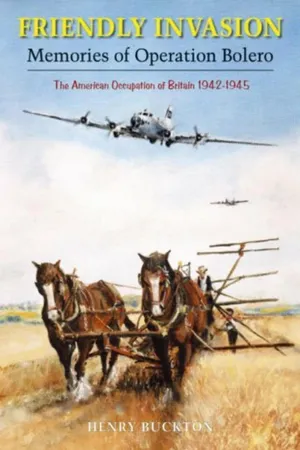
eBook - ePub
Friendly Invasion
Memories of Operation Bolero, The American Occupation of Britain 1942-1945
- 208 pages
- English
- ePUB (mobile friendly)
- Available on iOS & Android
eBook - ePub
Friendly Invasion
Memories of Operation Bolero, The American Occupation of Britain 1942-1945
About this book
Information
Chapter 1
‘HEY GUYS, WE’RE IN ENGLAND’
For various reasons American servicemen began to arrive in different parts of Britain from the spring of 1942 onwards. Cheltenham in Gloucestershire was chosen to locate the headquarters of the US Army’s Services of Supply Command (SOS). American Army chiefs had insisted on a central site, preferably in southern England, from where they could administer to the needs of the troops and installations that would follow. General John Lee, who had been appointed to command SOS forces in Europe, inspected the suggested site covering Benhall Farm and Oakley Farm in June 1942. The buildings he found there had been built by and for the British War Office, to act as an evacuation point in the event of invasion.
The site proved ideal and, one month after General Lee’s inspection, the first wave of US personnel began to arrive. But although office facilities were in place, later occupied by GCHQ, there were no barracks for the men. Officers were quartered in local hotels, while for the GIs tented camps sprang up all around Cheltenham, including one in Pittville Park near the Pump Room, and another at the famous Prestbury Park racecourse. At many locations, these tents were eventually replaced by more permanent forms of accommodation, including brick-built barracks and the now legendary Nissen huts, many of which can still be seen around the country, acting as lasting reminders of this brief moment in our nation’s social history.
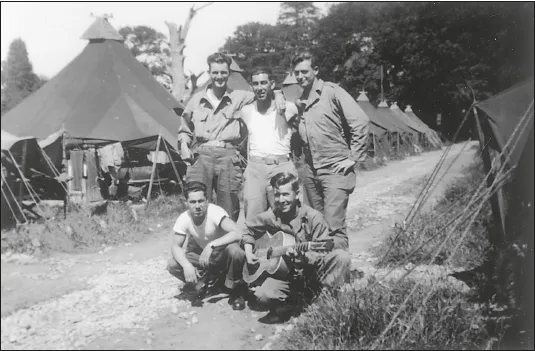
1 American soldiers at a tented camp at Threemilestone in Cornwall in 1944. (Photo: courtesy of Brian Bawden)
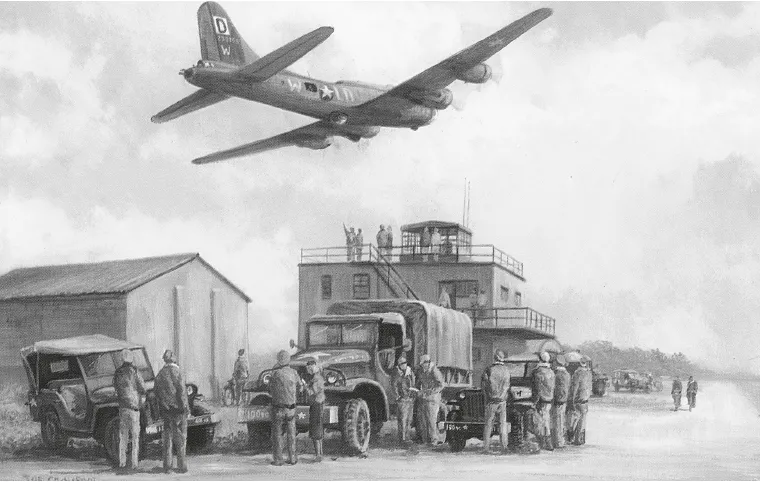
2 A B-17 flying over Thorpe Abbots, a typical American airbase in East Anglia. From a painting by Joe Crowfoot. (Copyright: Joe Crowfoot and reproduced with his permission)
FIRST IMPRESSIONS
Before long American bases were springing up everywhere, especially in East Anglia, from where the 8th USAAF would begin its bombardment of Nazi-occupied Europe. Throughout the West Country, depots, hospitals and other sites began to appear in preparation for the massive influx of personnel that would arrive during the build up to Operation Overlord in June 1944.
To have Americans stationed near your town or village was such a big event, especially for children, that many people naturally always remember their very first contact with them. Many people had a pre-conceived idea of what they were like. As a 14-year-old living in Dereham in Norfolk, Tony Blades had only ever seen Americans at the local picture palace, admitting that he could only associate them with the movie stars he had seen. He and his friends wishfully thought that, back home in the United States, they were probably all either cowboys or gangsters. Impressionable young ladies, on the other hand, might have associated them with the more glamorous type of films they were accustomed to watching, set in places with romantic sounding names like Hollywood, Beverly Hills, or Manhattan.
Dereham was close to several American airbases that had been taken over by men and aircraft of the 8th Air Force – the Mighty Eighth – notably at Shipdham, which had become home to the 44th Bomb Group; and Wendling, where the 392nd Bomb Group had taken up residence. Both of these groups were components of the 14th Combat Wing, and flew a variety of B-24 Liberator bombers during their stay. It was inevitable therefore that, once settled in, the young servicemen who flew and maintained these ‘ships’, as the Americans called their aircraft, would begin to visit the town.
Tony’s first contact happened one afternoon not long after he’d left school and was working in a nearby stationers and newsagent. ‘Two Yanks,’ he recalls, ‘as we affectionately knew them, came into the shop and picked out a picture postcard of the town costing 1d.’
The American showed the card to the teenager, along with a £1 note asking, ‘Will this be enough?’. When told that he could purchase 240 postcards for his £1 he said with amazement, ‘Gee! Things are cheap in England.’

3 Meeting the locals. An American soldier chats to a lady walking her dog in Minchinhampton Park, in Gloucestershire, one of the many tented campsites in the area. (Photo: courtesy of Stan Dyer)
The prospect of coming to Britain for these young men must have been quite daunting, because, although they largely shared the same language, their culture was very different. In fact, the United States itself is so huge that there were vast cultural differences within its own boundaries. This meant that, as well as coming face to face with the British, they were also meeting American citizens from other parts of the Union for the very first time as well.
Because some of the Americans appeared to be loud, confident, and well paid, compared with British troops, they were generally believed to be men of the world. But in reality, this was often far from the case. For many it was the very first time that they had been away from their homes and indeed for a lot of them the very first time that they had been away from their mothers. This left many of them in a high state of bewilderment, so they were forever looking to be liked by the general populace of Britain. It becomes evident that they did this by being very friendly and over-generous.
Of course there were mixed reactions among the British, who had been at war since September 1939. In Bristol, for instance, Doreen Govan recalls seeing the slogan ‘Go home Yanks’ appearing in prominent places around the city. ‘Rather ungrateful really,’ she reflects, ‘since the reason they were “over here” was ostensibly to help us win the war.’ But for most, there was also a tremendous sense of relief, that at last we had a friend. No longer were the British and her Commonwealth allies fighting alone.
Today, Fairford in Gloucestershire is still associated with the American Air Force, but Jim Jefferes can remember the day when the GIs first arrived. He was in the carpentry classroom at Fairford school, when armoured vehicles began to roll into the town and line up in front of the church. The children were allowed to go outside and watch as the convoy of vehicles, each one bursting with infantry soldiers attired in full battle dress, came to a halt enabling the soldiers to alight.
‘This was the tremendous and irrefutable visual evidence that we were no longer fighting the war on our own,’ he states, ‘but that this huge and powerful country had thrown itself steadfastly behind us. As the tracked vehicles rumbled by the soldiers threw us packs of army field rations. However frugal these rations were, they had a profound effect. For the first time since the beginning of rationing somebody was giving us something freely.’
By four o’clock the town was bustling with American troops and Jim feels that the first impression this gave to the local people was one of positive hope for the future. Their appearance seemed to change the whole atmosphere, as though a dark cloud had somehow been lifted. ‘They were friendly,’ he says, ‘and sympathised with the hardship the country was going through.’ Their music and songs touched the imagination and got people singing.
Olive Martin lived in Hampshire near Tidworth Barracks, where during the years immediately before the war she and her family had observed many changes. However, in the summer of 1942 she recalls how this busy place had become completely deserted. Then, one Sunday afternoon, she and her sisters were making their way home from a service at the Methodist church. They knew a shortcut, the route of which took them across the parade square. Suddenly they saw hundreds of men in strange uniforms playing ball games with unusual gloves on their hands. This was their introduction to both the Americans, and their beloved game of baseball.
The military training areas around Tidworth occupied various locations on both sides of the Hampshire/Wiltshire border, but it’s probable that the men Olive observed that day belonged to the 29th Infantry Division, who arrived at the barracks in early October 1942.
A little later in the war, the American Army established a camp near the Somerset town of Chard, during the build up to D-Day, at which troops began to arrive in preparation for the invasion of Normandy. Bernard Galpin and his friends would sit and watch the work as the camp was being erected, and recalls an incident which captures the confusion that some of the arriving troops must surely have felt. The men had not been informed of their final destination, and they only knew they had reached it, after arriving.
‘I was sitting on a gate at the far end of the camp near a place called Muddy Stile,’ says Bernard, ‘when a convoy of covered trucks arrived. They stopped, and after a while the backs opened up and out jumped hundreds of troops, looking lost.’
One of the soldiers came across to Bernard to ask where they were? He was told ‘Chard’, and looked confused. ‘Where’s Chard?’ he furthered. ‘In Somerset’, was the response. He still looked confused, and after asking where Somerset was and being told, ‘In England’, he shouted to his pals, ‘Hey guys, we’re in England!’
In Dorset, the Americans had their eyes on the little village of Charminster, a few miles from Dorchester. Because of its close proximity to Weymouth, which would feature heavily in the American invasion plans, the site was ear-marked as the location for a large ordnance depot, where fighting and other vehicles would be prepared in readiness for D-Day.
In time, the site would become the home and working base for many troops, but Ivor Peters who lived in the village can still remember the day in 1943 when the first Americans arrived. One weekend Ivor and a couple of his pals were walking through the village, when a strange looking lorry came slowly along the road and turned into a lane that led away from the main street. They knew immediately that the vehicle wasn’t British. It was painted in a drab khaki colour and the large white stars on the side of the cab and the unfamiliar uniforms of its occupants were obvious clues to its origin.
The boys chased the lorry along the lane and, after it had gone a short distance, it pulled up near the gateway into a large field. Several soldiers jumped out of the vehicle and proceeded to unload a sentry box, which they erected next to the gateway. Having done this, most of the men climbed back into the truck before it pulled away again, leaving behind the sentry box and a solitary soldier armed with a rifle. Ivor explains, ‘He was the first American soldier to occupy a site that was to become a large ordnance camp maintaining fighting vehicles, the likes of which we had only seen on the cinema screen.’
But what about the GIs themselves? What was their first impression of Britain? Before the war George Rarey had been a cartoonist and commercial artist. He was drafted into the Army Air Corps and trained as a fighter pilot. He came to England in 1943, and not only kept a cartoon journal of the daily life of his fellow pilots in the 379th Fighter Squadron, 362nd Fighter Group, but sent regular letters home to his recent bride Betty Lou. The consequences of the English weather were often depicted in his cartoons, and his first impression of Britain suitably comes from a letter to his wife sent in November 1943:
We came down from the Scottish coast on an English train that was a dead ringer for a Hitchcock setting. As we passed through the countryside and villages, the natives gave us a warm and much appreciated greeting. An Englishman on the Queen Elizabeth had told us that if we could see the mountains as we approached the British coast, it was a sign that it would soon rain. If we couldn’t see the mountains, it was already raining.
Still today, among those who remember the wartime American servicemen who came to Britain, there is a mixture of thoughts, although it quickly becomes evident that many people had pre-conceived opinions long before they even arrived. Many examples illustrate this point, such as the story of Peter Tamplin, who as a boy was evacuated from London to the Isle of Purbeck in Dorset.
Peter was staying at a place called Creech Grange and daily caught the bus to Stoborough Primary School near Wareham, some two miles away. On the day in question he and his companions were running late and consequently missed the bus. Faced with a two-mile trek they were only too glad to accept a lift from a passing US Jeep. ‘The Jeep already had three or four occupants,’ he explains, ‘plus their luggage, so we were perched on top at the back.’
After what he describes as an ‘exhilarating trip’ they arrived safely at school and only very slightly late. However, on relating the story of their adventure to the teacher, they were given the worst dressing-down of their young lives. For not only had they accepted a lift from strangers, but Americans at that. There was some talk of them having to undergo medical examinations but, after the initial shock had worn off, and the realisation by the teachers that they had not been harmed, the incident was forgotten. ‘Bear in mind,’ explains Peter, ‘that the school was in the hands of aged spinsters.’
Naturally, some of the Americans did live up to their reputation of being brash, and Bill Underwood recalls one occasion when a notable resident of Devizes in Wiltshire was forced into putting bragging Yanks from the 4th Armored Division in their places.
Bill’s father ran a barber’s shop in Devizes and, when the GIs first began to descend on the town, many would come in for a haircut or shave. One day Jim Jennings, the former mayor, was in the shop waiting for a haircut at the same time as a group of American soldiers. Jim was the owner of fairgro...
Table of contents
- Cover
- Title
- Copyright
- Contents
- List of Illustrations
- Acknowledgements
- Introduction
- 1 ‘Hey guys, we’re in England!’
- 2 Home sweet home
- 3 Getting to know you
- 4 Working together
- 5 Men and machines
- 6 A time to relax
- 7 Guys and dolls
- 8 GI brides and babies
- 9 ‘Got any gum chum?’
- 10 Bolero and beyond
Trusted by 375,005 students
Access to over 1.5 million titles for a fair monthly price.
Study more efficiently using our study tools.
Frequently asked questions
Yes, you can cancel anytime from the Subscription tab in your account settings on the Perlego website. Your subscription will stay active until the end of your current billing period. Learn how to cancel your subscription
No, books cannot be downloaded as external files, such as PDFs, for use outside of Perlego. However, you can download books within the Perlego app for offline reading on mobile or tablet. Learn how to download books offline
Perlego offers two plans: Essential and Complete
- Essential is ideal for learners and professionals who enjoy exploring a wide range of subjects. Access the Essential Library with 800,000+ trusted titles and best-sellers across business, personal growth, and the humanities. Includes unlimited reading time and Standard Read Aloud voice.
- Complete: Perfect for advanced learners and researchers needing full, unrestricted access. Unlock 1.5M+ books across hundreds of subjects, including academic and specialized titles. The Complete Plan also includes advanced features like Premium Read Aloud and Research Assistant.
We are an online textbook subscription service, where you can get access to an entire online library for less than the price of a single book per month. With over 1.5 million books across 990+ topics, we’ve got you covered! Learn about our mission
Look out for the read-aloud symbol on your next book to see if you can listen to it. The read-aloud tool reads text aloud for you, highlighting the text as it is being read. You can pause it, speed it up and slow it down. Learn more about Read Aloud
Yes! You can use the Perlego app on both iOS and Android devices to read anytime, anywhere — even offline. Perfect for commutes or when you’re on the go.
Please note we cannot support devices running on iOS 13 and Android 7 or earlier. Learn more about using the app
Please note we cannot support devices running on iOS 13 and Android 7 or earlier. Learn more about using the app
Yes, you can access Friendly Invasion by Henry Buckton in PDF and/or ePUB format, as well as other popular books in History & Military & Maritime History. We have over 1.5 million books available in our catalogue for you to explore.