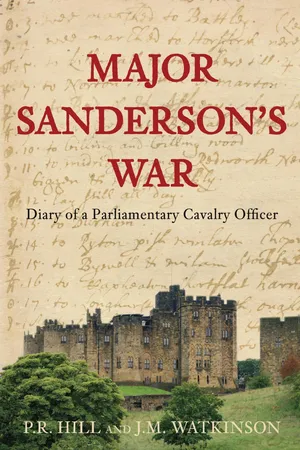
In 1919 the diary of a parliamentary cavalry officer, written on an interleaved copy of William Lilly's Merlini Anglici Ephemeris, was exhibited at the Society of Antiquaries of Newcastle upon Tyne. It was discovered to be that of Major John Sanderson for the year 1648, an officer in Colonel Robert Lilburne's regiment of horse. This was an extremely rare find, as while Civil War memoirs were common, daily accounts were not. Spanning from 11th January to 30th December, Sanderson's diary contained 270 entries that not only recalled well-known events, but also depicted the minutiae of patrol and skirmish. Major Sanderson's War is not merely a transcript of the diary, but an analysis of the role of cavalry and the northern campaign of the Second Civil War. No other book will provide the enthusiast with such a unique glimpse into the life of one of Cromwell's officers.
- 192 pages
- English
- ePUB (mobile friendly)
- Available on iOS & Android
eBook - ePub
About this book
Information
CHAPTER ONE
INTRODUCTION
In 1919 the manuscript diary of a parliamentary officer, written on an interleaved copy of William Lilly’s Merlini Anglici Ephemeris 1648, was exhibited by Mrs Wynne-Jones at the January meeting of the Society of Antiquaries of Newcastle upon Tyne. A transcript was produced the following month, and published in the Society’s Proceedings in 1921.1 The diary starts on 11th January and finishes on 30th December. Reference to other accounts of events mentioned show that the year covered is indeed 1648, the period of the Second Civil War.
Nowhere is the name of the diary’s author given but, from the nine references to Hedleyhope, the editor of PSAN was able to deduce that he was one of the Sandersons of that place, an estate some eight miles west of Durham City bought by the Sandersons in or before 1623 (map 1 (1) and plate 2). The identification is backed by other sources which describe the movements of Major John Sanderson in 1648 and confirm details given in the diary. His Will (Appendix 4) places him firmly in the Hedleyhope family.
Much has been written on the better-known campaigns of the English Civil War. Many commanders have left both contemporary and later letters and accounts but fewer of the junior officers have done so. Diaries written by participants in the Civil War in the true sense of a more or less daily account, are very rare. Memoirs are more common, but were usually written after the passage of some years, and tended to concentrate on what hindsight saw as important.
In many ways the most significant account is this diary for 1648 of Major John Sanderson, who was an officer in Colonel Robert Lilburne’s regiment of horse, originally part of the Northern Association of the parliamentary army. Of major importance is the sheer number of entries, all made within a few days at most of the events recorded, and the way in which they can be collated with other accounts to give a narrative thread. It is at times concerned with well-known events, but is also a remarkably detailed record of the endless day-to-day minutiae of patrol and skirmish. There is no other published source which allows the day-by-day reconstruction of a year in the Civil War.
Of other accounts which have been published, Captain Hodgson’s Memoir is not a diary and only occasionally mentions dates. It was probably not written until the 1660s,2 although the details may have been taken from a contemporary diary. He is telling a story, and concentrates very much on Happenings rather than the mundane everyday events. Atkyns Vindication is a document full of points of interest, but was written 25 years after he had served in the army. Gwyn is somewhat similar but is even less reliable as he wrote when advanced in years, some 35 years after the Civil War.3
Prince Rupert’s Journal4 is a simple record of where the prince went with very little detail given. For example, “23. Sunday, the Battle of Edgehill. The armyes all night in the feild” does not add anything to the history of the campaign. Its value, not inconsiderable in itself, lies largely in the detail of distances marched by an army.
The closest parallel to Sanderson’s Diary is that of Captain Birch, a parliamentary infantry officer. This is a genuine diary, which runs from 16th May 1648 to March 1650; it thus covers a longer period but there are only 83 entries in nearly two years, whereas Sanderson has 270 for the one year. He is generally more descriptive than Sanderson, chiefly on the subject of the weather and quarters, and his records of pay are especially useful, as will be seen. It is possible to plot Birch’s progress almost as closely as Sanderson’s, although he spent days and even weeks together in the same quarters and there is nowhere near the same sense of movement and activity.
John Sanderson’s Diary
Major Sanderson did not write his Diary as a history of the campaign in Northumberland and elsewhere. It seems to have been written more as an aide-memoire, very terse notes of where he went to and, sometimes, what he was doing (plate 1). It usually relates where he and his troop were quartered, it occasionally explains the reason for the journeys and, very rarely, tells us what other forces were doing. Sanderson concentrates on where he and his men were going; he has little interest in the activities of others. As Oxberry has commented “We could wish . . . that he had been endowed with just a touch of . . . a Boswell or a Pepys.”5
And yet, the very brevity of the entries, usually written within a day or two at most of the actual events, gives an immediacy and accuracy which would be missing if they were written at leisure much later, reviewing events in the light of history. Frustrating though it is, “today I did this” is in many ways of greater value than “this day ten years ago I did this because . . .” A history would be unlikely to relate what he paid for a yard of hay on 7th March, or that on 15th May “every Soldyer a bottle [a bundle of hay] under him.”
His Diary is not the only information on the Civil War which John Sanderson has left us. Two manuscript letters survive in the Baynes correspondence in the British Library, and his Relation of the battle of Preston was printed in 1648, the only known copy now in the library of Worcester College Oxford. Two letters of his from 1648 have already been published. All these contribute to the picture of the parliamentary major and his view of the war presented in this book, and are reproduced in Appendix 4. Some of the actions in which Major Sanderson was involved are reviewed in detail for the light they shed on the activities of the parliamentary army.
The Diary provides an unrivalled framework for a view of the Second Civil War but, just as it sheds occasional light on known events, so other sources are needed to explore its full potential. Chapter 5 uses the Diary in conjunction with all available sources to give a rounded view of the Civil War in the north in 1648.
This is a book written for the general reader, and can be read without recourse to the notes, which are largely devoted to the sources of information and quoted material.
The weather
The summer of 1648 was said to have been the worst in living memory with frequent rain, cold, storms, and bitter winds.6 In March there was a storm at Sherburn in Elmet with hailstones the size of walnuts and nutmegs, which broke windows, and killed ducks and geese.7 From mid-June to mid-July Capt. Birch complains of “extreame foul weather . . . in extreamity of wet and foul weather . . . Such a wet time this time of the yeare hath not been seen in the memory of man . . . extremely wet as it was.”8 In July Lambert wrote of “miserable marches”, “illness of weather”, and “bad weather.”9 In early August there was an “extraordinary storm, wind at North-East, with abundance of rain.”10 In his description of the battle of Preston, Burnet describes “the Rains which fell continually; for all the while there were such deluges of Rains not only over England, but over all Europe, that every Brook was a River.”
The weather was so bad that Parliament took notice of it: owing to “abundance of Rain and such unseasonable Weather, the like whereof hath scarce been known at this season of the year” the Lords and Commons “set apart a Day for Solemn Humiliation”.11
In the Isle of Wight “from Mayday to 15th September, we had scarce three dry days together. . . . When a dry day came they would reap [wheat] and carry it into the barns although they mowed it wet. . . . I told [the king] that in this 40 years I never knew the like before. . . . The rivers . . . have overflown . . . the rich vales stand knee deep with water . . .”12
There will not have been continuous heavy rain or no campaigning at all would have been possible, and the weather was certainly good enough for haymaking, as Sanderson was able, on 15th May, to obtain 100 country cart loads of hay. Rather, the records sound very like the weather experienced in 2007 as this text was being prepared, when violent storms, which caused serious flooding in June and July with up to two months’ rain falling in 24 hours, could ceased abruptly and give way rapidly to sunshine and scattered white clouds. Likewise, the retreat of the Scots from Preston to Wigan took place in very heavy rain and yet that night there was a full moon (see chapter 5, August). Unlike almost all other contemporary writers Sanderson mentions the weather only once, when rain caused a change of quarters on 20th June.
The calendar
In the middle of the seventeenth century the Julian calendar, in which the year began on 25th March, was still in use in England but the modern Gregorian style was also being used. Dates given in direct quotations are in their original style, which could be either, and som...
Table of contents
- Cover
- Title
- Copyright
- Contents
- Part I
- Part II
- Part III
- Appendix 1 Julian Style Calender For 1648
- Appendix 2 The Diary Volume and Almanacs
- Appendix 3 Transcript of Major Sanderson’s Diary
- Appendix 3a Sanderson’s Accounts
- Appendix 3b Sanderson’s Claim for Expenses
- Appendix 4 Letters and Other Documents Written by Major Sanderson
- Appendix 5 Seventeenth Century Roads and Maps
- Appendix 6 Horses
- Appendix 7 Brief Biographies
- Appendix 7a The Problem of Major Cholmley
- Bibliography
- End Notes
- Picture Section
Trusted by 375,005 students
Access to over 1.5 million titles for a fair monthly price.
Study more efficiently using our study tools.
Frequently asked questions
Yes, you can cancel anytime from the Subscription tab in your account settings on the Perlego website. Your subscription will stay active until the end of your current billing period. Learn how to cancel your subscription
No, books cannot be downloaded as external files, such as PDFs, for use outside of Perlego. However, you can download books within the Perlego app for offline reading on mobile or tablet. Learn how to download books offline
Perlego offers two plans: Essential and Complete
- Essential is ideal for learners and professionals who enjoy exploring a wide range of subjects. Access the Essential Library with 800,000+ trusted titles and best-sellers across business, personal growth, and the humanities. Includes unlimited reading time and Standard Read Aloud voice.
- Complete: Perfect for advanced learners and researchers needing full, unrestricted access. Unlock 1.5M+ books across hundreds of subjects, including academic and specialized titles. The Complete Plan also includes advanced features like Premium Read Aloud and Research Assistant.
We are an online textbook subscription service, where you can get access to an entire online library for less than the price of a single book per month. With over 1.5 million books across 990+ topics, we’ve got you covered! Learn about our mission
Look out for the read-aloud symbol on your next book to see if you can listen to it. The read-aloud tool reads text aloud for you, highlighting the text as it is being read. You can pause it, speed it up and slow it down. Learn more about Read Aloud
Yes! You can use the Perlego app on both iOS and Android devices to read anytime, anywhere — even offline. Perfect for commutes or when you’re on the go.
Please note we cannot support devices running on iOS 13 and Android 7 or earlier. Learn more about using the app
Please note we cannot support devices running on iOS 13 and Android 7 or earlier. Learn more about using the app
Yes, you can access Major Sanderson's War by P R Hill,J M Watkinson in PDF and/or ePUB format, as well as other popular books in History & Military Biographies. We have over 1.5 million books available in our catalogue for you to explore.