From interviews with his numerous contacts among the coalition forces stationed in Afghanistan, Mike Ryan has done what journalists have so far been unable to do.Battlefield Afghanistan is the first thorough-going account of the war in the former Taliban state: not the politics behind the conflict, but the actual situation for the men on the ground. Far from simply 'keeping the peace,' coalition forces in Afghanistan are currently involved in full-scale warfare with both al-Qaeda militants and the forces of the resurgent Taliban. Battlefield Afghanistan tells the real, inside story of the men under fire, based upon first-hand evidence from members of 3 Para, 16 Air Assault Brigade, the Royal Marines and the Special Forces community, together with the views and experiences of the US and French troops. As their accounts indicate, the hostilities faced have proved to be far greater than was anticipated, and the situation in Afghanistan far more serious than the politicians would like the public to realise.
- 192 pages
- English
- ePUB (mobile friendly)
- Available on iOS & Android
eBook - ePub
Battlefield Afghanistan
About this book
Information
VII
Hurt Locker
When you’re lying out wounded on Afghanistan’s plains,
and the women come out to cut off what remains,
you roll to your rifle and blow out your brains
and go to your God like a soldier.
Rudyard Kipling
Ominous words for any soldier about to deploy to Afghanistan in the spring of 2006. But then again, why worry if you are part of the British forces? After all, the UK Defence Secretary Dr John Reid, who has just ordered your deployment, has just informed Parliament that our boys might be able to go home having done their job of helping reconstruction ‘without a shot being fired’. This statement was of course a total crock: there was just no way that the British Army and its NATO Allies were going to enter Helmand Province – the Taliban’s backyard – without all hell breaking loose.
The tactical planners certainly didn’t believe it; they were sending in the UK’s most powerful Brigade first, 16 Air Assault Brigade, equipped with the mighty Apache Helicopter gunship, Afghanistan being its first operational deployment. One can partly understand the British Government’s reasons for playing this deployment down, as both the military and political situation in Iraq at the time were far from ideal. And openly admitting that the armed forces were about to be sent to hell and back wouldn’t have gone down too well with the British public. Now they, the government, are paying the price for this deceit. ‘Your name and your deeds were forgotten before your bones were dry. And the lie that slew you is buried under a deeper lie …’ (George Orwell).
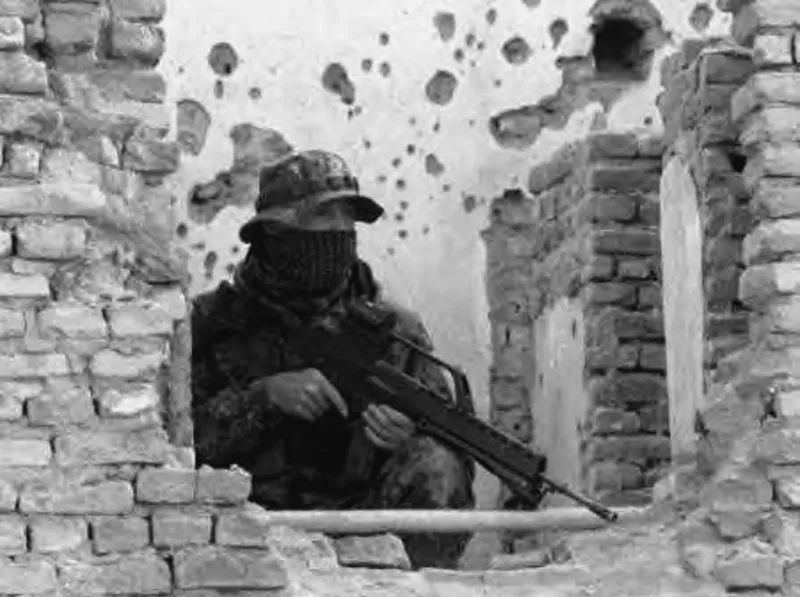
On guard: a soldier from Germany’s KSK Special Forces unit maintains a watchful eye. Note the bullet-ridden wall behind him.
The party’s leadership has insisted that Germany must stay the course. ‘If we leave Afghanistan now, the situation would only deteriorate,’[said] the Christian Democrats’ foreign policy spokesman Eckart von Klaeden … ‘Afghanistan would be reestablished as a haven for terrorists and Islamic extremists, and we would lose all credibility in the Muslim world.’ While the German Constitution, written in the wake of World War II, includes a ban on participating in any ‘war of aggression,’ … [in] Afghanistan, Germany has played a larger role, leading the peacekeeping force known as ISAF, which patrols the country’s north. But for the most part, it has refused to send soldiers to the restive south.
Mariah Blake, Christian Science Monitor, March 22, 2007
Prior to the spring of 2006, it all seemed to be going well in Afghanistan. Both the government and the media seldom discussed it. That was of course because we were too obsessed with Iraq and its problems at the time and believed that the war in Afghanistan had already been won, back in 2002. How wrong we were.
THE NEW TALIBAN
The only reason that things were quiet was the fact that the Taliban were lying low in Helmand Province, in southern Afghanistan, learning from the mistakes that had almost gotten them wiped out after 9/11. Now, they were both better trained and better equipped than ever before and in their newfound tactical awareness had taken to heart the bitter lessons of 2002 and were more than ready for payback time.
Elsewhere in Afghanistan, things were generally good. Women could now get an education and express themselves again, kids could go to school and mums and dads could start rebuilding their lives. As for the British, well, they never left Afghanistan after 2002, they just plodded on under the umbrella of Operation Herrick, the British contribution to the NATO-led International Security Assistance Force (ISAF) and to the US-led Operation Enduring Freedom (OEF). However, in 2003, the operation started to increase in scope, its geographical responsibilities growing, in contrast to the previous year, where the numbers of British soldiers committed had dropped right down to some 300 personnel. Prior to this, there had been Operation Veritas, the British support operation to the American invasion after 9/11, which climaxed with 1,700 Royal Marines of Task Force Jacana making a sweep of east Afghanistan after Operation Anaconda. And then there was Operation Fingal, a 2,000-strong contribution and leadership of a newly formed ISAF, and the overseeing of Afghan elections.
Between 2002 and 2003, the primary component of Operation Herrick were the 300 personnel assigned to provide security in Kabul, as well as training for the new Afghan National Army (ANA). In this role, they trained the NCOs, the French trained the officers, while the Americans trained the ordinary Afghan soldier. In mid 2003, the operational strength increased to battalion level, after two provincial reconstruction teams (PRTs) were established in north Afghanistan – one at Mazar-e-Sharif, and the other at Maymana. In addition, the British provided a rapid reaction force to Maymana after riots broke out in 2006 following the Danish Muhammad cartoons controversy. In late 2003, ISAF expanded into the north, accepting overall command of the PRTs in 2004, until Sweden and Norway took over them in 2005 and 2006 respectively. This transfer of responsibility was to allow UK forces to focus on their new role in south Afghanistan. Around the same time in May 2006, Lieutenant General David Richards became the appointed commander in Kabul of NATO Headquarters Allied Command Europe Rapid Reaction Corps (ARRC) raising military forces in Kabul alone to some 1,300 infantry and signals personnel. However, as great at this commitment looked at the time, it paled into insignificance when compared to the Helmand mission.
THE HELMAND MISSION
In January 2006, Defence Secretary Dr John Reid made his momentous and now infamous announcement that the UK would commit several thousand military personnel as part of a NATO PRT in Helmand for a period of some three years. This deployment had been in the offing for quite some time and formed part of ISAF’s gradual mission expansion from the Kabul region to the rest of Afghanistan. The British deployment was to be coordinated with fellow NATO countries as part of a plan to relieve the predominantly American-led Operation Enduring Freedom contingent in the south. In addition, forces from both the Netherlands and Canada also deployed to Oruzgan and Kandahar respectively in an effort to maximise combat effectiveness. In support of the British were contingents from both Denmark and Estonia, who sent some 400 troops collectively. But even with these extra numbers the forces would struggle.
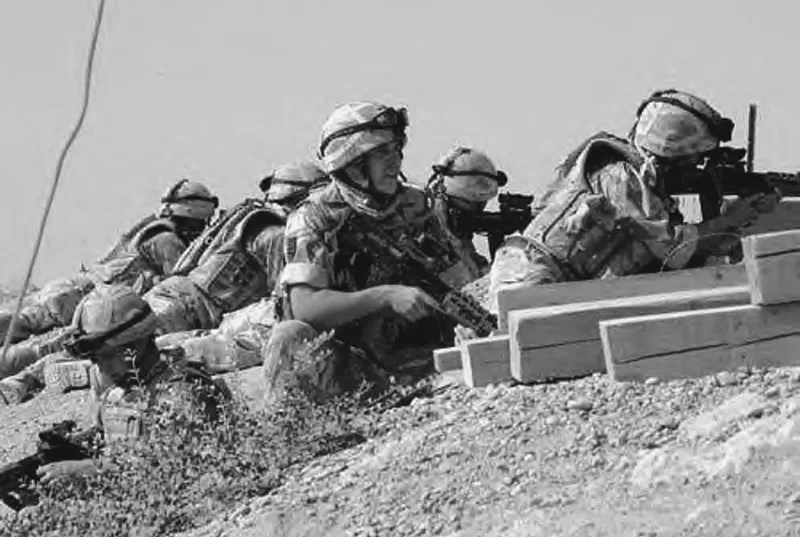
A Royal Marines Field Engineering unit takes cover after a Chinese-rocket attack on their position.
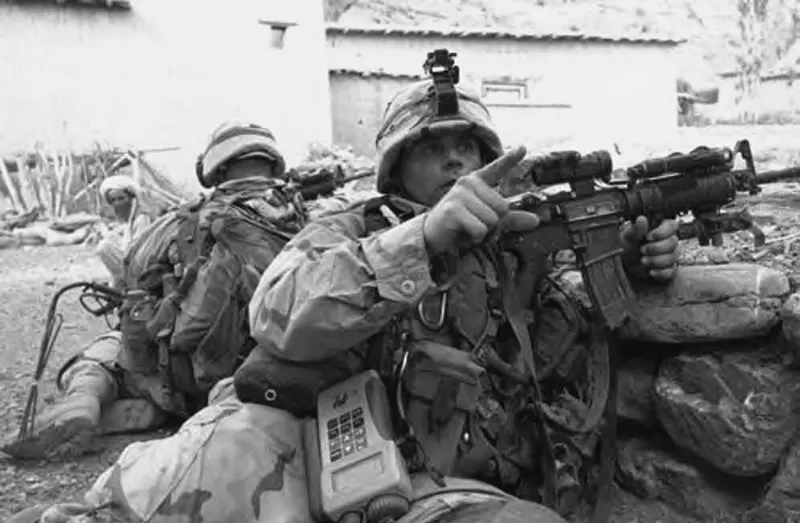
Soldiers from the mighty 82nd Airborne look out for enemy activity. Of interest is the satellite navigation system.
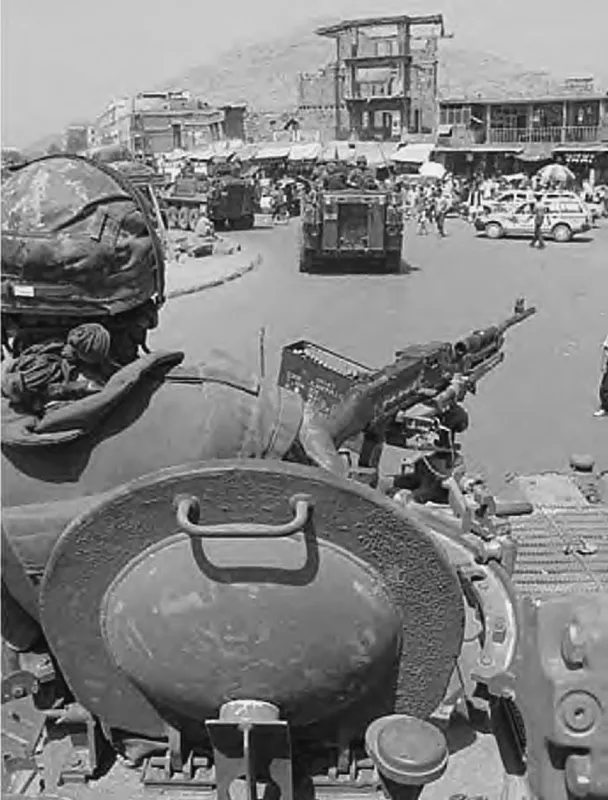
A Canadian armoured column slowly makes its way through the streets of Kabul, looking for combat indicators.
This is the UK’s current commitment to Helmand Province, but it is subject to change. At the time of writing, there have been two troop rotations, with the next one falling due in April 2007.
Operation Herrick IV (May–November 2006):
HQ, 16 Air Assault Brigade, Household Cavalry Regiment – 1 Sqn
3rd Battalion, The Parachute Regiment
7th (Parachute) Regiment, Royal Horse Artillery – 1 Bty
9th Regiment, Army Air Corps
32 Regiment, Royal Artillery – 1 Bty
39 Regiment, Royal Engineers
23 Engineer Regiment (Air Assault), Royal Engineers –
51 Parachute Squadron
51 Parachute Squadron
29 Regiment, Royal Logistics Corps
13 (Air Assault) Regiment, Royal Logistics Corps
7th Battalion, Royal Electrical and Mechanical Engineers
16 Close Support Medical Regiment
Operation Herrick V (November 2006–April 2007):
HQ, 3 Commando Brigade, The Light Dragoons – 1 Sqn
42 Commando, Royal Marines
45 Commando, Royal Marines
32 Regiment, Royal Artillery – 1 Bty
29 (Commando) Regiment, Royal Artillery
9th Regiment, Army Air Corps
28 Engineer Regiment, Royal Engineers
59 Independent Commando Squadron, Royal Engineers
Commando Logistics Regiment
27 Transport Regiment, Royal Logistics Corps
29 Regiment, Royal Logistics Corps
22 Field Hospital, Royal Army Medical Corps
Operation Herrick VI (April–October 2007):
HQ, 12 Mechanized Brigade, The Light Dragoons – 1 Sqn
1st Battalion, Grenadier Guards
1st Battalion, The Royal Anglian Regiment
1st Battalion, The Worcestershire and Sherwood Foresters
Regiment (29th/45th Foot)
Regiment (29th/45th Foot)
19 Regiment, Royal Artillery
3rd Regiment, Army Air Corps
9th Regiment, Army Air Corps
4 Logistic Support Regiment, Royal Logistic Corps
4 General Support Medical Regiment
Plus special forces support: the Special Air Service (SAS), Special Boat Service (SBS), Strategic Reconnaissance Regiment (SRR) and Special Forces Support Group (SFSG).
On paper at least, it looked an impressive force, as it involved elements of all of the British spearhead and special forces. But with a resurgent Taliban to fight, plus the ever-dragging millstone of Iraq draining resources and assets at a rapid rate, there were some ravens circling that no one saw.
It all seemed to have started off well enough, when a squadron of Royal Engineers, supported by Royal Marines, built two massive fortified camps, plus a small air base for the British, NATO and Afghan forces that were to be deployed in Helmand – and encountered no resistance from the Taliban, in spite of their making numerous threats to the contrary. This was the calm before the storm.The British Forward Operations Base (FOB) in Helmand was known as Camp Bastion. It soon became a hive of activity during the spring of 2006 as soldiers worked up their skills and check-fired their weapons in anticipation of forthcoming operations. They didn’t have to wait very long.
On May 1, the US Operation Enduring Freedom Task Force operating in Helmand was relieved of its command in a ceremony attended by the incoming British. Hours later, the Americans began a major offensive against the Taliban in southern Afghanistan, part of Operation Mountain Thrust. As a result of this operation, ISAF forces were now in open conflict with the Taliban. Initially all went well, but a slight setback occurred on May 24, when an RAF Hercules was destroyed in a fire soon after landing at Lashkar Gar, the capital of Helmand. Fortunately, all 27 passengers, including the British Ambassador Steven Evans, were evacuated safely. Apart from the Ambassador’s near-thing, there was another interesting aspect to this air...
Table of contents
- Cover
- Title
- Copyright
- Contents
- Dedication
- Acknowledgements
- Author’s Note
- Preface
- Abbreviations
- Introduction
- I Baiting the Bears
- II Avenging Angels
- III The Taliban
- IV The Devil’s Harvest
- V Hell from Above
- VI Chariots of the Damned
- VII Hurt Locker
- Conclusion
- The Fallen
- Picture Section
Trusted by 375,005 students
Access to over 1.5 million titles for a fair monthly price.
Study more efficiently using our study tools.
Frequently asked questions
Yes, you can cancel anytime from the Subscription tab in your account settings on the Perlego website. Your subscription will stay active until the end of your current billing period. Learn how to cancel your subscription
No, books cannot be downloaded as external files, such as PDFs, for use outside of Perlego. However, you can download books within the Perlego app for offline reading on mobile or tablet. Learn how to download books offline
Perlego offers two plans: Essential and Complete
- Essential is ideal for learners and professionals who enjoy exploring a wide range of subjects. Access the Essential Library with 800,000+ trusted titles and best-sellers across business, personal growth, and the humanities. Includes unlimited reading time and Standard Read Aloud voice.
- Complete: Perfect for advanced learners and researchers needing full, unrestricted access. Unlock 1.5M+ books across hundreds of subjects, including academic and specialized titles. The Complete Plan also includes advanced features like Premium Read Aloud and Research Assistant.
We are an online textbook subscription service, where you can get access to an entire online library for less than the price of a single book per month. With over 1.5 million books across 990+ topics, we’ve got you covered! Learn about our mission
Look out for the read-aloud symbol on your next book to see if you can listen to it. The read-aloud tool reads text aloud for you, highlighting the text as it is being read. You can pause it, speed it up and slow it down. Learn more about Read Aloud
Yes! You can use the Perlego app on both iOS and Android devices to read anytime, anywhere — even offline. Perfect for commutes or when you’re on the go.
Please note we cannot support devices running on iOS 13 and Android 7 or earlier. Learn more about using the app
Please note we cannot support devices running on iOS 13 and Android 7 or earlier. Learn more about using the app
Yes, you can access Battlefield Afghanistan by Mike Ryan in PDF and/or ePUB format, as well as other popular books in History & Military & Maritime History. We have over 1.5 million books available in our catalogue for you to explore.