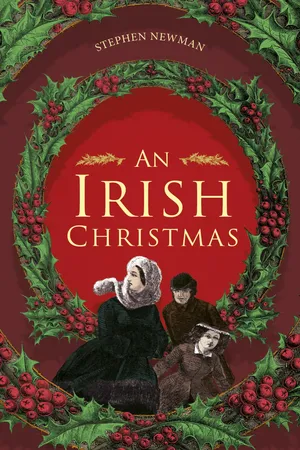
This book is a compendium of material, in English and Irish, on the festival of Christmas from the manuscripts of the National Folklore Collection recalling how Christmas was celebrated in the nineteenth and early twentieth century in all its regional diversity. The book begins with accounts of the Christmas preparations, before moving through Christmas Eve, with its fasting, feasting and a multitude of superstitions, Christmas Day, with its focus on the home and family, and on to the accounts of the communal celebration of St Stephen's Day with Wren Boys, games and hunting. Moving towards New Year's Day, the book recalls the optimism and fear associated with a transitional time when omens for the coming year were keenly observed, and finally concludes with accounts of the Little Christmas, also known as the Women's Christmas, celebrated on 6 January, and at which point the twelve-day festival comes to a close.
- 144 pages
- English
- ePUB (mobile friendly)
- Available on iOS & Android
eBook - ePub
An Irish Christmas
About this book
Information
Much like present times, it was on Christmas Eve that the festival began in earnest, and this was certainly the most ritualised day of the season. The Christmas story informed most customs, rituals and beliefs, especially as midnight approached, the time when it was believed Jesus was born. Interestingly, the account of Christmas Night, and the birth of Jesus, is relatively short in the New Testament with a far longer description of his death and resurrection. The interaction of the Christmas story with oral tradition has enhanced narrative strands over the centuries and has been continuously retold and reimagined within communities. In her article ‘Aifreann na Gine, Aifreann is Fiche’,1 Ríonach Uí Ógáin looks at the richness of lore associated with Christmas Eve. She notes, for example, that the folk imagination in Ireland has had a particularly strong engagement with the image of the Virgin Mary and Joseph seeking shelter in Bethlehem. As we will see, this part of the Christmas story is at the core of the candle rituals and is central to beliefs surrounding charity and generosity.
As families reunite for the festival, the collected material shows that stopping work was taken very seriously. It was almost taboo to engage in anything other than feeding animals and the necessary preparations for the Christmas dinner. All of the twelve days of Christmas were strictly observed as holidays and unnecessary work was commonly suspended until after 6 January. Michael Howard and Thomas Bolger from Kilrush recount the following:
Neither my three sons nor myself work from the Sunday before Christmas Day until after the Little Christmas. This was always the case amongst the tradesmen of the town. Not alone did painters stop work but also the coopers in Henry Street and the journeymen smiths who used to work at the three Smiths’ forges. (NFC 1391: 123; Michael Howard, Thomas Bolger, Kilrush, County Clare. Collector: Seán McGrath, January 1955.)
Niall Ó Dubhthaigh in Donegal emphasises the abstention from work throughout the festival:
Chuala mise m’athair mór á rá gur chuala sé a athair féin á rá ina chuid laethaibh óga san go mbíodh saoire ar an dá lá dhéag sin. Ní bhíodh obair thalamh nó sórt ar bith faoin spéir ag dul anseo nó i bparáiste ar bith eile thart fá dtaobh dúinn Lá Nollag. Bhíodh spórt agus greann agus imirt cluichí agus rudaí mar sin ag dul acu ach ní bheireadh siad arm ar bith ar scor lá oibre a dhéanamh. Bhíodh siad ar shiúil, ag iomáin, agus dá mbeadh aonach comhgarach bhíodh siad uilig aige. Bhíodh siad uilig ar shiúil a’ seilg fosta. Chasfaí baicle mhór de na buachaillí ar a chéile i mbaile éigin agus bheadh a gcuid cluichí iomána ansin acu agus gach sórt mar sin. Ansin nuair a thiocfadh an oíche bheadh a gcuid céilithe acu ins an chruth go mbeadh sean agus óg páirteach ins an ghreann a bhí ag dul ar aghaidh ar feadh an dá lá dhéag seo. Sin nuair a bhí na laethe glóracha ins an tír seo – i bhfad roimh bhliantaí an drochshaoil. ‘Sí bliain an drochshaoil an chéad rud a chuir maide ar an ghnás seo. Nuair a tháinig na bliantaí sin tháinig siad agus chuaigh siad thart agus ní raibh na daoine ariamh ó shoin chomh gleoiréiseach agus a bhí siad roimhe sin.
[I heard my grandfather saying that his own father told him that when he was young the twelve days of Christmas were always a holiday. No work of any sort was done here or in any parish around us during the Christmas period. There used to be sport, merriment and games and so on, but not a tool was lifted to do a day’s work. There used to be hurling and if there was a fair anywhere near they used to all attend. They used to go out hunting as well. A gang of boys would meet in some town and have their games of hurling. Then at night they’d have céilí dances, with young and old partaking in the merriment over these twelve days. These were the glory days in this country, long before the famine years. It was the year of the famine that put paid to such customs. These years came and went but the people were never as jolly again as they were before.] (NFC 932: 378–9; Niall Ó Dubhthaigh, Cloghaneely, County Donegal. Collector: Seán Ó hEochaidh, 1943.)
Mrs Bridget Hanratty of south Armagh gives a sense of the taboo surrounding work during Christmas:
Divil2 the work people done on the twenty-fourth. Not out in the fields. They’d do wee bits of turns about the place (house, yard and haggard3). ‘Ded,4 I mind5 people down the road here who would always start on Christmas Eve, an’ divil the much they were better of it. People always remarked it. Lawless they were. They’d start on that day to put out dung. It was always remarked. (NFC 1087: 123–4; Bridget Hanratty (90), Dromintee, County Armagh. Collector: Michael J. Murphy, December 1944.)
The weather would be keenly observed at this time with a number of superstitions surrounding it. The most common in the collection was the following:
They used to say that a ‘White Christmas meant a lean churchyard and a Green Christmas meant a fat churchyard.’ And ’twas true, as if there was very wet weather around the Christmas, a lot of people died. And we knew long ago what sort of weather to expect from the twelve days of the holidays, as they used to say: ‘For each day of Christmas, the following twelve months will suit.’ This meant that each of the Twelve Days were supposed to represent a month, and you could reckon on whether the following year would be wet or fine. (NFC 1391: 123; Tadhg Kelly, Kilrush, County Clare. Collector: Seán McGrath, January 1955.)
It was not uncommon in Irish folklore to believe that bad weather was a punishment for the behaviour of humanity on earth. In the following from Niall Ó Dubhthaigh, he appears to link the lack of white Christmases to the First World War (1914–18), which had also contributed to the general decline in prosperity among the people:
Tháinig athrach mór ar an Nollaig cinnte ó bhí mise mé féin óg. Nuair a bhí mé i mo ghasúr agus rachaimís taobh amuigh den doras, bhíodh an sneachta suas go dtí ár muineál orainn. Bhíodh achan nduine ag dréim agus bhíodh siad cinnte go mbeadh sneachta trom ann i dtráthaibh na Nollag. Agus ó bhí an Cogadh Mór deireanach ann d’imigh an sneachta agus d’imigh achan rud a raibh rath agus rathúnas ar bith air a bhaineas leis na daoine nó leis an tír. Tá sé canta ariamh go ndéan Nollaig ghlas reilig mhéith agus creidim féin go bhfuil seo fíor go leor. An geimhreadh nach mbíonn an sneachta ann fán Nollaig, bíonn mórán aicídeacha ag dul agus mórán daoine, sean agus óg, ag fáil bháis.
[Christmas has changed so much since I was young. When I was a child you’d go out the door and be up to your neck in snow. Everybody expected snow and were certain of heavy snow around Christmas. But since the last Great War, the snow has left, along with everything that provided wealth and prosperity to either the people or the country. It has always been said that a green Christmas leads to a fat graveyard and I believe this to be true. A Christmas without snow is full of illness, and results in the death of a lot of people, both young and old.] (NFC 932: 385; Niall Ó Dubhthaigh, Cloghaneely, County Donegal. Collector: Séan Ó hEochaidh, 1943.)
One aspect of Christmas Eve that has largely disappeared is the practice of fasting from early that morning until supper is served after dark. Bríghid Ní Aghartaigh, from County Donegal, describes it as follows, as heard from her grandmother: ‘Roimhe seo dhéanfadh an lá roimh Lá Nollag a throscadh. Ní íosfaí tadaí an lá sin ach trí ghreim arán coirce agus trí bholgam uisce ar maidin’ [Before now, the day before Christmas Day was always a fast day. Nothing would be eaten apart from three bites of oat bread and three mouthfuls of water]. (NFC 335: 136; Bríghid Ní Aghartaigh (30), Kilcar, County Donegal. Collector: Anna Ní Éigheartaigh, March 1936.)
In Kilrush the day itself was austere, with fasting and confession:
As long as I remember Christmas Eve was always a fast day, and workmen, immediately they finished work at noon, went straight to confession. They had a tea dinner, as they used to call it, tea and bread and jam, when they came home. (NFC 1391: 127; Tone O’Dea, Kilrush, County Clare. Collector: Seán McGrath, January 1955.)
Bríghid Ní Ruairc from County Cork describes the fast and the meal they enjoyed that night:
On Christmas Eve you’d get nothing to eat from breakfast – which was potatoes and dip (dip made of milk, salt and pepper, or usually grey water, salt and pepper, owing to the scarcity of milk) – until about 7pm, when the first supper was served. For this we had potatoes, fish (hake) and sauce made of milk and flour mixed together and boiled. The late supper, about 10.00pm, consisted of bread, butter, tea and currant cake. If any of us fell asleep before the last supper on Christmas Night, my father used say: ‘Éirígí as san nó gheobhaidh sibh an mol.’ [Give that up or you will get the ‘mol’]. The ‘mol’ was some fine fat sheep they had in heaven. Whiskey, porter and wine were drunk after the last supper. (NFC 1084: 160; Bríghid Ní Ruairc (70), Bantry, County Cork. Collector: Conchubhair Ó Ruairc, 1945.)
In Donegal the evening meal brought the fast to an end:
Sé an gnás anseo an dinnéar a ithe i dtráthaibh a haon a chlog sa lá. Ba é an gnás a bhí ann an dinnéar a chur chun moille go dtí an tráthnóna troscadh Oíche Nollag Mór. D’fhanachtaí insan am sin leis an chlapsholas go mbeadh achan nduine don teaghlach sa bhaile. Nuair a shuífí isteach chuig an tsuipéar ansin, dà mbeadh fear an tí beo choisreodh sé an bia. Cha raibh paidir nó rud ar bith speisialta aige a déarfadh sé ach go n-iarrfadh sé ar Dhia gan an teaghlach a laghdú – ‘go méadaí Dia ár gcuid agus ár gcuideachta,’ a déarfadh sé. Dá mbeadh an t-athair marbh nó ar shiúil, ‘sí an mháthair nó bean an tí a déarfadh seo. Idir sin agus an luí bíonn tae agus achan sórt is fearr ná a chéile ag na daoine anois, ach ins an tseanam, ní raibh iomrá ar bith ag na créatúir a bhí ann ar an milsíneacht atá ag dul ar na blianta deireanacha seo anois.
[The custom here is to eat dinner around one o’clock. But on Christmas Eve, due to the fast, it was delayed until evening. We waited until twilight when every member of the household would be at home. When we’d sit down to eat, it was the man of the house, if he were still alive, who would bless the food. There was no special prayer or words but he would ask God not to take anybody from the household – ‘may God increase our lot and our company,’ he would say. If the father was dead or away, the mother or the woman of the house would say the prayer. Before bedtime people have tea and a variety of treats. In the old days people never heard tell of all the sweet things available in recent years.] (NFC 932: 399–400; Niall Ó Dubhthaigh, Cloghaneely, County Donegal. Collector: Seán Ó hEochaidh, 1943.)
The following account is from Kilronan, on the Aran Islands:
Is lá troscaidh é an 24ú, ‘sé sin tá bigil ar an lá ach níl sé dian. Tá dhá shuipéar ins gach teach ar Oíche Nollag; le haghaidh an chéad shuipéir, tar éis na gcoinnlí a lasadh, tá fataí agus iasc, searc úr más féidir ach is annamh is féidir, nó searc saillte, ballach, mangach, bréim nó langa is fearr leo. Ní cheapfaí go mbeadh ronnach saillte sách gnaíúil don ócáid. Cuirtear príáil air nó anlann; tá an príáil déanta as bainne bruite ina mbíonn plúr leáite, oinniún agus gráinne beag siúcra. Fadó, d’ithtí an béile seo thíos ag an tine agus na fataí sa cheiseog agus a phláta féin ag chuile dhuine ar a ghlúinibh. Isteach ag an mbord anois é anseo. Tamall ina dhiaidh sin leagtar an bord i lár urláir na cistine. Bíonn cístí milse déanta le cúpla lá roimhe sin agus cuirtear ar an mbord iad in éindí le subh, im srl. Tá pota mór tae déanta agus ólann agus itheann chuile dhuine a sháith. Roimh an dara suipéar deirtear: ‘go mbeirimid beo ar an am seo arís.’
[The 24th is a fast day; there is a vigil but not a strict one. There are two suppers in every house on Christmas Eve. For the first supper, after lighting the candles, there is potatoes and fish, fresh shark if possible, though it rarely is, or salted shark. They prefer wrasse, pollock, bream or tangle. Salted mackerel wouldn’t be deemed appropriate for the occasion. A sauce or soup, made from boiled milk mixed with flour, onion and a small grain of sugar, was also served. Long ago this meal was eaten down by the fire, with the potatoes in a basket, and every...
Table of contents
- Cover
- Title
- Copyright
- Contents
- Introduction
- One: Preparation and Decoration
- Two: Christmas Eve
- Three: Christmas Day
- Four: St Stephen’s Day and the Day of the Holy Innocents
- Five: The New Year and Epiphany
- Notes
- Acknowledgements
Trusted by 375,005 students
Access to over 1.5 million titles for a fair monthly price.
Study more efficiently using our study tools.
Frequently asked questions
Yes, you can cancel anytime from the Subscription tab in your account settings on the Perlego website. Your subscription will stay active until the end of your current billing period. Learn how to cancel your subscription
No, books cannot be downloaded as external files, such as PDFs, for use outside of Perlego. However, you can download books within the Perlego app for offline reading on mobile or tablet. Learn how to download books offline
Perlego offers two plans: Essential and Complete
- Essential is ideal for learners and professionals who enjoy exploring a wide range of subjects. Access the Essential Library with 800,000+ trusted titles and best-sellers across business, personal growth, and the humanities. Includes unlimited reading time and Standard Read Aloud voice.
- Complete: Perfect for advanced learners and researchers needing full, unrestricted access. Unlock 1.5M+ books across hundreds of subjects, including academic and specialized titles. The Complete Plan also includes advanced features like Premium Read Aloud and Research Assistant.
We are an online textbook subscription service, where you can get access to an entire online library for less than the price of a single book per month. With over 1.5 million books across 990+ topics, we’ve got you covered! Learn about our mission
Look out for the read-aloud symbol on your next book to see if you can listen to it. The read-aloud tool reads text aloud for you, highlighting the text as it is being read. You can pause it, speed it up and slow it down. Learn more about Read Aloud
Yes! You can use the Perlego app on both iOS and Android devices to read anytime, anywhere — even offline. Perfect for commutes or when you’re on the go.
Please note we cannot support devices running on iOS 13 and Android 7 or earlier. Learn more about using the app
Please note we cannot support devices running on iOS 13 and Android 7 or earlier. Learn more about using the app
Yes, you can access An Irish Christmas by Stephen Newman in PDF and/or ePUB format, as well as other popular books in History & Irish History. We have over 1.5 million books available in our catalogue for you to explore.