The First World War claimed over 995,000 British lives, and its legacy continues to be remembered today.Great War Britain: Manchester offers an intimate portrayal of the city and its people living in the shadow of the Great War. A beautifully illustrated and highly accessible volume, it explores the city's regiments, the background and fate of the men on the frontline, the changing face of industry, the vital role of women, conscientious objectors, hospitals for the wounded and rehabilitation, peace celebrations, the fallen heroes and war memorials. The Great War story of Manchester is told through the voices of those who were there and is vividly illustrated with evocative images.
- 126 pages
- English
- ePUB (mobile friendly)
- Available on iOS & Android
eBook - ePub
Great War Britain Manchester: Remembering 1914-18
About this book
Information
1
MANCHESTER IN 1914
In the summer of 1914, Manchester, like many other cities across the country, was a place of contrasts. After a century and a half of economic growth it was a showcase of wealth and opportunity, with fine civic buildings, grand offices and prestigious warehouses, along with impressive railway stations and the Ship Canal, which united Manchester and Salford to the sea, and to the vast markets of the world.
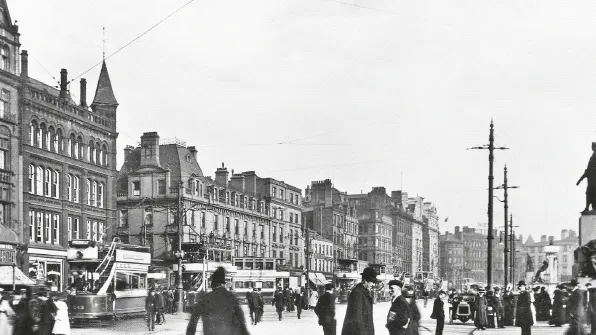
Piccadilly, early twentieth century.
Those decades of industrial enterprise are recorded for all to see across the city. In the Town Hall the names and coats of arms of the principle cities and countries which traded with Manchester are proudly displayed, while the day-to-day business of commerce operated in the bustling exchanges where commodities were bought and sold and commercial intelligence was shared. The city owed much to the textile industry but was also a centre of engineering and metal work, had its own deep shaft colliery and was home to countless smaller businesses specializing in everything from shipping insurance to tobacco manufacturers.
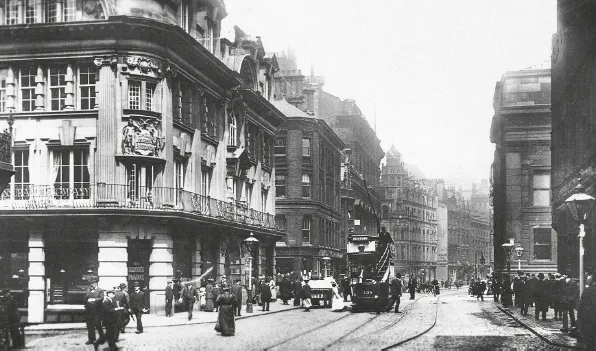
Cross Street, early twentieth century.
But less than a mile from all this glittering and solid evidence of success were the narrow streets, dark alleys and run-down parts of the city where ‘poverty still busied itself’.1 Manchester no longer had the slums which social observers Dr Kay and Frederick Engels had recorded in the early to mid nineteenth century, but there was still much that was grim and daunting.
The estimated total population of Manchester in 1914 was 731,830, and of that 210,494 were men between the ages of 15 and 45 years.
In 1904, a report on housing conditions drew attention to the ‘many houses at present occupied [which] are unwholesome, because they have been badly built or are in need of repair. Such houses are frequently damp and cold. Many of them are old and dirty.’ These suffered from a lack of basic sanitation and ventilation. Added to which, ‘many of them have too many people living in them for the size and number of rooms’ with rents ‘on average very little lower than those paid for good houses in other parts of the town.’2
Market Street, early twentieth century.
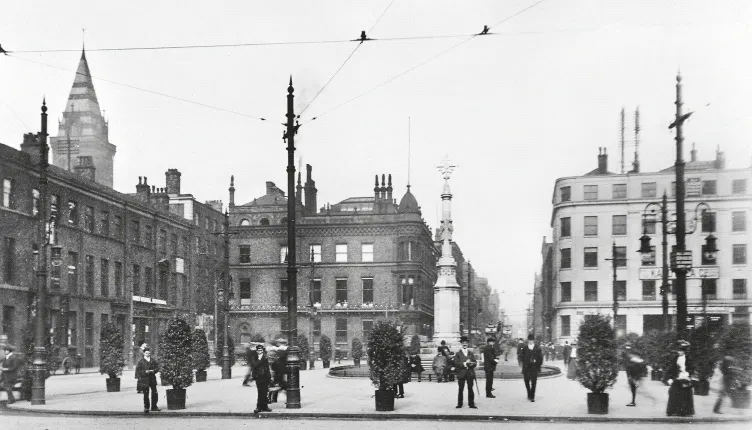
St Peter’s Square, early twentieth century.
The report focused on parts of Ancoats, Ardwick, Hulme, and Chorlton-on-Medlock as well as Salford, where life at the turn of the century was still an unpredictable struggle to make ends meet and where unemployment, illness or the death of the main wage earner could pitch a family into destitution and the workhouse.
In 1911 a full 9 per cent of young people in Manchester between the ages of 10 and 14 were at work, which in the case of boys rose from just 1 per cent of those aged 10-12 to 30 per cent by their 14th birthday.
Looking at the list of charities is to appreciate just how many of the poor citizens of Manchester might be forced into asking for help. They ranged from the Ragged School, through to those for ‘Destitute Women’ and ‘Inebriate Women’, to a vast array of night shelters and asylums, as well as support groups for ex-prisoners and army veterans. In 1911 there were twenty-nine orphanages and homes for children across the city, along with the Open All-Night Children’s Shelter, the St Vincent’s Night Shelter and Home for Girls, and the fourteen centres operated by the Manchester and Salford Boys’ and Girls’ Refuges and Homes, which had been established in 1870 to provide a bed and meal for homeless young boys but quickly expanded to provide much more.3 This included long-stay accommodation, training for work, as well as campaigning against the use of children as cheap labour and prosecuting neglectful parents.
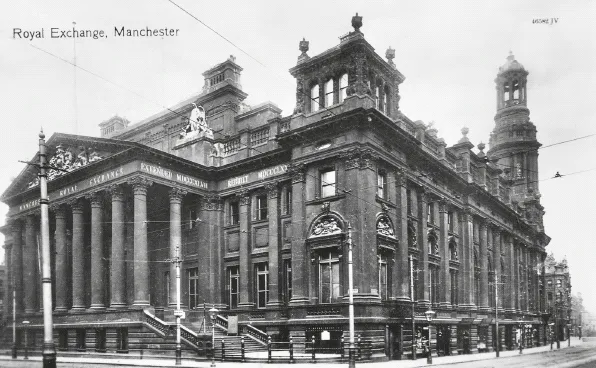
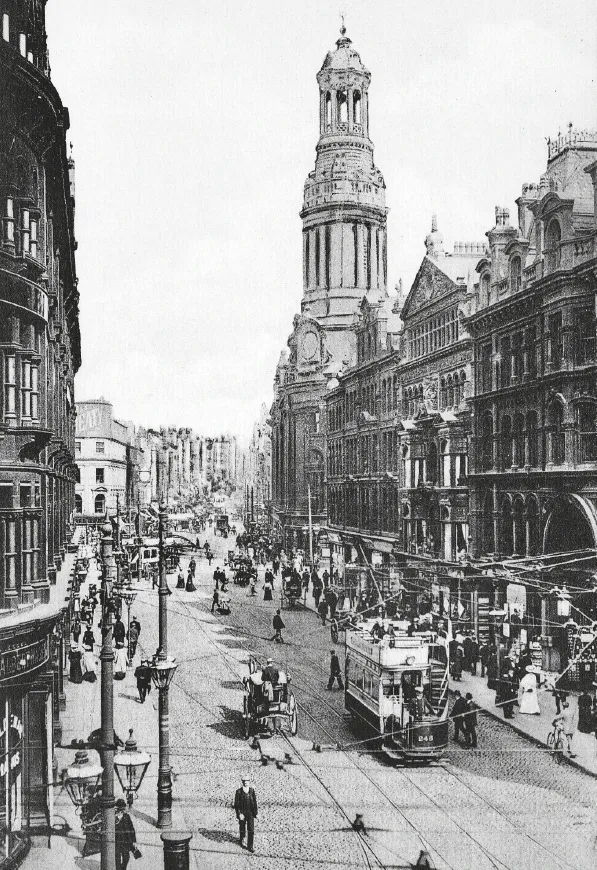
The Royal Exchange, early twentieth century.
OUT ON THE TOWN
The city offered plenty in the way of attractions, ranging from open-air spaces to theatres, art galleries and cinemas. At the most basic level there were fifty-seven recreational grounds, from the small space in Chorlton-cum-Hardy which covered 2 acres with a children’s play space and neatly laid flower beds broken by expanses of grass, to the Marie Louise Gardens which had over 4 acres and was described as a haven of tranquillity.
There were also the big parks. On the northern side of the city there was Heaton Park and Queen’s Park, and at the southern end there was Platt Fields in Fallowfield and Alexandra Park in Moss Side.
The city boasted forty-two halls and assembly rooms offering everything from debates and lectures to music recitals. The discerning member of the public might sit one day in the grand surroundings of Manchester Town Hall and on another in the equally impressive Free Trade Hall on Peter Street, or travel across town by Corporation tram to the Independent Labour Party Hall in Gorton, and, on a whim, attend an event in the modest room of the Conservative Association on Burton Road in West Didsbury.
If you just wanted a night out there was a clutch of theatres or music halls, some bigger than others and some more prestigious. They might have included the Palace Theatre of Varieties on Oxford Street, the Hippodrome at Hulme or the Empire at Ardwick Green, and of these your fancy might well have been taken by ‘What Price London? A revue in three scenes with a full company of 40 artistes’ at the Empire during early July 1914.
Just two months later and with the war well underway the entertainment reflected the changed situation. The Hippodrome on Oxford Street staged ‘a Grand Patriotic Scene: Soldiers of the King’ while Belle Vue staged ‘the Grand spectacle of the Battle of Kandahar’. During the war ‘admission was 6d All Day Every Day’. These may have seemed quite tame compared to the attractions of the new picture houses. The Deansgate could seat 1,500 and through April 1914 their rivals on Market Street and Oxford Road were ‘full to the doors with hundreds waiting for admission’.
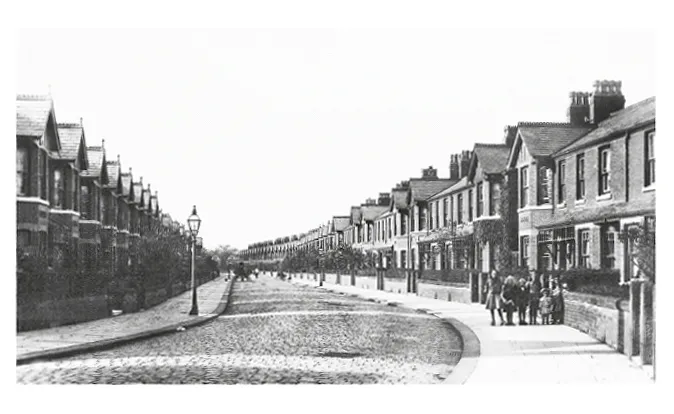
Nicholas Road, Chorlton; one of the new suburbs, c. 1914.
With the uncertainty of war, work was rapidly diminishing, with some warehouses closing early and employers exploring short-time work. Many dockers were unable to get work and it was feared that the number of unemployed would increase daily.
Life expectancy amongst male manual workers was still low, and child labour was common in factories. Against this there was a steady rise in the cost of food and fuel, while wages failed to keep pace, culminating in a wave of strikes which swept the country. During 1911 and into 1912, carters, labourers in the engineering works, municipal workers and railwaymen all came out on strike in Manchester.
The city was also at the forefront of the campaign to extend the franchise which Mrs Annot Robinson – a well known and respected campaigner for women’s rights and social justice for all – argued was about empowering women to allow ‘them to have some share of political power’, pointing out that in Manchester girls worked long hours for just six, seven, or eight shillings a week, and in the mackintosh trade wages sank below even that. ‘It was this underpayment of girls that incited them to evil living. If women were given an opportunity of influencing the laws of the land matters would be mended.’4
Sandwiched between these extremes of wealth and poverty were those who made their living from a range of professional and clerical occupations and could afford to move to the more comfortable suburbs south of the city, which were close to the countryside but within easy reach of the city centre.
This exodus had started as early as the 1830s but began in earnest in the last quarter of the nineteenth century, made possible by the provision of mains water, improved sanitation and gas supplies and helped further by new railway links and the expansion of the Corporation tram network. It was a development which prompted the Manchester Evening News to report that ‘the green fields of one summer are the roads and avenues of the next.’5 These suburban houses ranged from the tall semi-detached properties which could be rented for between £25 and £35 a year down to the ‘six shilling a week homes ... modest four-roomed houses with plenty of breathing space’.6
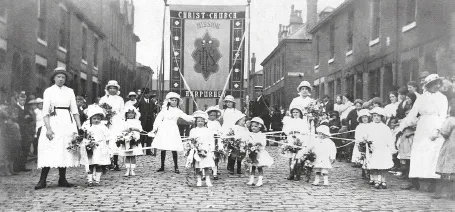
Children preparing for a procession from Harpurhey – possibly a Whit Walk – in the early 1900s.
These new communities were supported by their own shopping centres and a wide range of cultural and...
Table of contents
- Cover
- Title
- Copyright
- Contents
- Timeline
- Acknowledgements & Picture Credits
- Introduction: A Century On
- 1. Manchester in 1914
- 2. Adjusting to War
- 3. Digging Deep
- 4. Life on the Home Front
- 5. Armistice
- 6. Legacy
- 7. Postscript
- About the Author
- Bibliography
Trusted by 375,005 students
Access to over 1.5 million titles for a fair monthly price.
Study more efficiently using our study tools.
Frequently asked questions
Yes, you can cancel anytime from the Subscription tab in your account settings on the Perlego website. Your subscription will stay active until the end of your current billing period. Learn how to cancel your subscription
No, books cannot be downloaded as external files, such as PDFs, for use outside of Perlego. However, you can download books within the Perlego app for offline reading on mobile or tablet. Learn how to download books offline
Perlego offers two plans: Essential and Complete
- Essential is ideal for learners and professionals who enjoy exploring a wide range of subjects. Access the Essential Library with 800,000+ trusted titles and best-sellers across business, personal growth, and the humanities. Includes unlimited reading time and Standard Read Aloud voice.
- Complete: Perfect for advanced learners and researchers needing full, unrestricted access. Unlock 1.5M+ books across hundreds of subjects, including academic and specialized titles. The Complete Plan also includes advanced features like Premium Read Aloud and Research Assistant.
We are an online textbook subscription service, where you can get access to an entire online library for less than the price of a single book per month. With over 1.5 million books across 990+ topics, we’ve got you covered! Learn about our mission
Look out for the read-aloud symbol on your next book to see if you can listen to it. The read-aloud tool reads text aloud for you, highlighting the text as it is being read. You can pause it, speed it up and slow it down. Learn more about Read Aloud
Yes! You can use the Perlego app on both iOS and Android devices to read anytime, anywhere — even offline. Perfect for commutes or when you’re on the go.
Please note we cannot support devices running on iOS 13 and Android 7 or earlier. Learn more about using the app
Please note we cannot support devices running on iOS 13 and Android 7 or earlier. Learn more about using the app
Yes, you can access Great War Britain Manchester: Remembering 1914-18 by Andrew Simpson in PDF and/or ePUB format, as well as other popular books in History & British History. We have over 1.5 million books available in our catalogue for you to explore.