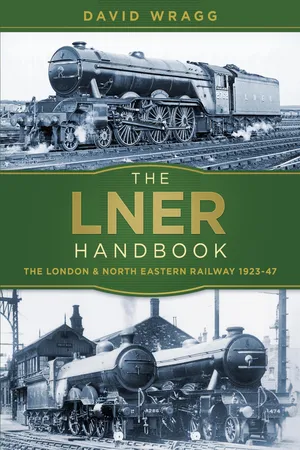
Renowned for its express locomotive Mallard setting a world speed record (126mph) for steam locomotives that endures to this day, the London & North Eastern Railway was the second largest of the 'Big Four' railway companies to emerge from the 1923 grouping and also the most diverse, with its prestigious high-speed trains from King's Cross balanced by an intensive suburban and commuter service from Liverpool Street and a high dependence on freight. Noted for its cautious board and thrifty management, the LNER gained a reputation for being poor but honest. Forming part of a series, along with The GWR Handbook, The LMS Handbook and The Southern Railway Handbook, this new edition provides an authoritative and highly detailed reference of information about the LNER.
- 101 pages
- English
- ePUB (mobile friendly)
- Available on iOS & Android
eBook - ePub
About this book
Information
Chapter 1
The Ancestors and the Neighbours
The London & North Eastern Railway was the second largest of the ‘Big Four’ (after the London Midland & Scottish Railway (LMS)), these being the railway companies that emerged as a result of the Railways Act 1921. This combined more than a hundred railway companies into just four companies: the LNER, LMS, GWR and Southern Railway. This was no foregone conclusion, however, as the original proposals for Grouping the railways envisaged seven companies rather than four, and a clue that the LNER might not have been a single railway lies in the fact that after Nationalisation it was split into three regions of the new British Railways (Eastern, North Eastern and Scottish). The original Railways Bill envisaged Scotland having a separate railway company while the other six companies would cover England and Wales. It was only after strong objections from Scotland that a Scottish railway company would have to raise fares and goods charges more than Anglo-Scottish companies, that the decision was taken to form what would eventually be the LNER and its West Coast counterpart, the LMS. The government’s original plans would have seen a ‘North-Eastern’ company rather than a London & North Eastern and Scottish business. In many ways, the original plan for the railways was what was foisted on them on Nationalisation when once again, a separate Scottish Region was introduced.
The story becomes even more complicated when one takes into account that at one time, a merger between the Great Northern and Great Central was mooted, but did not go ahead leaving the latter company to overstretch its resources building its own route to London, and also creating Marylebone, the last of the London termini to be built. Early in the 20th century, in 1909, Parliament refused to approve a merger in the east of England, involving the Great Northern, Great Eastern and Great Central companies, but after the First World War, it pressed ahead and insisted on an even more extensive merger to create what became the LNER. The 1909 merger of the three companies was actually intended to be a measure to eliminate wasteful competition and amalgamate receipts, leaving the individual companies to manage their own railways. This is perhaps why Parliament rejected the idea, as the railway companies were seen as strong regional monopolies with competition only at the fringes.
It is also worth speculating on whether the first stage would have led to a merged management of the three companies along the lines of the South Eastern & Chatham Management Committee. The point is, of course, that Parliament rejected a limited step towards a merger in 1909, but in 1921 forced through an even bigger merger of the railway companies.
To some extent, Grouping was a policy adopted in lieu of nationalisation, which had become a matter of debate before the First World War. It was also meant to rationalise the railways and curb competition while also exerting greater control over them, but it allowed the London Tilbury & Southend Railway to pass to the LMS, perpetuating competition on the busy lines between London and Southend. This was one of the drawbacks of the Railways Act 1921: it did not allow for reallocation of routes or territory, and in failing to do so, made the job of efficient management more difficult. There were former North British lines in the Western Highlands of Scotland that could have been better as LMS territory, or Great Central lines around Wrexham that could have gone to the Great Western or, if as some believe, the former Cambrian Railway should have been passed to the LMS, then so too should these routes, even though it would have made an overlarge and unwieldy railway even more so.
The London & North Eastern Railway’s constituent companies were:
Great Central Railway
Great Eastern Railway
Great North of Scotland Railway
Great Northern Railway
Hull & Barnsley Railway
North British Railway
North Eastern Railway
The subsidiaries included:
Brackenhill Light Railway
Colne Valley & Halstead Railway (not taken over until 1 July 1923)
East & West Yorkshire Union Railway (not taken over until 1 July 1923)
East Lincolnshire Railway
Edinburgh & Bathgate Railway
Forcett Railway
Forth & Clyde Junction Railway
Gifford & Garvald Railway
Great North of England Railway
Clarence & Hartlepool Junction Railway
Horncastle Railway
Humber Commercial Railway & Dock
Kilsyth & Bonnybridge Railway
Lauder Light Railway
London & Blackwall Railway
Mansfield Railway
Mid-Suffolk Light Railway
Newburgh & North Fife Railway
North Lindsey Light Railway
Nottingham & Grantham Railway
Nottingham Joint Station Committee
Nottingham Suburban Railway
Seaforth & Sefton Junction Railway
Stamford & Essendine Railway
West Riding Railway Committee
Under Grouping, the plan was simply to create a ‘North Eastern, Eastern and East Scotland’ railway company and it took all of 1922 for appointments and structures to be agreed. As with the other grouped companies, the companies absorbed were defined either as constituent companies, which meant that they had a director on the board of the new company, or as subsidiary companies.
The Constituent Companies
Great Central Railway
The last mainline railway to reach London, the Great Central Railway, was the new name coined for the Manchester Sheffield & Lincolnshire Railway to celebrate its transition from a trans-Pennine railway, when it opened its new line to London in 1899 with a new terminus at Marylebone. The company had its origins in the Sheffield Ashton-under-Lyne & Manchester Railway, opened in 1845, and which had required construction of the Woodhead Tunnel, 3 miles long through the Pennines and at the time, the longest in the UK. The SAMR acquired three railway companies and the Grimsby Docks Company in 1847, to form the Manchester Sheffield & Lincolnshire Railway (MSLR). The company continued to prosper, and in 1863 it entered the South Yorkshire coalfield through the acquisition of the South Yorkshire Railway. Expansion westward lay in the creation of the Cheshire Lines Committee with the Great Northern Railway and the Midland Railway. This gave the MSLR access to North Wales and to the port of Liverpool. Earlier alliances involved the London & North Western, Lancashire & Yorkshire and East Lancashire, as well as the Midland, in what was known as the Euston Square Confederacy, but this was dissolved in 1857 and replaced with a 50-year agreement with the Great Northern Railway, hitherto viewed as a rival.

Former Great Central inspection saloon No. 1234 at Dukinfield yard in 1924, before it was painted in LNER livery. (HMRS ABZ 112)
In 1864, a new chairman, Sir Edward Watkin, was appointed. This was just one of his railway chairmanships and he was an early advocate of a Channel tunnel. His other ambitions included taking the MSLR to London, and the company embarked on a period of expansion at the cost of its profitability, with no ordinary dividends paid after 1889. The London Extension was widely regarded as wasteful, with centres such as Nottingham, Leicester and Rugby already having good links to London, and was achieved by building a new line from Annesley in Nottinghamshire to Quainton in Buckinghamshire, and then running over a joint line with another Watkin company, the Metropolitan Railway, and from that a short line to the new terminus at Marylebone, to which the headquarters was moved from Manchester in 1905. Perhaps not surprisingly, the nickname for the MSL became ‘Money Sunk and Lost’, but the Great Central was little better, for all of its ambitions, as it was known as ‘Gone Completely’.
During this period, expansion was also helped by the acquisition of the Lancashire Derbyshire & East Coast Railway in 1907.
A new chairman in 1899, Alexander Henderson (later Lord Faringdon), appointed Sir Sam Fay as general manager in 1902, and he was joined that year by John G. Robinson, who had trained at Swindon. Robinson started to equip the GCR with powerful new locomotives, built at the company’s Gorton Works, Manchester, as well as comfortable new carriages. It was amongst the first railways to use bogie goods vehicles, and in 1907, one of the first hump marshalling yards at Wath in the South Yorkshire coalfield proved capable of sorting 5,000 goods wagons in 24 hours. A new port was built at Immingham, which allowed expansion of the company’s Humber shipping services, and when opened by King George V in 1912, Fay was publicly knighted. The port included an innovation when the Grimsby District Light Railway, which was opened in 1912 by the GCR to serve the new port, was electrified, but this was effectively a 4½-mile tramway with 16 single-deck tramcars drawing 500V dc power from overhead wires, and not connected to the rest of the GCR.
Elsewhere, power signalling was also introduced. Under Fay, the company expanded its through passenger services. There were also trials of steam and petrol-electric railcars, while a second route to London via High Wycombe was built jointly with the GWR. Nevertheless, despite the work on passenger services, 67 per cent of its turnover came from goods traffic and just 22 per cent from passengers.
The First World War ended expansion, and while three ships were seized in Continental ports by the Germans, the rest were requisitioned for the Royal Navy. Robinson saw his 2-8-0 heavy goods locomotive adopted as the standard for War Office use overseas, while Fay became director of movements at the War Office from 1916 until the end of the war.
Great Eastern Railway
The Great Eastern Railway was formed in 1862 on the long overdue amalgamation with three railways which were being worked by the Eastern Counties Railway, the East Anglian, Eastern Union; East Suffolk & Norfolk railways. The new GER gave East Anglia a single unified railway network east of Cambridge, but even so, relations between the companies were such that it took four years before the finances could be rationalised, and by that time, 1866, during the banking and railway finance crisis, the new company was forced briefly into liquidation. Nevertheless, the company had already purchased land in the City of London for a new terminus to replace the inconveniently sited Bishopsgate.

An unusual feature of the ex-GER Y5 class 0-4-0ST was that the coal was carried on top of the saddle tank. This view at Stratford carriage works in 1947 shows No. 8081. (HMRS ABT 114)
Lord Cranbourne, who later became Marquess of Salisbury, became chairman in 1868, and the GER began to move forward. The new Liverpool Street station opened during 1874–75, the last terminus to open in the City, and only permitted because it was approached in tunnel. By this time the GER also had a dense network of suburban lines in north-eastern London.
The GER inherited a broad spread of business, with extensive commuter traffic, albeit working class and less prosperous than that of the lines to the south; goods and passenger traffic to five ports (Felixstowe, Harwich, King’s Lynn, Lowestoft and Yarmouth), with the last two providing heavy fish traffic for London and the Midlands; holiday traffic, especially to Clacton, Lowestoft, Southend and Yarmouth; race traffic to and from Newmarket, and agricultural traffic, although this declined during the 1870s and 1880s with a crisis in Britain’s arable farming. Later, it developed coal traffic from Yorkshire to East Anglia when a line was opened in 1882 jointly with the Great Northern from south of Doncaster through Lincoln and Spalding to March. Although mishandled at first, from 1883 onwards, the GER also operated steam packet services, mainly to the Netherlands.
Despite the race and Continental traffic, the company suffered from a mass of low-fare business, and because of this, in 1872 it followed the Midland Railway by providing third-class accommodation on all passenger trains. In 1891, it was the first to provide restaurant car accommodation for third-class passengers. The company gained a reputation for punctuality and efficiency, although it struggled to cope with its peak period commuter traffic. The pressure on peak traffic declined sharply from 1901 after electric trams appeared in the East End of London, and the cost of electrification meant that it was rejected, even though the GER obtained Parliamentary powers as early as 1903.
For goods traffic, in 1899, its goods yard at Spitalfields, London, was the first in the UK to have electro-pneumatic power operation. Main line services were recast in 1914 by a new general manager, the American Henry Thornton, and after the First World War he did the same for the suburban services. The company was amongst the first to use distinctive stripes on its carriages to identify classes, with first having yellow lines and second blue, which earned them the title of the ‘Jazz Trains’.
In the meantime, a number of independent branch lines had been built in GER territory, while west of King’s Lynn several lines had ...
Table of contents
- Cover
- Title
- Copyright
- Contents
- Acknowledgements
- Preface
- Introduction to the 2017 Edition
- Introduction
- Chapter 1 The Ancestors and the Neighbours
- Chapter 2 The London Termini
- Chapter 3 LNER Destinations
- Chapter 4 Building a New Railway Company
- Chapter 5 The Managers
- Chapter 6 Steam Locomotives at the Grouping
- Chapter 7 Atlantic to Pacific
- Chapter 8 The Streamliners
- Chapter 9 Electrics and Diesels
- Chapter 10 The Named Expresses
- Chapter 11 Carrying the Goods
- Chapter 12 The Passenger Business
- Chapter 13 Publicity
- Chapter 14 The Record Setters
- Chapter 15 Shipping
- Chapter 16 Road Transport
- Chapter 17 Accidents
- Chapter 18 The Infrastructure
- Chapter 19 Railways at War
- Chapter 20 Under Attack
- Chapter 21 Peace and Nationalisation
- Chapter 22 What Might Have Been
- Appendices
- Bibliography
Trusted by 375,005 students
Access to over 1.5 million titles for a fair monthly price.
Study more efficiently using our study tools.
Frequently asked questions
Yes, you can cancel anytime from the Subscription tab in your account settings on the Perlego website. Your subscription will stay active until the end of your current billing period. Learn how to cancel your subscription
No, books cannot be downloaded as external files, such as PDFs, for use outside of Perlego. However, you can download books within the Perlego app for offline reading on mobile or tablet. Learn how to download books offline
Perlego offers two plans: Essential and Complete
- Essential is ideal for learners and professionals who enjoy exploring a wide range of subjects. Access the Essential Library with 800,000+ trusted titles and best-sellers across business, personal growth, and the humanities. Includes unlimited reading time and Standard Read Aloud voice.
- Complete: Perfect for advanced learners and researchers needing full, unrestricted access. Unlock 1.5M+ books across hundreds of subjects, including academic and specialized titles. The Complete Plan also includes advanced features like Premium Read Aloud and Research Assistant.
We are an online textbook subscription service, where you can get access to an entire online library for less than the price of a single book per month. With over 1.5 million books across 990+ topics, we’ve got you covered! Learn about our mission
Look out for the read-aloud symbol on your next book to see if you can listen to it. The read-aloud tool reads text aloud for you, highlighting the text as it is being read. You can pause it, speed it up and slow it down. Learn more about Read Aloud
Yes! You can use the Perlego app on both iOS and Android devices to read anytime, anywhere — even offline. Perfect for commutes or when you’re on the go.
Please note we cannot support devices running on iOS 13 and Android 7 or earlier. Learn more about using the app
Please note we cannot support devices running on iOS 13 and Android 7 or earlier. Learn more about using the app
Yes, you can access The LNER Handbook by David Wragg in PDF and/or ePUB format, as well as other popular books in Technology & Engineering & Rail Transportation. We have over 1.5 million books available in our catalogue for you to explore.