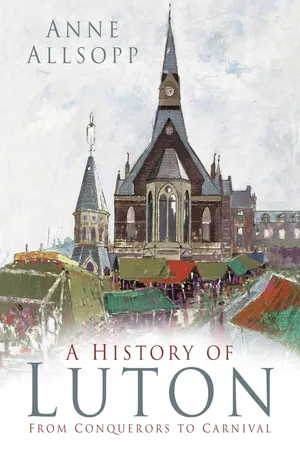
In the past, Luton was a market town and, for many years, was also a centre for the brewing industry. In the 19th century it became famous for hat making, and more recently it has grown into a thriving industrial centre. During the Second World War it played an important part in the manufacture of army vehicles, and children bound for school had to dodge the Churchill tanks on their way to various theatres of conflict. Nowadays, Luton Airport is the gateway for all types of traveller and the town is well known for its famous football team. Luton has always provided visitors with a warm welcome and many have stayed and made the town their home. Local industry offered employment opportunities in the early 20th century and many had cause to be grateful for its relative prosperity during the Great Depression. Following the Second World War, immigrants from the Indian subcontinent and from the West Indies brought with them colourful new cultures that are celebrated in the annual Carnival. This fascinating and illustrated account of Luton's past will inform and delight anyone who lives in the town and inspire those who grew up here.
- 206 pages
- English
- ePUB (mobile friendly)
- Available on iOS & Android
eBook - ePub
About this book
Information
X
Luton, the Town
THERE IS NO doubt that Luton has its own special character. Words that have been used to describe it include decent, down to earth, good-humoured, hard working, independent and individualistic. It has also been noted that it has always been a town without a privileged upper class, since in Luton almost everyone worked to earn his or her own living. The spirit of independence was reflected in its long battle to control its own affairs. At the beginning of the 19th century, the county town of Bedford had a larger population than Luton, which was then a market town of about three thousand people, but by the 1860s Luton’s population had overtaken that of Bedford. Consequently, the people of Luton became increasingly unhappy that administrative power was centred on Bedford.
Luton was certainly an independent little town and it kept its ‘small town atmosphere’ until at least the middle of the 20th century. Another indication of its special character was the particular status of its women, especially during the busy days of the hat industry. Nationally speaking, married women who worked were frowned upon, but in Luton there was usually no stigma attached to the hat workers and women were able to work and contribute to the family income for the whole of their lives.
Histories of Luton have usually included the town’s hamlets. A hamlet is considered to be a small village without a church, although Luton’s hamlets did in the course of time acquire their own places of worship. The hamlets were Biscot, Hyde, Leagrave, Limbury and Stopsley, but Biscot and Limbury were often linked together as Limbury-cum-Biscot. Most of them grew up near the river Lea, which rises at Leagrave, flows through Limbury and Biscot, and leaves the town beside the road to Hyde. There have been boundary changes and changes in administration over the years but one significant date is 1894 when the hamlets became known as ‘Luton Rural’. Leagrave, Limbury and part of Stopsley became part of Luton Borough in 1928 and the rest of Stopsley joined Luton in 1933. Apart from the hamlets, Luton has grown to include many small settlements, often known as Ends or Greens, whose names are now familiar, for example Chaul End, Farley, Lewsey, Ramridge, Round Green, Skimpot and Sundon.

93 Map of Luton based on the Ordnance Survey Map with the sanction of HM Stationery Office, 1915.
The following table gives details of the population growth of Luton, the hamlets and Bedford between 1841 and 1921.

Hyde is small but very interesting. One of the mills recorded in Domesday Book, although not the original building, stands on the county boundary and there was once another at New Mill End. The water meadows can still be seen and the bridge over the river is a popular spot for bird watching. There is a church, built on land donated by the Marquess of Bute and consecrated in 1842. In the graveyard behind the church is the Wernher family vault. Hyde became a separate parish in 1895.
There are no longer any shops and the railway stations have closed, as has the Leather Bottle, although the sewage works, opened in 1942, still functions and is of great importance to the health of the town. The road to Someries, an interesting reminder of generations long gone, leads almost to the airport boundary; there it is possible to stand and ponder as the history of the town comes face to face with its future. Hyde, unlike the other former hamlets, retains its rural atmosphere, thanks mainly to the fact that it is cut off from Luton by the Luton Hoo Estate.
The old National School on the Wheathampstead Road has long been a private house. In 1901 a Board School was built on land donated by the Luton Hoo Estate and provided an education for children from the surrounding area, including the estate, until 1984. The old school log books describe the difficulties experienced by staff and pupils as they travelled across the fields to school in inclement weather. One former pupil recalled that her mother used to give her a hot jacket potato to hold in her hand to keep her warm on the journey. The school is now a village hall.
Leagrave is by the source of the river Lea and stands beside the ancient earthwork known as Waulud’s Bank. The marshy area around was ‘common ground’ with its pasture, wildfowl and watercress beds. In 1868 a railway station was opened, linking Leagrave to Luton, London and the north. This busy station has not suffered the fate of many others and is now one of three that serve the town. In the early 20th century Leagrave Marsh was known as ‘The Blockers’ Seaside’, blockers being workers who pressed hats into shape. Leagrave, with its easy access, was no doubt a pleasant place for them to spend free time with their families.

94-6 Hyde Church, Leather Bottle, Luton Hoo Station.


This was an attractive little community. There was the little S-bend lane that led to Lewsey Road and on to Dunstable. The Board School, with its school house, was opened in 1875 but has now been replaced by private houses. There were the local inns: the Royal Oak, the Sugar Loaf and, opposite Marsh Farm, the Three Horseshoes. The picturesque cottage that stood beside the Sugar Loaf has been moved to the Chiltern Open-Air Museum. Leagrave became a separate parish in 1895 and a part of Luton Borough from 1928.
Life in Limbury-cum-Biscot must have been interesting to say the least at the time when the river marked the boundary between Saxon and Danish territory, a far cry from the modern housing and busy roads of today. It is also no doubt difficult to equate this part of Luton with the rural paradise described by Anthony Darby, who, as a boy in the early 1900s, went to Biscot to recuperate after an illness. In later life, he recalled that Biscot was a small hamlet, four miles from the town along country lanes, and boasted two farms, the Parish Church (consecrated in 1868), a pond in the road, a nearby school and 50 cottages. Its one landmark was Biscot Mill, forever turning, looking down on the village from a hill about half a mile distant.

97 Thatched cottage at Leagrave, 1961.
He stayed in a cottage with no piped water, gas or electricity and with an earth closet. But there was watercress for the picking and wild duck eggs to collect. His health soon improved because his hostess was able to make nourishing food, especially from eggs and milk in plentiful supply. Darby’s paradise has gone: Biscot Mill has been replaced by an inn of the same name, the Moat House is not a farm and the school has been demolished but, for those who are interested, the river can still be explored. The hamlet became a parish in 1895 and a part of Luton Borough from 1928.
The history of Stopsley has been studied in great detail and can be read in James Dyer’s book, aptly named The Stopsley Book. There are people living in Stopsley who still share a sense of community with its village spirit and individuality even though it has been administered as part of Luton since 1933. The civil parish covers a large area, from Someries Castle in the south to Galley Hill and the Icknield Way in the north. Stopsley retained the feel of a village until well into the 20th century. At its heart was the village green where villagers congregated on Bonfire Night. There was the police box and, beside the green, the maroon Corporation buses waited before their return journey to Luton. The centre of the village has been destroyed by development, although the Sportsman (c.1820) has survived, but Stopsley Common and the lynchets on Bradgers Hill are reminders of the past where country lovers can still explore and find typical downland flora.

98 Windmill at Biscot.
ADMINISTRATION
Luton had been a municipal borough since it received a Charter of Incorporation in February 1876. George Bailey, formerly secretary of the Board of Health, was the first town clerk, Edward Woakes continued as the Medical Officer of Health and William Bigg, a Quaker and retired bank manager, became the first mayor. However, the town continued to be run by the same ‘small-town hierarchy’ although in different official capacities. This seemed to work well for many years and a report by Grundy and Titmuss in 1945 described a similar state of affairs.
There is a richness of informal social intercourse, a diversity of small groups pursuing their interests unobtrusively, ample opportunity for discussing the affairs of the town and many an exchange of ideas by chance meetings; for those who are interested in the future of the town still know each other by sight and know where to find each other at most times of the day.
Stephen Bunker, writing about the links between local commerce and the religious outlook, described a town that old Lutonians can still remember, a town with ‘good stewardship, hard work, honesty, self-discipline, sobriety, punctuality, plainness, [that] all suited a town the commercial nature of which precisely required these standards of personal conduct’. Luton continued to be a prosperous town, even when most of the country was suffering acute economic depression. Vauxhall Motors, for example, was still advertising for workers when other parts of the country experienced high unemployment.
On 30 June 1926 Luton celebrated the Golden Jubilee of the granting of Municipal Borough status. The celebrations included a Swimming Gala at Wardown Lake and children from all the schools in Luton went to Pope’s Meadow for tea ...
Table of contents
- Cover
- Title
- Copyright
- Contents
- About the Author
- List of Illustrations
- Illustration Acknowledgements
- Acknowledgements
- Preface
- Introduction
- I: A Settlement on the River Lea
- II: Medieval Luton
- III: Seventeenth- to Nineteenth-Century Luton
- IV: Country Houses
- V: Education
- VI: Industry
- VII: Luton at War
- VIII: Migration
- IX: Leisure
- X: Luton, the Town
- Appendix I: Population figures
- Appendix II: Mayors and Members of Parliament
- Bibliography
Trusted by 375,005 students
Access to over 1.5 million titles for a fair monthly price.
Study more efficiently using our study tools.
Frequently asked questions
Yes, you can cancel anytime from the Subscription tab in your account settings on the Perlego website. Your subscription will stay active until the end of your current billing period. Learn how to cancel your subscription
No, books cannot be downloaded as external files, such as PDFs, for use outside of Perlego. However, you can download books within the Perlego app for offline reading on mobile or tablet. Learn how to download books offline
Perlego offers two plans: Essential and Complete
- Essential is ideal for learners and professionals who enjoy exploring a wide range of subjects. Access the Essential Library with 800,000+ trusted titles and best-sellers across business, personal growth, and the humanities. Includes unlimited reading time and Standard Read Aloud voice.
- Complete: Perfect for advanced learners and researchers needing full, unrestricted access. Unlock 1.5M+ books across hundreds of subjects, including academic and specialized titles. The Complete Plan also includes advanced features like Premium Read Aloud and Research Assistant.
We are an online textbook subscription service, where you can get access to an entire online library for less than the price of a single book per month. With over 1.5 million books across 990+ topics, we’ve got you covered! Learn about our mission
Look out for the read-aloud symbol on your next book to see if you can listen to it. The read-aloud tool reads text aloud for you, highlighting the text as it is being read. You can pause it, speed it up and slow it down. Learn more about Read Aloud
Yes! You can use the Perlego app on both iOS and Android devices to read anytime, anywhere — even offline. Perfect for commutes or when you’re on the go.
Please note we cannot support devices running on iOS 13 and Android 7 or earlier. Learn more about using the app
Please note we cannot support devices running on iOS 13 and Android 7 or earlier. Learn more about using the app
Yes, you can access A History of Luton by Anne Allsopp in PDF and/or ePUB format, as well as other popular books in History & British History. We have over 1.5 million books available in our catalogue for you to explore.