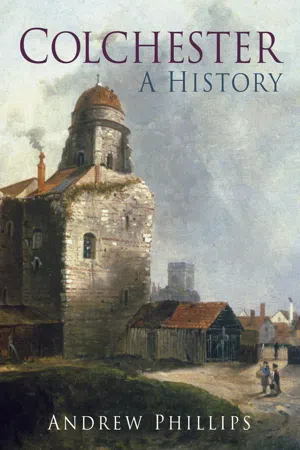
Colchester boasts 2,000 years of history. Few towns in Britain can equal that. Yet this new book, by a local author, is the first full and concise history of Colchester to be published for over half a century, during which time our knowledge of the town's past has grown immeasurably. The Iron-Age capital of King Cunobelin (Shakespeare's Cymbeline), Colchester was the target of the Roman invasion in AD 43. Where the Emperor Claudius received its submission, the Romans built a legionary fortress, the framework of which still forms the centre of Colchester. As capital of Roman Britain, Colchester was overrun and burnt by the warrior queen Boudica (aka Boadicea), then rebuilt and ringed by its famous walls. After Rome fell and the Saxon incursions began, the Saxon King Edward the Elder made it the leading town in Essex. The Normans raised its profile higher, when an Abbey, a Priory and a great castle gave it the strategic defence of Eastern England. It was besieged only once, when King John was in conflict with his barons over Magna Carta. For 400 years Colchester's cloth industry placed it among the top fifteen towns in the kingdom. It saw Protestants burnt at the stake, withstood a Civil War siege, was ravaged by plague and stood in the front line against invasion, first by Napoleon, then by the Kaiser, then by Hitler. An important engineering town since Victorian times, it is today a regional shopping centre, a major garrison town and a popular tourist attraction. This authoritative, readable and well illustrated work, from a professional historian, will doubtless become the standard work on this ancient town for at least the next half-century.
- 144 pages
- English
- ePUB (mobile friendly)
- Available on iOS & Android
eBook - ePub
About this book
Information
One
CAMULODUNUM
50 B.C.–A.D. 60

Colchester boasts 2,000 years of history. Even in England this is remarkable. Hence the tourist slogan that Colchester is ‘Britain’s Oldest Recorded Town.’ Is this correct? In part that depends on what is meant by a ‘town’. To see why, we must turn to the eye-witness account of these islands and their inhabitants provided by Julius Caesar. We can also learn from archaeology, whose evidence is frequently dramatic.
Although there had been settlements in what is now Essex for centuries before his arrival, Julius Caesar’s assault across the Channel in 55 B.C. provides our first documented history. By his own account Caesar was invading on the pretext that one British king had murdered another and his son, Mandubracius, had fled to Caesar for protection. Mandubracius was a prince of the Trinovantes, a tribe inhabiting most of modern Essex and South Suffolk. The Trinovantes were, Caesar wrote, ‘about the strongest [tribe] in south-east Britain’.
Caesar’s 55 B.C. invasion came close to total disaster. Hence his return in 54 B.C. with a larger army and an enormous navy. This time the Britons united under the leadership of Cassivellaunus, whose stronghold Caesar eventually attacked and overran. The evidence suggests that Cassivellaunus was king of the Catuvellauni, a tribe based on modern Hertfordshire, the next-door neighbours of the Trinovantes and the alleged murderers of the father of Mandubracius. The Trinovantes now appealed to Caesar to install Mandubracius as their king and to protect him from Cassivellaunus. These two tribes, the Catuvellauni and the Trinovantes, apparently hold the key to the origin of Colchester.

1 Roman Britain in c.A.D. 60, showing tribal divisions.

2 Four gold coins (staters) produced under Cunobelin bearing CAMU for Camulodunum and CUNO for Cunobelin.
Though Caesar had conquered no territory, he had, during his invasion, established direct links with several British tribes. Over the next 100 years, from its close trading contacts with Rome, the south-east became the power centre of Britain. This was a two-way process; not only did British grain, hides, metals and slaves reach the Roman world, but Roman luxuries were traded to the British aristocracy, spectacular evidence of which has been found in a series of royal or aristocratic graves, many near Colchester. The distribution of a coin called ‘British G’, current around 50-25 B.C., suggests that Colchester was already an important centre. Significantly, very few ‘British G’ coins have been found to the west in Catuvellauni territory.

3 The dyke and river system which defended Camulodunum, showing the Iron-Age farm at Abbotstone, the burial site at Stanway and the Roman town which forms the core of modern Colchester.

4 Gryme’s Dyke, today the western boundary of Colchester, still shows some of its rampart defences, despite 2,000 years of erosion.
British kings now began to issue coins carrying their own names, often tied to a specific mint. In the absence of any written British language, the coins carry Latin script, further evidence of Roman influences. The first king to name a mint was Tasciovanus, king of the Catuvellauni, and presumably a descendant of Cassivellaunus. His mint was at Verulamium (now St Albans), the tribal ‘capital’, but early in his reign he also issued coins from Camulodunum (now Colchester), presumably in Trinovantian territory.
From about A.D. 5 Cunobelin, described as the ‘son of Tasciovanus’ (Shakespeare calls him Cymbeline), also began to issue coins from Camulodunum – and only Camulodunum – and issued them in great numbers for over thirty years: perhaps a million gold coins according to a recent estimate. We must conclude that the Catuvellauni royal family, or Cunobelin at least, had made Camulodunum their new power base. It is easy to see why the port access this provided to the Roman world might be preferable to land-locked Verulamium. How far this entailed conquering the Trinovantes we do not know.
Camulodunum was very large – about ten square miles – and well defended, flanked to the north and east by the River Colne, to the south by the Roman River. To the west a whole series of dykes was built (earthen ramps and ditches), clearly meant to be defensive against the chariot warfare at which the British were so adept. Added together the dykes stretched perhaps 12 miles, an enormous investment in labour, though it should be pointed out that a good deal of the system was built or extended after the Roman Conquest. The Romanised name of Cunobelin’s stronghold – Camulodunum – is also significant. It means the fortress (dunum) of Camulos, the British war god. But was it a ‘town’?

5 Artist’s reconstruction of the original tomb of a British king, beneath the Lexden Tumulus, showing its rich assemblage of grave goods, most of which were later ritually ‘killed’.
The Romans did not think so and described the larger British settlements as ‘oppida’ (strongholds), not ‘urbes’ (cities). This would be reinforced by Camulodunum’s appearance. On present evidence much of it was rural, given over to fields and livestock, particularly cattle, and scattered settlements. Two areas of importance have been identified. At Sheepen, where shallow boats could be brought up the tidal River Colne, a manufacturing and commercial area existed. In particular, coin moulds have been found for Cunobelin’s formidable output of currency.
Perhaps more interesting is the second area at Gosbecks, much of it now set aside as the Gosbecks Archaeological Park. This appears to have been based on a large farmhouse complex surrounded by a ditch, cattle trackways and fields. A ‘sacred’ area nearby was later to house a temple. It has been interpreted as a royal centre, presumably of Cunobelin himself. From here during his extraordinarily long reign, Cunobelin’s trading network extended over much of southern England, where he held the status of a paramount king, termed by one Roman writer the ‘king of the Britons’. Indeed, it was tribal conflicts following his death, in which his sons appear to have been aggressors, that provided the pretext for the Roman conquest of Britain, 98 years after Julius Caesar’s first cross-Channel raid.
One other sign of Camulodunum’s importance must be mentioned: the contents of several remarkable graves. The most significant is the Lexden Tumulus, a large burial mound (today in someone’s back garden), datable to 15 to 10 B.C. and found to contain the richest collection of grave goods known for that date in Britain: at least 17 Roman amphora (wine flagons), rich garments, chain mail armour, a collection of figurines and vessels of copper. As part of the burial ritual most of these objects had been deliberately broken up. There may therefore have been more objects than we now have. The entire burial was probably placed within a large wooden chamber. Quite the most important find was a silver medallion of the Emperor Augustus, arguably presented to the buried man. On date evidence this could be Addedomarus, whose issue of Camulodunum coins ends about this time.
There are other burials. At Stanway several important chambered graves in ditched enclosures have been excavated, containing high status tableware, drinking vessels and other symbols of wealth, ritually broken up. Most significantly, as we shall see, most of these burials actually date from after the Roman Conquest.
The Roman Invasion
It had probably been Rome’s intention to control Britain since the days of Julius Caesar. An invasion was finally launched in A.D. 43 by the Emperor Claudius. Significantly, a large Roman army made straight for Camulodunum. Landing in modern Kent, several bloody battles were fought, probably at the River Medway and near a crossing of the Thames. Here one of Cunobelin’s sons, Togodumnus, was killed. Another son, Caratacus, lived to fight on and subsequently became an inspirational guerrilla fighter against the Roman advance, continuing the struggle in the Welsh hills.

6 Two crucial finds in the Lexden Tumulus: (i) delicate silverwork of ears of corn, which recall the grain on the coinage (ii) a silver medallion of the Emperor Augustus, perhaps a personal gift from the Emperor.
Meanwhile, north of the Thames, the invading army halted until they were joined by the Emperor Claudius himself, bringing, a Roman historian tells us, additional equipment and war elephants. Such a long journey from Rome, the only one the Emperor ever took, in order to lead his troops against the British stronghold, tells us volumes about the importance of Camulodunum, even if the whole event was carefully stage-managed. In a stay of just 16 days, Claudius took Camulodunum and received the submission of a number of native kings. Back in Rome his achievement was considered sufficiently real for him to have two triumphal arches built, a ‘triumph’ parade held in Rome and the title Britannicus granted to his son.
With Camulodunum subdued, the Roman army continued its advance north and west. Within four years most of south-east Britain, so long in contact with the Roman world, was subdued. This was not solely the result of battle: Rome had long known how to divide and rule. The invasion itself owed much to the friendly support of the Atrebates (in modern Sussex), who were now restructured as a client kingdom. Likewise the tribe to the north of the Trinovantes, the Iceni (modern Norfolk and part of Suffolk), were allowed to retain their autonomy under Prasutagus, a pro-Roman member of their royal family. It is a matter of some interest as to how the Trinovantes themselves were now treated.

7 An archaeological plan of the Roman Colonia, showing the street grid, the known excavated buildings, and the ditch of the earlier fortress marked with a dotted line.
In Caesar’s day they had been pro-Roman, seeking his help against their neighbours the Catuvellauni. Yet those neighbours had established their ‘capital’ in Trinovantian territory. The great Cunobelin was a Catuvellauni king ruling from Camulodunum. His sons led the fight against the Roman invasion. That was why the Emperor came to receive the surrender of Camulodunum. On whose side were the Trinovantes? We must assume they had accepted the rule of Cunobelin and his sons. Otherwise they deserved better from the Romans than what followed.
The XXth Legion, almost 5,000 strong, were to be housed in a permanent fortress built on a gravel ridge above the River Colne, a high point where today the town centre of Colchester stands. It commanded the heights above the Sheepen industrial area and stood uphill from the furthest point of tidal navigation. Built according to Roman military design, it was roughly four-square, 510 metres long, 445 metres wide, running west-east along the ridge, enclosing in all an area of some fifty acres, surrounded by a deep ditch and earth rampart. Inside were some sixty barrack blocks, the commander’s headquarters, stores and other buildings. Nothing on this scale had been seen in Britain before, and the manpower, logistics and assembly of material that it called for would vividly demonstrate Rome’s formidable administrative resources. Modern Colchester was thus Rome’s first command and control base in Britain.
The conquest of Britain meanwhile made slow progress. Tribes resident in what is now Wales were harrying the Roman forces, assisted by the second son of Cunobelin, Caratacus, who became a legend for his exploits against the Romans. The new governor of Britain resolved to move the XXth Legion from Camulodunum to the vicinity of Gloucester. As they left, the new legionary fortress was re-designated a colony, the foremost type of Roman city. Manned by retired Roman soldiers, it would have had its own Imperial charter, public services and a city council, serving as an example of Roman civilisation to the native population. It was also, for the present, the capital of Britannia, the new province. On this basis Colchester can claim to be Britain’s first town.
It was very much a planned town, its grid of intersecting streets varying only slightly from the layout of the legionary fortress. But the new colony did not consist solely of streets and buildings. It would have had its own ‘territorium’, land surrounding the town, divided into plots and farmed by the Roman citizens of the colony. Given a likely population for the built-up area of 2,000, the ‘territorium’ would have extended for several miles around. Such land may have been taken from estates owned by the Catuvellani royal family, but it seems also to have included Trinovantian territory.

8 A museum model, with f...
Table of contents
- Cover
- Title
- Copyright
- Contents
- About the Author
- List of Illustrations
- Introduction and Acknowledgements
- 1. Camulodunum 50 B.C.-A.D. 60
- 2. The Roman Town A.D.60-450
- 3. From Saxons to Normans 450-1200
- 4. The Medieval Town 1200-1525
- 5. The Godly Town 1525-1640
- 6. From Civil War to Commercial Crisis 1640-1720
- 7. The Long Decline 1720-1830
- 8. Pride and Progress 1830-1914
- 9. War, Depression, War 1914-45
- 10. As Far as the Eye can See 1945-2000
- Concise Bibliography
Trusted by 375,005 students
Access to over 1.5 million titles for a fair monthly price.
Study more efficiently using our study tools.
Frequently asked questions
Yes, you can cancel anytime from the Subscription tab in your account settings on the Perlego website. Your subscription will stay active until the end of your current billing period. Learn how to cancel your subscription
No, books cannot be downloaded as external files, such as PDFs, for use outside of Perlego. However, you can download books within the Perlego app for offline reading on mobile or tablet. Learn how to download books offline
Perlego offers two plans: Essential and Complete
- Essential is ideal for learners and professionals who enjoy exploring a wide range of subjects. Access the Essential Library with 800,000+ trusted titles and best-sellers across business, personal growth, and the humanities. Includes unlimited reading time and Standard Read Aloud voice.
- Complete: Perfect for advanced learners and researchers needing full, unrestricted access. Unlock 1.5M+ books across hundreds of subjects, including academic and specialized titles. The Complete Plan also includes advanced features like Premium Read Aloud and Research Assistant.
We are an online textbook subscription service, where you can get access to an entire online library for less than the price of a single book per month. With over 1.5 million books across 990+ topics, we’ve got you covered! Learn about our mission
Look out for the read-aloud symbol on your next book to see if you can listen to it. The read-aloud tool reads text aloud for you, highlighting the text as it is being read. You can pause it, speed it up and slow it down. Learn more about Read Aloud
Yes! You can use the Perlego app on both iOS and Android devices to read anytime, anywhere — even offline. Perfect for commutes or when you’re on the go.
Please note we cannot support devices running on iOS 13 and Android 7 or earlier. Learn more about using the app
Please note we cannot support devices running on iOS 13 and Android 7 or earlier. Learn more about using the app
Yes, you can access Colchester by Andrew Phillips in PDF and/or ePUB format, as well as other popular books in History & British History. We have over 1.5 million books available in our catalogue for you to explore.