Stephen Poole joined British Rail in 1973, working for three of its Regions and then for three of its Business Sectors in the run-up to privatisation. He experienced stations, depots, freight, parcels, yards, signalling, catering, major projects and business development. Using his extensive knowledge of the workings of British Rail, he paints a vivid picture of its inner life, set against the backdrop of political, industrial and social change that dominated the last twenty years of the nationalised railway. Inside British Rail is both a celebration of the determination and camaraderie shown by staff working in an industry that was struggling to survive, and a nuanced assessment of the difficulties, both internal and external, that contributed to its demise.
eBook - ePub
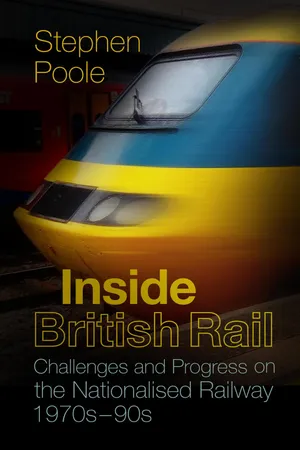
Inside British Rail
Challenges and Progress on the Nationalised Railway, 1970s-1990s
- 304 pages
- English
- ePUB (mobile friendly)
- Available on iOS & Android
eBook - ePub
About this book
Information
1

Computers, Engines and Ivory Towers
In the early 1970s BR had bought and installed, at a cost of around £10 million, a computerised vehicle management system developed by the USA’s Southern Pacific Railroad. TOPS (Total Operations Processing System) was a fairly crude, punchcard system that the SP had found difficult to implement because they had so many handover points to and from other operators who either used different control systems or had none at all. In 1979 I visited the Freight Office of the SP in Austin, Texas, and found that they were still using TOPS as it had been when sold to BR several years earlier. Indeed, I was able to load the ‘consist’ for a train to Llano into their machine without difficulty.
Britain’s railway system, having only the Harwich and Dover trainferries as outlets at the time, was better suited to TOPS and huge developments in its scope were made over the years. The Western Region had a further advantage in this respect: it had a busy freight network with only one outlet, this being the West of England line beyond Exeter. This was therefore an ideal proving ground for TOPS and, as a first step towards eventual national use, all freight movements in this area were put on to the new system. In 1975, at the time TOPS was extended to cover locomotive control and maintenance, I was working as an Assistant Traction Controller at Western Region HQ, Paddington. Our system of colour-coded tickets (one for each ‘nag’, as we called them at the time), upon which we recorded by hand every locomotive movement and the hours taken, as well as faults and other peculiarities, was supplemented and eventually replaced by TOPS. On the night shift for a couple of weeks we were accompanied by the TOPS Implementation Team, who showed us how to use the new system and invited us to devise our own TOPS enquiries and procedures to make the system work better for us. Broadly speaking, the implementation of TOPS led to the conclusion that the Western Region had been over-maintaining lots of its locomotives because we had been putting too many hours’ use on the tickets. Traction maintenance on the WR was based on hours in traffic. Over-maintenance, extravagance and slow realisation of cost-saving possibilities will be a recurring theme in this book.
Locomotive control on BR in the 1970s was a very chaotic affair, with the five Regions having different systems, different fleets and huge jealousies – and all this a mere twenty-five years after nationalisation. Amongst loco controllers, the Eastern Region had the best reputation for actually knowing where all its engines were, but against this they had a strange system of giving them ‘A’ exams (known on the WR as the ‘tickle brush’) every three days, almost regardless of how much or how little work each machine had done. Owning Regions had the power to insist that their locomotives be stopped for examination when due, whether on or off the home Region. On one occasion the Eastern Region Traction Controller at York instructed me to ensure that one of his Class 45 locos, which had been standing at Bristol Bath Road for two days, be given an ‘A’ exam before being used again. Since its previous exam it had only run from Newcastle to Bristol. Of course, one may well ask why an expensive machine had been standing idle for two days.
Over-maintenance and over-provision kept a whole range of small depots in existence, some at relatively obscure places such as Worcester and Newton Abbot. The resulting amount of locomotive ‘downtime’ was phenomenal, especially on a railway such as the Western with no electrification and therefore needing fuelling time for its fleet as well as maintenance time. For years the Western resisted all pressure to electrify and even now the only wires are for the BAA-operated Heathrow Express and the Eurostar depot.1 The Great Western itself remained for years as resolutely ‘diesel only’ as it wanted to be in 1954 when, in assessing the requirements for modernisation, all the Regions expressed ‘a distinct preference for electric traction instead of diesel, with the exception of the Western ...’ (A.J. Pearson, Man of the Rail). The Western somehow carried the day, though, with the 1955 Modernisation Plan being mainly based on diesel traction. In capital terms diesel was, of course, the cheaper option.
The implications of lasting Regional independence and self-assertion were numerous and largely counter-productive. We had our fair share as Traction Controllers. The Western had persisted with the installation of GWR Automatic Warning System (AWS), which was not the same as the BR AWS being introduced on the rest of the railway. This meant that many Western diesels were route-restricted. In particular, the GWR AWS equipment fitted under the engines played havoc with the fourth-rail return feed on lines shared with London Transport. These locomotives were slowly being refitted with standard equipment and the GWR AWS magnets on the track were all removed by late 1975. By how long and at what cost the national implementation of this vital safety equipment was delayed by the Western’s early intransigence is a matter of debate. Nevertheless, credit is due to the GWR for starting the implementation of AWS even if the particular form caused problems. Their system had its origins before the First World War while, in contrast, the Southern Region of BR had no form of AWS until the 1970s.
We guarded our own Regional locomotive fleets jealously, even though most machines could in fact travel anywhere on the railway. A favourite trick when traction was short was to send a type of locomotive on an inter-Regional working that could not be driven by the receiving Region’s crews. In that way the traction always came back home and the other Region had to find power for the next leg of the working. Accordingly, we would put the diesel-hydraulic Class 52 ‘Westerns’, which could only be driven by Western crews, on services to Birmingham while the London Midland would send Class 20s in pairs to Severn Tunnel Junction or would let the cumbersome sixteen-wheeled Class 40s come creeping in on overnight freights via Craven Arms, in the knowledge that Western crews were not trained to drive them.
When it came to the nightly inter-Regional locomotive balance, which was struck between all Regions’ Traction Controllers and the BRB representative at 0600hrs each morning, we had to include in our favour all these locomotives that were of no use to us. In dire circumstances of imbalance we would be instructed by the Board to redress matters by double-heading trains out of the Region, but if in reality the imbalance consisted in part of engines we couldn’t use, the result was the cancellation of internal services. Thus the words ‘CAPE, no power’, meaning cancelled, would reverberate through the telephone and teleprinter lines of a Region that, on paper, had a surplus of power. The balance was struck not only in terms of numbers but also of types. So, for instance, in the case of the unusable Class 20s arriving at Severn Tunnel Junction, the Western would be shown as having two Type 1s when it should have had none. The balance would therefore be shown as +2.
The problems caused by the inter-Regional balancing mechanism were numerous. On one occasion while I was at Paddington the day shifts had failed to rectify a locomotive imbalance between ourselves and the London Midland Region, resulting in the Board intervening and instructing us to send the LMR the requisite number of engines before the end of our night shift. The LMR, being bigger and better organised than the WR, could generally wield more clout in these matters. In this case the only way to fulfil the instruction was by using freight services from South Wales, even though the surplus was in fact at the London end of the Region. So we had to decimate our internal night freight services at the same time as double-heading freights to the LMR. No one was in a position to take a strategic view of the benefits or otherwise of this upheaval as the Board’s representative on nights was only a recorder – a clerical officer employed to initiate pre-determined procedures rather than to make decisions in his own right. The next day what was by then an internal imbalance between South Wales and London was put right by double-heading passenger trains from Paddington, which should have happened the previous day. Whether the shortage of traction on the LMR would have led to a greater loss of revenue than did our internal cancellations was not considered. Operating at that time was distinctly separate from commercial considerations, the two only meeting reluctantly and at arms’ length when timetable and resource changes were made.
Western traction of the mid 1970s consisted of Type 2 (Classes 25 and 31), Type 3 (Class 37) and Type 4 (such as Classes 46, 47, 50 and 52). Additionally, there were some lingering oddments: the experimental 1961 Brush locomotive D0280 Falcon was seeing out its days as a merry-go-round pilot on the coal circuit at Barry Docks, for example. Amidst this diverse plethora of ageing machines, the prototype Advanced Passenger Train and the High Speed Diesel Train were being developed and tested. The prototype HSDT had established a new world diesel speed record in June 1973 of 141mph and was well on its way towards introduction on passenger services on the Western Region in 1976, under the brand name of InterCity 125. Preparations were being made at Paddington for the new position of HST Controller, the ‘D’ having mysteriously disappeared for some reason, possibly having been no more than yet another internal Western assertion of its ‘no electrification’ policy. The 125, with its distinctive nose cone, went on to symbolise British success in terms of engineering, design and commercial impact and survives today with several private operators. But it was more than just a nose cone: the 125 was a complete concept, incorporating line speed improvements and innovations in passenger coach design and comfort. In its first two years on the Bristol and South Wales routes, business rose by 33 per cent. In the meantime, though, our express passenger services struggled on with Class 47 and Class 50 engines, limited to 95mph and 100mph respectively, helped out, of course, by our exclusive fleet of Class 52 diesel-hydraulics and a few Class 46s. Classes from other Regions worked on to the Western as well: not only the LMR 20s and 40s already mentioned but also most notably 33s from the Southern and 45s from the Eastern.

The HST (InterCity 125) is a lasting testament to British design and engineering, as well as to BR’s ability to run national projects in a way barely feasible nowadays. In its original livery, a set waits at Plymouth. (Photo: Caley Photographic)
In the mid 1970s the Welsh coal, steel and chemical industries were still extremely busy and there was a huge tonnage of traffic each night trickling down the many freight-only valley lines and then trundling over the Regional boundaries. Yard Supervisors, through their Freight Controllers, were forever asking for specials to clear surplus traffic and in those days, as well as one or more engines being needed for each train, a Driver, Secondman and Guard were also required – a far cry from today’s single manning. Many engines could not run in multiple with each other and so if double-heading was needed, two crews were necessary and the engines had to run in tandem, both being driven separately. Of the entire fleet of Class 47 locomotives, in effect the BR standard engine of the day, only two were fitted for multiple working at that time. These two, based on the Eastern Region, were known unofficially as Tweedledee and Tweedledum. How frequently they were at the same place at the same time when double-heading was actually needed I wouldn’t like to say.

Until the virtual abolition of coal mining in the 1980s, huge tonnages of coal made their way down the numerous Welsh Valley lines for onward movement to many parts of the country. Here 37279 leads a coal train through Taffs Well. (Photo: Adrian Brennan)
In addition to these heavy traction and crew costs, the main freight route from South Wales was via Bromsgrove, where banking engines were needed for the notorious and spectacular 1 in 39 Lickey incline. Even sleeper trains needed assistance here, although most other passenger trains could manage the bank unaided. Two Class 37s from Cardiff Canton were employed at Bromsgrove on each shift as bankers – another expensive operation, at which no one apparently batted an eyelid.
About the only fully brake-fitted freight trains in the mid 1970s were the company block trains and merry-go-round coal trains. Most other freight trains were a mixture of unfitted or vacuum-fitted wagons, needing a brakevan at the rear. Some passenger trains were still vacuum braked as well and some were still steam heated. So as well as a multitude of classes of locomotives there was a great diversity of characteristics and staffing needs. A steam-heated passenger train needed the Secondman to operate the steam boiler. Many engines were stripped of their boilers, or never had them, the resulting space sometimes being occupied by blocks of concrete to aid traction. Others could provide vacuum braking or air braking only, some were permanently speed-limited and others would have one or more traction motors out of use, with varying degrees of permanency. So allocating and controlling these fleets was a complex affair, made even more confusing by the fact that proper class numbering was only just coming in.
The old numbering system gave little indication of type or capability – you simply had to know which loco was which and of what it was capable. Mistakes were made, perhaps inevitably, from time to time. Most mistakes resulted in cancellation or delay to services, while some meant that passenger trains ran without heat or at reduced speed, or that freight trains ran with reduced loads. Occasionally, though, a mistake would lead to unsafe working. On 2 June 1976 a passenger train had become derailed at Reading West Junction as a result of locomotive 50019 having a loose metal tyre, which had come adrift and had jammed in a set of points. After this, special attention was given to the examination of the fitting, profile and wear of tyres. One victim of this was 47257 of Cardiff Canton depot, which was limited to 40mph until its wheels could be refitted. Despite the restriction being shown in the Driver’s book in the cab and on our locomotive control ticket, 47257 was put on to a Swansea–Paddington express one day, the mistake only coming to light when the loco number was passed to Reading Control. The train was stopped on signals somewhere near Didcot and proceeded at caution to Reading for a traction change. An internal enquiry ensued from which I, as Assistant Traction Controller on the South Wales panel that day, did not emerge with credit. I had entered the detail of the trip to London on the locomotive ticket without query, despite it having the coloured tab attached to it to signify the restricted working conditions. Full implementation of TOPS, with the generation of automatic warnings, would have stopped this sort of thing. But that was still to come.
As Traction Controllers we soon realised that the new TOPS locomotive control screens could be used for more than they were intended. The freeform message facility, known as ‘ZZ’, could be used to send messages from and to any screen or printer and, once this had been discovered, it was widely misused, especially on nights. Being a novice to the system (as we all were, of course), one of our Maintenance Controllers, known as Pal, was rather laboriously working through a screenful of information one night, updating the records as he went along when his screen was suddenly wiped clear and the message ‘PAL FOR THE TWO O’CLOCK BREW’ flashed up instead. The night air of Bayswater was shattered by the cry of ‘Which bastard did that?’ So we learned that ZZ messages wiped off anything you already had on your screen. Perhaps a quarter of a century later it really wouldn’t hurt me to say, ‘Sorry, Pal!’
All these activities took place in the attic of the Western Region HQ alongside Platform 1 at Paddington, although we overlooked Eastbourne Terrace rather than the station. The room was a disgrace in terms of decoration and maintenance: the walls were streaked with yellow–brown smears from the combined efforts of nicotine stains and a leaking roof, the window frames were rotten and out in the corridor there were pigeons nesting above the holes in the ceiling. Very strangely for a Region so proud of its past and of its independence this same dingy, inaccessible and dead-end corridor served as a gallery for framed photographs of past general managers, whose stern moustached faces peered out in the gloom at the surrounding dereliction.
Our telephone consoles at Paddington Control, into whic...
Table of contents
- Cover
- Title
- Copyright
- Contents
- About the Author
- Author’s Note
- Introduction
- Acknowledgements
- 1 Computers, Engines and Ivory Towers
- 2 Go Anywhere, Do Anything
- 3 Cash, Mangoes and Football
- 4 Creating Our Own Jobs
- 5 King Coal and King Arthur
- 6 Striking Off
- 7 Runaways and Other Misdemeanours
- 8 Files and Affectations
- 9 Sailing into Stormy Waters
- 10 Shunting and Sorting
- 11 The Old and the New
- 12 Exile on the Marshes
- 13 Winding and Flagging
- 14 Found in Possession … Out of Hours
- 15 Passing Times and Pulling Cords
- 16 Sit, Sleep or Stand?
- 17 Spotting the Enthusiasts
- 18 Footing the Bill
- 19 Holding the Purse Strings
- 20 Red Posts, Pubs and Sightseeing
- 21 Officers and Gentlemen
- 22 Old Boys, Sherry Parties and Mushy Peas
- 23 ‘Line-Cred’
- 24 Hoses, Holes and Harrowing Times
- 25 Hours and Hours
- 26 Nightwork
- 27 The Press Gang and the Ferry Man
- 28 Games of Monopoly
- Conclusion
- Bibliography
Trusted by 375,005 students
Access to over 1.5 million titles for a fair monthly price.
Study more efficiently using our study tools.
Frequently asked questions
Yes, you can cancel anytime from the Subscription tab in your account settings on the Perlego website. Your subscription will stay active until the end of your current billing period. Learn how to cancel your subscription
No, books cannot be downloaded as external files, such as PDFs, for use outside of Perlego. However, you can download books within the Perlego app for offline reading on mobile or tablet. Learn how to download books offline
Perlego offers two plans: Essential and Complete
- Essential is ideal for learners and professionals who enjoy exploring a wide range of subjects. Access the Essential Library with 800,000+ trusted titles and best-sellers across business, personal growth, and the humanities. Includes unlimited reading time and Standard Read Aloud voice.
- Complete: Perfect for advanced learners and researchers needing full, unrestricted access. Unlock 1.5M+ books across hundreds of subjects, including academic and specialized titles. The Complete Plan also includes advanced features like Premium Read Aloud and Research Assistant.
We are an online textbook subscription service, where you can get access to an entire online library for less than the price of a single book per month. With over 1.5 million books across 990+ topics, we’ve got you covered! Learn about our mission
Look out for the read-aloud symbol on your next book to see if you can listen to it. The read-aloud tool reads text aloud for you, highlighting the text as it is being read. You can pause it, speed it up and slow it down. Learn more about Read Aloud
Yes! You can use the Perlego app on both iOS and Android devices to read anytime, anywhere — even offline. Perfect for commutes or when you’re on the go.
Please note we cannot support devices running on iOS 13 and Android 7 or earlier. Learn more about using the app
Please note we cannot support devices running on iOS 13 and Android 7 or earlier. Learn more about using the app
Yes, you can access Inside British Rail by Stephen Poole in PDF and/or ePUB format, as well as other popular books in Technology & Engineering & Transportation Industry. We have over 1.5 million books available in our catalogue for you to explore.