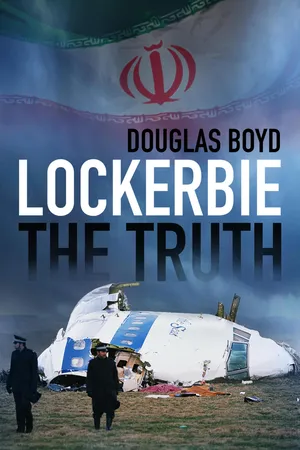
On 21 December 1988, Pan Am Flight 103 from Frankfurt to Detroit was destroyed by a bomb, killing all 243 passengers and sixteen crew. Large sections of the aircraft, bodies and personal effects crashed onto residential areas of Lockerbie, Scotland, resulting in the deaths of a further eleven people on the ground. The psychological damage to traumatised residents would take many years to disappear; in some cases, it never did. Libyan Abdelbaset al-Megrahi is the only person to have been convicted of the crime – though few believe that he acted alone and some believe him innocent. Author Douglas Boyd presents evidence that it was Iran, not Libya, which was responsible for the attack. On 3 July 1988 (less than six months before the Lockerbie bombing), Iran Air flight 655 was in Iranian airspace on a Bandar Abbas-Dubai flight when it was shot down by missiles from the USS Vincennes sailing illegally into Iranian territorial waters. Government leader Ayatollah Khomeini decreed that blood should flow in revenge. However, this line of enquiry was quietly closed and Libya declared guilty because the White House wanted neighbouring Syria and Iran on-side for the build-up to the first Gulf War against Saddam Hussein's Iraq. Lockerbie: The Truth at last reveals the facts about what happened on that awful night at Lockerbie.
- 252 pages
- English
- ePUB (mobile friendly)
- Available on iOS & Android
eBook - ePub
Lockerbie: The Truth
About this book
Information
1
IN THE BEGINNING
Thirty years after the tragedy which saw nearly 300 people simultaneously murdered in December 1988, the name of Lockerbie is still a synonym for mass murder.
Actually, there are twice as many victims in this story and half of them died five months earlier. The sequence of events really begins shortly after the 1979 Islamic Revolution that deposed Iran’s last shah, Mohammad Reza Pahlavi, and replaced his British- and American-backed regime by a theocratic government headed by Ayatollah Ruhollah Khomeini. In the revolutionary disorder, many senior Iranian officers were executed as being loyal to the shah, with command of some military units being taken over by imams. This led Iraq’s Baathist dictator Saddam Hussein to revive the millennial Persian–Arab conflict by invading Iran on 22 September 1980, using as his casus belli a dispute about the common border of the two countries in the Shatt el-Arab waterway. The real reason for the invasion was to capture Iranian oilfields. Far from being a primitive squabble between ‘people in faraway countries’, as Neville Chamberlain might have said, this war was the first one in which modified Soviet ballistic missiles were used by both sides, and chemical weapons claimed thousands of victims. It continued for nearly eight years at a cost of some 1.5 million lives, half of them civilians shot by small-calibre projectiles, blown to pieces by artillery shells and bombs or killed by poison gas.
Having, like Britain, previously supported the corrupt regime of the Shah of Iran in return for controlling the country’s oil supplies, the USA was not unnaturally suspected of giving support to anti-Khomeini elements in the hope of regaining control of the Iranian oil. In fact, the CIA had been running a significant number of agents inside Iran and the tension between Washington and Tehran reached ignition shortly after US President Carter announced on 23 October 1979 that he was allowing the exiled shah into the USA for treatment of his late-stage terminal cancer. American diplomats in Iran were aghast, knowing that this was the last straw for all Iranians who suspected US interference in their affairs. They were right to be horrified. On 4 November allegedly spontaneous rioting by ‘students’ ended with sixty-six American diplomats and other US nationals taken hostage by the rioters and confined in the US Embassy in Tehran. One woman and two Afro-Americans were released on 19 November after praising the aims of the revolution in front of cameras and microphones; the following day four more women and another six Afro-Americans were also released. After one more prisoner was freed, suffering from belatedly diagnosed multiple sclerosis, the remaining fifty-two hostages were held for a total of 444 days.
Diplomatic negotiations and sanctions failed to secure the release of the hostages. On 20 March 1980 at a top-level meeting in the White House, a blockade of all Iranian ports was debated, for both imports and exports. More aggressively, Admiral James Lyons drew up a plan for carrier-based US marines to take by force and occupy the undefended Kharg island in the north of the Persian Gulf, where 95 per cent of all Iranian oil exports was piped into waiting tankers. He promised that would bring Tehran to its knees inside two weeks. Fortunately for the hostages, who would have been subject to retaliation, cooler heads prevailed. Instead, President Carter did approve a rescue operation dubbed Eagle Claw using Rangers and newly formed Delta Force units based on the massive American aircraft carriers USS Nimitz and USS Coral Sea, which were on station in international waters near Iran. The essence of the plan was to take advantage of the Iranians’ preoccupation with their war against Iraq to land the special forces from military helicopters near Tehran, where they would be picked up and transported by CIA sleepers into the capital to kill the guards at the embassy and drive the hostages to a sports stadium nearby. There, the helicopters would land to spirit rescuers and rescued away to safety.
On 24 April 1980 the rescue attempt failed catastrophically after two helicopters were put out of action by dust storms encountered during the mission – which, due to the extreme secrecy surrounding Eagle Claw, lacked any current meteorological information. A third helicopter crashed into a fixed-wing aircraft, killing eight soldiers. This was a high cost in lives for a failed rescue operation. Removed from the embassy and dispersed all over Iran to prevent any further American rescue attempt, the unlucky fifty-two were eventially released on 20 January 1981 after mediation by Algeria and the payment of a king’s ransom: 50 tonnes of gold worth $7.98 billion.
In early 1983 US President Reagan’s National Security Council (NSC) expressed the view that the Iraq–Iran conflict might spread to other Middle Eastern countries and his National Security Planning Group considered that the conflict must lead to higher oil prices and/or disrupt oil supplies from the region. The war was also taking its toll at sea, with Iraqi missile attacks and bombing of Iranian shipping and offshore oil platforms leading Tehran to retaliate against ships in the Persian Gulf that belonged to Arab states giving Saddam Hussein huge loans to bolster his war effort. In one three month period, February to April 1984, Iraqi aircraft sank or heavily damaged sixteen ships,1 mostly tankers that exploded in huge fireballs with some loss of life. Wrongly blamed by Arab states supporting Iraq for starting what was called ‘the tanker war’, Iran eventually replied in kind. This resulted in the US Navy (USN) launching Operation Earnest Will in July 1987, during which American warships escorted reflagged Kuwaiti oil tankers safely through the Persian Gulf. There were frequent firefights between US warships and a flotilla of armed speedboats built by the Swedish company Boghammar AB and capable of reaching speeds of 45 knots. Armed with 12.7mm heavy machine guns, rocket launchers and mortars, they were manned and operated by the Iranian Guardians of the Revolution paramilitary navy, which regarded the Iranian Navy as politically unreliable because its personnel was averse to martyrdom!
The war in the Persian Gulf was a dirty affair, even by the standards of undeclared warfare. It reached its nadir at the Conference of the Organisation of Islamic Cooperation at Kuwait in January 1987 when delegates debated the treachery of the USA, which insisted on a worldwide blockade of Iran and yet was supplying arms shipments to Tehran in the Iran–Contra deals negotiated by Colonel Oliver North. None of the speakers gave much credibility to the Reagan administration’s excuse that this was a rogue operation, not approved by the White House.2
Readers whose memories go back no further than the two Iraq wars involving Western coalition forces – Operation Desert Storm in 1991, triggered by Iraq’s invasion of Kuwait the previous year, and the war of 2003 ironically dubbed ‘Iraqi Freedom’ and spuriously justified by claims from US President George W. Bush and British Prime Minister Tony Blair that Saddam Hussein was about to use weapons of mass destruction (WMDs) – none of which were ever found by UN inspection teams – may be surprised to learn that, in the preceeding eight-year war between Iraq and Iran, geopolitical considerations had aligned America and its allies on the side of Saddam Hussein. This was despite Iraq’s close ties with the USSR throughout the Cold War and the fact that it had been placed on Washington’s List of State Sponsors of Terrorism on 29 December 1979 for its support of the Abu Nidal and other terror groups. Yet, throughout the Iran–Iraq War the USA remained officially neutral, although supplying political support and some aircraft to Saddam Hussein. When, in March 1982, Iran launched a successful counteroffensive, the USA upped its level of support for Iraq to prevent an Iranian victory and helpfully removed Iraq from the List of State Sponsors of Terrorism, so that American arms manufacturers could legally supply arms to Iraq; sales to Iraq reached a record high in 1982.
During the Cold War neither NATO governments nor those of the Soviet Union’s Warsaw Pact countries wished to become directly involved, so they supported proxy wars instead. Yet, in June 1987, when US Defense Secretary Caspar Weinberger and Assistant Secretary of Defense Richard Armitage visited Hawaii, Admiral James ‘Ace’ Lyons, Commander-in-Chief, US Pacific Fleet defied the normal channels of communication by lobbying them to ‘take the war to the enemy’ by exploiting an operational advantage that would come in August when the aircraft carrier USS Constellation and her battle group, deployed to the Gulf of Oman in support of Earnest Will, was due to be relieved by USS Ranger and her battle group. With two carrier battle groups briefly on station during the handover, plus the recommissioned Second World War battleship USS Missouri and five other warships tasked to Earnest Will, Lyons argued there was a short window of opportunity to destroy the economy of the Islamic Republic of Iran by taking out harbours, oil installations and strategic targets inland in one massive blow before the Iranians had time to react.
Whatever Weinberger and Armitage thought of the idea, President Reagan’s National Security Adviser Lieutenant General Colin Powell blocked the idea. Yet in October 1987 US warships attacked Iranian offshore oil platforms in retaliation for an Iranian attack on a US-flagged Kuwaiti oil tanker. On 14 April 1988, the American frigate USS Samuel B. Roberts was badly damaged by an Iranian mine, with ten sailors wounded. The American response four days later, dubbed Operation Praying Mantis, was an attack on Iranian vessels in Iranian waters, which sank or damaged half of Iran’s small navy in a few hours, including the two British-built frigates Sahand and Sabalan.
The choke point for international shipping carrying supplies to Iraq at the head of the Persian Gulf and conveying in the other direction one-fifth of the world’s oil exports each day was at the Strait of Hormuz – the narrow passage leading from the Gulf of Oman to the Persian Gulf. Because the strait is only 21 nautical miles across at its narrowest point, internationally designated seaways through it traverse what would otherwise be territorial waters of both Iran to the north and Oman to the south. US Navy warships on escort duty also used these seaways under an Iranian law of 1934, as amended by a law of 1959.3 On Sunday, 3 July 1988, one of these was the heavyweight Ticonderoga-class guided missile cruiser USS Vincennes, commanded by Captain William C. Rogers III.
Vincennes was the most sophisticated ship in the US Navy, costing more than $1 billion. Crewed by about 400 officers and ratings, she had two 5-inch guns and a range of other anti-ship and anti-aircraft weaponry. Most importantly, it had Aegis, a state-of-the-art seaborne alternative to an Airborne Warning and Control System (AWACS) aircraft covering the Strait of Hormuz, supposedly giving a similar degree of accurate, detailed real-time analysis of airborne and surface activity and communications in the region.
What sort of man was the captain of Vincennes? In view of what was about to happen, it seems incredible that Rogers was a son of a Second World War US Navy psychologist and himself a university-qualified psychologist. Having enlisted in the navy at the mature age of 27, this was his twenty-third year of service after two years of teaching high school science in civilian life. His attitude to authority was not what one might expect from a former schoolteacher. That was made clear when he sent only a lowly lieutenant from his crew to the important briefing on the rules of engagement in the Gulf on being posted there in May 1988. When officers of the departing USS Wainwright offered to brief their replacements on the current situation, they were cold-shouldered with, ‘Aegis will sort all that out’. In war games at Tactical Training Group, Pacific, Rogers had both ignored instructors’ advice and repeatedly violated the rules of engagement laid down.4 Once on station in the Gulf, where his mission was to supervise and, if necessary, back up smaller naval craft escorting tanker convoys, Rogers chafed at the bit, frequently pleading with his superior, Rear Admiral Anthony Less, for a more aggressive role for Vincennes – one message specifically asking permission ‘to go into harm’s way, for which [Vincennes] was intended’.5
Rogers, who had been given command of the missile cruiser Vincennes in April 1987, was from the same mould as Admiral Lyons. Since joining Operation Earnest Will, Rogers had earned a reputation among other USN captains in the region for extreme aggressiveness and his ship was given the nickname ‘Robocruiser’ after the cartoon character Robocop, always spoiling for a fight. It seems that he thought the moment had come on 3 July 1988 to seize the mantle of Lyons. That morning, Vincennes was 40 nautical miles north of its station allotted by Middle East Task Force Command after Roberts had received reports from the USS Montgomery in the Strait of Hormuz of some gunfire from Iranian speedboats in the area. Driven by the 80,000 horsepower of its four gas-turbine engines, Vincennes travelled towards the location at 30 knots until Rear Admiral Less at Fleet Headquarters in Bahrain ordered Rogers to stay clear of the area and instead despatch a Seahawk SH-60B LAMPS helicopter to assess the scene at a distance. The pilot reported back that a small number of the fast Iranian Boghammars were routinely harassing a German-flagged Pakistani freighter, the Dhaulagiri, but not attacking it.
Rogers headed north again, still making 30 knots. Passing the Dhaulagiri, he ignored a signal from it reading A-OK. At 0840 the Omani coastguard radioed the Iranian small craft to clear the scene. The coastguard also warned Vincennes that its excessive speed and aggressive posture were not acceptable in Omani waters. Almost simultaneously, Fleet HQ in Bahrain ordered Rogers to return to his allotted station, leaving the Seahawk helicopter to observe. Rogers grudgingly complied until the co-pilot of the helicopter radioed that he was taking airburst fire from the gunboats. In fact, one Iranian Revolutionary Guard boat near the freighter quite reasonably fired ten warning shots well ahead of the Seahawk when it intruded into Iranian airspace. It also defied the rules of engagement, ignoring the agreed 4-mile separation by approaching to within half that distance of the Iranian boats.
Taking this as sufficient reason to send his crew to battle stations, Rogers ordered full speed and headed north again to engage the Boghammar speedboats that were ‘attacking’ his helicopter. The $400 million Aegis combat information system on board Vincennes, with its three-dimensional phased-array AN/SPY radar, was not designed for skirmishes with small boats, but for all-out war with the Soviet Navy, being capable o...
Table of contents
- Cover
- Title
- Copyright
- Contents
- List of Abbreviations and Acronyms
- Introduction
- Part 1
- Part 2
- Part 3
- Part 4
- Annexe: List of Fatalities at Lockerbie
- Acknowledgements
- Further Reading
- Notes and Sources
- Picture Section
Trusted by 375,005 students
Access to over 1.5 million titles for a fair monthly price.
Study more efficiently using our study tools.
Frequently asked questions
Yes, you can cancel anytime from the Subscription tab in your account settings on the Perlego website. Your subscription will stay active until the end of your current billing period. Learn how to cancel your subscription
No, books cannot be downloaded as external files, such as PDFs, for use outside of Perlego. However, you can download books within the Perlego app for offline reading on mobile or tablet. Learn how to download books offline
Perlego offers two plans: Essential and Complete
- Essential is ideal for learners and professionals who enjoy exploring a wide range of subjects. Access the Essential Library with 800,000+ trusted titles and best-sellers across business, personal growth, and the humanities. Includes unlimited reading time and Standard Read Aloud voice.
- Complete: Perfect for advanced learners and researchers needing full, unrestricted access. Unlock 1.5M+ books across hundreds of subjects, including academic and specialized titles. The Complete Plan also includes advanced features like Premium Read Aloud and Research Assistant.
We are an online textbook subscription service, where you can get access to an entire online library for less than the price of a single book per month. With over 1.5 million books across 990+ topics, we’ve got you covered! Learn about our mission
Look out for the read-aloud symbol on your next book to see if you can listen to it. The read-aloud tool reads text aloud for you, highlighting the text as it is being read. You can pause it, speed it up and slow it down. Learn more about Read Aloud
Yes! You can use the Perlego app on both iOS and Android devices to read anytime, anywhere — even offline. Perfect for commutes or when you’re on the go.
Please note we cannot support devices running on iOS 13 and Android 7 or earlier. Learn more about using the app
Please note we cannot support devices running on iOS 13 and Android 7 or earlier. Learn more about using the app
Yes, you can access Lockerbie: The Truth by Douglas Boyd in PDF and/or ePUB format, as well as other popular books in History & Modern British History. We have over 1.5 million books available in our catalogue for you to explore.