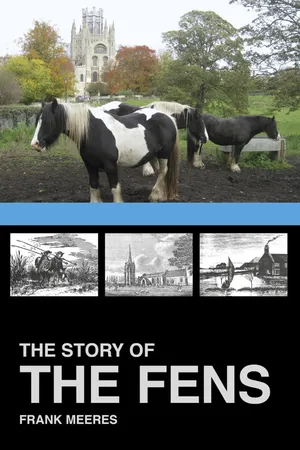
Lincolnshire, Cambridgeshire, Norfolk and Suffolk, as well as Peterborough City Council, all lay claim to a part of the Fens. Since Roman times, man has increased the land mass in this area by one third of the size. It is the largest plain in the British Isles, covering an area of nearly three-quarters of a million acres and is unique to the UK. The fen people know the area as marsh (land reclaimed from the sea) and fen (land drained from flooding rivers running from the uplands). The Fens are unique in having more miles of navigable waterways than anywhere else in the UK. Mammoth drainage schemes in the seventeenth and eighteenth changed the landscape forever – leading slowly but surely to the area so loved today. Insightful, entertaining and full of rich incident, here is the fascinating story of the Fens.
- 256 pages
- English
- ePUB (mobile friendly)
- Available on iOS & Android
eBook - ePub
The Story of the Fens
About this book
Information

THE TWENTIETH CENTURY AND BEYOND
The austere sun descends above the fen,
An orange cyclops-eye, scorning to look
Longer on this landscape of chagrin. 95
The turn of the century saw the start of attempts to preserve the landscape of ‘Old Fenland’ for future generations. In 1899, the National Trust purchased 2 acres of land at Wicken Fen for £10: this was the very first National Trust property. In 1911, a further 97 acres at Wicken Fen were bequeathed. The first keeper appointed by the Trust was local man, George ‘Bill’ Barnes. In those days, the old habits of ‘preserving’ rare specimens by shooting birds or collecting eggs were still common. Barnes later recalled the time when a rare Montagu’s Harrier nested on the Fen: egg-collectors gathered and were only deterred by a white lie, when he informed them that the nest was in marsh too dangerous to visit!
Drainage
The twentieth century saw a new technological development in the continual struggle to control flooding: as their boilers became unsafe, steam pumping engines were replaced with the more compact diesel or petrol engine. These could be started up at once – unlike the steam engines that took hours to get going – which meant that they were much more suitable for intermittent running. Small oil-driven pumps were in use by 1900: the first large oil engine was introduced in the Methwold and Feltwell District. Some new steam pumps were still erected, however, such as at Rummers in the North Level, which was built in 1927 and drove an Appold centrifugal pump. Another new introduction, to become common a few decades later, was the use of concrete for bridge building. Horseshoe Bridge at Spalding Common was one of a pair built in 1910 for the Deeping Fen Trustees by the Liverpool Ferro-Concrete Company: the entire structure was built in reinforced concrete. Its twin, Money Bridge over the River Glen near Pinchbeck, was demolished in the 1980s.
It might be thought that with the onset of the agricultural depression the work of reclaiming the Wash would have come to an abrupt end. Instead, at a meeting held in 1900, it was declared that the reclamations were still in their infancy, and the potential for further reclamations was discussed. A new embankment was to be constructed, parallel to the existing line of reclamations, which was to be called the Century Bank: seven new blocks of enclosed marsh would be made in its lee. The required money was raised from mortgages secured on the value of the two blocks of land already reclaimed. By 1904 the first of the new enclosures, covering 571 acres, had been completed at a cost of £6,799. When, in 1906, most of the existing enclosures were sold off – mainly to large landowners, some of whom were members of the Board – the sales raised sufficient cash to clear the mortgages and to leave £4,697 to invest in further reclamation work.
In 1908 it was estimated that the rest of the proposed new enclosures in the lee of the Century Bank could be completed at a cost of £1,045. The bank itself had now been standing so long that it was partly derelict, and a replacement was needed to complete the scheme. Further large blocks of land, to the north of the 1904 reclamations, were completed in 1910 and 1911, and another small area just to the north of Lynn was reclaimed in 1914. During the First World War some maintenance work was carried out on the banks, using German prisoners of war. The Company continued to operate, selling land and putting forward new plans, but only in 1923 did work on embanking recommence, now in the area between the 1904 enclosures and the land reclaimed in 1882, to the north of Lynn. In August 1927 the main sea wall around this second batch of enclosures was completed and the water excluded from 300 acres. In 1928, the work was completed and two new enclosures made.
At this time the government proposed taking over the assets and liabilities of the company through the Ouse Drainage Bill, but the plan came to nothing and embanking continued. A further 175 acres at the northern end of the reclamations, and abutting on the block enclosed in 1911, was completed in 1933; the new land was valued at £5,250. However, no further intakes from the marshes were made, in part because of fears that the Great Ouse Catchment Board would make a claim on the Company under the terms of the Drainage Act on the grounds that the land reclaimed had largely been created as a result of the work that the Board itself had carried out in changing the character of the river outfalls. The Second World War ended further work, and only after the war had ended were further reclamations begun, with three further blocks being enclosed from the saltings in 1949. The Company was taken over by the Crown Estate under the Norfolk Estuary Act of 1964, and some further reclamations were made into the late 1960s. 96
Reclamations at Wingland between 1910 and 1974 totalled more than 2,000 acres. Borstal boys at North Sea Camp started reclamation work in 1936, later enclosures down to 1979 completing a 970-acre project that became the Camp Farm.
Of course, nature could not be completely tamed. There were floods, the most notable being those of 1912, fully reported in the press:
In the Isle of Ely and in many parts of Norfolk large areas of cultivated land are under water and the loss inflicted upon farmers is enormous. In the majority of cases the ground is only under a few inches of water, but in low-lying parts the hedge tops are barely visible above the floods. Cut wheat and barley can be seen in places half submerged by the flood water, and the rain is widespread. In one apple orchard adjoining the Ely–Norwich line the water reached to the fruit on the trees. Many fields had become lakes … All the streets at Bourne were flooded yesterday, and furniture was floating about in inundated houses. The Fens around Bourne are under water to the depth of more than two feet and cut corn is floating on the surface. Potatoes and mangolds have been washed away. 97

A common Fenland scene; flooded fields in 1912. (Norfolk Record Office)

The great flood of August 1912, Hilgay. (Norfolk Record Office)
Farming
The Small Holdings Act of 1892 allowed – but did not compel – county councils to buy land for smallholdings, which were to be sold to the occupants over several years. Lincolnshire county councillor Richard Winfrey set up the Lincolnshire Small Holdings Association in 1894, the first of its kind in the country. The Association rented 650 acres around Spalding and sub-let them to 202 separate tenants: tenancy rather than ownership proved to be the way forward. The movement spread to Norfolk, again under Winfrey’s leadership. Tom Williamson takes up the story:
In 1902, 130 labourers in Nordelph asked Winfrey to help them obtain smallholdings. They petitioned Norfolk County Council for 500 acres and Winfrey bought 50 acres in the parish, but this was only a start and in 1904 the county council purchased a further ninety-one acres at Chapel Farm. Thirty-five holdings of between one and twelve acres were laid out. The tenants included twenty-eight agricultural labourers, a carpenter, a baker, a grocer, and a man who worked as a travelling showman in the summer and in the winter hired his horses to their neighbours to work in their fields. The success of the scheme was attributed to the local availability of part-time work and the fertility of the soil. 98
A child bought up at Southery recalled life there in about 1915, writing about Southery Common:
It was mostly black earth bordered with grass and weeds, just a wide drove that continued onto the fen from Common Lane … For many months of the year the footpath beside the dyke was very slippery. Only farm workers with waggons, tumbrils and animals used the drove, where there were many deep holes filled with thick, black mud – known locally as ‘slub’ – into which the horses sank to their bellies. During the dry period of summer, clouds of soot-like dust arose from the animals’ feet, dulling the weeds and grass; and to ride in a cart was reminiscent of a monster switchback where one wheel went down into a hole while the other went up over a mound and people and packages were tipped from side to side. 99
Fens prosperity was built on diversification – market gardening, pea production for canning, bulbs, sugar beet factories at Spalding, Ely and Lynn, HL Foods based at Little Sutton, pre-packed foods; and distribution companies such as Leverton’s of Spalding.
Woad
Woad production continued in a few places in the Fens through the nineteenth century and into the twentieth. In Young’s time, it was grown at Brothertoft, as we have seen, on Moulton Common before its enclosure, and at three other places, which he does not name. There was still a woad mill at Tattershall Road in Boston in the 1840s: seven families are listed in the 1841 census as working there, an unpleasant task and not just because of the smell: the dye stained one’s skin. The site was cleared for railway development in the mid-1840s.
Woad was still being grown in the Fens, however: Benjamin Armstrong noted it in 1854. In Wheeler’s time, in the 1880s, woad was being grown at Algarkirk, Skirbeck, Wyberton and Parson Drove. Wheeler reiterates that woad gives the land a thorough cleaning, often being followed by very good crops of oats and then wheat on the land. A 1907 newspaper article notes that woad at that date was grown only in the Boston and Wisbech areas.

Interior of a woad mill.
The woad mill at Parson Drove is often said to be the last place in England where woad was grown and milled:
The plant grows about six feet high, and has a blue-green leaf and bright yellow flower … It is weeded by men and women clad in hardened skirts and leathern knee-caps, who creep along the ground and take out the weeds with a curious little handspade which fits into the palm. The plant is picked by hand. The leaves are crushed to a pulp in the mill by rude conical crushing wheels dragged round by horses, and are then worked by hand into large balls and laid on ‘fleaks’ of twined hazel, or on planks, in special sheds, for three months to dry. After this the balls are thrown together, mixed with water and allowed to ferment in a dark house for five or six weeks. The woad is then rammed into casks and is ready to be sold to cloth manufacturers.
John Dawbarn, writing in 1952, recalled:
The old woad mill stood on the right hand nearly opposite the church as one takes the Wisbech road from the village. Old residents can remember the horse-propelled crushing wheel in action, pulping the leaves of the woad plant, after which process the pulp would be worked by hand into balls as big as Dutch cheeses then left to shrink by exposure to sun and air. The writer remembers as a boy being taken to see the huge wooden drying sheds, then tumbling rapidly into decay. Here men used to work in the dark, for light would spoil the dye. A few specimens of isatis tinctoria, last relics of a dead industry may still be seen growing in cottage gardens.
The last woad mill at Parson Drove was demolished in 1914: built of blocks of turf with timber and reed-thatched roof, it was a temporary structure which could be moved every few years. Woad continued to be grown as a commercial crop at Skirbeck until 1932, when the mill there was demolished. 100
The name now survives only in the occasional Woad Lane or Woad Cottage.
Flower-Growing
The tulip is not native to the British Isles, the first known mention of it being in 1578, having been spreading across Europe from Turkey where it originated: the name may derive from the Turkish word ‘tulband’, meaning turban. ‘It is from the Dutch fields that our English garden varieties have come, from there that the stocks planted in the English fields originated, and from there that many Dutchmen have come to England, at first to sell and soon to begin growing bulbs here.’ 101
The selling and growing of bulbs began around Spalding; late nineteenth-century trade directories list bulb growers there and at Whaplode and Bourne. The introduction of Darwin tulips in 1905 helped the expansion: they were long stemmed and gave both a crop of bulbs and a good cut flower. By 1933, there were about 150 bulb growers cultivating 2,500 acres of bulbs in the Spalding and Wisbech districts. Dominicus van Konynenburg came over from Noordwyk in Holland in 1922 and became the leading daffodil producer in Britain and a major producer of tulips, building up the Spalding Bulb Company. Other Dutch families included Moerman, Nell, Lindhout, Buschman – and van Geest. The latter are more generally known for importing bananas but are also major bulb producers: they have taken over the Spalding Bulb Company. At peak periods Spalding railway station was handling many thousands of boxes of fresh flowers every night, but by the 1950s road transport was beginning to take over. Bulb auctions were first held at Spalding in 1948. A Tulip Week was first held in the same year, developing into ‘Tulip Time’ in 1950, and the first Spalding Flower Parade in May 1958: up to 400,000 people came to see the increasingly sophisticated floats, climaxing w...
Table of contents
- Cover
- Title
- Copyright
- Contents
- Introduction
- One: Origins
- Two: The Fens Drowned
- Three: Fenland in the Middle Ages
- Four: The Great Draining
- Five: The Fens Half-Drained
- Six: Eighteenth-Century Fenland
- Seven: Victorian Fenland
- Eight: The Twentieth Century and Beyond
- Notes
- Bibliography
Trusted by 375,005 students
Access to over 1.5 million titles for a fair monthly price.
Study more efficiently using our study tools.
Frequently asked questions
Yes, you can cancel anytime from the Subscription tab in your account settings on the Perlego website. Your subscription will stay active until the end of your current billing period. Learn how to cancel your subscription
No, books cannot be downloaded as external files, such as PDFs, for use outside of Perlego. However, you can download books within the Perlego app for offline reading on mobile or tablet. Learn how to download books offline
Perlego offers two plans: Essential and Complete
- Essential is ideal for learners and professionals who enjoy exploring a wide range of subjects. Access the Essential Library with 800,000+ trusted titles and best-sellers across business, personal growth, and the humanities. Includes unlimited reading time and Standard Read Aloud voice.
- Complete: Perfect for advanced learners and researchers needing full, unrestricted access. Unlock 1.5M+ books across hundreds of subjects, including academic and specialized titles. The Complete Plan also includes advanced features like Premium Read Aloud and Research Assistant.
We are an online textbook subscription service, where you can get access to an entire online library for less than the price of a single book per month. With over 1.5 million books across 990+ topics, we’ve got you covered! Learn about our mission
Look out for the read-aloud symbol on your next book to see if you can listen to it. The read-aloud tool reads text aloud for you, highlighting the text as it is being read. You can pause it, speed it up and slow it down. Learn more about Read Aloud
Yes! You can use the Perlego app on both iOS and Android devices to read anytime, anywhere — even offline. Perfect for commutes or when you’re on the go.
Please note we cannot support devices running on iOS 13 and Android 7 or earlier. Learn more about using the app
Please note we cannot support devices running on iOS 13 and Android 7 or earlier. Learn more about using the app
Yes, you can access The Story of the Fens by Frank Meeres in PDF and/or ePUB format, as well as other popular books in History & British History. We have over 1.5 million books available in our catalogue for you to explore.