The suburbs – long sneered at for being dreary and stultifying – have always been far livelier and more entertaining than they're given credit for. In this witty and sharply observed account of what it was like to grow up in one in the 1950s and '60s, David Randall gives the other side of suburbia: full of absurdities and happiness, scandals and follies, and inhabitants both sage and silly. Here, at last, is the truth about what life was really like behind the often-closed (but not always net) curtains of our semi-detacheds. This is that rare book: a most unmiserable memoir.
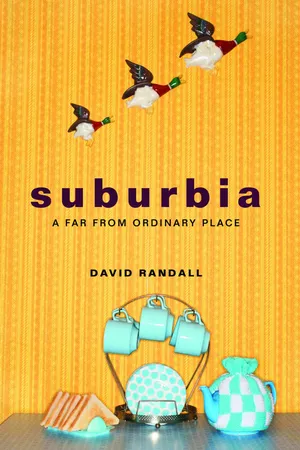
- 256 pages
- English
- ePUB (mobile friendly)
- Available on iOS & Android
eBook - ePub
About this book
Information

SIX
the suburban home
The one thing that everyone who doesn’t know about the suburbs thinks they know about the suburbs is that the houses there all have lace curtains at the windows. And they’re equally sure that just behind them skulks a busybody with hands poised to twitch the curtains aside so the comings and goings of neighbours can be seen and mentally logged. It’s a tired old cliché that falls at the first hurdle, one of the features of such curtains being that they don’t need to be touched to get a view. Unparted, they allow the watcher to see out while simultaneously screening them from the watched. Thus, any front room is turned into a sort of bird hide.
Our road’s resident observer was Mrs Pobjoy, known to Mum and Dad as Mrs Peepjoy. She lived opposite and was, for all her nosey-parkering, something of a benefactor to us. Every Friday afternoon when we were young this jolly woman, who resembled the late Queen Mother but spoke like the actress Irene Handl, would walk over the road and slide a couple of Mars bars for us under our back gate. But, when not doing this, taking her dog for a walk or making sure her husband Sid’s Masonic regalia was ready for the next Lodge meeting, she was an enthusiastic noter of local activity. We never actually saw her at the window, peering through the gauze of her lace curtains, but her detailed knowledge of which tradesman went to which house, and when, rather gave her away. ‘I see the collars man was late again,’ she might say, or, ‘There’s been another delivery at number 27.’ Very little escaped her. And in the 1950s and 1960s – with almost every house in the suburbs containing a housewife at home during the day, and all the regular deliverymen calling, plus Mormons and other evangelisers – there was much to monitor. (When the Holy Joes called and asked ‘Does Jesus live in this house?’, we were always tempted to answer, ‘No. He’s at number 35,’ and point them in the direction of the church organist two doors down.) Pity the poor nosey-parker nowadays, with virtually everyone out at work and the only door-knockers being drivers of online shopping vans looking for somewhere to leave the absentee’s purchase.
Nor, to tackle the crux of the ‘lace curtains of suburbia’ idea, were they ever hung at the windows of every home. Rejected by some for their bland appearance and by others for signalling a lack of fashionableness, their use has always seemed strongly related to the size of the house, being less and less common the higher up the housing ladder you go. Seemingly ubiquitous in a street of terraced houses, they peter out to rarities in avenues of double-fronted detacheds. They’re a kind of privacy meter: the less secluded your property, the more likely you are to fit nets. Set back from the street up a curving gravel drive, there’s not much need for the screening they offer. But if your front room is near the pavement, nets let you keep your furniture, décor and general level of tidiness to yourself. Take them away, and your front room and its contents are as available to the gaze of passers-by as a well-lit shop window.
Mum and Dad couldn’t abide the things. This was partly aesthetics (not much point in having mock-Tudor leaded lights if you smothered them with nets), but was also – in the age of pea-souper fogs, near-universal cigarette and pipe smoking, and rooms heated and fugged by coal fires – simple practicality. Nets were a bit of a fag to keep clean. So rapidly would they discolour that, in the winter, it wasn’t just the house-proud taking them down and washing them every few weeks or so. Thus, a second net for every window would have to be kept in reserve so it could be put up while its dirty twin was being cleaned. Some nets were straightforward affairs, with possibly a small element of self-patterning; others had considerably more to them: swirls, floral shapes and complex perforations so that they looked like giant doilies hanging above the windowsills. And then there were what Mum called ‘show-off curtains’, nets with sweeping swags, ruches and flounces that resembled the drapery of a sultan’s seraglio. These, when visiting a new friend, were a lowering sight, an infallible sign that his mother would be far more concerned you didn’t import mud into the house than with making sure you were properly lemonaded and caked.
The process by which something becomes supposedly typical of a certain kind of home, as net curtains have, defies understanding. But, like all clichés, once planted in the wider cultural mind it is almost impossible to shift. Two further examples. First, ducks on the wall: three china wildfowl, modelled in flying formation and with flat backs so they could hang flush on a wall. These were produced by the Stoke pottery firm of Beswick, and sold moderately well, but never in sufficient numbers to justify their reputation as the very symbol of suburbia. In a lifetime of living in outer London, I’ve yet to see these birds in their supposedly natural habitat: the wall of a semi-detached. Second, Basildon Bond writing paper, the favoured writing medium for letter-writing suburbanites at a time when, in order to communicate with suppliers of goods and services, compose complaints and keep in touch with distant relatives, you had to put pen to paper. Basildon Bond is an early example of a product being named to give it snob appeal, i.e. suggest it had more class than it actually did. It was launched under this name in 1911 after the directors of the paper firm Millington’s attended a shooting party at a stately home near Reading called Basildon Park. They correctly surmised that the name would evoke in suburban minds an image of the lady of the house composing her letters while seated at a walnut-veneered bureau, with inkwell, blotter and sealing wax all to hand. These days, when shooting weekends in grand country houses no longer feature quite as much in the newspapers as they once did, ‘Basildon Bond’ is more likely to suggest the Essex suburb of the same name. However, metropolitans sneering at its users should know that it was the writing paper of choice for poet and roustabout Dylan Thomas, never likely to be confused with a resident of Acacia Avenue.
In the 1960s and 1970s, no sideboard or cocktail cabinet was complete without its lava lamp – a glowing glass container full of coloured water and globules of wax that, heated from the base, would rise slowly in coagulating shapes before cooling and falling to the bottom to start a shape-changed rise to the top again. Mick and I bought Mum and Dad one in 1970, and it proved so indestructible that it was still going strong when Mum moved into a nursing home more than thirty years later. Respectable owners of these lamps would have been surprised to know that their inventor, Edward Craven Walker, was a public-school-educated accountant and wartime RAF pilot, whose great passion in life was naturism and making films about nudist colonies. Members of the sort of cinema clubs where such films were shown may recall his Eves on Skis, featuring naked female slalomers, and his masterpiece, Travelling Light, showing nudist swimmers. Sales of the latter film enabled him to buy his own naturist resort, where he once caused a stir by trying to bar any nudist he regarded as overweight. He had previously run an agency which found families for the large number of young Continental women wishing to become au pairs. Young women, clothed or unclothed, were thus something of a theme in his life.
The lava lamp was a rare example of an ornament in our house. Mum and Dad were very much down on what they called knick-knacks or ‘dust-collectors’. Our house always looked as if it had been visited by a very tidy burglar who’d removed everything from the shelves, mantelpieces, plate racks and sideboard tops, but left no mess. I never knew Mum or Dad to buy anything that was purely decorative. Not so Grandma Randall. She was a great believer that children should be seen and not heard, and a visit to her home meant sitting silently on poufs, keeping an ear cocked for the offer of a biscuit or bit of cake, and hoping it wouldn’t be much longer before Dad rose to his feet and declared we must be going. But most of all, it meant gazing at the crowded contents of her front room. There was much to take in. Unlike our own ornamentless home, Grandma’s front parlour had lots of old stuff. Against the wall facing the bay window was a large faux (at least I hope it was faux, given its subsequent fate) Queen Anne cabinet full of what I now know to be Crown Derby porcelain, the gilding on the Japanese patterned cups, saucers and plates making me wonder when I was young why Grandma, living in this small house in Wandsworth, would have gold treasures in her home. On the wall to the right, the one dividing the room from the hallway, were two other tall glazed cabinets full of more fine china, some of it the unmistakable jasperware of Wedgwood. But what kept taking the eye was the marble fireplace, so large and dominating that it would have been more in scale with a Pall Mall club than this Victorian terraced house. At the centre of its deep mantelpiece was a golden ormolu clock, and, at each end, were ebony sculptures a foot or so high of Roman charioteers.
Quite what these exotic objects were doing in the home of our lower middle-class widowed grandmother is anybody’s guess. I might be able to make an educated guess at their provenance had they been passed down the generations to me, but they weren’t. When Grandma died in 1964, her two children (Dad and Auntie Doris) paid – actually paid – someone to take them away. Such was often the fate of would-be heirlooms in those days before endless antiques programmes on television, and beady-eyed attitudes towards the contents of elderly relatives’ homes, had sensitised people to the value of the old.
My wife, too, was deprived of her heirlooms in rather more upsetting circumstances. A grandfather clock and round Georgian dining table shone out among the utility furniture of her father’s home, until, one day, two spivs ‘on the knock’ called at his house when he was in his 80s and gave him a few hundred pounds to take them away. Table and clock would have been smartened up, price-tagged at a minimum of four figures, and in a Bond Street saleroom within the month. What we minded was not so much the loss for ourselves as the diddling of her war hero father, who by then was no longer as sharp as he’d been in his prime.
If Mum and Dad were immune to the charms of ornamentation, they did have an occasional weakness for the furniture fads of the day. They managed to give the suburban craze for picture windows a miss, the means by which many a semi had its character surgically removed. But they succumbed to the interiors equivalent: an early 1960s fashion for boarding over feature staircases and panelled doors with slabs of hardboard. This was not a sudden enthusiasm for modernity, but because Dad decided that, if the staircase spindles and door mouldings were boxed in, Mum would have less dusting to do. Indeed she did. So did many women at that time, for boarding over stair and door panels was vigorously promoted by television’s first makeover programme presenter, a man called Barry Bucknell. The nation’s apprentice home improvers may not have shown quite as much keenness to follow his lead if they’d been aware that he was a conscientious objector during the war and had recently served as a Labour councillor, neither activity (or inactivity, as they would see it in the case of 1939–45) usually going down all that well in the suburbs. Maybe Dad got wind of Mr Bucknell’s antecedents, for he didn’t go the whole recommended hog and cover the hardboard with Fablon, sticky-backed plastic sheets available in a wide range of unpleasant patterns. Mercifully, Mum and Dad confined Fablon to the insides of kitchen shelves.
And then there were gadgets, outstanding of which among their collection was the hostess trolley, a sort of electrically heated sideboard on wheels which enabled the dinner party giver to keep the meal hot until it was served. Made of metal, and about half the size of a real sideboard, the hostess trolley was given a veneer of dining room presentability by a wood-effect coating. It was launched in 1953 as the age of servants in even wealthy homes was coming to an end. The idea was that it would allow the preparer of the meal (presumed to be female, hence the product’s sexist name) to be able to decant the food into heated compartments and so, when her guests arrived, be free to socialise rather than toil in the kitchen. It sold in fair quantities, often to couples who rather liked the idea that they were the sort of people who might throw a dinner party, even if they rarely, if ever, actually would. The hostess trolley was therefore one of those things, like fish knives or, later, fondue sets, that aspiring suburban couples bought or were given, but rarely used.
The other gadget which, in the mi...
Table of contents
- Cover
- Title
- Copyright
- Contents
- Preface
- One The Suburbanophobes
- Two A Small Scandal in Suburbia
- Three And Where Do Your People Come From?
- Four A Sheltered Existence
- Five Suburban Streets
- Six The Suburban Home
- Seven Smoking, Drinking and Suburban Oddballs
- Eight Training for Little Suburban Citizens
- Nine Suburban Sundays and the Mystery of Girls
- Ten The Great Suburban Outdoors
- Eleven Art and Artlessness in the Suburbs
- Twelve Suburban Shopping
- Appendix: A Suburban Inheritance
Trusted by 375,005 students
Access to over 1.5 million titles for a fair monthly price.
Study more efficiently using our study tools.
Frequently asked questions
Yes, you can cancel anytime from the Subscription tab in your account settings on the Perlego website. Your subscription will stay active until the end of your current billing period. Learn how to cancel your subscription
No, books cannot be downloaded as external files, such as PDFs, for use outside of Perlego. However, you can download books within the Perlego app for offline reading on mobile or tablet. Learn how to download books offline
Perlego offers two plans: Essential and Complete
- Essential is ideal for learners and professionals who enjoy exploring a wide range of subjects. Access the Essential Library with 800,000+ trusted titles and best-sellers across business, personal growth, and the humanities. Includes unlimited reading time and Standard Read Aloud voice.
- Complete: Perfect for advanced learners and researchers needing full, unrestricted access. Unlock 1.5M+ books across hundreds of subjects, including academic and specialized titles. The Complete Plan also includes advanced features like Premium Read Aloud and Research Assistant.
We are an online textbook subscription service, where you can get access to an entire online library for less than the price of a single book per month. With over 1.5 million books across 990+ topics, we’ve got you covered! Learn about our mission
Look out for the read-aloud symbol on your next book to see if you can listen to it. The read-aloud tool reads text aloud for you, highlighting the text as it is being read. You can pause it, speed it up and slow it down. Learn more about Read Aloud
Yes! You can use the Perlego app on both iOS and Android devices to read anytime, anywhere — even offline. Perfect for commutes or when you’re on the go.
Please note we cannot support devices running on iOS 13 and Android 7 or earlier. Learn more about using the app
Please note we cannot support devices running on iOS 13 and Android 7 or earlier. Learn more about using the app
Yes, you can access Suburbia by David Randall in PDF and/or ePUB format, as well as other popular books in History & Social Science Biographies. We have over 1.5 million books available in our catalogue for you to explore.