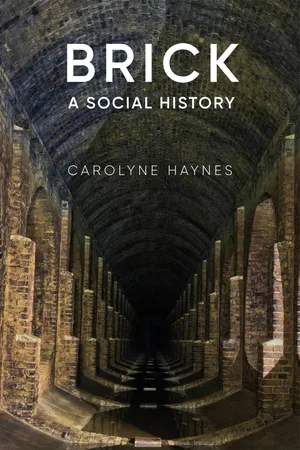
Bricks – such small and seemingly uninteresting things – have helped to build the way we live as society has evolved, from the feudal system of early Britain right up to today. Originally very expensive, bricks were only used by those who could afford them. This gradually changed with the Great Fire of London in 1666 when legislation decreed that the city must be rebuilt with non flammable materials, and bricks came into their own. A few centuries later bricks formed the infrastructure of industrial Britain as the need for canals and railways grew. But bricks are also associated with some of the worst slums this country has ever known, with poor bricks and sandy mortars indirectly causing misery for thousands of people. Our love affair with bricks continues today, with exposed brickwork being used to decorate both exteriors and interiors. But how are bricks made? What are they made of? Who made them and how have they changed through time? In Brick Carolyne Haynes answers these questions and reveals the surprising social history of bricks in Britain.
- 203 pages
- English
- ePUB (mobile friendly)
- Available on iOS & Android
eBook - ePub
About this book
Information
Topic
ArchitectureSubtopic
Architecture Methods & Materials1
A VERY BRIEF CHEMISTRY LESSON
Should our civilization crash, should a new dark age come, clay will still be here, and we can, each of us, scoop it from the earth and use it for our most basic needs, the preparation of food, and for shelter.
(Clay, Suzanne Staubach)
Bricks
We don’t make bricks entirely of clay, but without clay we couldn’t make bricks. It is the ‘glue’ that holds the brick together and the squishy bit that moulds it into shape. Clay is a very tactile material that has the ability to be both malleable, or plastic, and hard. It was once, many billions of years ago, stone. Over time the stone was worn away by the action of weather, water and, to a lesser extent, vegetation and it changed in nature. This chemical change was part of a very long and complex process that culminated with the formation of the ingredients needed to make clay: alumina, silica and chemically bonded water. The resulting particles then took two distinct routes. Some didn’t travel far and were laid down in layers that became almost as rock-like as the rocks that they were formed from. This is called shale and feels too hard to conform to our standard idea of what clay is, but it is too soft to be stone – you can usually pick it off in layers. The other particles travelled further and were distributed widely by the action of wind and water to form layers of sediment. This eventually formed the sticky kind of clay we are more familiar with and find when digging in the garden in many parts of Britain. The period in which the clay was formed resulted in it being suited to making different types of bricks. Here is a quick summary to give an understanding of the complexities involved:
The Holocene period – 11,700 years ago up until today – formed the alluvial clays, examples of which can be found all down the east coast of the country. They were the earliest clays to be used for brickmaking in Britain and arguably the easiest as they were close to the surface and already a mixture of sand and clayey silt.
Pleistocene clays – 2.6 million to 11,700 years ago – were formed in east Suffolk, most of northern England and eastern Wales.
Eocene clays – 54.8 million to 33.7 million years ago – give the bricks a blotchy purple colour. The most notable examples can be seen all round Reading, but also in the type of clay known as London clay.
The Cretaceous period – 142 million to 65 million years ago – formed the Wealden clays, running in a swathe all along West Sussex to Dorset. Also Gault clays, which were limited to Kent and Cambridge and gave bricks a pale ‘white’ colour.
The Jurassic period – 205 million to 142 million years ago – formed the Lias and Oxford clays.
Triassic clay – formed 248 million to 205 million years ago – was a reddish brown sort of mudstone that could be found all around Leicestershire and Nottinghamshire.
Carboniferous clays – 354 million to 290 million years ago – were a form of shale associated with coal. It was important for the Staffordshire tile and brick industries and today’s Flettons that are made in the Peterborough area.
For hundreds of years superficial deposits of clay were all that were used for pottery and brickmaking. There was so much available that there was no need to quarry down to find more.
The particles that form clay have an important attribute – they are almost two-dimensional in shape, giving them a tendency to slip across each other when wet. It is this slipperiness that makes clay plastic. It means that you can take a lump of it, add water, squeeze it between your fingers, form any shape you like and it will hold that shape. It gets stickier as you add water until it turns into a slurry. Often the clay we dig will happily stick to anything that it touches – your spade, your boots, your hands – with great tenacity. If you take a lump of clay and make a shape out of it, then leave it somewhere dry, it will, once excess water has evaporated, go hard. The molecules will hold rigidly onto each other but only until they get wet again.
So, we have a plastic material that is easy to form into shapes and will dry hard. This makes it very suitable for the forming of adobe, or mud, bricks but it has the awkward habit of turning back into a sloppy mess when wet. A material that was plastic enough to form a shape but then could become permanently hard would be a huge improvement – and clay is also that material. Although the molecules slip happily over each other when there is water present and will slip less happily when dry, they undergo a big change when heated strongly. If clay is taken to a temperature in excess of 900°C, then the material changes in nature and creates strong interlocking molecular bonds. A burnt brick is a new material and is both strong and very long lasting. You can leave a burnt brick out in the rain for hundreds of years and still have a brick.
Clay used on its own generally makes very poor bricks. Too pure and it will shrink excessively, crack or warp as it dries. So, although we tend to say that bricks are made from clay, they are in fact made from a mixture of clay and other substances, and the old term of ‘brick earth’ is more accurate. If you are lucky, the mixing has already been carried out for you by nature; if not, you have to mix in other substances by hand – usually sand, ash and to a lesser extent, chalk. Nearly all the clay we dig out of the garden contains some sand. If you are prising the earth off the spade and it comes away in clean slices, then you are blessed with a lot more clay than sand. If the soil runs through your fingers, you probably have more sand. Sand, or silica, stops shrinking and cracking by bulking out the clay with a relatively neutral filler. It has the added advantage of being able to vary colour and texture in the finished bricks, but it can cause problems. Too much sand and bricks are not strong enough, and if taken to too high a temperature the sand turns to glass, spoiling the brick.
Ash is a viable alternative to sand as long as there are large sources available. The coal fragments left in the ash help the brick to burn. A naturally occurring fuel appears in the carboniferous clays mentioned above. This clay has a high level of organic matter in it, forming a kind of oil. When taken up to a high temperature in the kiln, the oil acts as an additional fuel source in the same way as particles of unburnt coal do in the ash.
If you were lucky, nature did the mixing for you. It is unsurprising that many of the early brickyards were based near river estuaries. The sand from the sea would form layers with the silts washed down by the river to create the perfect mix.
In the early days of brickmaking, trial and error was behind much of the science and it was only with experience that good bricks could be made. Mistakes would have happened throughout the process by getting the initial mix wrong, not letting the bricks dry out enough before burning, and then not reaching the right temperature when in the kiln. A bad batch of bricks for whatever reason was a nightmare for the brickmaker, as it was a waste of so much invested manpower. When the Whitgift Hospital (Croydon, South London) was built in 1596, the bricks were commissioned specially for the job. Sadly for the brickmaker, the first batch were rejected. A very early document describes the exchange between the maker and his client with cringing accuracy that anyone who has ever been involved with putting up a building will recognise today. It starts off with the brickmaker trying to defend himself:
he would have excused himself but his handiwork spake against him; and we were so rounde with him, that he burst into tears, saying it was never the lyke served in anie worke he was ashamed of it; he could not excuse it …
Before blaming it on his materials:

The site of a small nineteenth-century brickyard that once made bricks using the silt formed by the tidal River Hamble. Located near Manor Park, Hampshire. (CMH)
it was the wickedness and deceitfulness of the yearth and albeit he not thoroughly make amends, yet he could be contente to do what lay in him; but not of that yearthe.
(Nathanial Lloyd, A History of English Brickwork, H. Greville Montgomery, 1925, p.18)
To go into a large amount of detail about the types of clays and brick earths would be too big a diversion here, but it is useful to give a brief description of a few of the varieties of materials and methods that can be used to make bricks and the different effects created. Common clays are often called either strong or mild. Milder clays are those that have already sufficient additives to make them work quite well, whilst a strong clay is nearly all clay. As we have noted above, the latter cannot be used alone and has to be mixed with something else. Marl is a name given to the weaker mixes of clays, those that already contain a naturally high level of chalk or sand and are ideal for brickmaking. They still need to be used with care, as there may be large pieces of chalk or shell (bigger than a pea) in them that can cause problems in the firing of the brick. If bigger bits do get left in, they can blow apart in the heat, causing damage to the bricks. The colour of the clay is not necessarily an indication of the resulting colour of the brick. A dark red clay may only be this colour due to vegetation, which will burn off giving a much paler brick. Clays from different layers or areas of the quarry can be mixed before making the bricks to ensure the correct colour.
Minerals in the clay can also have an effect on the colour. A mixture of iron oxides and lime compounds will give a red brick, if burnt on a lower heat, because of the iron. However, if the heat is raised the lime will react with the iron and a ‘white’ (pale grey/yellow) brick is formed. The type of sand used in making the brick or the amount of oxygen available when firing can also vary the colour. With oxygen present, iron compounds make a red brick, but if oxygen levels are reduced the same mixture creates a black or ‘blue’ brick. The firing of a kiln would often end up with three qualities of bricks. Those that have burnt perfectly, those that got too hot, and those that have not got hot enough. A perfect brick rings true when you take it from the kiln. This is difficult to describe in words, but such perfect bricks make a satisfactory ‘tink’ when tapped together. If there is a fault with them they go ‘dunk’! Perfect bricks shun rain, look good, face frosts with impunity and generally are a delight to work with. These are more expensive to buy. Bricks that did not get hot enough in the kiln are cheaper and they are cheaper for a good reason, because they aren’t as good. They can be used for internal walls or in places where quality isn’t such an issue, but used where the weather can get to them they start to misbehave quite quickly. They absorb moisture, react badly to frost and decay faster than a brick should. However, from time immemorial unscrupulous builders have tried to cut corners when it comes to materials, and so these substandard bricks will often be found in external or loadbearing walls when really they are not fit for purpose.
The bricks that get too hot can be used in walls but it depends on how hot is too hot. If the sand has fused into a mass, then it is unlikely that the brick is the right size (they usually expand), or the proper shape or the right colour. These bricks are really only fit for breaking up and using as hard core. However, it is possible to create what was once a very desirable effect by getting the bricks a little bit too close to the fire. Tudor brickwork often incorporated the use of ‘black’ bricks to make a diamond or nappy-shaped pattern. These black bricks were formed by placing the short end (or header) of the brick close to the wood being burnt in the kiln. If they got hot enough then the sand combined with the wood ash to make the shiny – partly glazed – black surface. This is harder to achieve with modern kilns as they burn so hot and so cleanly.
Lime
Although most people know something about bricks, not so many have any clue as to what lime is, or why it is so important. Lime, like clay, is a material that can change from being malleable to hard. It is also very corrosive and although this makes it difficult to work with, both of these properties have been found to be valuable.
Lime is made from calcium carbonate. There are a number of types of rock rich in calcium carbonate in Britain, including limestone and chalk. Chalk is a white stone of medium strength found in large deposits across the country, for example, the hills of the South Downs in Hampshire and Sussex. Limestone is a harder stone and found in a swathe that runs roughly from the Bath in the south-west up to Lincolnshire in the north-east. It isn’t difficult to know whether you are in a chalk or limestone area because the houses will tend to be built of the respective stones. Calcium carbonate is a stable material but it can be broken down if heated strongly (up to 1,100°C), whereupon it loses one carbon and two oxygen atoms. These are given off in the form of the common gas carbon dioxide, leaving a whitish crumbly substance, calcium oxide, also known as lime or quicklime. This is strongly alkaline and is very reactive with water, creating a fizzing, violent reaction that gives off considerable amounts of heat. This reactivity with water makes it horrible to handle, as it seeks out the moisture in the skin and the result causes burns. It is so corrosive that one of its many uses over time has been to dissolve bodies in mass graves. Once water has been added, the calcium oxide turns into calcium hydroxide (hydrated or slaked lime). In this state it is a little easier to handle and is less reactive. From the moment it is made lime will try to slowly absorb calcium dioxide from the air and set hard, turning back into calcium carbonate again. The cycle is then complete. It isn’t as strong as the original stone but it is strong enough to bond walls together or form concrete, and it is this property that has made it so important to the history of building.
The main skill required to make lime is to ensure the right temperature has been reached. Without temperature gauges it could be a bit hit and miss and if a filled kiln didn’t burn hot enough, rectifying the problem was hard. It is not very easy to empty a badly burnt kiln and the waste of man-hours and the high cost of the fuel made it an expensive undertaking. Having said that, making lime was certainly easier than making bricks. There were not so many things that could go wrong and if they did, then at least the stone could be reclaimed and burnt again. By contrast, once bricks have been fired in a kiln it is impossible to go back. Even if the clay hasn’t burnt properly it will have changed enough to ensure it isn’t plastic any more. Losing a whole kiln of bricks was really hard, and even with modern technology it still happens.
Once the lime was made it was destined for a wide variety of processes. In the early days it was used more or less equally for agriculture and construction, but with the rise in demand for buildings that came with the industrial revolution larger quantities were needed for construction. Lime was used to create mortar. This is a mixture with the constituency of a soft butter that can be spread on a layer of stone or brick before putting another layer of stone or brick in place. You don’t have to have mortar between joints and many buildings have been built without it, relying instead on the weight of stone to hold walls in place. However, mortar helps to bind smaller stones together and thinner walls can be built, thereby saving on the amount of masonry used. It also saves time as the selection of stones can be more casual – the mortar filling up any gaps in the joints. A dry-stone wall – without mortar – has to be laid with care and the right stones select...
Table of contents
- Cover
- Title
- Copyright
- Contents
- Introduction
- Acknowledgements
- 1 A Very Brief Chemistry Lesson
- 2 Clay
- 3 A Roman Holiday
- 4 An Influx of Religion
- 5 One Last Invasion
- 6 A Medieval Brickyard
- 7 Wool, War and Wealth
- 8 Fear of Fire
- 9 Keeping up with Demand
- 10 A Time of Transition
- 11 The Search for Perfection
- 12 The Classical City
- 13 The Pace Quickens
- 14 A Victorian Love Affair
- 15 ‘The March of Bricks and Mortar’
- 16 The Poor are Always with Us
- 17 Working Life in the Brickyards
- 18 Decline and Resurrection
- Appendix A: Buriton Chalk Pits
- Appendix B: Bursledon Brickworks
- Bibliography
- Picture Section
Trusted by 375,005 students
Access to over 1.5 million titles for a fair monthly price.
Study more efficiently using our study tools.
Frequently asked questions
Yes, you can cancel anytime from the Subscription tab in your account settings on the Perlego website. Your subscription will stay active until the end of your current billing period. Learn how to cancel your subscription
No, books cannot be downloaded as external files, such as PDFs, for use outside of Perlego. However, you can download books within the Perlego app for offline reading on mobile or tablet. Learn how to download books offline
Perlego offers two plans: Essential and Complete
- Essential is ideal for learners and professionals who enjoy exploring a wide range of subjects. Access the Essential Library with 800,000+ trusted titles and best-sellers across business, personal growth, and the humanities. Includes unlimited reading time and Standard Read Aloud voice.
- Complete: Perfect for advanced learners and researchers needing full, unrestricted access. Unlock 1.5M+ books across hundreds of subjects, including academic and specialized titles. The Complete Plan also includes advanced features like Premium Read Aloud and Research Assistant.
We are an online textbook subscription service, where you can get access to an entire online library for less than the price of a single book per month. With over 1.5 million books across 990+ topics, we’ve got you covered! Learn about our mission
Look out for the read-aloud symbol on your next book to see if you can listen to it. The read-aloud tool reads text aloud for you, highlighting the text as it is being read. You can pause it, speed it up and slow it down. Learn more about Read Aloud
Yes! You can use the Perlego app on both iOS and Android devices to read anytime, anywhere — even offline. Perfect for commutes or when you’re on the go.
Please note we cannot support devices running on iOS 13 and Android 7 or earlier. Learn more about using the app
Please note we cannot support devices running on iOS 13 and Android 7 or earlier. Learn more about using the app
Yes, you can access Brick by Carolyne Haynes in PDF and/or ePUB format, as well as other popular books in Architecture & Architecture Methods & Materials. We have over 1.5 million books available in our catalogue for you to explore.