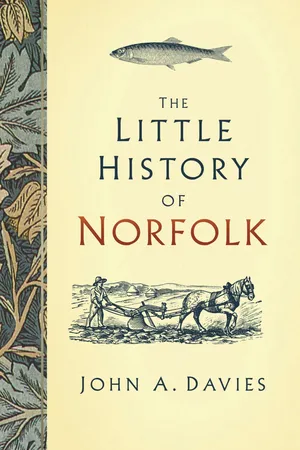
Embark upon a journey through Norfolk's eventful history, from the earliest times to the present day. From the discovery of fossil footprints dating back nearly one million years, to Boudica's revolt, the Roman occupation, the creation of the Norfolk Broads during the Middles Ages and the growth of the textile industry and agricultural advances, this county has always been at the forefront of innovation and the development of our nation. Mustard manufacturing, Viking farmers, friendly invasions and digging up ancient mammoths – we do things differently here in Norfolk.
- 224 pages
- English
- ePUB (mobile friendly)
- Available on iOS & Android
eBook - ePub
The Little History of Norfolk
About this book
Information
1
THE EARLIEST PEOPLE
The First Million Years
It was close to one million years ago that the first humans, who were distant relatives of today’s population, first set foot on the soil of what is now Norfolk. Recent discoveries from the county’s north coast have revealed evidence that has dated the arrival of these first people to double the age evidenced anywhere else in Britain. These were explorers; pioneers moving out into unknown parts of the world. They were intent on pushing forward even into the coldest, less hospitable and marginal lands, braving the very harshest climate in search of food, shelter and resources, while at the same time embodying the same spirit of exploration and curiosity that we recognise today.
The earliest humans had evolved in Africa over two million years ago. Their descendants spread outwards, expanding north and west across Europe. It was not until much later, just some 100,000 years ago, that our direct ancestors, modern humans or Homo sapiens, evolved in Africa. They too began to move outwards, eventually populating the whole world.
The enormous timespan covered by this initial period in our story, stretching from the arrival of the very first humans until approximately 8000 BC, is called the Palaeolithic. Norfolk contains some unique and internationally significant evidence from this period that throws new light on the human colonisation of Europe.
THE LAND
Britain was physically joined to the continent of Europe at this time. Today’s flat Norfolk landscape was once covered by hills and valleys, more similar in appearance to parts of northern Britain today. This was the Ice Age, which lasted between 700,000 and 10,000 years ago. During that time, the world’s climate changed dramatically. Not only was the landscape very different in appearance, but it also suffered extreme climatic conditions, often much colder and drier than today. The prevailing cold conditions were occasionally interrupted by warmer periods, when the climate was much more similar to that of today, called interglacials, followed by more extreme phases of intense cold and glaciation. Glacial ice steadily scoured the land, finally leaving it flat as we find it today. Sea levels fell hugely on occasions – by as much as 100m during the times when water became ice. Norfolk was positioned at the edge of the glaciations; partially covered by ice sheets during the Devensian and Wolstonian and completely covered during the Anglian (oldest) phase.
Ice Age Norfolk was the home of huge and exotic creatures. Giant elephants taller than double-decker buses roamed the landscape. They were preyed on by huge cats and, eventually, their carcases were dismembered by scavengers, such as hyaenas, in a scenario we would consider more characteristic of today’s African savannah. Less than 10 miles east of Norwich, astonishing evidence has been collected for some very large exotic mammals. A site at Norton Subcourse has revealed fossil skeletons belonging to creatures who lived during a warm period between 750,000 and 500,000 years ago. Fossil bones include those of a giant form of hippopotamus, weighing between 6 and 7 tonnes (compared with a mere 4 tonnes of the modern hippo).
Much of our evidence for these creatures comes from the dark geological deposit known as the Cromer Forest Bed, situated at the base of the cliffs lining the northern East Anglian coast. It is exposed at intervals around the east coast between Weybourne in the north and Kessingland (Suffolk) in the south. Laid down between 1.5 million and 500,000 years ago and now beneath the sands and gravels left by glaciers, it has long been famous for the fossil remains that it contains. Some thirty years ago the most spectacular discovery was made.
In 1990 some enormous bones were exposed, which were later identified as those of a male mammoth who lived between 600,000 and 700,000 years ago. It belonged to the species Mammuthus trogontherii, otherwise known as the Steppe Mammoth, which was probably the largest species of mammoth that ever lived. The creature originally stood a huge 4.5m at the shoulder and weighed 10 tons, double the weight of the largest elephant living today. What became known as the West Runton Mammoth is the oldest mammoth skeleton ever to be found in Britain. During its lifetime, much of the Norfolk landscape probably looked similar to today’s Norfolk Broads.
When first discovered, the West Runton Mammoth was thought to have come from a time long before the first humans reached Britain. Just a decade later, this changed as further significant discoveries were made just 30km along the coast at Happisburgh.
THE FIRST PEOPLE
Erosion continues to accelerate along the length of coast between Great Yarmouth and Cromer, making this the fastest retreating stretch of coastline in Europe today. Storms in early 2018 left hundreds of coastal homes threatened with destruction, most recently in the vicinity of Hemsby. One of the worst-affected beaches is at Happisburgh, where the cliffs have been eroded into an embayment, currently reaching inland some 100m from the original cliff line. This location had once been part of the floodplain of an ancient river. Until less than 20 years ago it was thought that the earliest humans in Britain arrived in the south of England 500,000 years ago. Discoveries at Happisburgh have doubled the known duration of human occupation in Britain.
It was in 2013 that a remarkable discovery was made. Following winter and spring storms, Happisburgh’s foreshore revealed a series of impressions in the estuarine muds. Detailed study showed that these hollows were fossil footprints. They had been left behind by a group of at least five people, perhaps a family group, which included an adult male, females and possibly adolescents and children. These footprints are evidence of the very first people to arrive in what is now Norfolk some 950,000 years ago. Their arrival can be associated with the landscape and the creatures it supported, on which they were dependent.
These early people were from a species known as Homo antecessor, an early form of human who would have looked fairly similar to us. They had large brains and used a basic range of stone tools. They would have feared the abundant predators and rarely hunted the really big game around them. They mainly hunted smaller creatures and gathered plants.
Happisburgh was situated on a natural routeway north as people spread further and further out across Europe. Ongoing research there has shown how humans were exploiting this area, as they moved from a familiar Mediterranean habitat into northern forested areas and coping with lower winter temperatures. The discovery was made here because the location is at a point where geological deposits of that date coincide with both coastal erosion and an area of ongoing archaeological scrutiny. But early human exploitation need not be unique to this specific area. Other finds of similar antiquity may yet be found elsewhere in Norfolk and possibly elsewhere in Britain.
These findings have profound implications for our understanding of early human behaviour. We now know that the early humans were able to adapt, survive, and were prepared to colonise areas of extreme climatic conditions, following the first human dispersal out of Africa. Norfolk may once again be portrayed as a borderland, situated on the periphery of the habitable world at that time.
Another pre-modern form of early human known to have inhabited Norfolk was Homo heidelbergensis. Evidence for this form of early human has again been discovered at Happisburgh, dating from around half a million years ago, through the presence of their flint tools and cut animal bones. The discovery, which was made as recently as the year 2000, can again be attributed to Norfolk’s rapidly eroding eastern coastline.
NEANDERTHALS IN NORFOLK
Although humans had been present at these very early times, their occupation of Britain was not continuous. On occasions, this country became too cold to sustain human life. It was deserted for a huge expanse of time between 180,000 and 60,000 years ago before humans, in the form of Neanderthals (Homo Neanderthalis), finally returned to Britain. A site at Lynford, near Thetford, has provided evidence for the first human presence in Britain after an absence of 120,000 years. This location would, once again, have been on the very edgeland of habitable land as conditions gradually became warmer.
Lynford is situated in Thetford Forest, and has a group of gravel pits located on the south bank of the River Wissey, where gravel extraction initially revealed the remains of mammoths. Subsequent archaeological investigation found evidence of early human activity in direct association with the mammoth bones, in the form of beautiful fresh-looking black flint handaxes within the same layer of sediment. Significantly, these axes were of the ‘bout coupé’ form, which were the type of tool used by Neanderthals.
The Lynford site has been dated to between 67,000 and 64,000 years ago, approximately 30,000 years before the arrival of modern humans. The Neanderthals had visited an area of stagnant water surrounded by marshes, next to a large river where both game animals and their predators had come to drink. Reindeer, bison, horse and woolly rhinoceros were accompanied by brown bear and spotted hyaena at the location. A range of human tools was discovered, including some forty-five bout coupé handaxes.
The remains of at least nine woolly mammoths were recovered, making this the only recorded mammoth butchery site known in Britain. It is uncertain whether Lynford’s Neanderthals were hunters of the large game animals or merely scavengers of the meat from dead animals. In either event, it is clear that they used their flint tools to remove joints from the mammoth carcases.
THE FIRST MODERN HUMANS
The new species Homo sapiens evolved in Africa. It was around 40,000 years ago that these modern humans started to reach Britain, with Norfolk being one of the first locations they came to. Homo sapiens are social creatures and these early ancestors lived in family groups or small bands. They developed a more sophisticated language, which facilitated communication with other groups and enabled the benefits of cooperation. They forged bonds with other groups and could expand the group when needed, perhaps for hunting big game or at times of crisis. These early people foraged both for food and for knowledge and clearly had a deep understanding of their surroundings. With Homo sapiens came a technological revolution that saw the invention of boats, oil lamps, bows and arrows, and needles. The first art can also be dated to this time.
Now, in addition to the deposits at Happisburgh that have revealed the presence of two species of early hominin – Homo heidelbergensis and the earlier Homo antecessor – the addition of Neanderthals and modern humans, Homo sapiens, make Norfolk unique within Britain by having evidence for four species of humans.
THE DISCOVERY OF A WIDER LANDSCAPE
The landscape of Ice Age Norfolk would have been completely unrecognisable to us. Britain was still part of the European landmass, the North Sea was still far away, and small freshwater streams flowed across the great plain of Doggerland that joined Norfolk to the mainland of Europe. One of the most enthralling archaeological projects in recent years has been the mapping of this massive submerged landscape, which is larger than the area of the United Kingdom. Archaeological evidence has been found to show that people were living on the plain and moving across it. It was a discovery on the Leman and Ower Banks in the North Sea, some 40km beyond today’s north Norfolk coast, which played a key role in the rediscovery of this sunken landscape.
In 1931 a trawler fishing beyond Cromer dredged up a block of peat from the seabed that contained a beautiful, polished, barbed harpoon or spearhead, which had been made from red deer antler. This magnificent item had been thrown, or perhaps dropped, by a prehistoric hunter. The peat around it had been formed in freshwater conditions, proving that this location had once been inland from the sea. Radiocarbon dating showed that this had been formed around 9800 BC and that the spearhead had been used towards the end of the last Ice Age. This discovery proved that a substantial area of dry land, on the edgeland of what is now Britain, had formed a land bridge with other parts of Europe. Significantly, it also served to focus research into exploration of this lost landscape and, ultimately, the concept of climate change, which is of critical interest today.
The final effects of the ice were coming to an end around 13000 BC. The climate and environment of Britain had begun to change. As conditions became milder, human populations moved north into the area of Norfolk in increasing numbers, following herds of game. These people who arrived as hunters were presented with new opportunities for subsistence and other new challenges as they adapted to new conditions following the end of the age of ice.
2
BRITAIN BECOMES AN ISLAND
8000 BC–AD 43
The period from around 8000 BC to AD 43 embraced some of the most significant developments in the history of humankind in Britain, involving episodes of revolution and invasion. The period starts with the end of the Ice Age and the occupation of the area by an early indigenous hunter-gatherer population, continuing through the first Agricultural Revolution and the arrival of domesticated plants and animals. The impact of the introduction of farming was to influence all subsequent human development, paving the way for the first settled communities and changing and shaping the way of life of all people through to the present day.
This new and largely peaceful existence was suddenly shattered in a period of catastrophic change as new settlers from mainland Europe rapidly replaced the native farming population. These influential events were not restricted to Norfolk, but the area’s geographical location on the exposed east coast ensured that it was in the vanguard to receive the initial impact.
The new settlers introduced the first use of metals to Britain. As time progressed, we later see the coming together of ever larger groups of people, eventually forming into regional tribes. The later years of this period witness the first contacts with the world of Rome.
AFTER THE ICE: THE MESOLITHIC PERIOD
The period from about 8000 BC is known as the Mesolithic, or more popularly the ‘Middle Stone Age’. The final throes of the Ice Age saw the last northern ice sheets continue to melt and sea levels rose by between 23mm and 33mm each year. The diminishing land bridge became wet and marshy and it became increasingly hazardous for people to cross. The plain of Doggerland steadily became covered by the North Sea. The relatively large population that had been drawn there by its abundant wildlife and natural resources now needed to move inland, in both dire...
Table of contents
- Cover
- Title
- Copyright
- Contents
- About the Author
- Acknowledgements
- Introduction
- 1 The Earliest People
- 2 Britain Becomes an Island
- 3 The Romans
- 4 The Anglo-Saxons and Vikings
- 5 The Normans and Early Medieval Period
- 6 Late Medieval
- 7 Tudors to the Eighteenth Century
- 8 The House of Hanover
- 9 The Victorians to the Great War
- 10 The War Years
- 11 Modern Times
- Further Reading
- Index
Trusted by 375,005 students
Access to over 1.5 million titles for a fair monthly price.
Study more efficiently using our study tools.
Frequently asked questions
Yes, you can cancel anytime from the Subscription tab in your account settings on the Perlego website. Your subscription will stay active until the end of your current billing period. Learn how to cancel your subscription
No, books cannot be downloaded as external files, such as PDFs, for use outside of Perlego. However, you can download books within the Perlego app for offline reading on mobile or tablet. Learn how to download books offline
Perlego offers two plans: Essential and Complete
- Essential is ideal for learners and professionals who enjoy exploring a wide range of subjects. Access the Essential Library with 800,000+ trusted titles and best-sellers across business, personal growth, and the humanities. Includes unlimited reading time and Standard Read Aloud voice.
- Complete: Perfect for advanced learners and researchers needing full, unrestricted access. Unlock 1.5M+ books across hundreds of subjects, including academic and specialized titles. The Complete Plan also includes advanced features like Premium Read Aloud and Research Assistant.
We are an online textbook subscription service, where you can get access to an entire online library for less than the price of a single book per month. With over 1.5 million books across 990+ topics, we’ve got you covered! Learn about our mission
Look out for the read-aloud symbol on your next book to see if you can listen to it. The read-aloud tool reads text aloud for you, highlighting the text as it is being read. You can pause it, speed it up and slow it down. Learn more about Read Aloud
Yes! You can use the Perlego app on both iOS and Android devices to read anytime, anywhere — even offline. Perfect for commutes or when you’re on the go.
Please note we cannot support devices running on iOS 13 and Android 7 or earlier. Learn more about using the app
Please note we cannot support devices running on iOS 13 and Android 7 or earlier. Learn more about using the app
Yes, you can access The Little History of Norfolk by John A. Davies in PDF and/or ePUB format, as well as other popular books in History & British History. We have over 1.5 million books available in our catalogue for you to explore.