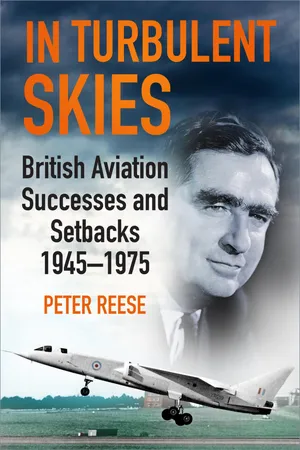
In 1945 confidence in British aviation was sky-high. Yet decades later, the industry had not lived up to its potential. What happened? The years that followed the war saw the Brabazon Committee issue flawed proposals for civil aviation planning. Enforced cancellations restricted the advancement of military aircraft, compounded later on by Defence Minister Duncan Sandys abandoning aircraft to fixate solely on missiles. Commercially, Britain's small and neglected domestic market hindered the development of civilian airliners. In the production of notorious aircraft, the inauspicious Comet came from de Havilland's attempts to gain an edge over its American competitors. The iconic Harrier jump jet and an indigenous crop of helicopters were squandered, while unrealistic performance requirements brought about the cancellation of TSR2. Peter Reese explores how repeated financial crises, a lack of rigour and fatal self-satisfaction led British aviation to miss vital opportunities across this turbulent period in Britain's skies.
- 304 pages
- English
- ePUB (mobile friendly)
- Available on iOS & Android
eBook - ePub
About this book
Information

1
CIVIL FLIGHT AFTER THE WAR:
STOPGAP AIRCRAFT
The Second World War checked what promised to be an exciting and expansionary time for British civil aviation, although just prior to the war Britain’s aircraft industry lagged behind both the US and Germany in the development and production of saleable civil transport aircraft.1 Journey times to other European capitals and to Empire destinations were coming down sharply, while flying across the Atlantic – if not yet in one bound – was increasing in frequency. As a result, flight was well on its way to becoming an accepted, if by no means regular, form of travel, with rapid growth certain.

Savoia-Marchetti S.73, a stylish Italian airliner. (Author’s collection)
In Britain such progression was checked by the outbreak of the war when its civil aviation was still in flux. On 4 August 1939, one month before war was declared, Imperial and British Airways united to become the British Overseas Airways Corporation (BOAC), but it would be a further nine months before, on 1 April 1940, the new authority started operating. By this time, overriding military requirements had led to the RAF’s takeover of Imperial’s former headquarters at Croydon and the decision to stop building civilian airliners during the war, in stark contrast to the continued production and development of airliners in the US.
Remarkably, unlike the German Luftwaffe, the RAF had made no detailed plans prior to the war for using civilian aircraft to support its increasing transport requirements. In any case, the planes available were a mixed bag with many at the veteran stage, although just before the amalgamation attempts had been made to obtain new and better aircraft. By the end of 1938, Imperial Airways had introduced their first Empire flying boats, and in the case of land planes, Armstrong Whitworth Ensigns were coming into service along with (the far less robust) de Havilland Albatrosses.
British Airways had always been more fortunate in not having to buy British aircraft and they had purchased Fokker and Junkers aeroplanes before acquiring American Lockheed 10s and 14s, whose 200mph cruising speed brought even Eastern European destinations a morning’s flight from London.2 On successive weekends in September 1938, the latter were used to fly Neville Chamberlain to Munich to engage in talks with Adolf Hitler over his proposed occupation of the German Sudetenland. Whatever the British airliners’ capabilities, in view of the imminent war, Sir Francis Shelmerdine, the then Director of Civil Aviation, took the revolutionary step of recommending the compulsory chartering and employment of all civilian aircraft.

The German Junkers Ju 52/3m, undoubtedly one of the best-known interwar aircraft. (Farnborough Air Sciences Trust)
Consequently, when war was declared, domestic air services were immediately suspended with land-based aircraft moving to Whitchurch near Bristol and the flying boats to Poole. At Whitchurch the staff camouflaged the planes by hand-painting them using pots of green and brown paint.
Although some cross-water services to Scotland, across the Channel, and to neutral states were soon resumed, other civilian aircraft were brought into the so-called National Air Communication Scheme, which was intended to act as a surrogate transport service for the Royal Air Force.3
In November 1939, a number of aeroplanes were flown out to France, where some were destroyed by the advancing Germans. In 1940, for instance, four of the twelve Ensigns were lost and only four Lockheed 14s out of seven survived the year.
By the end of 1940 the British Purchasing Commission was buying up what planes it could in the US, including second-hand DC-2s and Lodestars, to reinforce both BOAC and the RAF’s transport landplane fleet in the Near East and on the vital air route across Africa.4
With so many changes and aircraft losses, continuity among BOAC’s senior management would have been of obvious advantage but Sir John Reith, its outstanding chairman and author of the airlines’ amalgamation, left to join the War Cabinet as Minister of Information. He was succeeded by oil magnate the Honourable Clive Pearson, who although a gifted financier and air enthusiast who had masterminded the amalgamation of the internal airlines into British Airways, was essentially a shy man who lacked Reith’s contentiousness.
Pearson selected ship-owner Walter Runciman to be his director general and brought with him his previous managing director at British Airways, Major Ronald McCrindle, together with the company’s senior financial advisor, Gerard d’Erlanger. He quickly lost d’Erlanger, who assumed control of what came to be called the Air Transport Auxiliary, an organisation whose pilots, including women such as Amy Johnson, would ferry service aircraft from the factories to RAF squadrons.
From the outset, Pearson and his board faced major problems over aircraft capacity as they attempted to keep the traditional Empire routes open in the face of enemy action. These multiplied after attacks that caused repair facilities to be transferred from the UK to Durban, South Africa, with others established in Cairo, Egypt. From Durban, BOAC’s flying boats were able to progress through the Middle East to Australia and New Zealand on the so-called Horseshoe Route. Converted Liberator bombers were brought into use to fly RAF crews across the Atlantic to Montreal, where they picked up new aircraft coming on line in the US and Canada.5 Another important assignment was to fly between Scotland and Stockholm, to bring back indispensable Swedish ball-bearings.6 These were dangerous times for in the Middle East BOAC’s aircrews were often required to operate in extremely difficult conditions, such as having to fly a few feet from the ground to avoid enemy fighter interceptors in the Western Desert, or when flying to the relief of Malta.
Even so, to the dismay of some board members, during 1941 the Corporation’s tasks were reduced when Churchill asked Pan American Airways to take over many of the arrangements for the delivery of military aircraft to the Middle East. Following the US’s entry into the war, Pan American in turn relinquished its trans-Africa service to the United States Army Air Force, which commenced delivering supplies to its armed forces as well as those of China and Russia.
Whatever BOAC’s best efforts, with no new British planes it suffered from a chronic shortage of aircraft, a situation highlighted in December 1942 when during a debate in the House of Commons. Robert Perkins, the one-time scourge of Imperial Airways, described BOAC’s fleet in the following derogatory terms:
This mixed contingent of aircraft consists partly of old crocks, five, six, seven years old, many of them ripe for the scrap heap. It consists partly of RAF throw-outs, crumbs from the rich man’s table, machines which the RAF do not want, and partly owing to the generosity of our American friends, modern American machines.7
The modern American machines to which Perkins referred included the rugged all-metal Douglas Dakotas, which were delivered from 1942 onwards. In fact, BOAC not only had to share flying responsibilities with the Americans but had to watch the RAF’s growing involvement in operating regular transport services, until on 11 March 1943 the House of Commons learned of the RAF’s intention to establish its own Transport Command. The fast-expanding movement of personnel by air and the addition of other officials to the RAF’s earlier VIP passengers made this an inevitable step. The beleaguered BOAC board hardly saw it this way, considering it a major threat to their existence and to British civil aviation as a whole.

Douglas DC-3 Dakota IV with RAF markings. A total of 1,928 Dakotas were received by the RAF during the war. (Farnborough Air Sciences Trust)

Short S.25 Sunderland III G-AGJO, named Honduras. (Farnborough Air Sciences Trust)
Acting on this belief, Clive Pearson sent a memorandum to Harold Balfour, the Under-Secretary of State for Air, in which he emphasised that BOAC should not be in a subservient position where RAF Transport Command was concerned, and sought his assurance that the Corporation should operate all the regular trunk services ‘subject to political and military requirements’.
In fact, Pearson went much further, for when the minister’s response did not appear to recognise ‘the difficult conditions in which the Corporation has operated throughout its existence’, the chairman, accompanied by his board members (with the exception of Gerard d’Erlanger, who was running the Air Transport Auxiliary) tendered their resignations on 19 March 1943.
This was a gross overreaction and an ill-advised one, since it was hardly likely to change the government’s policy in their favour. In response it swiftly appointed a more malleable board with Lord Knollys, one-time Governor of Bermuda, as an ‘amateur’ chairman and Air Commodore Critchley, a veteran of the Great War and golf fanatic, as Director General. Despite his golf, Critchley saw that BOAC received extra aircraft and by the end of 1944 the airline had 44 flying boats and 111 land planes in service, including 52 Sunderlands.8
However inept Clive Pearson’s tactics, he had already proved himself an unquestioned champion of British civil aviation and in a final riposte he and his fellow directors set their future hopes down in a White Paper emphasising especially the lack of provisions for long-term post-war matters.9
In fact, Pearson was mistaken about the absence of long-term planning, although things were unquestionably still in the early stages. Three committees had already met to consider the question of British civil aviation’s revival after the war. Two sat as early as 1941, one under eminent aeronautical engineer Roy Fedden to consider future technological developments, while, under Sir Francis Shelmerdine, a government departmental committee discussed post-war policy in more general terms. In the following year an independent committee of senior industrialists with Peter Masefield as secretary also commenced looking at civil aviation’s future.
Due to other more pressing priorities none were sure of bringing about major results. The situation was, however, about to change when the Prime Minister’s attention was forcibly drawn to the problem. This occurred during 1942 when he decided to fly to Moscow and let Joseph Stalin know there was no chance of the UK and US opening a Second Front in Western Europe during the coming year. The only available aircraft was a Liberator bomber. Churchill was placed in its converted bomb bay, wh...
Table of contents
- Cover
- Title
- Copyright
- Contents
- Acknowledgements
- Prologue
- Part 1 - Continuing High Ambitions
- Part 2 - Expectations Denied
- Part 3 - Indecision and Cancellation
- Part 4 - Flights from Reality
- Summary
- Notes
- Select Bibliography
Trusted by 375,005 students
Access to over 1.5 million titles for a fair monthly price.
Study more efficiently using our study tools.
Frequently asked questions
Yes, you can cancel anytime from the Subscription tab in your account settings on the Perlego website. Your subscription will stay active until the end of your current billing period. Learn how to cancel your subscription
No, books cannot be downloaded as external files, such as PDFs, for use outside of Perlego. However, you can download books within the Perlego app for offline reading on mobile or tablet. Learn how to download books offline
Perlego offers two plans: Essential and Complete
- Essential is ideal for learners and professionals who enjoy exploring a wide range of subjects. Access the Essential Library with 800,000+ trusted titles and best-sellers across business, personal growth, and the humanities. Includes unlimited reading time and Standard Read Aloud voice.
- Complete: Perfect for advanced learners and researchers needing full, unrestricted access. Unlock 1.5M+ books across hundreds of subjects, including academic and specialized titles. The Complete Plan also includes advanced features like Premium Read Aloud and Research Assistant.
We are an online textbook subscription service, where you can get access to an entire online library for less than the price of a single book per month. With over 1.5 million books across 990+ topics, we’ve got you covered! Learn about our mission
Look out for the read-aloud symbol on your next book to see if you can listen to it. The read-aloud tool reads text aloud for you, highlighting the text as it is being read. You can pause it, speed it up and slow it down. Learn more about Read Aloud
Yes! You can use the Perlego app on both iOS and Android devices to read anytime, anywhere — even offline. Perfect for commutes or when you’re on the go.
Please note we cannot support devices running on iOS 13 and Android 7 or earlier. Learn more about using the app
Please note we cannot support devices running on iOS 13 and Android 7 or earlier. Learn more about using the app
Yes, you can access In Turbulent Skies by Peter Reese in PDF and/or ePUB format, as well as other popular books in Technology & Engineering & Manufacturing. We have over 1.5 million books available in our catalogue for you to explore.