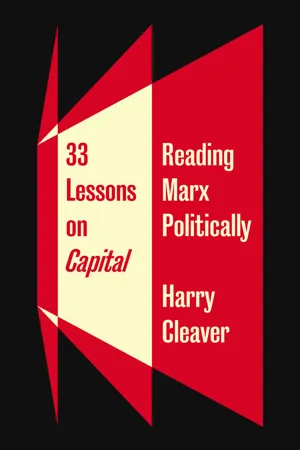
This book provides an up-to-date reading of Capital Volume I, emphasizing the relevance of Marx's analysis to everyday twenty-first century struggles. Harry Cleaver's treatise outlines and critiques Marx's analysis chapter by chapter. His unique interpretation of Marx's labour theory of value reveals how every theoretical category of Capital designates aspects of class struggle in ways that help us resist and escape them. At the same time, while rooted within the tradition of workerism, he understands the working class to include not only the industrial proletariat but also unwaged peasants, housewives, children and students. A challenge to scholars and an invaluable resource for students and activists today.
- 512 pages
- English
- ePUB (mobile friendly)
- Available on iOS & Android
eBook - ePub
About this book
Information
1
Introduction
Thirty-three lessons on the 33 chapters of Volume I of Karl Marx’s Capital. What?! Yet another book on Capital? Why read this one, among so many? Well, if you are looking for a scholarly text that interprets Capital as a work of economics or philosophy, this one is probably not for you. If you are seeking an interpretation designed to justify some partisan political platform, skip this one. If you need a philological treatise that draws on all editions and translations, look elsewhere. But, if you want to discover how what Marx wrote 150 years ago can help us understand our struggles and figure out what to do next, then this particular appropriation might provide some of what you are looking for.
The basic premise behind this book is the notion that Marx wrote Capital to put a political weapon into the hands of those of us opposed to capitalism and struggling to get beyond it. What kind of weapon? Above all, a theoretical one, designed to vivisect capitalism in ways that reveal how it dominates, exploits and alienates us, but also its vulnerabilities. Although committing surgery on living animals for research, testing or education is vile, vivisecting capitalism theoretically to figure out how to disrupt it, defeat it and create real alternatives, is all too necessary.1 Fortunately, Marx has not only given us tools for just such a purpose but has also shown us how to use them. This book aims to sharpen those tools—by demonstrating how even the most abstract concepts in Capital designate aspects of the antagonistic social relationships of capitalism in ways that help us resist and escape them. Capital was written as a political document; we do well to read it as such and put it to use.
At the time of its publication in 1867, Marx’s long-time engagement in the workers’ movements of the mid-nineteenth century made the political character of Capital quite clear.2 Yet, unlike earlier works, such as the relatively short and pithy Communist Manifesto of 1848, written with Engels for the Communist League at the beginning of the Revolutions of 1848, Capital is a massive tome, rivaling in length and complexity such classic works as Adam Smith’s Wealth of Nations (1776) or Hegel’s Phenomenology of the Spirit (1807). So, it is not surprising that economists have taken Capital to be offering an alternative economic analysis of capitalism and philosophers have read it as proposing an alternative philosophical science. But for those being exploited by capitalists at the time and doing their best—often with Marx’s support—to organize resistance, Capital provided both historical perspective and analytical tools. True then; still true today.
An example of his history-telling can be found in Chapter 10, where he sketches how capitalists, as they gained power, extended the length of the working day, forcing workers to work longer and longer. But he also sketches how workers, supported by social reformers, pushed back—forcing the government to create factory inspectors and then to pass Factory Acts imposing shorter hours. For workers, these were battles over how much of their lives they had to give up to their employers and how much they could retain for their own purposes. But his history is framed by his theory of absolute surplus-value (Chapters 7–11), which showed them how central such struggles were, not only to how much of their lives they were giving up, but how success in forcing down the length of the working day opened new possibilities for struggle. By creating more and more free time, successful work reduction made it possible to allocate more of their time and energy to exploring alternatives to capitalist ways of organizing their lives. By the time workers in the United States were fighting for a working day of eight hours, their slogan was “Eight hours of work, eight hours of sleep and eight hours for what we will!”
Similarly, his historical analysis of the increasing displacement of workers by machinery (Chapters 12–15) emphasized how it was a response to their struggles to work less. Against capitalists and their political economists who touted the use of machinery as making it possible to produce more with less work (higher productivity), Capital shows how capitalists use machines in a strategy of relative surplus-value to undermine workers’ self-organization and increase profits by intensifying work! Armed with Capital, workers could argue, “Sure, we’ll go along with new machines, but only if the increased productivity results in our having to work less! Machines should make our work both shorter and less onerous, not longer and more intense!”
Against employer and political economists’ arguments that increases in wages were impossible given the limits of the “Wages Fund” or would reduce the wages of other workers, Chapter 24 of Capital provided an analysis that permitted workers to argue how, within the context of rising productivity, not only were increased wages compatible with increased profits but wages could rise at the same time that work was reduced. “Enough with the bosses arrogating the entire fruits of increased productivity to themselves, they must share!”
But that was 150 years ago, give or take. What about today? How relevant are these issues and these analytical categories now? Unfortunately, struggles over the time of labor and the use of machines are still very much with us, not only in factories and offices but throughout society.
For the first half of the twentieth century, workers continued to hammer down the length of the working day, forcing capitalists to rely more and more on machines. Prototypical of the latter were the scientific management methods of Frederick Taylor (1856–1915) applied on the assembly lines of Henry Ford (1863–1947).3 So iconic were these that some analysts characterize the whole period as one of “Fordism.” For a while, in the 1940s and 1950s, work time was stabilized for a great many at about 40 hours a week and deals cut over productivity won higher wages but not less work. But a new cycle of struggle in the 1960s, often by workers wanting more free time to enjoy their higher wages, not only undermined absolute surplus-value through absenteeism and wildcat strikes but also undermined the capitalist use of machines through playing on the job and sabotage. The growth in productivity slowed and then declined, subverting relative surplus-value. The capitalist counterattack was multipronged but ultimately, by the beginning of the 1980s, they succeeded in reducing wages and increasing working hours. The decades-long, on-again, off-again march of workers toward zerowork was reversed and ever since capitalists have been using every ploy possible to increase work time.
Similarly, as computers—in both manufacturing and service industries—have become the most ubiquitous machines of our time, capitalists have deployed them systematically both to raise productivity and to extort more work. Early on, this extortion was obvious as personal computers displaced typewriters and programs were written to count secretarial keystrokes per minute, providing overseers with the means of pressuring typists to work faster, much as control over the speed of Ford’s assembly line provided the means to force manufacturing workers to work harder. Today, the widespread use of computers to compile data, “metrics,” is aimed at providing employers with new tools to increase workloads. At the same time, the deregulation of finance, the use of computer algorithms to guide speculation and the manipulation of debt have combined to enrich some capitalists while undermining workers’ income and wealth (mostly dependent on home ownership), forcing workers into longer hours or second jobs.
Finally, all these phenomena can be found far beyond the walls of factories and offices. They permeate schools, homes and everyday life in ways Marx never dreamed of, but whose character can still be illuminated by applying his theories. And this is true not only of capitalist methods but of our resistance. Against Fordist methods which had provided a template for the organization of schools, students in the 1960s rebelled, demanding less work and more time for self-defined, even self-organized studies. One result was “grade inflation” or higher grades for less work. Another was the creation of whole new fields, e.g., Black, Mexican-American or Women’s Studies. As schools substituted programmed, handheld computers for slide rules or calculators, students who were once asked to solve only one or two problems are today expected to solve dozens. Not less work, but more work. As with metrics in offices and factories, computer tracking of grades has given professors and administrators a tool to fight “grade inflation” and impose speed-up and more schoolwork. As women resisted subservience to housework, capital responded with household appliances, increasingly programmed and operated by built-in software. Although such equipment might be expected to result in less work, studies show that media-promulgated, ever-increased standards of cleanliness and expectations of beautiful homes and gardens have resulted in more housework rather than less.4 While the Internet and social media have provided workers, students and housewives with the means to organize against all this work, it has also provided capital with the means to track and subvert such organization, while spreading propaganda designed to accentuate well-known methods of dividing and conquering, i.e., the use of race, gender, ethnicity and national identity.
In short, what we have today are new forms of old conflicts. In an age where capitalists have sought to convert all of society into a social factory, resistance and struggle are everywhere and Capital still provides us with many tools for understanding the strategies arrayed against us and some insight into how the resistance of those who came before us may still be relevant to our actions today. The obvious question is what are those tools and how do we discover their usefulness?
If, as I argued in Reading Capital Politically (RCP), “capital” is not a thing but an antagonistic set of social relationships analyzed by Marx in Capital, then each and every category he deploys in the development and presentation of his theory denotes some aspect of those relationships.5 Above I mentioned his concepts of absolute and relative surplus-value. My formulation of the phenomena these two categories denote are the result of my particular—some say idiosyncratic—understanding of what Marx means by “value,” a much-disputed concept among both Marxists and their critics.
In RCP, I dissected Chapter 1 of Volume I on “The Commodity” and showed how each of the abstract concepts of the substance, measure and form of value can be understood not only as designating aspects of commodities, commodity exchange and money, but also as revealing aspects of the class struggles of capitalism—of the antagonistic conflicts between capitalist efforts to subordinate life to commodity production and our resistance to such subordination. This new book systematically extends that kind of analysis to the other chapters of Volume I of Capital.
Both RCP and this book are byproducts of some four decades of teaching, first at the L’Université de Sherbrooke in Quebec, then in the graduate program of the New School for Social Research in New York City and then at the University of Texas at Austin. The notes that became RCP were drafted in New York and turned into a book in Austin. As years went by and time permitted, to help students work their way through the first volume of Capital, I supplemented my undergraduate lectures by creating outlines and writing commentaries on Chapters 2–33, amplifying what I had time to say in the classroom for students to study at their leisure, independently of class times or office hours.
When the World Wide Web became available and RCP went out of print, I scanned the book, used OCR to create a digital version, used basic HTML to code it, and uploaded it, along with my existing outlines and commentaries to the course website as a “study guide,” illustrated with images, excerpts from literature, songs and textbook-like concepts and questions for review (http://la.utexas.edu/users/hcleaver/357k/357ksg.html). From that point on, I prepared new outlines and commentaries directly in HTML.
Convinced by many folks that I should meld RCP’s treatment of Chapter 1 with my notes on all the other chapters and publish the lot in the form of a hard-copy book, I decided to try. I copied and pasted the study guide webpages into MSWord documents and edited them, removing course-specific material, revising the text to reduce the number of words to a count consistent with an editor’s notion of a reasonably sized book. In the process, I realized that I also needed to revise the substantive chapters of RCP to correspond to the mode of my treatment of the other chapters. In the process, I found myself writing an entirely new book, not merely an expansion of RCP. Eventually, the contents of this book will be merged with the fully illustrated versions of the commentaries and course materials on the web.
The notes and commentaries on each chapter reflect the multiple objectives that I pursued in teaching Marx’s ideas. I came to study Marx, as I believe many do, as the result of dissatisfaction with alternative approaches to struggles in which I was personally engaged and to others I judged significant. I discovered, bit by bit, diverse “Marxist” interpretations of Capital—a diversity that reflects the contradictory politics of his interpreters. Trying to sort out those contradictions led me to examine their common source. As Friedrich Nietzsche (1844–1900) said of history, so I have come to say of Marx, the best reason to study the man’s writings is because they can enrich our lives, by informing our efforts to free ourselves of the constraints that limit us and by helping us discover freer ways to live, as individuals and as a society.6
OBJECTIVES AND ELABORATIONS
My primary objectives in my courses on Marx were twofold: rejecting the roundabout approach of a survey course, I offered students who wanted to study his ideas: 1) the opportunity to read his original writings; and 2) what I judged to be one useful interpretation. Because I had come to believe that the indispensable core of his theory is his labor theory of value, I also decided that the most appropriate place to start was Volume I of Capital, his most systematic presentation of that theory, where he deploys it to reveal the nature of capitalism, the struggles to which it inevitably gives rise and the possibilities for transcending it.
But “teaching” Capital raised other pedagogical problems. In small graduate classes, everyone could read the same material, sit around a table and discuss it, with individuals’ contributions informed by their own preoccupations, e.g., other things they were studying or the subject of their thesis or dissertation. In large undergraduate classes, for the most part lecturing dominated. In both cases, my contributions—in discussions or lectures—reflected my reading of the material being covered. Because I agree that all readings involve interpretation, I never pretended that mine was a true and accurate exposition of “what Marx really meant.” On the contrary, I presented my reading/interpretation as one of many possible alternatives. Therefore, I suggested to my students that their studies could most usefully proceed through two stages. First, ...
Table of contents
- Cover
- Title
- Copyright
- Contents
- Acknowledgments
- Sources and Citations
- 1 Introduction
- 2 Capital: A Critique of Political Economy
- 3 Part Eight: So-called Primitive Accumulation
- 4 Part One: Commodities and Money
- 5 Part Two: The Transformation of Money into Capital
- 6 Part Three: The Production of Absolute Surplus-Value
- 7 Part Four: The Production of Relative Surplus-Value
- 8 Part Five: The Production of Absolute and Relative Surplus-Value
- 9 Part Six: Wages
- 10 Part Seven: The Process of Accumulation of Capital
- 11 Conclusion
- Index
Trusted by 375,005 students
Access to over 1.5 million titles for a fair monthly price.
Study more efficiently using our study tools.
Frequently asked questions
Yes, you can cancel anytime from the Subscription tab in your account settings on the Perlego website. Your subscription will stay active until the end of your current billing period. Learn how to cancel your subscription
No, books cannot be downloaded as external files, such as PDFs, for use outside of Perlego. However, you can download books within the Perlego app for offline reading on mobile or tablet. Learn how to download books offline
Perlego offers two plans: Essential and Complete
- Essential is ideal for learners and professionals who enjoy exploring a wide range of subjects. Access the Essential Library with 800,000+ trusted titles and best-sellers across business, personal growth, and the humanities. Includes unlimited reading time and Standard Read Aloud voice.
- Complete: Perfect for advanced learners and researchers needing full, unrestricted access. Unlock 1.5M+ books across hundreds of subjects, including academic and specialized titles. The Complete Plan also includes advanced features like Premium Read Aloud and Research Assistant.
We are an online textbook subscription service, where you can get access to an entire online library for less than the price of a single book per month. With over 1.5 million books across 990+ topics, we’ve got you covered! Learn about our mission
Look out for the read-aloud symbol on your next book to see if you can listen to it. The read-aloud tool reads text aloud for you, highlighting the text as it is being read. You can pause it, speed it up and slow it down. Learn more about Read Aloud
Yes! You can use the Perlego app on both iOS and Android devices to read anytime, anywhere — even offline. Perfect for commutes or when you’re on the go.
Please note we cannot support devices running on iOS 13 and Android 7 or earlier. Learn more about using the app
Please note we cannot support devices running on iOS 13 and Android 7 or earlier. Learn more about using the app
Yes, you can access 33 Lessons on Capital by Harry Cleaver in PDF and/or ePUB format, as well as other popular books in Politics & International Relations & Economic Theory. We have over 1.5 million books available in our catalogue for you to explore.