- English
- ePUB (mobile friendly)
- Available on iOS & Android
eBook - ePub
About this book
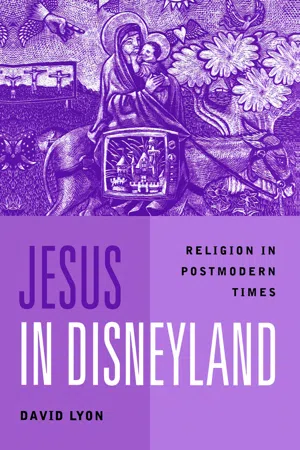
In this lively and accessible study, David Lyon explores the relationship between religion and postmodernity, through the central metaphor of 'Jesus in Disneyland.'
Information
1
Meeting Jesus in Disneyland
It is Disneyland that is authentic here! The cinema and TV are America’s reality! The freeways, the Safeways, the skylines, speed, deserts – these are America, not the galleries, the churches, the culture.
Jean Baudrillard1
The scene is Anaheim, California, home of Disneyland. Not unusually, 10,000 people are streaming through the turnstiles. Only today they are heading for a Harvest Day Crusade. In place of the regular attractions and rides, Christian artists perform at several stages through the park, and an evangelist, Greg Laurie, preaches a gospel message. While some find the juxtaposition somewhat incongruous (has not the Disney Corporation expanded its family values to include gays and lesbians? is beer not sold here?) the organizers have no qualms about it: “We saw Disneyland as an opportunity to bring God’s kingdom to the Magic Kingdom. We felt that, as they opened the door to us to share Christ, we wouldn’t turn down the opportunity just because other things take place there. Jesus is the example for this.”2
Jesus in Disneyland. A bizarre sounding collaboration. Or is it? Just why does it appear so odd? At first blush, the objection could be that an ancient, premodern religion is found side-by-side, or, more accurately, interacting with, the epitome of postmodern culture – the artificial, simulated, virtual, fantasy world of Disney. It is not as if this religious group is merely using the park as a stadium for its event. To a considerable extent they adopt the styles, the fashions, even the attitudes of Disneyland. And they are not alone. Other groups – such as at the annual evangelical Spring Harvest weeks at Butlin’s Holiday Camps or at Christian events at Legoland in the UK, and at numerous Christian theme parks, such as Logosland in Ontario – use similar venues and methods.
It seems like an anachronism. Two vastly different historical eras are telescoped incongruously into one, within the gates of a theme park. Not only do the two seem historically out of place; culturally, too, they clash. The simply-dressed, sandal-clad, travelling rabbi who quietly admitted to close associates that he was God’s promised Messiah – Jesus – also has connections with the self-advertising, technologically complex, consumer culture of comfortable California? Anachronism or not, such things occur, especially in America.
But the problem is not just one of oddity. This collusion – or collision – of cultures also takes place in a context that was once supposed to have erased most traces of conventional religion from daily life. It is often said that when premodern religions met modernity, from the seventeenth century onwards, relations were less than cordial. The scientific-technological revolution, the burgeoning of industrial capitalism, and the rise of urbanism and democratic polities often had an abrasive and corrosive effect on organized religion. The mathematician LaPlace took the trouble to inform the French emperor that he “had no need of the hypothesis” of God.3 For many others, the process was implicit, whereby the “hypothesis” was for all practical purposes quietly dropped. Religious vestiges gradually succumbed to the evolutionary forces of modernity. Or so the story goes.
All this, and more, makes it hard to account for the Jesus in Disneyland event. Yet it occurred. And, apart from a few raised eyebrows, it was not treated by those involved as an anomaly or an isolated California quirk. Perhaps the difficulty is in the eye of the beholder? Those accustomed to the predominantly secular discourse of contemporary politics, mass media, or academe apparently have a harder time coping with Jesus in Disneyland than those who actually attended this event. This is not meant to imply that there is no anomaly, or that the view from below, which cheerfully harmonizes the surface contradictions, is in fact superior or correct. Nor do I mean to propose, however, that the secular discourse has it right either. Rather, I suggest that both perspectives should be problematized – held up for serious and careful examination – as a prelude to a better accounting for the event.
In what follows, I offer just such a problematizing account, as an introduction to the broad themes of this book. While the Jesus in Disneyland event is interesting in its own right, it also opens a fascinating window on contemporary religion and society. Conventional religion – in this case Christianity, but similar analysis can be made of other religions – is caught at a curious cultural juncture. Disneyland captures several crucial features of this, as the theme parks epitomize the tensions of modernity. Both modern and postmodern elements may be discerned at Disneyland, and today religious life is drawn by the pull of both gravitational fields.
Disneyland is a social and cultural symbol of our times. In particular, Disneyland is a trope for the democratization of culture, including religion.4 An event like the one noted here raises questions about the deregulation of religion. Disneyland also points up the ambiguities and ironies of modernity and postmodernity, as well as their sources, the proliferation of new communications media, and the growth of consumerism. Disneyland as a cultural symbol also hints strongly at questions of authority and identity, and of time and space, each of which is crucial for a contemporary understanding of religion, spirituality, and faith.
Disney’s social impact
There can be little doubt that Disney’s influence is universal. Wherever it is possible to see a television or a cinema screen, Disney characters will not be strangers. And in more and more world tourist destinations, a Disney theme park is within reach. Plans for the latest are currently under way in Hong Kong.5 Disney’s impact extends far beyond films or parks made by the Disney corporation. By the end of the twentieth century Disney had become a byword for commercial culture, a symbol for animated cartoon lives, a model for tourist activities, and a mode of imagination. But it was also a way of communicating, a herald of technological futures, an architectural inspiration, and a guide to city planning. In Melbourne, Australia, a recent festival celebrated a Disneyfied Winnie-the-Pooh as a “United Nations ambassador for international friendship!” Under these conditions, it would be surprising if Disney did not have a religious relevance.
There are two main concepts used in exploring Disney’s social influence, Disneyfication and Disneyization. Each has something significant to offer, but it is worth distinguishing between them. Disneyfication tends to be used critically. Spy magazine, for instance, defines Disneyfication as “the act of assuming, through the process of assimilation, the traits and characteristics more familiarly associated with a theme park … than with real life.”6 The same magazine reported a telephone interview with Walt Disney World, in which it asked about the possibility of laying on a “Fantasia wedding,” featuring a transparent box of mice, with pinned-on ear enlargements. The Disney receptionist balked at this, explaining that Mickey himself would attend. “Why simulate it with a real mouse when you can have the genuine article there?”, she asked. The author of this piece also observed that “Genuine Disneyfication must be tawdry, contrived, useless, and dripping with class panic.”
More sociologically Chris Rojek focuses on the moral and political culture represented by the Disney leisure industry, coming to the caustic conclusion that Disney parks “encourage the consumer to relate to America as a spectacle rather than as an object of citizenship.”7 Disneyfication makes social conflict temporary and abnormal, emphasizes individual rather than collective action, and generally acts as a mouthpiece for the American Way. The Disney world view fails to make sense of the present or to provide a plausible vision of the future, sacrificing “knowledge for staged spectacles organized around soundbites of history and culture.”8 Thus for Rojek Disneyfication subtly organizes our lives, even while letting us think that we are in a realm of release and escape.
Umberto Eco takes a similarly critical line, applying it to the ongoing uncertainty generated by Disney in order to perpetuate consumption. Deep questions of good and evil are rendered shallow through this process. The cynical shows through all too readily. Eco thinks of America as the prominent hyper-reality, whose ideology “wants to establish reassurance through imitation. But profit defeats ideology, because the consumers want to be thrilled not only by the guarantee of the good but also by the shudder of the bad.” Thus there must be metaphysical evil, “both with the same level of credibility, both with the same level of fakery. Thus, on entering his cathedrals of iconic reassurance, the visitor will remain uncertain whether his final destination is heaven or hell, and so will consume new promises.”9
Such critical approaches to Disney have much to commend them. Disneyfication may be viewed as a process that diminishes human life through trivializing it, or making involvement within it appear less than fully serious. No wonder Neil Postman wrote of “amusing ourselves to death.”10 Yet the Disneyfication thesis also has limits. The negative approach is not necessarily helpful in all contexts. With no pretence at neutrality, the term Disneyization has been proposed as an analytical alternative. Alan Bryman proposes that it should be defined as “the process by which the principles of the Disney theme parks are coming to dominate more and more sectors of American society as well as the rest of the world.”11 He isolates four elements of Disneyization, which are outlined below. As I shall show, each principle also resonates in significant ways with some major themes of this book.
The first aspect is “theming,” which can of course be found in many contexts not directly touched by Disney. Thus cafés and bars may be themed, along with hotels and shopping malls. Well-known examples include the Hard Rock Café and the Subway outlets. Theming lends coherence to a site, giving it a story line. Theming creates connections and thereby gives a particular ambience to a complete environment. Today, that environment may be physical, at a permanent theme park site. But it may also be virtual. All computer users have become aware of particular kinds of “environments” that are themed in idiosyncratic ways, the “Mac” environment, or the “Netscape” one, and so on. Theming may be seen as postmodern surrogates for narratives (even “metanarratives”) which, however fragmentary or temporary, tell tales within which lives may be located.
Bryman’s second aspect is the “dedifferentiation of consumption.” This technical term refers to ways that “forms of consumption associated with different institutional spheres become interlocked with each other and increasingly difficult to distinguish.”12 It is a breaking down of conventional cultural differences between kinds of consumption and between consuming and other activities. In the World Showcase of the EPCOT Center, visitors to Disneyland think they are sampling cultures from around the world, whereas in reality they are entering a thinly disguised shopping area. Conversely, sites where one expects to shop seem to spawn attractions. You can find rides and leisure zones within shopping malls. Airports and train stations provide evidence of the same phenomenon. Authentic crafts and current CDs can be bought, haircuts and massages obtained, tickets bought and checked. Increasingly, then, in more and more daily life contexts, one may expect to consume across a broad range of items. Such dedifferentation accentuates the consumer culture, in which consumption becomes an order of life. The dedifferentiated environment privileges consumer outlooks and consumer skills.
Thirdly, Disneyization means merchandising. Images and logos are used to promote goods for sale, or are themselves for sale. The parks are both places where such merchandise is sold and the source of images and logos. Likewise the films are a source of images and logos that appear on merchandise, sometimes even before a film has been released. Many others, from sports teams to universities, have learned the Disneyesque techniques and advantages of merchandising. From our point of view, merchandising points up the power of an image, both in its own right and as something that can be bought. Merchandising also refers to itself and thus connects with a more general trend towards self-referentiality, which is a prime component of the post-modern. A recent example of this is the picture of the classic Coke bottle that appears on Coke cans, to reassure imbibers that it is the “real thing.”
Fourthly, Disneyization involves emotional labour. Rather as McDonald’s restaurants attempt to control the ways their employees view themselves and how they feel, so the Disney Corporation encourages scripted interactions using its staff. Theme park employees are well known for their smiling friendliness and helpfulness. Disney employees are supposed to give the impression that they are having fun too and not really working.13 This focus on the self, and how the self is expressed, is again a feature of the postmodern. As we shall see, the modes of self-expression in postmodern times relate to the religious realm in interesting ways.
Bryman explores the possibility that while McDonaldization exudes some very modern features associated with bureaucratic organization, Disneyization portends a shift into the postmodern. Disneyization spells consumerism and a concern with the sign value of goods, with style and identity projects. Disneyization breaks down differences, is depthless, and deals in cultivated nostalgia and in playfulness about reality. These are certainly themes that I think are deeply significant, both for the worlds of Disney and for the worlds of the postmodern. How far these features are affecting – and are affected by – contemporary religious spheres remains to be seen.
Modern and postmodern
The Jesus in Disneyland event may be used as an exemplar for understanding religion and society relationships at the turn of the twenty-first century. In several significant respects, religion is being both Disneyfied and Disneyized. This is what makes Disneyland such a good trope for contemporary culture, both modern and, increasingly, postmodern. Disneyland encapsulates in concentrated form some leading trends, especially the preoccupation with consuming – fashion, film, and music – and the experience of spectacles made possible by high technology. While Disney’s simulations by electronic media raise doubts about reality, and thus connect neatly with the postmodern, there are many other features of Disneyland that still seem thoroughly modern. High technology, to take the most obvious example, is also explicitly linked, through the high-tech EPCOT Center, with classic modern notions of progress and linear time.
How, after all, does one enter the Magic Kingdom? What sustains this world? Well, all major credit cards are accepted and these, along with the whole massive theme park system, are entirely dependent on the highest of high technology. Night and day, electric power flows into Disneyland to support the operation of machinery and its finely tuned computer-controlled system. Moreover, McDonaldization, which epitomizes principles of modernity such as bureaucratic organization and scientific management, is also present in the theme parks.14 Whatever else postmodern means, at Disneyland or elsewhere, it emphatically does not mean that consumer capitalism has collapsed or that modern technology has been jettisoned. Just the reverse. The modern and the postmodern are equally characteristic of Disneyland.
It is crucial to dispose of the idea that modernity has somehow ground to a halt, to be replaced by postmodern conditions. Rather, the prefix “post” is attached to “modernity” in order to alert us to the fact that modernity itself is now in question. This does not mean that the sense of an ending – evinced in much postmodern literature – is insignificant, only that it can be over-extended. Sociologically speaking, although the rediscovery of deep cultural influences has helped to balance the analysis of social structure, the danger is to imagine that somehow social settings are irrelevant to the emergence of new cultural landscapes. Postmodernity is a kind of interim situation where some characteristics of modernity have been inflated to such an extent that modernity becomes scarcely recognizable as such, but exactly what the new situation is – or even whe...
Table of contents
- Cover Page
- Title Page
- Copyright
- Contents
- Acknowledgements
- Preface
- 1. Meeting Jesus in Disneyland
- 2. Faith’s Fate
- 3. Postmodern Premonitions
- 4. Signs of the Times
- 5. Shopping for a Self
- 6. A Global Spirit
- 7. Telescoped Time
- 8. Faith’s Future
- Notes
- Bibliography
- Subject Index
- Name Index
Trusted by 375,005 students
Access to over 1.5 million titles for a fair monthly price.
Study more efficiently using our study tools.
Frequently asked questions
Yes, you can cancel anytime from the Subscription tab in your account settings on the Perlego website. Your subscription will stay active until the end of your current billing period. Learn how to cancel your subscription
No, books cannot be downloaded as external files, such as PDFs, for use outside of Perlego. However, you can download books within the Perlego app for offline reading on mobile or tablet. Learn how to download books offline
Perlego offers two plans: Essential and Complete
- Essential is ideal for learners and professionals who enjoy exploring a wide range of subjects. Access the Essential Library with 800,000+ trusted titles and best-sellers across business, personal growth, and the humanities. Includes unlimited reading time and Standard Read Aloud voice.
- Complete: Perfect for advanced learners and researchers needing full, unrestricted access. Unlock 1.5M+ books across hundreds of subjects, including academic and specialized titles. The Complete Plan also includes advanced features like Premium Read Aloud and Research Assistant.
We are an online textbook subscription service, where you can get access to an entire online library for less than the price of a single book per month. With over 1.5 million books across 990+ topics, we’ve got you covered! Learn about our mission
Look out for the read-aloud symbol on your next book to see if you can listen to it. The read-aloud tool reads text aloud for you, highlighting the text as it is being read. You can pause it, speed it up and slow it down. Learn more about Read Aloud
Yes! You can use the Perlego app on both iOS and Android devices to read anytime, anywhere — even offline. Perfect for commutes or when you’re on the go.
Please note we cannot support devices running on iOS 13 and Android 7 or earlier. Learn more about using the app
Please note we cannot support devices running on iOS 13 and Android 7 or earlier. Learn more about using the app
Yes, you can access Jesus in Disneyland by David Lyon in PDF and/or ePUB format, as well as other popular books in Social Sciences & Sociology of Religion. We have over 1.5 million books available in our catalogue for you to explore.