- Examines the international aspect of the interdependence of globalization and technology.
- Explores the role of cross-border interdependence in the innovation process, as well as interdependence between firms.
- Reveals an interesting paradox: locations and firms are increasingly interdependent through supranational organisations and the flow of investments, technologies, ideas, and people; but knowledge creation suffers from 'inertia' and remains concentrated in a few locations.
- Draws on a wide variety of data at the firm and national level in the sphere of R&D and technological innovation.
- Spells out important lessons for both policy makers and managers on industrial policy as well as the organisation of research and development by firms.

eBook - ePub
Globalization and Technology
Interdependence, Innovation Systems and Industrial Policy
- English
- ePUB (mobile friendly)
- Available on iOS & Android
eBook - ePub
Globalization and Technology
Interdependence, Innovation Systems and Industrial Policy
About this book
In this book Rajneesh Narula examines the interdependence of globalization and technological innovation at two levels: first, between locations, by examining the role of cross-border initiatives in the innovation process; second, between corporate entities, by studying the dynamics of inter-firm R&D collaboration.
Information
1
Technology and Globalization as Concatenated Processes:
A Brief Commentary on the Causes of Globalization
1.1 Introduction
To reiterate what has been stated in the introduction, evolutionary processes have two fundamental features. First, they occur in historical time and are non-reversible. Second, they are about the creation of novelty, and this creative process involves selection mechanisms in which the environment determines which novelties survive. Thus, by extension, it is about both creation and destruction of novelties, and the cumulative processes that these entail. Technology and globalization are both evolutionary, but it is essential to emphasize that they are by no means synchronized. They are instead co-evolutionary. That is, they represent different systems that are evolutionary, but are to some extent independent. By extension, this implies that they are also to some extent interdependent. The word ‘concatenation’ describes this well. It implies that technology and globalization are inextricably linked together, yet are not the same object. There are other co-determinants of globalization, some of which are also linked to technological change, and also bound to evolutionary principles. It is essential that we understand their principal components before we get to the heart of the matter, which is to understand the changing interdependence of firms and countries on a cross-border basis. To this end we also need to have an understanding of globalization’s tangible properties and causes; it is a sum of its parts, no more and no less.
There are two secondary issues that I want to illustrate by example in this chapter, but not seek to prove in any rigorous fashion. First, that globalization is a summation and accumulation of various other evolutionary processes. There are myriad other processes and events which through an unlikely and complex intertwining define the essence of globalization. It is a slippery beast, precisely because it does not really exist. But as with all myths it has real foundations, and this is what much of this chapter will attempt to do. Second, that globalization is not new (Drucker 1997). Its equivalent Latin word was probably in daily use during the heyday of the Roman Empire. It is simply fashionable once again. Yet it grips our imagination, fascinating and horrifying us simultaneously. Globalization – and its constituent processes – has occurred largely incrementally, punctuated by numerous discontinuities. Various aspects of globalization are more intense than they were in the past, but globalization in the sense of interdependence has historical, past dependence.
This chapter seeks to put the rest of this volume in context: although much of the rest of this book purports to focus explicitly on technology and globalization, globalization is a much larger and more involved phenomenon. Chapter 1 sets the stage by going through some of various elements that intermediate between globalization and technology.
1.2 Mapping globalization
It is no simple task to map out the causes of globalization: a whole literature has evolved in pursuit of this elusive goal, most recently reviewed by Ietto-Gillies (2002), and probably most thoroughly by Dicken (1998) and Held et al. (1999). The problem, as I see it, is that any analysis of the causes of globalization requires an anti-monde test. That is, what might be the case ‘in another world’? This is different from simply comparing an ex ante situation with the ex post environment, which is the most prevalent means of economic analysis. This is not simply because economists are lacking in imagination, but that economics (despite the best efforts of some) is not a science but a social science. The beauty of science is in its clear-cut boundaries. An experiment in physics or engineering is regarded as successful only if it can be repeated ad infinitum with exactly the same results, regardless by whom or where or when. Furthermore, it is possible to exclude certain processes in the repetition, to create a ‘control’. In the social sciences, we are obliged to throw in a ‘ceteris paribus’ clause even into our theorizing. In order to test these arguments we sometimes introduce numerous restrictive and often implausible assumptions. Unfortunately all else rarely is equal. Time moves on, and with it there are numerous other factors that have changed. We cannot, for instance, study how Bismarck might have helped create a coherent nation-state in the Balkans. Even when our analysis is drawn to rather simple questions, there remains a non-replicable element, because there are a hundred other factors, which cannot be precisely identified, much less controlled. The various social science disciplines are largely inseparable when dealing with questions of even reasonable magnitude.
In addition to the non-replicability bottleneck, we are faced with the chicken and egg dilemma. Are economic units more interdependent because of improved transportation opportunities? There is no denying that there is a relationship between the two, but might it not also be the case that the need of economic units to transport goods more efficiently leads to improved transportation? Similar arguments can be made about information and communications technologies (ICTs), other new technologies, international institutions, and the like.
I believe the best we can reasonably expect to say is that there are numerous factors that are interrelated, and should not worry too much about the direction of the causality or the relative importance of each. Academics (myself included) sometimes get mired in technicalities and miss the big picture.
After such an opening, it seems rather bold to attempt to map out the primary forces underlying globalization, but this is exactly what I have attempted to do in figure 1.1. This is not a complete taxonomy, and the layout, order and arrows are for illustrative purposes only, since cause and effect are hard to determine. I have tried to classify the causes of globalization into three distinct categories, as distinct from outcomes of globalization. However, there is a decided fuzziness between the two categories, and in this chapter I discuss some (but not all) elements from each of the categories:
1 Those associated with political economy and the environment (figure 1.1). Sections 1.3, 1.5, 1.6, 1.7, and 1.10 briefly discuss some of these forces. Note that there is considerable overlap between these variables, and with FDI and trade.
2 Those associated with technology are on the right-hand side of figure 1.1. In this chapter, I shall only discuss new technologies (section 1.8) and the multi-technology firm (section 1.9). This oversight is intentional, since technology is one of the main themes of the subsequent chapters.
3 Variables associated with the growth, spread and the intensity of MNE activity (figure 1.1), and are analysed in section 1.4. Note that, strictly speaking, the growth of MNE activity is a subset of financial liberalization, which itself is a function of numerous other political economy variables.
4 Variables that are most commonly identified as outcomes of globalization (figure 1.1). In this chapter I provide some brief comments on the homogeneity of consumption patterns and standardization (section 1.11).
Figure 1.1 Mapping globalization
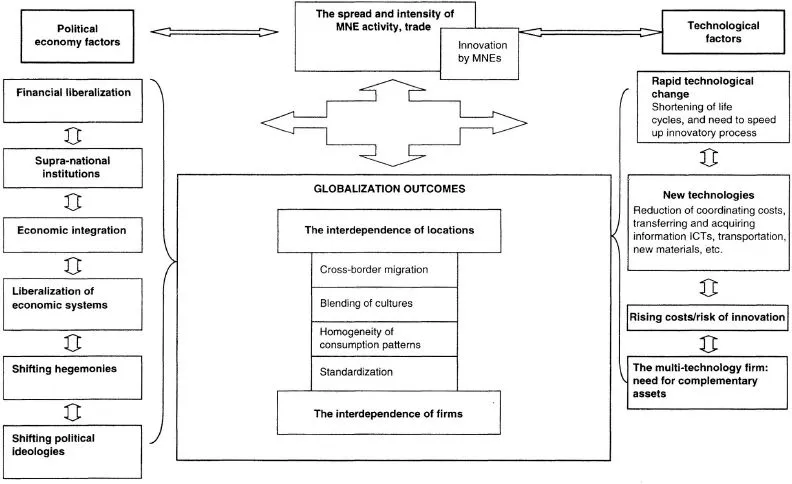
Note that the MNE category is purposely not sub-categorized, with the exception of globalization of innovation by MNEs (section 1.5). This is because MNE activity is itself a function of the various other primary forces. For instance, one can say that increased MNE activity is a result of increased cross-border competition. However, cross-border competition is a function of economic and regional integration. It is also a result of financial liberalization, the shift towards market economies and neo-liberal economic policies. These in turn are partly caused by the ascendancy of the US as a singular hegemonic power. There is also a process of positive feedback: the greater the spread of any given MNE, the greater the pressure on its competitors to spread likewise.
It should be patently obvious that the creation of four clear and distinct categories is fraught with difficulty. To give another example, new information and communication technologies may have reduced transaction costs, and made economic integration (both de facto and de jure) possible. But economic integration itself would not have been possible without the reduction of trade and investment barriers. Such reductions would not have occurred had not economic actors (such as MNEs) engaged in trade and investment demonstrated the positive social returns of increased cross-border activity. The increases in trade and investments have driven the need to improve appropriability of MNEs’ intellectual property rights, and the ability to enforce contracts across borders, prompting the development of supra-national institutions and international agreements. Such agreements are essential for economic integration, but creating such agreements depends on participants having sufficiently compatible legal frameworks. It should be obvious from these two examples that trying to map all inter-linkages is futile, because the links between all these factors are self-reinforcing and rampant.
It is important to re-emphasize that while most change occurs incrementally, discontinuities play a significant and unpredictable role, although hindsight has the advantage of always being perfect. Such discontinuities can be political (e.g., the collapse of the USSR), technological (e.g., the invention of the transistor), or even natural (e.g., El Niño, the AIDS epidemic). It is tempting to include ‘chance’ as an important variable, but this would be universal platitude and thereby a tautology.
The next few sections deal with some of these main forces underlying globalization, all described with the caveat that each is a function of the others, but keeping the focus on technology and globalization. The categorization is simply a device to aid the reader by providing simplicity of presentation, without, it is hoped, oversimplification. In each section I will highlight three points: I provide a brief historical context and its development to the current state of affairs; I provide some brief discussion on how the factor in question relates to the other factors; and where relevant, I hope to highlight that interdependence is at an early – and not necessarily stable – stage of evolution.
1.3 Financial liberalization
Liberalization has come to have many meanings, and these vary to include the liberalization of capital flows, the liberalization of trade regimes, and the liberalization of markets and economic systems. In this section my interest is on financial liberalization, and in particular on international capital flows, although the liberalization of economic systems is an associated process, which is discussed in section 1.6. It is no exaggeration to claim that the liberalization of capital flows has been a decisive feature of the post-1945 ‘liberalization’.
International capital flows can be differentiated into several types (Held et al. 1999):
- foreign direct investment;
- international bank lending;
- international bonds and other credit instruments;
- portfolio investment, which implies ownership of shares or bonds of firms located overseas without the control associated with direct investment;
- international equities and other financial instruments (such as options and derivatives);
- development assistance and aid (both government to government aid, and NGO-controlled flows);
- monetary flows (through the sales and purchase of foreign currencies).
As admirably narrated by Held et al. (1999: ch. 4), there has been a gradual globalization of such activities over the last 150 years or so. In other words, liberalization too has occurred largely incrementally over the long term, dating back to the establishment of the formal gold standard in 1878. The gold standard as a concept – that currencies were backed by reserves of gold – survived until the end of the twentieth century, although the institutions associated with the gold standard were superseded by new regulations (and organizations to monitor and enforce these regulations) established under the terms of the Bretton Woods agreement in 1944.
The liberalization of capital flows in the Bretton Woods scenario was not all-inclusive. It led to the growth of mult...
Table of contents
- Cover
- Contents
- Title Page
- Copyright
- Figures
- Tables
- Boxes
- Abbreviations
- Acknowledgements
- Introduction
- 1 Technology and Globalization as Concatenated Processes: A Brief Commentary on the Causes of Globalization
- 2 Cross-border Interdependence between Locations: Learning, Growth and Systems of Innovation
- 3 Innovation Systems and ‘Inertia’ in R&D Location: Norwegian Firms and the Role of Systemic Lock-in
- 4 Cross-border Interdependence between Firms: The Growth of Strategic Technology Partnering
- 5 In-house R&D, Outsourcing or Alliances? Some Strategic and Economic Considerations
- 6 Technological Catch-up and Strategic Technology Partnering in Developing Countries
- 7 Technology, Globalization and Policy Issues: Some Observations
- Notes
- References
- Index
Trusted by 375,005 students
Access to over 1.5 million titles for a fair monthly price.
Study more efficiently using our study tools.
Frequently asked questions
Yes, you can cancel anytime from the Subscription tab in your account settings on the Perlego website. Your subscription will stay active until the end of your current billing period. Learn how to cancel your subscription
No, books cannot be downloaded as external files, such as PDFs, for use outside of Perlego. However, you can download books within the Perlego app for offline reading on mobile or tablet. Learn how to download books offline
Perlego offers two plans: Essential and Complete
- Essential is ideal for learners and professionals who enjoy exploring a wide range of subjects. Access the Essential Library with 800,000+ trusted titles and best-sellers across business, personal growth, and the humanities. Includes unlimited reading time and Standard Read Aloud voice.
- Complete: Perfect for advanced learners and researchers needing full, unrestricted access. Unlock 1.5M+ books across hundreds of subjects, including academic and specialized titles. The Complete Plan also includes advanced features like Premium Read Aloud and Research Assistant.
We are an online textbook subscription service, where you can get access to an entire online library for less than the price of a single book per month. With over 1.5 million books across 990+ topics, we’ve got you covered! Learn about our mission
Look out for the read-aloud symbol on your next book to see if you can listen to it. The read-aloud tool reads text aloud for you, highlighting the text as it is being read. You can pause it, speed it up and slow it down. Learn more about Read Aloud
Yes! You can use the Perlego app on both iOS and Android devices to read anytime, anywhere — even offline. Perfect for commutes or when you’re on the go.
Please note we cannot support devices running on iOS 13 and Android 7 or earlier. Learn more about using the app
Please note we cannot support devices running on iOS 13 and Android 7 or earlier. Learn more about using the app
Yes, you can access Globalization and Technology by Rajneesh Narula in PDF and/or ePUB format, as well as other popular books in Politics & International Relations & Globalisation. We have over 1.5 million books available in our catalogue for you to explore.