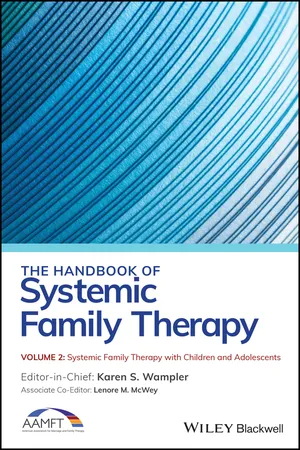
Volume II of The Handbook of Systemic Family Therapy presents established and emerging models of relational treatment of children and young people. Developed in partnership with the American Association for Marriage and Family Therapy (AAMFT), it will appeal to clinicians, such as couple, marital, and family therapists, counselors, psychologists, social workers, and psychiatrists. It will also benefit researchers, educators, and graduate students involved in CMFT.
- English
- ePUB (mobile friendly)
- Available on iOS & Android
eBook - ePub
About this book
Information
Part I
Overview
1
The Evolution of Systemic Approaches to Children and Adolescents
Richard S. Wampler
This volume in The Handbook of Systemic Family Therapy is focused on systemic therapy with children and adolescents. In it, you will find many different systemic approaches to the myriad problems for which young persons (birth to “emerging adulthood”) and their families seek services. Throughout this chapter, I will emphasize the need for systemic family therapists to actually think systemically. Offspring of all ages, including infants and their parents, can potentially benefit from a systemic family approach. Infants and toddlers certainly require a different approach than preschoolers, high schoolers, and emerging adults, but all these offspring are embedded in systems that can benefit from the services of systemic family therapists.
Roles for Systemic Family Therapists
Not every problem presented in systemic family therapy (SFT) has a diagnosis in DSM‐V or ICD‐10, but understanding how systems function and how to encourage change can lead to young persons and families who are stronger and more resilient. SFT can provide primary assistance for some cases, without reference to other entities or professionals. However, SFT also can provide critical secondary support for families in other cases by collaborating with the wider community of professionals, agencies, and other entities. In these latter cases (e.g., chronic illnesses), SFT practitioners can provide services to families while also advising, informing, supporting, and cooperating and communicating with other mental and physical health providers, as well as learning from these other providers' expertise. In still other cases, SFT needs to take a tertiary place—being aware of and referring clients to other services and watching admiringly as others with different knowledge and expertise do their work. A useful SFT motto is “Stay in your lane!”
Another valuable SFT motto is “Be an advocate!” One of the strengths of systemic thinking is to consider “what else” might be responsible for the issues with which the young person is dealing. Certainly, some children and adolescents actually ask to come into SFT for help; however, many (most, if we are honest) come into SFT because someone else wants them there. In the first case, the prospective client may need to share a secret (feelings of mental illness, sexual assault, domestic violence, sexual identity). In the second case, the prospective client is seen as causing a “problem” for another person or entity, presenting a dilemma for a therapist who wants to practice SFT effectively. Do we see the child/adolescent individually, with a parent or both parents, with any siblings, with any other relatives or professionals? The unexpected answer is, “Yes!”
Choosing the right client system
SFT has outlasted the purists who claim SFT is impossible without the whole system and family in the room. The reality is that most experienced systemic family therapists find themselves in a room with a young person, perhaps with one or both parents or not, and with one or more others or not. Developing and refining a theoretical SFT position and using that position to inform therapy are critical for SFT. Theory provides a roadmap, but it is not the actual journey we must take with clients. Flexibility in what actually happens in cases is a necessity. I am reminded of a young solution‐focused therapist, a purist, who worked successfully in the homes of very distressed and disorganized families where a child was on juvenile probation. He told me about a surprisingly directive intervention he had made, and I twitted him with, “What happened to your claim that solution‐focused therapy was about the family's capacity to use prior successes to meet current challenges?” His response was, “This is a family that has never been successful. I had to lead them through this intervention to allow them to find a solution. Then, I could refer back to that success for the next problem we needed to solve.” Searching for a prior solution to a relevant problem is not a solution when the family truly cannot claim any prior success.
Young people do not exist in a vacuum, and it is helpful to begin with an appreciation of where humans and human systems arose and developed, what happens when family and systems support or fail to support young people, the consequences of that support or failure, how other variables can be critical to that support or failure, and how therapy services for young people began and grew into SFT.
Choosing the right word
“Parent” will be used in this chapter to include biological fathers and mothers, adoptive parents, stepparents, grandparents and other relatives, and foster parents—in short, the primary caregiver(s) for a child. However, when discussing a specific parent or type of parent, the corresponding term will be used. For example, much of the research on developmental processes and “parenting” that will be discussed is based on “mothering,” and “mother” and “maternal” will be used accordingly.
Children and Adolescents as Members of Systems
Humans are social animals, and their infants and young children cannot survive without being accepted as members of a social system. The earliest social groups or bands were built around the unit of a mother and her offspring, and matrilineal descent was critical in determining band membership. A mother and her young offspring were not safe unless incorporated into larger systems ranging from nuclear and extended families, bands, and tribes to confederacies of tribes (e.g., city‐states, nations). Throughout human history (250,000 years) and in many modern cultures around the world, the extended family with multiple generations living with or near one another has been the norm. However, family researchers from high‐income countries, that is, the Western, Educated, Industrialized, Rich, and Democratic (“WEIRD”) countries (Heinrich, Heine, & Norenzayan, 2010), have tended to focus on twentieth‐ and twenty‐first‐century Western culture and the two‐parent nuclear family as the standard to measure the strengths and weaknesses of other kinds of families from different ethnic/racial groups or with different cultures. Therapists are hardly immune to these biases when working with young people and their families who do not match this expected standard.
This fundamental model of the extended family, in contrast to the culturally specific view of two parents and their offspring as the family prototype, is no accident. In On the Origin of the Species (1859) and The Descent of Man (1871), Darwin argued against special creation and put forward the ideas that different living species have been established over time from common ancestors through a process of evolution from one generation to the next. It follows that the great apes must be closely related to humans. It remained for field research (e.g., Fossey, 1983; Galdikas & Briggs, 1999; Goodall, 1986) and more recent DNA research (e.g., Dannemann & Kelso, 2017; Mallick et al., 2016; Sequin‐Orlando et al., 2014) to confirm and extend these argume...
Table of contents
- Cover
- Table of Contents
- Title Page
- Copyright Page
- About the Editors
- List of Contributors
- Preface
- Volume 2 Preface
- Foreword
- Part I: Overview
- Part II: Problems in Parent-Child and Sibling Relationships
- Part III: Child and Adolescent Disorders
- Part IV: Challenging Family and Social Contexts
- Part V: Future Directions
- Index
- End User License Agreement
Trusted by 375,005 students
Access to over 1.5 million titles for a fair monthly price.
Study more efficiently using our study tools.
Frequently asked questions
Yes, you can cancel anytime from the Subscription tab in your account settings on the Perlego website. Your subscription will stay active until the end of your current billing period. Learn how to cancel your subscription
No, books cannot be downloaded as external files, such as PDFs, for use outside of Perlego. However, you can download books within the Perlego app for offline reading on mobile or tablet. Learn how to download books offline
Perlego offers two plans: Essential and Complete
- Essential is ideal for learners and professionals who enjoy exploring a wide range of subjects. Access the Essential Library with 800,000+ trusted titles and best-sellers across business, personal growth, and the humanities. Includes unlimited reading time and Standard Read Aloud voice.
- Complete: Perfect for advanced learners and researchers needing full, unrestricted access. Unlock 1.5M+ books across hundreds of subjects, including academic and specialized titles. The Complete Plan also includes advanced features like Premium Read Aloud and Research Assistant.
We are an online textbook subscription service, where you can get access to an entire online library for less than the price of a single book per month. With over 1.5 million books across 990+ topics, we’ve got you covered! Learn about our mission
Look out for the read-aloud symbol on your next book to see if you can listen to it. The read-aloud tool reads text aloud for you, highlighting the text as it is being read. You can pause it, speed it up and slow it down. Learn more about Read Aloud
Yes! You can use the Perlego app on both iOS and Android devices to read anytime, anywhere — even offline. Perfect for commutes or when you’re on the go.
Please note we cannot support devices running on iOS 13 and Android 7 or earlier. Learn more about using the app
Please note we cannot support devices running on iOS 13 and Android 7 or earlier. Learn more about using the app
Yes, you can access The Handbook of Systemic Family Therapy, Systemic Family Therapy with Children and Adolescents by in PDF and/or ePUB format, as well as other popular books in Psychology & Psychotherapy. We have over 1.5 million books available in our catalogue for you to explore.