Siegfried Kracauer was one of the most important German thinkers of the twentieth century. His writings on Weimar culture, mass society, photography and film were groundbreaking and they anticipated many of the themes later developed members of the Frankfurt School and other cultural theorists.
No less remarkable were the circumstances under which he made these contributions. After his early years as a journalist in Germany, the rise of the Nazis forced Kracauer into exile – first in Paris and then, after a protracted flight via Marseilles and Lisbon, to the United States. The existential challenges, personal losses and unrelenting hardship Kracauer faced during these years of exile formed the backdrop against which he offered his acute observations of modern life.
Jörg Später provides the first comprehensive biography of this extraordinary man. Based on extensive archival research, Später's biography expertly traces the key influences on Kracauer's intellectual development and presents his most important works and ideas with great clarity. At the same time, Später ably documents the intensity of Kracauer's personal relationships, the trauma of his flight and exile, and his embrace of his new homeland, where, finally, the 'groundlessness' of refugee existence gave way to a more stable life and, with it, some of the intellectually most fruitful years of Kracauer's career.
The result is a vivid portrait of a man driven both by an urge to capture reality – to attend to the things that are 'overlooked or misjudged', that still 'lack a name', as he put it – and by a need to find his place in a hostile, threatening world.
- English
- ePUB (mobile friendly)
- Available on iOS & Android
eBook - ePub
About this book
Information
1
Siegfried Kracauer – A Life
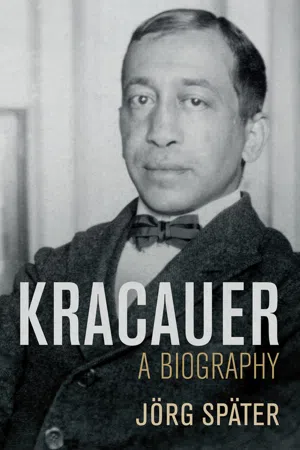
The picture shows Siegfried Kracauer. But his face looks bruised. His eyes are not quite straight; his nose seems flattened, and his lips appear to be swollen. His stereotypically Germanic first name weighs him down, while his family name indicates his Jewish ancestry. The neatly arranged bow tie is perhaps too tight. The forty-year-old’s jacket restricts him. In his seemingly uncomfortable attire, he looks out sadly at the world. He does not give the impression that he is one of the leading literary names of the Weimar Republic; he rather looks like someone who has been forced to wear a suit. Perhaps the letter next to him contained some bad news, and he has just sat down, exhausted. The Nazis are coming. The broken glass is a reminder of the fragility of existence. The thought of Heine’s ‘torn world’, in particular, comes to mind – of the modern individual whose mind is torn from the physical world and from society, and who experiences all the loneliness, absence of meaning, and alienation that follow from that separation.1 Kracauer himself spoke of ‘transcendental’ and ‘ideological’ homelessness. But the fact that our hero appears in such a sorry shape, underneath broken glass, is purely accidental. The glass negative had broken at some point, and on the occasion of Kracauer’s hundredth birthday the parts were put back together like a puzzle in order to produce a photo from the not quite complete negative. But is reality not in any case a construction – especially where contingency is involved?
Another picture shows Kracauer twenty years later, this time in America after the war. He is sitting with his back to the camera, working: he is wearing glasses, paper in front of him, a pen in his hand. He seems to be focused. The atmosphere is relaxed; the writer is sitting outside on the veranda, with the trees in front providing shade. Kracauer seems less slight than in the other picture, despite the fact that, in reality, he had neither grown taller nor put on weight. But what does that mean ‘in reality’? In this photograph, we are allowed to look over the author’s shoulder. It is not a typical portrait: we do not see the face of the one portrayed. And yet there is no doubt that this is Kracauer.2 It was taken by his wife, Elisabeth, during a holiday in Stamford, New York, in 1950. It was during this year that, for the first time since 1933, financial hardship and the psychological stress of years of persecution began to abate. Kracauer had just completed From Caligari to Hitler, which would become a classic of the social psychology of film history and a model text for a whole generation of film critics.3 The book did not completely do away with his financial worries, but at least he was in demand again. Film journals asked him to rank the best films, or to compile lists of his best articles from the time of the Weimar Republic, when he was senior editor of the Frankfurter Zeitung. On such occasions, Kracauer was also asked to provide a curriculum vitae. Perhaps the photograph pictures him replying to just such a request.4 I imagine that in the line for ‘Date of Birth’, he would write: ‘I will not give that away, as a matter of principle!’
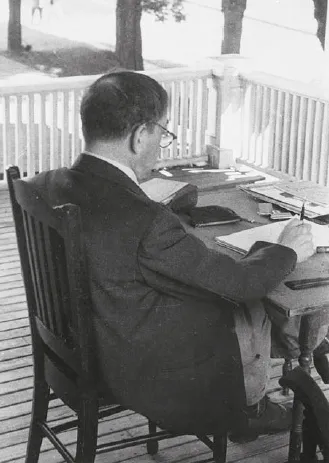
Figure 2. Siegfried Kracauer in Stamford, New York, 1950
Copyright: DLA Marbach, Photo: Lili Kracauer
As this imagined response suggests, Siegfried Kracauer had a peculiar side, and he had various quirks – such as, for instance, insisting that no one should know how old he was. On his seventy-fifth birthday, he explained this Rumpelstiltskin attitude to his friend Theodor W. Adorno as follows:
This is a matter that is deeply rooted in me and very personal. Call it an idiosyncrasy – but the older I get, the more everything in me revolts against the display of my chronological age. Of course, I am fully aware of the dates, which become more and more ominous, but as long as they do not confront me in public, they at least do not take on the character of an indelible inscription that everyone, myself included, is constantly forced to see. Fortunately, I am still able to ignore the chronological fatality, and that is of infinite importance for the progress of my work, for my whole inner economy. My kind of existence would literally be at stake if the dates were stirred up and attacked me from the outside.5
Kracauer was in a race against time. He wanted to complete a book on the writing of history before his own time came to an end. But there was even more behind this idiosyncrasy. He wanted to live extraterritorially, that is, outside of society and historical time. This was an attitude of not belonging, of shyness, the attitude of someone leading a ‘non-identical existence that cannot be mediated by any generality’.6 This need to be outside of space and time was an expression of Kracauer’s experience of having been a refugee. He had escaped only by the skin of his teeth. As a survivor, he elevated extraterritoriality so that it became the ideal condition for the historian who temporarily leaves his or her own self behind in order to embark on a journey into the past. For Kracauer, it seems, homelessness and alienness were modes of being that may have resulted from compulsion and distress but nevertheless opened up new possibilities for approaching the world.7
If such an extraterritorial character lived outside of any contexts or personal relationships, it would be impossible to write a biography about him. But, in fact, Kracauer had a much more complex relationship to biography than his extraterritorial attitude might suggest. In an article of 1930, written during his ideology-critique years, he condemns biography as ‘an art form of the new bourgeoisie’ and interprets it as a ‘sign of escape’. The more obsolete the individual becomes, the argument goes, the more important individualism becomes in literature.8 Five years later, he wrote a biography himself – of Jacques Offenbach. At the very beginning, he assures the reader that this is not one of those biographies that depicts the private life of its protagonist but ‘a biography of a society in that, along with portraying the figure of Offenbach, it allows the figure of the society that he moved and by which he was moved to arise, thereby emphasizing the relationship between the artist and a social world’.9 The notion of a ‘biography of society’ was inspired by the idea of relating the individual’s life to the general social totality: each side was to explain the other. Kracauer’s portrait of Offenbach’s life thus came to suggest the very opposite of extraterritoriality (despite the fact that the composer too was an émigré). It seems unlikely that the later Kracauer would still have written a rounded and coherent biography of the kind implied by the idea of a ‘biography of society’. By that point, he considered a synthetic mediation of micro- and macro-history, of the general and the particular, to be impossible. Yet in another twist in Kracauer’s relationship to biographical matters, he did recognize in himself, at the end of his life, a synthesizing continuity that he said held together all of his intellectual endeavours. He sketched a philosophy of history in which historical reality, like photographic reality, is an ‘anteroom’, and he thought that this philosophy – aiming ‘to bring out the significance of areas whose claim to be acknowledged in their own right has not yet been recognized’ – had unconsciously been the motivating force behind all of his writings.10 In retrospect, the ego was pushing into the foreground, and this, of course, fits with the fact that Kracauer had written two semi-autobiographical fictional works – Ginster and Georg – and would have liked to write a sequel to them. Although the idea of an objective biography (including a biography of society) might be an illusion, it is nevertheless not illegitimate to attempt one – on the contrary.
The story of Kracauer’s life is unusually fascinating and impressive, and it is therefore difficult to understand why no biography of him has been written before. There is only the small Rowohlt volume by Momme Brodersen and the indispensable chronicle of the Marbacher Magazin (1988), edited by Ingrid Belke and Irina Renz. This is all the more surprising given that there are now two editions of his collected works, each with a carefully prepared editorial apparatus, as well as countless interpretations of him in the fields of German studies and cultural studies. The reason for the absence of a biography is most likely that biographies of literary authors are written by literary scholars, those of social philosophers by sociologists or philosophers, and biographies of theorists of film by film scholars – but Kracauer did not belong to a single academic discipline, and he thus always falls between two stools. When historians write biographies (which are mostly of politicians), they are quick to claim that their protagonist is a representative of a whole age, or that the crisis of modernity is reflected in his or her works, or something of a similar magnitude. I would like to be a little bit more cautious. Kracauer, of course, did not live his life in order to become a symbol for this or that. And yet even a cursory glance at his life reveals that we are dealing with an extraordinary individual, someone about whom much more is to be related than just the details of his private life.
Kracauer was born in 1889 and grew up in Frankfurt am Main in an assimilated Jewish household he experienced as petit bourgeois and bleak. As an adolescent he felt lonely and ugly. He had a stammer, and an academic career therefore seemed unlikely. Once he had gained his university degree in architecture (during which he also studied a little sociology and philosophy under, among others, Georg Simmel), his family urged him to work as an architect to make a living, and for a short while he obeyed. But he saw himself as a writer of cultural philosophy, and in the years immediately after the First World War he went from job to job before finally becoming the literary editor of the Frankfurter Zeitung and a well-respected figure of the Weimar cultural scene. It was mainly because of him that film criticism came to be accepted as an intellectually respectable genre. He was a prolific writer – essays, reviews, articles on questions of philosophy and religion, of sociology and literature, on the newly formed Soviet Union, on the Bauhaus, on the Jewish renaissance, texts on his travels, on streets in Berlin, Frankfurt and Paris, on the detective novel, on hotel foyers and entertainment halls. He came to understand his times by paying attention to the things that were overlooked. I...
Table of contents
- Cover
- Contents
- Title page
- Copyright page
- Dedication
- Figures
- Acknowledgements
- 1. Siegfried Kracauer – A Life
- 2. Early Things: Before 1918
- 3. Revolution, the Frankfurter Zeitung and Cultural Criticism around 1920
- 4. Friendship (Part 1): The Jewish Renaissance in Frankfurt
- 5. Friendship (Part 2): The One Who Waits
- 6. The Crisis of the Sciences, Sociology and the Sphere Theory
- 7. Friendship (Part 3): Passion and the Path towards the Profane
- 8. The Rebirth of Marxism in Philosophy
- 9. Kracauer Goes to the Movies: A Medium for the Masses and a Medium for Modernity
- 10. At the Feuilleton of the Frankfurter Zeitung
- 11. Inflation and Journeys into Porosity
- 12. Transitional Years: Economic Upturn, Revolt, Enlightenment
- 13. The Primacy of the Optical: Architecture, Images of Space, Films
- 14. Ginster, Georg and the Salaried Masses
- 15. The Idea as Bearer of the Group: The Philosophical Quartet
- 16. Berlin circa 1930: In the Midst of the Political Melee
- 17. The Trial
- 18. Europe on the Move: Refugees in France
- 19. The Liquidation of German Matters
- 20. Two Views on the Second Empire: Offenbach and the Arcades
- 21. The Disintegration of the Group
- 22. Songs of Woe from Frankfurt
- 23. La Vie Parisienne
- 24. The ‘Institute for Social Falsification’
- 25. Vanishing Point: America
- 26. Fleeing from France, a Last Minute Exit from Lisbon
- 27. Arrival in New York
- 28. Define Your Enemy: What is National Socialism?
- 29. Know Your Enemy: Psychological Warfare
- 30. Fear Your Enemy: Deportation and Killing of the Jews
- 31. Fuck Your Enemy: From Hitler to Caligari
- 32. Cultural Critic, Social Scientist, Supplicant
- 33. The Aesthetics of Film as Cultural Studies
- 34. Two Boxes from Paris
- 35. Working as a Consultant in the Social Sciences and Humanities
- 36. Mail from Germany, Letters from the Past, Travels in Europe
- 37. The Practice of Film Theory and the Theory of Film
- 38. Talks with Teddie and Old Friends
- 39. Time for the Things before the Last
- 40. After Kracauer’s Death
- Bibliography
- Index
- End User License Agreement
Trusted by 375,005 students
Access to over 1.5 million titles for a fair monthly price.
Study more efficiently using our study tools.
Frequently asked questions
Yes, you can cancel anytime from the Subscription tab in your account settings on the Perlego website. Your subscription will stay active until the end of your current billing period. Learn how to cancel your subscription
No, books cannot be downloaded as external files, such as PDFs, for use outside of Perlego. However, you can download books within the Perlego app for offline reading on mobile or tablet. Learn how to download books offline
Perlego offers two plans: Essential and Complete
- Essential is ideal for learners and professionals who enjoy exploring a wide range of subjects. Access the Essential Library with 800,000+ trusted titles and best-sellers across business, personal growth, and the humanities. Includes unlimited reading time and Standard Read Aloud voice.
- Complete: Perfect for advanced learners and researchers needing full, unrestricted access. Unlock 1.5M+ books across hundreds of subjects, including academic and specialized titles. The Complete Plan also includes advanced features like Premium Read Aloud and Research Assistant.
We are an online textbook subscription service, where you can get access to an entire online library for less than the price of a single book per month. With over 1.5 million books across 990+ topics, we’ve got you covered! Learn about our mission
Look out for the read-aloud symbol on your next book to see if you can listen to it. The read-aloud tool reads text aloud for you, highlighting the text as it is being read. You can pause it, speed it up and slow it down. Learn more about Read Aloud
Yes! You can use the Perlego app on both iOS and Android devices to read anytime, anywhere — even offline. Perfect for commutes or when you’re on the go.
Please note we cannot support devices running on iOS 13 and Android 7 or earlier. Learn more about using the app
Please note we cannot support devices running on iOS 13 and Android 7 or earlier. Learn more about using the app
Yes, you can access Kracauer by Jörg Später, Daniel Steuer in PDF and/or ePUB format, as well as other popular books in Philosophy & Philosophy History & Theory. We have over 1.5 million books available in our catalogue for you to explore.