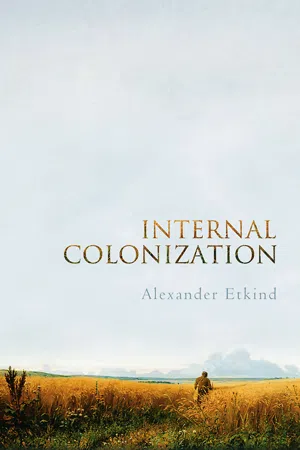
This book gives a radically new reading of Russia's cultural history. Alexander Etkind traces how the Russian Empire conquered foreign territories and domesticated its own heartlands, thereby colonizing many peoples, Russians included. This vision of colonization as simultaneously internal and external, colonizing one's own people as well as others, is crucial for scholars of empire, colonialism and globalization.
Starting with the fur trade, which shaped its enormous territory, and ending with Russia's collapse in 1917, Etkind explores serfdom, the peasant commune, and other institutions of internal colonization. His account brings out the formative role of foreign colonies in Russia, the self-colonizing discourse of Russian classical historiography, and the revolutionary leaders' illusory hopes for an alliance with the exotic, pacifist sectarians. Transcending the boundaries between history and literature, Etkind examines striking writings about Russia's imperial experience, from Defoe to Tolstoy and from Gogol to Conrad.
This path-breaking book blends together historical, theoretical and literary analysis in a highly original way. It will be essential reading for students of Russian history and literature and for anyone interested in the literary and cultural aspects of colonization and its aftermath.
- English
- ePUB (mobile friendly)
- Available on iOS & Android
eBook - ePub
About this book
Information
Part I: The Non-Traditional Orient
1
Less than One and Double
On March 25, 1842, in St. Petersburg, one official lost his nose. This noseless person, Kovalev, had just returned from the Caucasus, the embattled southern border of the Russian Empire. In the imperial capital, he was seeking a promotion that would put him in charge of a nice, bribable province of central Russia. But Kovalev’s nose betrayed him. His face was flat. Without his nose, he could not visit his women. He even missed a job interview, so strong was the shame of being noseless. Finally, his nose was captured on its way to Riga, the western border of the Empire. “Russia is a wonderful country,” wrote Nikolai Gogol who composed this story. “One has only to mention an official” and all his peers, administrators “from Riga to Kamchatka,” unanimously believe that “you are talking about them” (Gogol 1984: 3/42). From the Caucasus to St. Petersburg and from Riga to Kamchatka: it’s a long trip for a nose.
Career of Improvement
Gogol’s “The Nose” is a beautiful example of what Homi Bhabha calls the “colonial doubling,” which summarizes the processes of loss, splitting, and reconfiguration that are essential for the colonial situation. We can lose a part in many interesting ways, from castration, or decolonization, or even from shaving, or some combination of these. Presenting a faceless colonial administrator, Gogol analyzes his nose as an imperial fetish, a “metonymy of presence” where presence is unreachable and its signs, unrecognizable. Indeed, for Kovalev, there was no presence without his nose. Without the part, everything that the whole required – office, power, women – became unreachable. When in its proper place, the nose is just a little part of Kovalev’s wholeness, a metonymy of his impeccable functioning as the corporeal and imperial subject. Lost, the nose turns into the all-embracing symbol for Kovalev’s unaccomplished dreams and aspirations, the summary metaphor for all those goods, bodies, and statuses – vice-governorship, fortunate bride, social pleasures – which are unreachable for the noseless. The part is made into a fetish only after it has been lost. The Hegelian relations of master and slave are analogous to Gogolian relations of the whole and the part. As long as the part is the slave of the whole, the order is safe; but the rebellion of the part has more dramatic effects than the rebellion of the slave, because it questions the deepest, the most naturalized perceptions of the social order. Colonial differences cross-penetrate all social bodies, including the body of Kovalev. Together, Kovalev and his separatist nose make a wonderful illustration for the enigmatic, Gogolian formula that Bhabha repeats without explaining: “less than one and double” (Bhabha 1994: 130, 166).
An imperial author with an exemplary biography, Gogol was born in Ukraine and moved to St. Petersburg where he failed first as an official and then as a historian, succeeded as a writer, and failed again as a political thinker. He belongs to the list of great colonial authors, along with James Joyce and Joseph Conrad. The plot of Dead Souls was an imperial project; with his Napoleonic look, the protagonist Chichikov plans to resettle the purchased peasants to a recently colonized land near Kherson in the southern steppe and to mortgage them to the state. The fact that the peasants were dead makes their transportation easier. Kherson was the land of the notorious Potemkin villages, but the internal provinces that Chichikov visited on his way were no more trustworthy. Dead Souls should be read as the saga of Russia’s colonization, a text on a par with the British Robinson Crusoe or the American Moby Dick. When Gogol’s Inspector-General went on stage in 1836, hostile critics targeted precisely this colonial aspect of Gogol’s inspiration. These horrible events could never have happened in central Russia, only in Ukraine or Belorussia; or even worse, continued a critic, they could have happened “only on the Sandwich Islands that captain Cook visited” (Bulgarin 1836). With and without their lost noses and dead souls, Gogol’s characters were precise images “of a post-Enlightenment man tethered to … his dark reflection, the shadow of colonized man, that splits his presence … repeats his action at a distance” (Bhabha 1994: 62). The colonial nature of Gogol’s inspiration has been emphasized by a more recent wave of scholarship, which was itself inspired by the post-Soviet transformation of Ukraine (Shkandrij 2001; Bojanowska 2007). Understandably, postcolonial scholars have focused on Gogol’s Ukrainian roots and stories. The colonial nature of his works on Russia and the Russians, such as “The Nose” and Dead Souls, have eluded them, because such an understanding requires the concept of internal colonization. I believe that postcolonial criticism clarifies Gogol, but the opposite is also true: Gogol helps us to understand Bhabha.
In 1835, when Gogol was teaching Universal History at St. Petersburg Imperial University and Kovalev was starting his service in the Caucasus, Lord Macaulay delivered his Minute on Indian Education. Working for the Viceroy of India, Macaulay argued that only teaching English to the Indian elite would create the “interpreters between us and the millions whom we govern.” He referred to Russia as the positive model:
Within the last hundred and twenty years, a nation which has previously been in a state as barbarous as that in which our ancestors were before the crusades, has gradually emerged from the ignorance. … I speak of Russia. There is now in that country a large educated class, abounding with persons fit to serve the state in the highest functions. … There is reason to hope that this vast empire, which in the time of our grandfathers was probably behind the Punjab, may, in the time of our grandchildren, be pressing close on France and Britain in the career of improvement. (Macaulay 1862: 109–10)
For Macaulay, the west and the east were but steps on the worldwide ladder of history. Where England was in the tenth century, Russia was in the eighteenth and Punjab in the nineteenth. In this vision, the higher stages smoothly replaced the lower ones in the mother country. In the large space of empire, these different stages of progress all coexisted; moreover, they became known to the politician mainly because of their coexistence in the imperial domain rather than because of their obscure traces in the national archive. In India and Russia, higher races, castes, and estates cohabited with lower ones. The imperial task was to make order out of this chaos, which meant creating categories, managing hierarchies, regulating distances. After Peter the Great, “the languages of Western Europe civilized Russia. I cannot doubt that they will do for the Hindu what they have done for the Tartar,” said Macaulay.
A few years later, the leading Russian critic, Vissarion Belinsky, wrote that, without Peter the Great, Russia “would probably still have accepted European civilization but it would have done so in the same way in which India adopted the English one” (1954: 5/142). In other words, Belinsky saw Russia’s westernization as a response to the anxiety of being colonized by the west, though of course this anxiety was also a European influence, one of those languages that Russia, like India, imported from the west. As a matter of fact, India was a colony and Russia was an empire, which made Macaulay’s comparison a little forced; what is interesting is that he did not notice it. For Belinsky and his readers, Russia’s sovereignty – its difference from India – was the crucial fact. The imperial gradient between the higher and lower groups was immense in the British and Russian Empires; in the former the difference was mainly between the mother country and the colony, while in the latter the difference was mainly between groups within the mother country. Although straight in the national domain, the line of progress curved and folded within its imperial possessions. Later, Marxist theorists struggled with the same issue. Lev Trotsky called it “combined and uneven development” (1922, 1959). In his vision, advanced and backward societies coexisted in Russia simultaneously and “traumatically”; their contradictions would “inevitably” result in a revolution (Knei-Paz 1978: 95).
During the High Imperial Period, which lasted from Russia’s victory in the Napoleonic War (1814) to its defeat in the Crimean War (1856), the Russian educated class spoke and wrote French as well as Russian. German was a heritage language for many, and English was for the crème de la crème. The famous works of Russian literature depicted this polyglossia and were often inspired by French examples (Meyer 2009). In Aleksandr Pushkin’s novel in verse, Evgenii Onegin (1832), Tatiana’s letter of love was written in French. Typical for ladies of high society, Tatiana’s Russian was worse than her French, explained Pushkin. French was the language of women and family life; Russian was the language of men, of the military service and the household economy where work was carried out by serfs and soldiers. In Lev Tolstoy’s War and Peace (1869), where the action takes place during the Napoleonic War, the officers and officials who were fighting with the French speak French with their wives and daughters, Russian to their subordinates, and mix the languages when talking to their peers. Unlike Pushkin, who in his novel “translated” Tatiana’s letter into Russian verse, Tolstoy wrote these long dialogues in French and published them with no translation, expecting his readers to understand them. But his public was changing rapidly and within a few years he had to translate these French sections into Russian for the next edition of his masterpiece.
After reading Alexis de Tocqueville’s Democracy in America, a former officer of the Imperial Guard, Petr Chaadaev, asked in 1836: Does Russia also have a destiny? His answer was devastating: “We live in our houses as if we are stationed there; in our families we have the outlook of foreigners; in our cities we are similar to nomads, we are worse than nomads.” At exactly the time when the Empire was as rich and large as never before, the imperial elite felt as if they were invaders stationed in their own cities, homes, and lives. “Our remembrances do not go deeper than yesterday; we are foreign to ourselves. … Our experiences disappear as we are moving ahead. This is a natural consequence of a culture that is entirely borrowed and imitated” (Chaadaev 1914: 110). Illustrating his thesis, Chaadaev compared the Russians to the Native Americans. He asserted that there were “people of outstanding depth” among the Native Americans, but the Russians had no sages who could be compared to these natives (Chaadaev 1914: 116; Etkind 2001b: 24). These feelings of the foreignness in the native land, the stoppage of time, and the imitative character of culture were subjective components of reversed, internal orientalism (Condee 2009: 27).
Chaadaev wrote his epistle in French, but when it was published in Russian translation, it caused a scandal. Denouncing Chaadaev, one official with Siberian experience wrote that he “denies everything to us, puts us lower than the American savages” (Vigel 1998: 78). Awakened by Chaadaev, a group of intellectuals turned his cultural criticism into the call for nationalist reawakening. Having adopted an unfortunate name, the Slavophiles, they reinvented the global language of anti-imperial protest that was rooted in the French Enlightenment, the American Revolution, Edmund Burke’s criticism of British policies in India, the experience of the Napoleonic wars, and, last but not least, the Polish rebellions against the Russian Empire.
In 1836, Gogol described St. Petersburg as “something similar to a European colony in America: there are as few people of the native ethnicity here [St. Petersburg] and as many foreigners who have not yet been amalgamated into the solid mass” (1984: 6/162). Like many Russian intellectuals of his time, Gogol was very interested in America and even dreamed about emigration to the US. Comparing the imperial capital to America sounded good to this outsider. In a remarkable twist, the conservative Russians of the 1840s employed the language of colonial discontent for their criticism against their own culture. A former officer of the Imperial Guard, Aleksei Khomiakov, wrote in 1845 that in Russia, the Enlightenment took “a colonial character.” In 1847, he characterized the educated society in Russia as “a colony of eclectic Europeans, thrown into a country of savages.” He also stated that the enlightened Russia “fashioned itself in an aggressive way, like a European colony anywhere in the world, conceiving the conquest with best intentions but without means to realize them and … without a superiority of spirit that could give some kind of justification for the conquest.” He characterized this “colonial relationship” as “the struggle” between “the entirely unjustified repulsion” on the part of the elite toward the people and “the well-justified suspicion” on the part of the people towards the elite. On this base, Khomiakov diagnosed in the Russian society “fundamental doubling,” “imitativeness,” “false half-knowledge,” “a lifeless orphanhood,” and “cerebral deadliness.” Like his favorite writer, Gogol, he loved the metaphor of doubling/splitting (razdvoenie) and used it profusely. Doubling was induced by the Petrine reforms but increased after that. Doubling was an unavoidable result of too abrupt, too rapid social change. Doubling separated the life of the people and the life of the higher estates. “Where the society is doubled – a deadly formalism reigns the day” (Khomiakov 1988: 100, 43, 152, 96, 139). Much earlier, Khomiakov (1832) wrote a tragedy about the legendary Ermak, a Cossack who conquered Siberia for the Russian crown. Far from glorifying Ermak, it shows a repenting criminal, cursed by his father, convicted by the Tsar, and betrayed by the fellow Cossacks. A Shaman offers him the crown of Siberia, but he prefers suicide. If it were a story about Montezuma, it would have been perceived as an early and strong anti-imperial statement; Ermak has never been successful on stage, with either the critics or the historians. Khomiakov spent many years writing a multi-volume saga of peoples’ migrations and resettlements, starting from the antiquity. An Anglophone and Anglophile, he speculated about the colonized Celts, Indians, and Hottentots. Colonial practices were in his mind, whether he was writing about Russia or the world. One of the most gifted people of his time – an amateur engineer, artist, historian, and theologian – Khomiakov was piously Orthodox, like other Slavophiles, but in his own creative way (Engelstein 2009). Through the years, he corresponded with a cleric from Oxford about a unification of Orthodox and Anglican churches; he even believed that the same could happen with the Calvinists (Khomiakov 1871: 105).
While the British administration was introducing English in Indian schools, Macaulay’s Russian counterpart, the Minister of the Enlightenment Sergei Uvarov, decided that the Europeanization of Russia had gone too far. Reporting in 1843 about the first decade of his ministerial job, he saw his success in “healing the new generation of its blind, thoughtless predisposition towards the foreign and the superficial” (Uvarov 1864). Remarkably, Uvarov drafted his projects for the new “national” education in French but then switched to Russian (Zorin 1997). A dilettante orientalist but a professional administrator, Uvarov was responding to a wave of popular sentiment that was universal for post-Napoleonic Europe.
A long time has passed since Macaulay and Uvarov planned to re-educate their spacious domains. As in India, nationalism in Russia took two competing forms, rebellious and anti-imperial on the one hand, official and pre-emptive on the other. If Peter I was a model for Macaulay, Lev Tolstoy was an influence on Mahatma Gandhi. Russia was a great European power alongside those of Britain or France, and a territory that received its civilization from the west, like Africa or India. This is why Macaulay compared the Russian Empire not to the British Empire but to its colony, India. It was to the Russians themselves and not to the Poles or the Aleuts, that the Empire was teaching French with the success that Macaulay wanted to emulate and Uvarov to unwind. This success did not last long, but it was important for all aspects of imperial culture and politics. It divided the intellectuals into those who mourned the lost originality of native ways and those who welcomed the bursting creativity of cultural hybridization, a divide well known to the scholars of colonial cultures. “Learning is nothing but imitation,” proclaimed a leading academic historian, Sergei Soloviev, whose son, Vladimir, became the most original Russian philosopher (1856: 501). Through the High Imperial Period, the understanding of Russia as an imperial and a colonial country was shared even by those who did not have much else in common. A late and revisionist follower of the Slavophiles, Fyodor Dostoevsky wrote in 1860 that no country is less understood than Russia; even the moon is better explored, wrote Dostoevsky, who was in the know: he had just been released from a Siberian prison camp. In his vision, the people of Russia were sphinx-like – mysterious and omniscient; he called on his public to approach the people with an Oedipal feeling of awe (1993: 12–13). The philosopher and governmental official, Konstantin Kavelin, used the same colonial rhetoric in 1866, justifying the slow pace of the reforms that he helped to write into the law: “Imagine a colonist who starts a household in the wilderness. … Whatever he did his success would not be able to stand comparison with the life standard of a town. … We are the very same colonists” (Kavelin 1989: 182).
Slavic Wilderness
The fierce, transnational polemics that raged between Marxists at the turn of the twentieth century alerted them to the relation between imperialism and national economies. The polemics had a critical stance; many believed that Marx did not understand this relationship. The Russian economist Petr Struve emphasized the “third persons,” neither capitalists nor workers, who complicated the class war. Living pre-capitalist lives, these “third persons” consumed the “surplus product” of the economy and provided capitalism with labor and growth (Struve 1894). Responding to this argument, the German socialist Rosa Luxemburg stated that foreign markets play this role far better than Struve’s internal “third persons.” According to Luxemburg’s Accumulation of Capital (2003), capitalism would always need fresh markets and, therefore, is inescapably connected to imperialism. Thus, a struggle against capital is also a struggle against the empire. In memorable words, Hannah Arendt observed that by synthesizing two programs of emancipation, social democratic and anti-imperialist, this Marxist message had made recurrent waves throughout our world: “[E]very New Left movement, when its moment came to change into Old Left – usually when its members reached the age of forty – promptly buried its early enthusiasm for Rosa Luxemburg together with the dreams of youth” (1968: 38).
In response to Luxemburg, Vladimir Lenin, in his early book The Development of Capitalism in Russia, suggested that in larger countries such as Russia and the United States, the unevenness of development plays the role of global inequality, so that the colonization of these internal spaces would consume the “surplus product” and give a boost to capitalist development. Internal inequalities would play the same role as external ones. Speaking of the underdeveloped Russian territories on the Volga, in Siberia, and elsewhere, Lenin used the concepts of “internal colonization” and “internal colony” (1967: 3/593–6). Responding to his opponents, “legal Marxists” like Struve, Lenin discussed not only the flows of capital, but also the demographical patterns of peasant migrations into the territories of internal colonization. With no hesitation, Lenin applied this concept, internal colony, to those parts of Russia that were populated by ethnic Russians, such as the steppes of Novorossiysk and the forests of Archangel; territories with mixed and changing population, such as Siberia and the Crimea; and lands with ethnically alien peoples, such as Georgia. In Lenin’s account, his own homeland on the Volga was one of these internal colonies. He based his speculations about “the internal colonization” and “the progressive mission of capitalism” on a systematic analogy between the Russian Empire and the US, which he abandoned a few years later (Etkind 2001b).
In the US, W. E. B. DuBois wrote about American underprivileged minorities, social and racial alike, in colonial terms: “[T]here are groups of people who occupy the quasi-colonial status: laborers who are settled in the slums of large cities; groups like Negroes … ” (cited in Gutiérrez 2004). Both Lenin and Du...
Table of contents
- Cover
- Title page
- Copyright page
- Acknowledgments
- List of Illustrations
- Introduction
- Part I: The Non-Traditional Orient
- Part II: Writing from Scratch
- Part III: Empire of the Tsars
- Part IV: Shaved Man’s Burden
- Conclusion
- References
- Index
Trusted by 375,005 students
Access to over 1.5 million titles for a fair monthly price.
Study more efficiently using our study tools.
Frequently asked questions
Yes, you can cancel anytime from the Subscription tab in your account settings on the Perlego website. Your subscription will stay active until the end of your current billing period. Learn how to cancel your subscription
No, books cannot be downloaded as external files, such as PDFs, for use outside of Perlego. However, you can download books within the Perlego app for offline reading on mobile or tablet. Learn how to download books offline
Perlego offers two plans: Essential and Complete
- Essential is ideal for learners and professionals who enjoy exploring a wide range of subjects. Access the Essential Library with 800,000+ trusted titles and best-sellers across business, personal growth, and the humanities. Includes unlimited reading time and Standard Read Aloud voice.
- Complete: Perfect for advanced learners and researchers needing full, unrestricted access. Unlock 1.5M+ books across hundreds of subjects, including academic and specialized titles. The Complete Plan also includes advanced features like Premium Read Aloud and Research Assistant.
We are an online textbook subscription service, where you can get access to an entire online library for less than the price of a single book per month. With over 1.5 million books across 990+ topics, we’ve got you covered! Learn about our mission
Look out for the read-aloud symbol on your next book to see if you can listen to it. The read-aloud tool reads text aloud for you, highlighting the text as it is being read. You can pause it, speed it up and slow it down. Learn more about Read Aloud
Yes! You can use the Perlego app on both iOS and Android devices to read anytime, anywhere — even offline. Perfect for commutes or when you’re on the go.
Please note we cannot support devices running on iOS 13 and Android 7 or earlier. Learn more about using the app
Please note we cannot support devices running on iOS 13 and Android 7 or earlier. Learn more about using the app
Yes, you can access Internal Colonization by Alexander Etkind in PDF and/or ePUB format, as well as other popular books in Literature & Literary Criticism. We have over 1.5 million books available in our catalogue for you to explore.