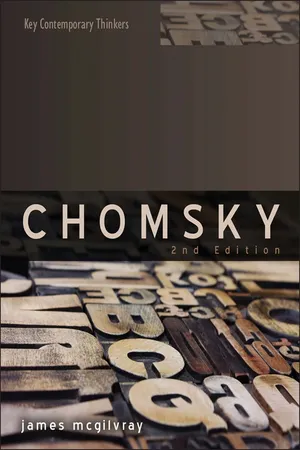
Noam Chomsky has made major contributions to three fields: political history and analysis, linguistics, and the philosophies of mind, language, and human nature. In this thoroughly revised and updated volume, James McGilvray provides a critical introduction to Chomsky's work in these three key areas and assesses their continuing importance and relevance for today.
In an incisive and comprehensive analysis, McGilvray argues that Chomsky's work can be seen as a unified intellectual project. He shows how Chomsky adapts the tools of natural science to the study of mind and of language in particular and explains why Chomsky's "rationalist" approach to the mind continues to be opposed by the majority of contemporary cognitive scientists. The book also discusses some of Chomsky's central political themes in depth, examining how Chomsky's view of the good life and the ideal form of social organization is related to and in part dependent on his biologically based account of human nature and the place of language within it. As in the first edition, McGilvray emphasizes the distinction between common sense and science and the difference between rationalist and empiricist approaches to the mind, making clear the importance of these themes for understanding Chomsky's work and showing that they are based on elementary observations that are accessible to everyone. This edition has been extensively re-written to emphasize Chomsky's recent work, which increasingly 'biologizes' the study of language and mind and - by implication - the study of human nature.
This book will be of interest to students and scholars of philosophy, linguistics, and politics, as well as to all those keen to develop a critical understanding of one of the most controversial and important thinkers writing today.
- English
- ePUB (mobile friendly)
- Available on iOS & Android
eBook - ePub
About this book
Information
1
Chomsky's Contributions
Chomsky's contributions and access to them
Noam Chomsky works in several intellectually important areas and has made significant contributions to others, including some developing fields. Perhaps the most prominent areas in which he works are linguistics, political analysis and criticism, and the philosophies of language and mind. In this chapter, I will outline these contributions and describe how they have been received. At the end of the chapter, I will say something about the extent to which Chomsky's intellectual contributions relate to one another – the extent to which his science of language relates to his political views through his view of the human mind and human nature.
The beginning
Chronologically speaking, Chomsky's first contributions were to political and social analysis. At the age of ten, he wrote an essay on the Spanish Civil War and the spread of fascism, noting the role of the fall of Barcelona and Toledo in this regard. This and other early contributions were unrecognized except by a small group associated with his Deweyite grade school run by the Temple University in Philadelphia. The reading he did in preparation for this article in his grade school newspaper indicated his strong interest in politics. Continued reading in political affairs during his early teenage years sufficed to write many years later a sophisticated review of Gabriel Jackson's scholarly book on the Spanish Civil War.
There is a lesson in Chomsky's early intellectual achievement in the social/political domain. Perhaps surprisingly, it should not be seen as particularly unusual or remarkable. Any child of his age who focuses their interests in the way he did could do it – although very likely now, of course, with a different political issue. That is because everyone, including the fairly young, has available the tools of folk psychology, which – when joined to a critical attitude supplemented by efforts to find out what actually happened rather than accepting what one is told happened by government officials or standard media sources – suffice to produce a sophisticated essay or discourse on this or other political matters. Other children have managed similar ‘feats’, although not often with the politics of a region of the world and how it is affected by the economic and military imperial ambitions of powerful states. Many children can recite in detail the statistics for players on a football team and assess the chances of the team succeeding. Many others might read in detail and keep up on the exploits of various ‘celebrities’, engaging in sophisticated talk with others about their favorites. Still others can speak with authority on the benefits of various computers and computer games. In effect, other children like the young Chomsky have used the tools of folk psychology to develop remarkably sophisticated understandings of sports and of other domains of human interest and interaction. Sometimes they can assess as well as adults the prospects of a team or the foibles of their parents and other adults. Chomsky's accomplishments in his grade school and early teens relied on the same tools as did theirs: describing people's actions in specific domains and figuring out their interests and motivations. Granted, the fact that Chomsky focused his interest on the actions of people in the political domain does not by itself suffice to explain his sophisticated review of Jackson's book. Clearly, in addition Chomsky had – and has – an extraordinarily good memory and capacity to organize thoughts. He has a very well honed critical attitude. And he describes himself as a “fanatic” in his efforts to gather information. In his teenage years, he would take trips alone to used bookstores in New York to find materials to read. He continues to read massive amounts of material in various fields. Some of these factors make him unusual, but a basic point remains: all people have the intellectual capacity needed to understand, assess, and make decisions in the political and social domains. There is no need for specialized knowledge of the sort needed in the advanced mathematical-formal sciences such as chemistry, physics, or the mathematical linguistics that Chomsky first developed. This difference – and the explanation for the differences in accessibility and ‘expertise’ in the sciences as opposed to politics and other areas of human concern – is one of Chomsky's central themes. I return to it several times, and especially in the fourth chapter.
The natural science of language
Widespread recognition of Chomsky's intellectual contributions came first with his efforts to construct a natural science of the human language – that is, with his first efforts to create linguistics as a formal natural science. He began his work in linguistics while still an undergraduate at the University of Pennsylvania. There he wrote The Morphophonemics of Modern Hebrew and submitted it as his undergraduate thesis in 1949. That document was revised and became his Master's thesis at Penn in 1951; it was eventually published (1951/1979). His PhD thesis in linguistics consisted in a chapter of a massive work he wrote while a Junior Fellow at Harvard. That work, The Logical Structure of Linguistic Theory (LSLT), was thinly distributed, largely ignored, and not published – and then only in part – until 1975. The first of his monograph-length works to be published was Syntactic Structures (1957), which was essentially a workbook for a course in linguistics as he understood it at MIT, a course attended by MIT undergraduates – primarily mathematicians and engineers. Considerably later, Chomsky's courses came to attract professional mathematicians, physicists, philosophers, and some psychologists interested in Chomsky's formal approach to constructing theories of a mental system.
Syntactic Structures and LSLT made groundbreaking proposals and helped develop an approach to the study of language and the mind unique for its time in the 1950s, and still in a minority position with those who do computer modeling of mental capacities, philosophy of mind and language, psychology, and even linguistics. Linguistics as understood in the US for the first half of the twentieth century was dominated by a procedural form of structural linguistics accompanied – often – by behaviorist assumptions concerning how to learn a language and the belief that (perhaps phonetic features aside) languages could take any form whatsoever. The work of Bloomfield, Joos, and Chomsky's instructor and advisor at the University of Pennsylvania, Zellig Harris, dominated the field. The basic aim was to make some assumptions about what the ‘simples’ of language are (syllables, or perhaps phonemes) and, given this, find procedures for putting them together to yield the, or a, ‘form’ for a language. Chomsky's work made it clear that this approach failed to make sense of the facts, that that kind of bottom-up procedure would not yield the relevant units of language. Among the important units it could not deal with are the morphemes (irreducible parts of words) that a child must quickly come to recognize as the significant ones if he or she hopes to acquire a language in anything like the kind of time period actual children manage to acquire one – typically, with adult competence, and without regard to specific language or the child's native general intelligence, about three and a half or four years. A morpheme is an abstract unit. Children – even infants – appear to be able to single them out. But that requires that they have available to them at a very early age some mental device that ‘sees’ the morphemes and other abstract units.
To do this, Chomsky assumed, the child's mind must bring to experience a way of organizing it in order to yield the ‘right’ structure (or structures, for multilinguals) for the data received in the short time it takes the child's mind to acquire a language. The child's mind must bring to experience an innate notion of what a natural language – including a sign language – must look like and some kind of way to ‘select’ the language(s) spoken or signed in the populations in which a child develops. If so, the linguist's task consists in offering a theory of what the child's mind brings to experience or input in order to acquire or learn languages under the conditions that children actually do. To offer this, the linguist must postulate and construct a theory of what the child's mind begins with (the “initial state”; Chomsky called it “Universal Grammar” or UG), of how a specific language is acquired or grows, and of the possible final states that languages can assume. Chomsky held from the beginning and continues to hold that this daunting task requires using the methods of the natural scientist, not the social scientist. Natural scientists offer formal, explicit theories of the phenomena of nature that postulate ‘hidden’ entities, events, and systems.
We will find Chomsky's answers to how the child's mind manages to acquire a language under actual conditions in a later chapter; there came to be more than one as his theories improved. The important point for present purposes is that any theory or science of language had better assume from the beginning that language is – like walking – a capacity that is innate in human beings, and apparently one of very few mental capacities available to no other creatures. And if language is innate and a mental system, another reasonable assumption is that the right place to look for language – that is, for the subject matter of a theory of language and of how a language develops or grows – is inside the head, not in communities of speakers or in linguistic actions and behaviors. These assumptions, that the methods of the reasonable linguist depend on assuming innateness (nativism) and postulating what is inside the head that accounts for the relevant facts (internalism), were and still are characteristic of Chomsky's naturalistic approach to language.
These same assumptions are, however, anathema to many others who would like to consider themselves scientists of the mind and language. This is especially true of behaviorists and the many who were influenced by them, and of those who – like the behaviorists – assumed that languages are somehow lodged primarily outside the head (externalists) and/or are learned primarily as a result of training (anti-nativists). That is a large group: it includes the proceduralists, behaviorists, and – now – connectionists, plus the great majority of psychologists, philosophers, and computer modelers.
To counter the externalists and anti-nativists, Chomsky pointed to their errors. That effort began with his devastating 1959 review of the behaviorist psychologist B. F. Skinner's Verbal Behavior, and continued thereafter in many articles and books (1975, 1980/2005, 2000, among others). More important, he also chose to undermine the assumptions of externalists and anti-nativists about how to proceed in constructing a science of the mind – that is, their methodology and its standards of success. Chomsky characterized those who share externalist and anti-nativist assumptions about how to proceed as “empiricists” and later (but amounting to the same thing) “methodological dualists.” He also defended his own nativist and internalist assumptions, which he called the assumptions of a “rationalist,” later “methodological monist,” and most recently, “biolinguist.” His defense consisted of – among other things – pointing out not only that the rationalist approach made the best sense of elementary observations concerning language and its use, but that sciences of the mind and language based on rationalist assumptions made far greater progress by the standards of the natural sciences than any based on empiricist ones. This suggests that rationalist methodologies and assumptions are more empirically based than are empiricist ones. If correct, the result appears ironic: empiricists in the study of mind, and language in particular, are not empirical scientists, where rationalists are.
One might wonder why so many reject an internalist and nativist strategy for the scientific study of language. One plausible answer is that these assumptions conflict with the commonsense conception of language. According to that conception, languages are learned from parents and others; they are human inventions, created to provide for effective communication. These views conflict with a nativist methodology. Again according to common sense, languages are basically social institutions, the property of communities, thus external to any particular mind, making an internalist strategy appear wrong-headed. There are other factors too, but perhaps the commonsense view is the most important. Because readers are likely to be influenced by this commonsense view too, I devote considerable parts of chapters 2 through 5 to explaining why Chomsky's science of language is nativist and internalist, and why these methodological assumptions also work with other components of the mind. And I return very briefly to Chomsky's rationalist/empiricist distinction and the justification for a rationalist approach after sketching his contributions in political analysis and criticism and his work in the philosophies of language and mind.
Political analysis and criticism
The second major area to which Chomsky has contributed – and surely the best known in terms of the number of people in his audience and the ease of understanding what he writes and says – is his work in sociopolitical analysis, political, social, and economic history, and critical assessment of current political circumstance. In Chomsky's view, while those in power might – and do – try to obscure their intentions and defend their actions in ways that make them acceptable to citizens, it is easy for anyone who is willing to be critical and consider the facts to discern what they are up to. In an interview with Bill Moyers on PBS several years ago, Chomsky remarked that all one needs for understanding political and social affairs in general is what he calls “Cartesian common sense.” For Chomsky, this involves the capacity he and other normal persons have available to them to employ the natively available tools built into common sense, and particularly those of folk psychology. As suggested before, that capacity, plus a critical attitude sensitive to the influence of self-interest and self-deception on oneself and on others – especially in analyzing political and economic structures and the actions of those who are in positions of power – is what is needed. And it is this capacity that Chomsky asks his readers and listeners to exercise, so that – given the facts to the extent that they are available – they can make up their own minds.
A considerable part of Chomsky's work in this area consists in correcting official histories which portray the actions of imperial powers such as the US now and Britain in the nineteenth century as the acts of beneficent powers with moral aims. The actions of imperial states include efforts to use military and economic power to colonize and control economies and political decisions in foreign states, hardly honorable acts. To make them appear to be justified, however, these uses of power are presented to the citizens of the imperial power as efforts to ‘civilize’, ‘improve’, and otherwise bring what citizens consider benefits (recently democracy and freedom, and in nineteenth-century Britain, Christianity) to the populations of those they control or attempt to control. Prominent examples of Chomsky's work in this regard appear in his many discussions of Vietnam (where, he argues, the US won after all in its overall strategy of preventing the spread of indigenous economic and social development), of US efforts to turn the Philippines into a colony, of nineteenth-century British efforts to do the same in India (and, of course, Africa), of US efforts ever since the Monroe Doctrine to control politics and economies throughout South and Central America, and – perhaps most discussed of all – of various US involvements in the Middle East and the Palestinian–Israeli conflicts. The title of his massive 1983 book The Fateful Triangle suggests his views: virtually from the beginning, the US's involvement in the Palestinian–Israeli conflict has been one of serving the US's interests.
As he points out in several places (e.g., 1996), his primary aim in all his political work is to reach people who are in a position to act as moral agents and can do something about the atrocities that the exercise of imperial ambitions always produces, such as the hundreds of thousands of civilians killed in the ‘surgical’ US invasion of Iraq, preceded by the Bill Clinton-induced embargo of medicine and other needs, an embargo that led to hundreds of thousands of other deaths, predominantly of the young. These facts are hidden from US citizens by compliant corporate-run media that serve the interests of the elite. In effect, Chomsky tries to reach the citizens of democracies who can vote imperial governments out of power and replace them with more morally responsible ones. That is one of the reasons he gives for focusing predominantly on the US: he aims to reach the citizens of the one country that still dominates the world in economic and military matters and yet can still be controlled by its citizens. Despite unending and in recent years increasingly successful efforts to influence and control the vote on the parts of corporations and the economic elite that benefit from these imperial actions, the US still affords its citizens the right to organize and to vote. Resisting the efforts of corporate-run media, government spin personnel, and corporate influence on legislatures is, however, a daunting task. Certainly many in the US read Chomsky's books of political analysis and criticism. And he can count on getting audiences for his talks, often ranging into the thousands. Further, he is not alone: others, such as the late Howard Zinn, have played important roles in attempting to correct official history, critically assess current political and economic policies, and encourage individuals to organize to take control of governments that are now largely under the control of corporate and economic elite power. Chomsky and those who work with him have had little direct effect in the US, however, no doubt due in part to corporate control of media, of government, and – judging by decisions that give corporations almost unlimited control of political advertising – of the US Supreme Court.
Despite this, Chomsky emphasizes, there is at least some reason for optimism. It is not that there have been no advances due to the work of progressively minded individuals and organizations. During the last century and a half there have been real improvements in coming to recognize slavery as simply immoral, in recognizing and entrenching in law women's rights, in forcing governments to justify invasions, and in other ways that would now be difficult for those in power to reverse. And currently there are groups seeking to right the wrongs of massive inequalities in wealth distribution and ensure greater benefits to the “99 percent,” although so far, with little success. These extreme inequalities began to develop in the 1970s in the US with its unilateral rescinding of the Bretton Woods financial control agreements, followed in succeeding years by the steady diminution of the financial regulations that had been established in order to prevent a repeat of the recession of the 1930s. The story is a long one, throughout suggesting that the US government in the last 40 or so years is a one-party system (the Business Party, with ever-increasing dominance by the financial sector), with two slightly different variants. Some aspects of it are taken up in the chapters on Chomsky's political work.
In general, progress in reversing policies that benefit the elite is slow and difficult. In current relatively democratic but capitalist socioeconomic systems, at least 80 percent of the populations of these nations have no control at all over economic decisions. That is given to increasingly diminishing numbers of ‘managers’ – at the top, to the wealthy elite, and corporations, which have as a result massive powers that are well entrenched in the political, economic, and ideological structures of these capitalist-plutocratic economies. Earlier in Britain and now in the US, the elite and corporations have for decades enjoyed the benefits of a nation's imperial ambitions. In the US, and especially after World War II, economic and military power has led to virtual control of the economies and social policies of several foreign states. These are among the reasons that change that actually brings about improvement is difficult. It is possible, but requires the work and cooperation of a large number of people who are organized and are aware of the problems and who have in mind a view of an alternative economic and social system that distributes wealth in a far more equitable way, giving everyone a degree of power in economic decision-making. Some might point out that there is a swifter way: violent revolution. That is an option, but it is a very dangerous one. Chomsky rejects it (1981b) except as a last resort. It is very hard to justify, and history has shown that on the whole the changes brought about too often eliminate the good in an existing system while rarely bringing real benefits to those who need them the most.
As mentioned, attempts to bring about political and economic reform in a democracy depend on the willing cooperation of a large proportion of a population, and cooperation is possible only if linguistic, social, political, and economic knowledge are within the cognitive capacities of anyone. But that is available: everyone has Cartesian common ...
Table of contents
- Cover
- Key Contemporary Thinkers
- Title page
- Copyright page
- Preface
- Introduction
- 1: Chomsky's Contributions
- 2: The Mind and Its Sciences
- 3: Partitioning the Mind: Bad and Good Cognitive Science
- 4: Human Problem-Solving Capacities
- 5: The Science of Language
- 6: Linguistic Meanings and Their Uses
- 7: Chomsky on Politics: Some Basic Themes
- 8: Language and Politics: Justification
- Glossary
- Bibliography
- Index
Trusted by 375,005 students
Access to over 1.5 million titles for a fair monthly price.
Study more efficiently using our study tools.
Frequently asked questions
Yes, you can cancel anytime from the Subscription tab in your account settings on the Perlego website. Your subscription will stay active until the end of your current billing period. Learn how to cancel your subscription
No, books cannot be downloaded as external files, such as PDFs, for use outside of Perlego. However, you can download books within the Perlego app for offline reading on mobile or tablet. Learn how to download books offline
Perlego offers two plans: Essential and Complete
- Essential is ideal for learners and professionals who enjoy exploring a wide range of subjects. Access the Essential Library with 800,000+ trusted titles and best-sellers across business, personal growth, and the humanities. Includes unlimited reading time and Standard Read Aloud voice.
- Complete: Perfect for advanced learners and researchers needing full, unrestricted access. Unlock 1.5M+ books across hundreds of subjects, including academic and specialized titles. The Complete Plan also includes advanced features like Premium Read Aloud and Research Assistant.
We are an online textbook subscription service, where you can get access to an entire online library for less than the price of a single book per month. With over 1.5 million books across 990+ topics, we’ve got you covered! Learn about our mission
Look out for the read-aloud symbol on your next book to see if you can listen to it. The read-aloud tool reads text aloud for you, highlighting the text as it is being read. You can pause it, speed it up and slow it down. Learn more about Read Aloud
Yes! You can use the Perlego app on both iOS and Android devices to read anytime, anywhere — even offline. Perfect for commutes or when you’re on the go.
Please note we cannot support devices running on iOS 13 and Android 7 or earlier. Learn more about using the app
Please note we cannot support devices running on iOS 13 and Android 7 or earlier. Learn more about using the app
Yes, you can access Chomsky by James McGilvray in PDF and/or ePUB format, as well as other popular books in Philosophy & Philosophy History & Theory. We have over 1.5 million books available in our catalogue for you to explore.