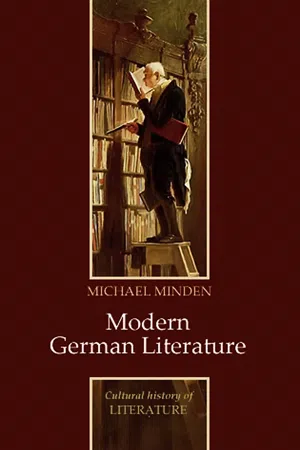
This accessible and fresh account of German writing since 1750 is a case study of literature as a cultural and spiritual resource in modern societies.
Beginning with the emergence of German language literature on the international stage in the mid-eighteenth century, the book plays down conventional labels and periodisation of German literary history in favour of the explanatory force of international cultural impact. It explains, for instance, how specifically German and Austrian conditions shaped major contributions to European literary culture such as Romanticism and the 'language scepticism' of the early twentieth century.
From the First World War until reunification in 1990, Germany's defining experiences have been ones of catastrophe. The book provides a compelling overview of the different ways in which German literature responded to historical disaster. They are, first, Modernism (the 'Literature of Negation'), second, the literature of totalitarian regimes (Third Reich and German Democratic Republic), and third the various creative strategies and evasions of the capitalist democratic multi-medial cultures of the Weimar and Federal Republics.
The volume achieves a balance between textual analysis and cultural theory that gives it value as an introductory reference source and as an original study and as such will be essential reading for students and scholars alike.
- English
- ePUB (mobile friendly)
- Available on iOS & Android
eBook - ePub
Modern German Literature
About this book
Information
1
A European German Literature
Towards the end of the nineteenth century, the best-selling novelist and theorist of realism Gustav Freytag described the earlier Golden Age of German literature as a soul without a body. He regarded it as miraculous that the writing of Johann Wolfgang von Goethe (1748–1832), Friedrich Schiller (1759–1805), and the whole ensuing cultural attitude that became famous in Europe by the name of ‘Romanticism’ could have come about before there was a definable Germany. It was surprising that this could have happened in advance of the subsequent political maturity of modern Germany with which Freytag and his colleagues identified themselves. Yet, despite the late feudalism of small duchies, bishoprics and principalities and the sclerotic institutions of the Holy Roman Empire (to which Napoleon finally put an end in 1806), there was a German cultural identity, based upon a shared language, that went back in various ways to the Middle Ages, and which had been particularly strong since the Protestant Reformation. The very social and political deficits of the German lands in relation to France and Great Britain were the strongest elements in a powerful desire for a public German culture that transcended random political and national boundaries.
The desire among educated Protestant Germans for a modern cultural identity realized through the resource of the German language coincided with the wider European interest of the late eighteenth century in individualism and interiority. This coincidence is behind the particularly intense and fertile symbiosis between German writers and European culture from the 1770s onwards. Several factors are at play here. First, there is the pressure-cooker effect of this urge for collective and personal identity, each intensifying the other, pushing up against social and political forms generally uncongenial to it. With the French Revolution and the Napoleonic wars, however, local allegiance to progressive states, of which Prussia and Weimar are different kinds of example, gave shelter from the storm, both politically and financially. They provided a base from which to rein back the alarming results of the revolution, aesthetically at least, without discarding the ideals that inspired the revolution in the first place.
At the same time, the efflorescence of German writing represented in successive waves by Friedrich Gottlieb Klopstock (1724–1803), Gotthold Ephraim Lessing (1729–1781), Herder, Goethe, Schiller, Heinrich von Kleist (1777–1811), Friedrich Hölderlin (1770–1843) and others, coincided more immediately than could be said to be the case with the original Golden Ages of France, Britain or Spain with the modernization of the publishing industry. A self-consciously aspirational literary culture therefore sought to find an accommodation with the new market for literature. In this it was not entirely successful, yet this lack of success highlights a discrepancy between cultural values and pragmatic circumstances immanent in European cultural history to this day.
These factors make of the first great phase of German literature – before its ‘soul’ becomes ‘embodied’, to recall Freytag’s simile, in modern German political nationalism – a magnification of the hopes, tensions and accommodations within post-Enlightenment modernity more generally. Under the name of ‘Romanticism’, what one might term the first symbiosis of German literature with that of Spain, France and Britain offers the rest of Europe after 1815 not only a model for nationalism, but also an alternative to the rise of industrial culture and utilitarianism, which is paradoxically at the same time a sphere of activity and production – modern literature – admirably suited to capital exploitation.
Enlightenment identities
In the 1720s, the Leipzig university professor Johann Christoph Gottsched (1700–1766) launched a cultural campaign in support of the dignity of the German language. Leipzig at that time was the literary capital of the German lands, and from here Gottsched’s campaign adumbrated the authority and set the terms of reference for a recognizably modern institution of literature in German Protestant areas from East Prussia to Switzerland. Gottsched’s attention was particularly turned towards dramatic literature since the theatre is at once a tangible public event and a cultural medium. Gottsched and his wife, Luise Adelgunde Victorie, née Kulmus (1713–1762), wrote tragedies and comedies and, in cooperation with the first serious modern German theatre director Friederike Caroline Neuber and her husband Johann, laid the groundwork for the later cultural revolution of the 1770s which was expressed largely in the forms of dramatic literature, taking its traditional literary historical name, the ‘Sturm und Drang’, from the title of a play published in 1776.
The symbiotic moment in the case of the Gottscheds and the Neubers in the earlier part of the century was one between German needs and French influence. Gottsched, in converting a relatively modest local organization of German-language poets into the Deutsche Gesellschaft, wanted to emulate the Académie française. The plays he and his wife produced were largely based on classical models in the French manner, while his reform of German literature followed Boileau’s Art poétique, that is to say a regular and prescriptive model for the ‘kinds’, the forms and themes, of literature, such as to make them an appropriate vehicle for the civilizing ideals of reason and order emanating from the French Enlightenment.
Luise Gottsched’s most famous play, Die Pietisterey im Fischbein-Rocke [Pietism in a Whalebone Skirt, 1736], was a rationalist satire upon the gullibility, hypocrisy and bigotry of Pietists. The second wave of symbiosis that enriched German literature was intimately bound up with precisely the area of experience the rationalist dramatist had controversially lampooned.
Pietism was a development within the Protestant persuasion away from dogmatic Lutheran orthodoxy in the direction of the practical cultivation of good works, collective immersion in scripture, and personal worship. Despite its emphasis upon private devotion and its aversion to the official Protestant establishment, its influence spread throughout the Lutheran parts of the German-speaking world, sometimes with official state approval. In the early decades of the eighteenth century, Philipp Jacob Spener and August Hermann Franke introduced Pietist pedagogical initiatives at the University of Halle, and Nikolaus Graf von Zinzendorf founded what became a famous religious community at Herrnhut in Saxony. Pietism came to be associated with deep, life-denying introspection in the later part of the century and was in itself opposed to modern secular literature.
Despite this puritanical remoteness from secular life, the importance that Pietism attached to reading and to individual experience (in the heart of which revelation was sought) and its opposition to cold authoritarian dogma from which it sprang as a movement were congenial to the psychological formation of individuals who contributed decisively to a new sort of literature.
This literature provided the common ground upon which personal and national identity came together. In the widely read writing of Klopstock (Der Messias [The Messiah], first three cantos 1748; Oden, 1771), religious feeling, at once highly personal in the Pietistic inflection and something with which all Protestant Germans could identify collectively (Herder called Der Messias the first classical German book since Luther’s Bible), fused with the noisy rebuttal of rule-bound literary dogma. It was at once specific to German identity and another point of symbiosis, since Klopstock’s main model was Milton’s Paradise Lost.
Eschewing rhyme as trivial and using the then unfashionable hexameter in his epic and free rhythms in his lyric poetry (of which ‘Die Frühlingsfeyer’ [‘Spring Celebration’] of 1759 is a good example), Klopstock identified literature as something other than a bourgeois version of courtly refinement or public entertainment. It became a medium in which serious issues – the big questions in life – and a broad swathe of das Volk, in other words ‘the nation’, could be addressed. It was the portal through which the ‘soul’ of Protestant affect entered German literature.
The confluence of religious sensibility with personal affect in lyric poetry is a chief characteristic of German literature from Klopstock onwards. It reflects the popularity of Pietist hymns and resonates in the extraordinary suggestive power that the famous Lieder of nineteenth-century Romantic composers add to the words of lyric poems. Modern German lyric poetry not only carries the range of reference from small to sublimely large (‘Staub, und auch ewig’ [‘dust and yet eternal’], as Klopstock wrote of the nature of man in the ode ‘An Gott’), but it retains the range of appeal from popular to hermetic, often in the work of the same poet.
Lessing combined a rationalist impulse to reform public culture with indigenous German Protestant individualism. In 1767, by then already famous as a playwright and critic, he agreed to become the dramatic critic (Dramaturg) of a project for a national theatre launched by a consortium of leading citizens of the free city of Hamburg. This project took up the initiative of the Gottscheds and the Neubers to create at the institutional level a focus for a German culture to rival that of other European countries, but failed to sustain itself for more than three years, largely due to the reluctance of the government of Hamburg to subsidize it. It is entirely consistent with Freytag’s image of disembodiment that Lessing’s actual writings for the Hamburg theatre grew more and more remote from their original function as part of a planned national institution, becoming instead founding theoretical documents of a new dramatic literature.
In these and other writings, Lessing developed his ideas about what the theatre should be in contemporary Germany. Less rationalist and dogmatic than the Gottscheds, he was more empirically focused upon realism as a pragmatic and social value. He took Shakespeare as the polemical counter to French neoclassicism. He wanted to encourage and facilitate an attitude of moral progress without overt didacticism and by fashioning an appeal to the expectations and experience of the contemporary audience. His plays and aesthetic writings explored the possibilities of dramatic literature as a testing ground for practical morality, in which the pleasure of the spectator fused with an increase in his or her sensitivity for others and for the complexities of the competing value systems, both moral and aesthetic, of the time.
Hence with Minna von Barnhelm (1767), which became the most performed piece in the repertoire of the Hamburg theatre (and remains popular to this day), Lessing wrote a comedy in which familiar comedy types were nuanced into socially and psychologically differentiated characters, and the traditional comic intrigue, the function of which was to unmask delusion or vice, became a means of investigating the competing and equally valid claims of honour and love. Both in this play and the tragedy Emilia Galotti (1772), to which we return below, a realism not only of dialogue, character and plot motivation but also of social and political topicality coexists with the commitment to create serious drama along more or less traditional lines. They are plays in which the given tensions of the time, between Enlightenment and absolutism, empiricism and rationalism, debate and authority, faith and scepticism are inscribed on every level to create complex modern works of art.
While Lessing opposed arbitrary authority wherever he encountered it, in state, church or theatre, he nevertheless assumed, along with his generation, and indeed the next one, that a coherent account of the universe and of man’s place in it would be the ultimate outcome of every emancipated investigation. Hence behind his famous demolition of Gottsched’s rationalist imitation of French classical tragedy (in the seventeenth of his Letters on contemporary literature, 1759), there stands a belief in the timeless authority of Aristotle, just so long as he has been properly understood. Likewise, it is the calling of reason to discern behind the vicissitudes and accidents of empirical experience the work of divine providence. His contribution to German literature resides in the fact, therefore, that his concessions to contemporary reality and rhetorical informality, and his commitment to moral improvement through emotional engagement, rest upon an authority all the more unchallengeable for being ultimately invisible behind the masks of Aristotle, Shakespeare, God: the authority of ‘art’ as a modern alternative to the dogmas of church and state. This in turn rests upon the assumption of the time that the universe was coherent in relation to human identity in history, even as the evident dubiousness of this assumption was bound to leave questions unanswered.
The case of Karl Philipp Moritz (1756–1793) provides an especially rich and multi-faceted insight into the cultural pattern that underlies the narrative of German literary history in these decisive decades of the eighteenth century. In his psychological novel, which is also an autobiography, Anton Reiser (1785–1790), Moritz provides an account of what it was like for an individual socialized in the pre-modern world to experience the impact of the new culture. Goethe’s Die Leiden des jungen Werthers [The Sorrows of Young Werther, 1774] was a public discourse of private anguish, a kind of legitimation of inwardness as a reality rather than as a sphere in need of subordination to explicit moral or religious regimens. When he reads it, Moritz/Reiser recognizes his own hitherto inchoate inner life portrayed in public. This felt like an infinitely more authentic externalization and staging of his sense of self than the sermons the young man, brought up in a strict Pietist household but shaped by a modern education, had once so fervently aspired to preach. These could have only ever been a rhetorical performance, a kind of morally sanctioned dissimulation, rather than what now seemed to a young generation to be a public projection of genuine personal feelings.
Yet Moritz’s autobiographical novel does not just provide an account of this impact which in the 1770s was called the moment of the Genie (the word ‘genius’ used to describe an individual rather than a quality), denoting the discovery of an inner creativity that replaced the need for external authority. It is rather an empirical account of this impact and a diagnosis of it as a psychological and moral shortcoming. It puts the Genie back in the bottle. What makes Moritz representative is both an awareness of the power of this emancipatory moment, in which private and collective identities merge and confirm one another, and of the need for it to be contained.
Under Goethe’s influence, Moritz was the first to propose in theoretical terms the idea of art as autonomous. This conception of art was brought into the mainstream of aesthetic thought by Kant in his Critique of Judgement in 1790 and by Schiller in his wake. In propounding his theory, Moritz is providing the positive to the negative he had given in Anton Reiser. Reiser, his (former) self, was someone who emerged from the grim ordinariness of eighteenth-century Germany into the artificial light of the new reading and writing. He was seduced by it into inventing a false self, a bogus authenticity not just symbolized by, but actually historically embodied in, the exaggerated expectations for the theatre among the generation of the 1770s. The categorical distinctions Moritz devised correct this failing. He argued that the poet as an artist (as opposed to the hack or dilettante) must not write with an effect in mind but must achieve a representation of the indwelling (ultimately divine) truth of the original reality or experience. Real poets are also categorically distinguished from those who may aspire to a state of attention in which art can be appreciated but should not confuse this with the ability to create it. Poets are inhabited by a ‘Tatkraft’ or ‘Bildungskraft’ (‘vigour or formative [creative] energy’) that enables them to present the self-contained fullness required of real art. Consumers have the ability to receive the autonomous work of art but not to create it.
Yet Moritz held faith with his own experience over Werther. It was clearly vital to him to distinguish the work, which he always revered, from his bad reaction to it, which he turned into a cautionary tale. There is a similar process of rationalist discrimination when Moritz distinguishes his own literary prose work, the ‘psychological novel’ Anton Reiser, from Werther, which he calls poetry or art. This is because it achieves in its central moment the artistic miracle of portraying the desire to display without violating the autonomy of art by being the result or effect of that desire. The legitimation for Anton Reiser is not artistic at all but, on the one hand, moral, and, on the other, empirical-scientific.
The case of Moritz thus focuses the following: first, the difficulty for Germans to find a perspective from which to value the modern novel. Moritz had written a superb example of one, but denied it the dignity of art, while his life had been changed by another, but this he idealized. The plays of the Sturm und Drang superimposed upon a utopian dream of cultured public institutions the new realism of the empirical and rational Enlightenment. There is a creative mismatch between the aspiration to make a national culture, in which context a national theatre is attractive, and the surging print culture and book market, in which prose literature was at home.
The subsequent development of the serious modern German drama bears out its origin in utopian containment of potentially destructive emancipatory forces. The direction was set in Lessing’s last play, Nathan der Weise (1779), in which a public theological debate, brought to an end by the combined forces of orthodox Lutheranism and local state power, was diverted into the realm of dramatic literature (written to be read rather than performed), in which an ideal accommodation between the Jewish, Christian and Islamic faiths and a rebuttal of benighted religious dogma is embodied in characters and blank verse rather than in direct polemic. After his debut as a revolutionary realist in the 1770s, Goethe’s dramas, such as Iphigenie auf Tauris (1779–1787) and Torquato Tasso (1790), are artificial cultural constructs, highly stylized and remote from popular appeal. In the case of his most famous work Faust, on which he worked all his life, we have a sort of monstrous development beyond the popular dramatic form in which it originated in the 1770s in the direction of what Franco Moretti has termed ‘modern epic’. By this, Moretti meant a compendious literary work, hybrid as regards genre, undertaking the impossible task of giving a unified artistic account of modernity. For Moretti, the category of modern epic also includes such works as Wagner’s Ring cycle, in which the history of nineteenth-century German (indeed European) drama culminated, Joyce’s Ulysses and Márquez’s One Hundred Years of Solitude. This is a long way from popular improving entertainment.
Moritz was also representative of the time in that he occupied a position between the popular and the learned. The possibility of making a living as a writer was just beginning for Germans, although this required a tremendous struggle for survival. Moritz retained something of the Genie long after it was fashionable and exploited ...
Table of contents
- Cover
- Cultural History of Literature
- Title page
- Copyright page
- Dedication
- Acknowledgements
- Introduction: Cultural History of Literature
- 1 A European German Literature
- 2 Poetry and Politics
- 3 Imperial Modernity
- 4 The Literature of Negation
- 5 The Fate of Affirmative Literature
- 6 Literature in Democratic Capitalism
- Conclusion: The End of the Age
- References
- Index
Trusted by 375,005 students
Access to over 1.5 million titles for a fair monthly price.
Study more efficiently using our study tools.
Frequently asked questions
Yes, you can cancel anytime from the Subscription tab in your account settings on the Perlego website. Your subscription will stay active until the end of your current billing period. Learn how to cancel your subscription
No, books cannot be downloaded as external files, such as PDFs, for use outside of Perlego. However, you can download books within the Perlego app for offline reading on mobile or tablet. Learn how to download books offline
Perlego offers two plans: Essential and Complete
- Essential is ideal for learners and professionals who enjoy exploring a wide range of subjects. Access the Essential Library with 800,000+ trusted titles and best-sellers across business, personal growth, and the humanities. Includes unlimited reading time and Standard Read Aloud voice.
- Complete: Perfect for advanced learners and researchers needing full, unrestricted access. Unlock 1.5M+ books across hundreds of subjects, including academic and specialized titles. The Complete Plan also includes advanced features like Premium Read Aloud and Research Assistant.
We are an online textbook subscription service, where you can get access to an entire online library for less than the price of a single book per month. With over 1.5 million books across 990+ topics, we’ve got you covered! Learn about our mission
Look out for the read-aloud symbol on your next book to see if you can listen to it. The read-aloud tool reads text aloud for you, highlighting the text as it is being read. You can pause it, speed it up and slow it down. Learn more about Read Aloud
Yes! You can use the Perlego app on both iOS and Android devices to read anytime, anywhere — even offline. Perfect for commutes or when you’re on the go.
Please note we cannot support devices running on iOS 13 and Android 7 or earlier. Learn more about using the app
Please note we cannot support devices running on iOS 13 and Android 7 or earlier. Learn more about using the app
Yes, you can access Modern German Literature by Michael Minden in PDF and/or ePUB format, as well as other popular books in Literature & German Literary Criticism. We have over 1.5 million books available in our catalogue for you to explore.