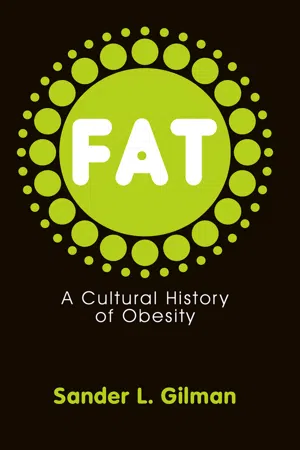
This fascinating new book by Sander Gilman looks at the interweaving of fact and fiction about obesity, tracing public concern from the mid-nineteenth century to the modern day. He looks critically at the source of our anxieties, covering issues such as childhood obesity, the production of food, media coverage of the subject and the emergence of obesity in modern China. Written as a cultural history, the book is particularly concerned with the cultural meanings that have been attached to obesity over time and to explore the implications of these meanings for wider society. The history of these debates is the history of fat in culture, from nineteenth-century opera to our global dieting obsession. Fat, A Cultural History of Obesity is a vivid and absorbing cultural guide to one of the most important topics in modern society.
- English
- ePUB (mobile friendly)
- Available on iOS & Android
eBook - ePub
About this book
The modern world is faced with a terrifying new 'disease', that of 'obesity'. As people get fatter, we have come to see excess weight as unhealthy, morally repugnant and socially damaging. Fat it seems has long been a national problem and each age, culture and tradition have all defined a point beyond which excess weight is unacceptable, ugly or corrupting.
Information
1
EPIDEMIC OBESITY
Constructing diseases such as obesity does not always mean inventing them. Often real pathological experiences are rethought as part of a new pattern that can be then discerned, diagnosed, and treated. Obesity as a category has been the subject of such a public reconceptualization over the past decades. It has become the target of public health campaigns and spurred a global rethinking of where the sources of danger for the public may lie. Such a rethinking mixes together and stirs many qualities in order to provide a compelling story that defines ‘obesity’ as the ‘new public health epidemic’.1 This is not to discount the costs, both personal and national, that overweight can accrue, but to understand why, in the twenty-first century, we have suddenly seen the ‘moral panic’, which was associated in the 1980s with HIV/AIDS as a potentially global disease, being transferred to obesity.
In July 2004 the then American Health and Human Services Secretary Tommy G. Thompson announced that Medicare was abandoning a long-held policy which said obesity was not a disease, opening the way for the government to pay for a whole range of possible treatments, from surgery and diets to psychotherapy.2 Soon afterwards, a cartoon by Dick Locher of the Tribune Media Services appeared, showing a portly little boy reading a newspaper with the headline ‘Obesity now considered a disease’. He then calls his school and says: ‘Hello, Principal’s office? This is Tommy Frobish . . . I won’t be in school today, I got a disease’.
We know what type of disease Tommy Frobish had: scientists at the annual meeting of the American Association for the Advancement of Science in February, 2002 had already warned the government that obesity was now a ‘global epidemic’ – no longer confined to western, industrialized societies.3 This reflected a growing consensus in the 1990s that obesity (not smoking) was going to be the major public health issue of the new millennium.4 By 2005 the ‘war against obesity’ had replaced the ‘war against tobacco’, even though world-wide tobacco sales continue to increase. Although the phrase ‘war against obesity, sloth, and addiction’ appears in the UK in The Times as early as 1981,5 in Canada, as of the summer of 2005,
fat is Ontario’s new public health enemy No. 1. Jim Watson, recently appointed by Premier Dalton McGuinty to wage war on our slothful, couch-potato ways, made a first-strike assault against flab this week by warning he intends to get ‘aggressive on obesity’. Watson, the province’s new health promotion minister, boldly suggested ‘fat is the new tobacco. I think obesity is the challenge of the 21st century, just as smoking was the challenge of the 20th century.’6
The ironic tone of the news report makes it clear that declaring ‘war’ against fat is a very much more contentious issue than declaring ‘war’ against smoking. In the United States at the same moment, military recruiters were dealing with another war – and with an inability to recruit soldiers into the military to fight in Iraq because of their weight.7 The most innocent victims, children throughout the world, seem to be at greatest risk in this ‘war against obesity’.8
1 EPIDEMIC OBESITY
Media outlets were (and are) rife with warnings about the ‘obesity epidemic’. This was not the first time that the media had used the phrase. The notion of an ‘epidemic’ of ‘obesity’ (in cattle) as a ‘form that chimes in with a rather artificial idea of animal beauty’ was part of the debate between ‘contagionists and non-contagionists’ as early as the 1860s.9 It is only in the very late twentieth century that obesity becomes an ‘epidemic’ in humans.
‘Epidemic’ was first used in the context of an ‘epidemic of heart disease’, for which obesity (and smoking) were seen as major causes.10 By 1987, members of the media began to evoke the specter of ‘epidemic obesity’ as a problem of its own: ‘ “Childhood obesity is epidemic in the United States,” said Dr William H. Dietz Jr of New England Medical Center’.11 Headlines such as ‘Obesity epidemic raises risk of children developing diabetes’ grabbed the attention of the reader.12 Even those reporters who are a bit more attuned to what the term epidemic may imply tend to agree: ‘To describe what has happened as an epidemic may seem far-fetched. That word is normally applied to a contagious disease that is rapidly spreading. But the population that is obese has grown 400 percent in the last 25 years’.13 The media saw its goal as being to help fight this new epidemic of obesity.
Even the food industry feels that no one is ‘better suited to solve the obesity epidemic’ than they are.14 The ‘wellness’ industry, too, is aware of the potential of the obesity epidemic: ‘According to a new study, Americans consider childhood obesity as serious a problem as smoking or school violence, exceeded only by substance abuse as a health threat to school-age children..15 For profit-hungry health and nutrition vendors, obesity is a growth industry.
From the USA to Australia, the ‘obesity epidemic’ has become a ‘political issue’.16 The British Labour government in 2004 admitted that it had removed the tackling of this epidemic from its public health goals and belatedly published a major account of the epidemic, including a horror story about the death of a three-year-old girl from obesity.17 According to the press, there was no question that ‘her death was due to over-feeding and bad parenting’.18 The story turned out to be a poor indicator of the epidemic, as the child had died of a genetically transmitted disease in which obesity was just one factor. The media stressed the ‘fear factor’ of children out of control: ‘She weighed six stone [84 lbs.], not because her parents stuffed her face with food, but because of a rare genetic condition . . . There can be no license to publish dodgy facts by claiming that they serve a worthy cause’.19 Even the British afternoon TV hosts Richard and Judy got into the act bemoaning ‘the wild-eyed woman on the TV news trying to scare the pants off us all with a vision of hugely overweight children being choked by their own fat, and the committee’s warnings that today’s children would be “the first generation to die before their parents as a consequence of obesity”. It also predicted that large numbers of people would be disfigured by blindness and amputation as a result of diabetes – to which obesity can contribute. I knew it was all cobblers, scare tactics on a lunatic scale’.20 Yet in spite of these regular revelations of hyperbole and poor science, we remain in the twenty-first century both literally and conceptually in the middle of an obesity epidemic.
What fascinates me is the power of using the term ‘epidemic’ in the context of obesity as a means of characterizing obesity as a ‘disease’. Obesity is not itself a ‘disease’ but rather a phenomenological category which reflects the visible manifestation of bodily size, which in turn can have multiple (or multifactorial) causes. No one dies from ‘obesity’. One dies from those pathologies which may result from extreme overweight. Obesity may be a tertiary cause of morbidity or mortality: it may lead to diabetes, which may lead to vascular disease. Thus the image of an ‘epidemic’ of obesity demands a single, clearly defined cause for this ‘disease’, much as we have encountered in other recent epidemics of infectious diseases. It is striking that the assumptions about the mono-causality of ‘obesity’ – the latter’s representation as having a single cause – is part of the urban myth of disease.21
Yet politicians’ use of the term ‘epidemic’ is in many ways very much in line with that of the medical profession. ‘. . . Obesity and sedentary lifestyle are escalating national and global epidemics that warrant increased attention by physicians . . . at the pivotal role of physicians and other health care professionals in curbing these dangerous epidemics. . . .’.22 As early as 2002, the Lancet warned against the global ‘obesity epidemic’ and provided a detailed account of the public health discussions of this new killer.23 In 2004, E.B.R. Desapriya of the British Columbia Injury Research and Prevention Centre for Community Child Health Research in Vancouver, BC (Canada) warned as follows: ‘The obesity epidemic poses a public-health challenge. Obesity has a more pronounced effect on morbidity than on mortality, and an increase in its prevalence will have an important effect on the global incidence of cardiovascular disease, type 2 diabetes mellitus, cancer, osteoarthritis, work disability, and sleep apnoea. A 1% increase in the prevalence of obesity in such countries as India and China leads to 20 million additional cases. The state of childhood obesity in the USA, Canada, and many other countries worldwide has reached epidemic proportions; the Canadian prevalence tripled between 1981 and 1996’.24 Yes, everyone agrees, we are in the middle of an obesity ‘epidemic’.
Epidemic is a technical term from epidemiology meaning any ‘large-scale temporary increase in the occurrence of a disease in a community or region, which is clearly in excess of normal expectancy. Yet it is ‘widely used to describe clusters of diseases in general [although it has] traditionally been used when infections strike a population’.25 ‘Epidemic’ maintains a powerful metaphoric connection to contagion. It can, of course, be applied to any disease, no matter what its cause, and to all injury, including gun-shot wounds – as the Centers for Disease Control found (to their political embarrassment) a number of years ago – or other health-related event.26 Epidemics may be global (pandemic), but they are always defined by their rate of increase, not by their universality. But, even here, the model, as given by voluntary contributions to a web site, is that of the spread of an infectious agent: ‘When each infected individual is infecting more than one other individual, so that the number of infected individuals is growing exponentially, the disease is in an epidemic state’.27 Epidemic, as we can see here, has a strong popular use in terms of the spread of infectious diseases. As the OED notes, its primary meaning is that of a disease ‘prevalent among a people or a community at a special time, and produced by some special causes not generally present in the affected locality’.
‘Epidemic’ seems to be a creation of the seventeenth century, borrowed from the French at precisely the same time as the term ‘obesity’. One of the first uses of the term ‘obesity’ appears in Tobias Venner’s handbook of humoral good diet and health of 1620. Venner notes that ‘a fat and grosse habit of body is worse than a leane, for besides that it is more subject to sicknes, it is for all corporall actions farre more unapt. They are more sickly that have grosse and full bodies, not onely because they abound with many crude and superflous humors, but also because they lesse (by reason of the imbicillity of their heat) resist extrinsicall and intrinsicall causes that demolish their health’.28 ‘Obesity’ is, according to Venner, a disease process. Thomas Lodge needed to define this new notion of ‘Epidemick’ for his readership in 1603: ‘An Epidemick plague, is a common and popular sicknesse, hapning in some region, or country, at a certaine time, caused by a certaine indisposition of the aire, or waters of the same region, producing in all sorts of people, one and the same sicknesse’.29 Two decades later Francis Bacon, in his Historie of the Raigne of King Henry the Seventh (1622), can speak of the ‘sweatingsickness’ as ‘was conceived not to be an epidemick disease, but to proceed from a malignity in the constitution of the air, gathered by the predispositions of the seasons; and the speedy cessation declared as much’.30 ‘Epidemic’ quickly takes on metaphoric meaning, as in John Milton’s condemnation of an ‘epidemick whordom’ in his 1643 treatise on divorce.31 This movement between illness and metaphor continues in our contemporary anxiety about the epidemic of obesity.
What was seen to cause human ‘obesity’ has varied over time. Today there seems to be a stress on a plurality of often conflicting causes.32 Central among them are social and genetic–physiological explanations:
1 A shift in the ‘quality of life’ and in life expectancy.: we live longer now, have less physically stressful occupations, and have easier access to more food.
2 Our psychological makeup: we depend psychologically on food as a means of manipulating our immediate environment. On this assumption, obesity is simply on a continuum with anorexia nervosa, which has been so labeled by psychologists. Obesity is thus a mental illness.
3 Abundant access to poor food and the absence of structures to engage physical activity: this is the ‘obesity of poverty’ argument – that is, the argument that poverty is a contributory factor in one’s becoming obese.
4 Loss of control over food consumption through addictive behavior: addiction is usually understood on the medical model of some type of genetic pathological predisposition in an individual or group rather than as a ‘weakness of will’.33
5 A genetic ‘normal’ predisposition, understood in terms of an evolutionary biological drive to accumulate bodily fat in order to prevent starvation in times of famine: this is the ‘ob-gen’ argument, first put forth in the classic 1994 paper on the genetics of obesity in mice, which concluded by extrapolating it to human beings.34
6 A disruption of normal growth caused by changes in the endocrine system through other, pathological, changes including aging (also understood as pathological).
7 The result of infection, as we shall see below.
What is clear is that any single explanation may be possible for any given individual, but it is the social implications of ‘obesity’ that have now turned it into an ‘epidemic’.
The anxiety about ‘epidemics’ points out the danger which lies in a ‘moral panic’ that defines those ‘diseases’ we openly fear and those ‘infected’ persons we openly disdain. Obesity is now the central ‘danger’ to confront all aspects of life or all societies (as it is seen as an epidemic of poverty as well as of affluence). Its spread seems ‘like’ that of a contagious disease. Yet each discussion of obesity seems to choose some model for its cause and nature – a model which could be the point of intervention to end this plague, be it the danger of fast food, of too much sugar or fat, of too little exercise, of damaged psyche or weak will, of too large portions, of genetic predisposition or of hormonal imbalance. It is not unpredictable that there has been a strong argument for at least some cases of obesity being the result of an infectious agency: this fulfills all of the metaphoric power of the ‘moral panic’ about fat and limits its locus to a limited and treatable cause. In the United States this is embodied by ‘the Center for Science in the Public Interest. That’s the advocacy group that periodically issues breathless bulletins (“Food porn!”) warning that one food or another (eggs, soda, shellfish, Mexican food, Chinese food, French fries, donuts, beef, salt, etc.) is bad for you’.35 A magic bullet can be found which is simply more di...
Table of contents
- Cover
- HalfTitle
- Title
- Copyright
- Dedication
- Contents
- Introduction: Some Weighty Thoughts on Dieting and Epidemics
- Chapter 1: Epidemic Obesity
- Chapter 2: Childhood Obesity
- Chapter 3: The Stigma of Obesity
- Chapter 4: Obesity as an Ethnic Problem
- Chapter 5: Regions of Fat
- Chapter 6: Chinese Obesity
- Conclusion: ‘Globesity’ and its Odd History
- Notes
- Further Reading
- Index
Trusted by 375,005 students
Access to over 1.5 million titles for a fair monthly price.
Study more efficiently using our study tools.
Frequently asked questions
Yes, you can cancel anytime from the Subscription tab in your account settings on the Perlego website. Your subscription will stay active until the end of your current billing period. Learn how to cancel your subscription
No, books cannot be downloaded as external files, such as PDFs, for use outside of Perlego. However, you can download books within the Perlego app for offline reading on mobile or tablet. Learn how to download books offline
Perlego offers two plans: Essential and Complete
- Essential is ideal for learners and professionals who enjoy exploring a wide range of subjects. Access the Essential Library with 800,000+ trusted titles and best-sellers across business, personal growth, and the humanities. Includes unlimited reading time and Standard Read Aloud voice.
- Complete: Perfect for advanced learners and researchers needing full, unrestricted access. Unlock 1.5M+ books across hundreds of subjects, including academic and specialized titles. The Complete Plan also includes advanced features like Premium Read Aloud and Research Assistant.
We are an online textbook subscription service, where you can get access to an entire online library for less than the price of a single book per month. With over 1.5 million books across 990+ topics, we’ve got you covered! Learn about our mission
Look out for the read-aloud symbol on your next book to see if you can listen to it. The read-aloud tool reads text aloud for you, highlighting the text as it is being read. You can pause it, speed it up and slow it down. Learn more about Read Aloud
Yes! You can use the Perlego app on both iOS and Android devices to read anytime, anywhere — even offline. Perfect for commutes or when you’re on the go.
Please note we cannot support devices running on iOS 13 and Android 7 or earlier. Learn more about using the app
Please note we cannot support devices running on iOS 13 and Android 7 or earlier. Learn more about using the app
Yes, you can access Fat by Sander L. Gilman in PDF and/or ePUB format, as well as other popular books in Social Sciences & Cultural & Social Anthropology. We have over 1.5 million books available in our catalogue for you to explore.