![]()
1
Selling Technology Solutions
The Marketing of Educational Technology
The BETT (British Education, Training and Technology) Show1 is reputed to be the largest educational trade fair in the world. Held annually in the cavernous Victorian arena of London’s Olympia exhibition centre, it provides a startling indication of the growing importance of technology companies within the education marketplace. The main exhibition area is populated with stands from many major national and international corporations – Microsoft, Apple, RM, Oracle, BT, Dell – as well as broadcasters and other media companies with an interest in this field, such as the BBC, Channel 4 and Granada. More specialized mid-range software and hardware companies – TAG, Immersive, Harcourt, Promethean – also compete for attention, while around the fringes of the hall a wide range of smaller exhibitors ply their trade.
First established in 1984, the BETT Show is organized by EMAP Education, part of EMAP Business Communications, a leading UK media company. In addition to organizing exhibitions – particularly ‘business-to-business’ events – EMAP runs radio stations, and publishes trade papers and consumer magazines ranging from Therapy Weekly and Steam Railway right through to market-leading titles such as FHM, More! and Heat. Its annual turnover in 2005 was over £1 billion.2 The BETT Show is sponsored by BESA (the British Educational Suppliers Association) and the magazine Educational Computing and Technology, and is run in association with the Times Educational Supplement, the government’s Department for Education and Skills (DfES) and Educational Events Limited.
BESA is the leading partner in this alliance. Founded in 1933, it is the trade association for the educational supply industry, claiming a membership of over 250 manufacturers and distributors. These companies produce a range of ICT hardware and software, as well as more traditional teaching aids, furniture and other materials designed for use in educational settings ranging from pre-school to university. Some of these older products – wallcharts, stationery, worksheets, even books – continue to feature on the fringes of BETT, well away from the main site of the action.
Almost 30,000 visitors attended over four days in 2006, most leaving the exhibition with large bags emblazoned with logos and stuffed with lavishly produced handouts, catalogues and free software samples.3 Attending BETT is a gruelling experience. The noise level in the hall makes it difficult to carry on a conversation, and it is almost impossible to find a place to sit down. The wide range of stands – reaching almost 650 in 2006 – can prove bewildering and disorientating. The 168-page official show guide contains advice on planning your visit; and it is now possible to subscribe to ‘BETT mobbing’, a service that sends alerts to your mobile phone about ‘cool things to see’.
BETT has grown significantly in recent years, registering steady annual increases in the number of attendees and the number of stands. Those who visit are mainly UK teachers: according to BESA, around one-third of UK schools send teachers to the show each year. The organizers also promote the show through information sent to schools and through more practical means, such as arranging transport: in the past they have even collaborated with local education authorities to charter a train (dubbed the ‘Education Express’), with the dual objective of providing transport to the show and ICT training on board. However, the attendance figures have also seen particular increases both in the proportion of business personnel and ‘consultants’, and in the number of international visitors. Each year, the British government sponsors more than sixty overseas education ministers to attend the show – and to enjoy the facilities of its ‘international lounge’ – suggesting that the UK is now playing a leading role in the global marketing of educational technology.
Sales Pitches
The sales pitches adopted at BETT vary from the minimalist to the hyperactive, although the latter are much in evidence. Some of the larger exhibits are the most understated, suggesting that the central aim is one of branding rather than direct selling of products. Others use glossy images taken from the companies’ CD-ROMs, web pages or books, often emphasizing primary colours in a style characteristic of children’s publishing. Most of the larger stands include several terminals at which participants can try out the products on offer, as well as a presentation area with seating and a large whiteboard screen. Several run timetabled demonstrations and ‘seminars’ at which new products are showcased, and uniformed representatives are on hand to provide additional persuasion. Many exhibits include endorsements from reviewers or key figures in education, while others have large television screens showing promotional videos, often featuring fast-moving excerpts from their productions set to music. For technology companies, this is highly labour-intensive work: RM, for example, claimed in 2006 to have 100 staff working on its two stands, with fifty separate presentations in its two ‘theatres’. The overall cost of the show to exhibitors is reputed to be more than £6 million.4
In some instances, the sales techniques are more assertive. Several exhibitors offer quizzes and competitions, or the chance to win a free lunch. Others provide gifts, in the form of pens, yoyos, badges and chocolate bars; the BBC launched its digital curriculum, with its new street-credible title ‘BBC Jam’, by offering free pots of jam. Several stands have salespeople in costume: in 2006, William Shakespeare was on hand, along with a large cuddly bear, a nineteenth-century aristocrat, a robot and various medieval peasants. In previous years, Lara Croft lookalikes have roamed the halls, while in 2006 ‘booth babes’ dressed in white mini-skirts with company names emblazoned on their backsides attempted to entice the visitor to purchase the latest educational software solution.
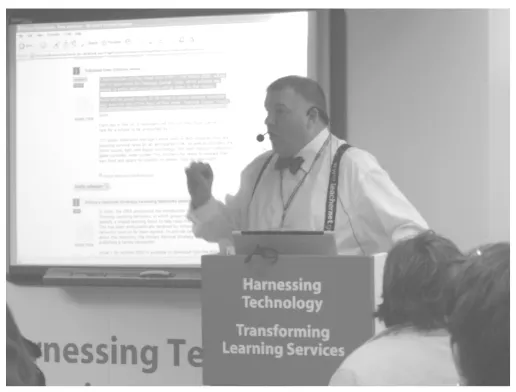
While some of the presenters have a vaguely educational gravitas, most are more akin to market traders or ‘barkers’ at a funfair. They are fast-moving, amplified, ‘punchy’ and humorous, using repetition and rhetorical questions in the style of a department store salesman extolling the virtues of carpet shampoo. Prominent among them is Russell Prue, a self-styled ‘independent ICT Evangelist’, who presented at five different stands in 2006, in each case wearing different braces carrying the relevant company slogan along with his trademark glittering red bow tie. Formerly employed by the UK computer hardware company RM as ‘Chief Product Evangelist’, Prue is the author of The Science of Evangelism, and is frequently engaged by the Department for Education and Skills to promote its policies.5
The view of technology promoted at BETT is relentlessly upbeat. In the words of the show’s 2006 slogan, technology is ‘Engaging – Enriching – Empowering’. It will motivate, inspire and stimulate teachers and students, and transform the learning experience:
BETT … bringing together the global teaching and learning community for four days of innovations and inspirations. BETT is the place to see exciting ideas, the latest technology, practical solutions that can have an immediate impact, and new ways to put ICT at the heart of learning. (BESA website)
The straplines of individual exhibitors reinforce this almost mystical message: ‘lighting the flame of learning’ (Promethean); ‘inspiring creativity in the classroom’ (Smoothwall); ‘share knowledge, spark brilliance’ (Adobe); ‘transforming the future’ (RM). Even the DfES partakes of the same rhetoric, albeit in slightly more muted terms: technology is about ‘creating opportunities, realizing potential, achieving excellence’. Learning via technology, it is repeatedly asserted, is ‘fun’, exciting and motivating for young people in a way that more traditional methods are not.
While the BETT Show is almost exclusively targeted at schools, several key exhibitors also have significant interests in the domestic market. This interest in out-of-school learning is reflected in the straplines: ‘Extending the classroom into the home: Knowledge through your television’ (NTL); ‘Non Stop Learning – Non Stop Managed Services’ (Compaq); ‘Portable Learning’ (ACER). Likewise, the Microsoft presentations speak of ‘anytime, anywhere learning’ and ‘learners without limits’, and claim that their products are ‘bridging the gap between learning in and beyond the classroom’; part of the pitch of ‘BBC Jam’ is the ability of students to access it at home, ‘or as a continuation of their learning at school’, finding that ‘almost without knowing it, they are actually learning all the time’.
One of the recurrent themes that emerges here is the idea that technology represents a ‘solution’ – although it is never quite clear what problems it solves. There are no problems at BETT, only solutions – ‘solutions for schools’, ‘solutions that delight you’, ‘flexible solutions’, ‘solution providers’, ‘portable, hand-held solutions’, ‘integrated education ICT solutions’, ‘end-to-end solutions’, and many more. Some companies promoting managed learning environments claim that they can cater for all ICT requirements and thereby provide the ‘total solution’ for every need. In some cases, the term ‘solution’ appears to take the place of the material object – the hardware or software – that is actually on sale. In this formulation, the technology seems to move beyond being a mere consumer product, and to assume an almost metaphysical dimension; and, in the process, it is endowed with a magical ability to stimulate and transform teaching and learning.
Another broad theme here is the view of technology as empowering and emancipating: ‘What ever you want to do, YOU CAN!’ (Microsoft); ‘Release your time – release your potential’ (Capita). Teachers, it is implied, have been held back in some unspecified way, but can now be freed by technology. In this utopian vein, BT (British Telecom) even promises to take consumers to ‘educational ICT heaven’:
[Through technology] we are able to develop best-of-breed solutions that empower teachers, delight learners and enable everyone to realise their full potential.
According to this kind of futuristic rhetoric, ‘the digital age’ is a ‘new era’: it offers ‘new horizons in education’ and an opportunity to ‘build your future’. Such assertions are frequently accompanied by images of outer space, the earth, the sun and the solar system.
Yet while they are keen to reassure teachers that technology is about freedom, and that its use is natural and intuitive, these promotional texts also give them cause for concern about their own role in this technological age. They draw attention to the dangers of being ‘left behind’, and the responsibility that teachers have to keep up to date, to implement government policy, and to use their ICT funding wisely. In a context of increasing investment in ICT, teachers need guidance; and this is precisely what the industry, by means of BETT, purports to provide. ICT, it is argued, is no longer a matter of choice: all teachers, regardless of their curriculum area, will need to be familiar with it. As Kevin Robins and Frank Webster (1999) have noted, debates around information technology have often been characterized by a rhetoric of ‘inevitability’. In these formulations, this is allied with one of professionalism: just as the ‘good parent’ invests in technology in order that their child does not fall behind, so too does the professional teacher.
The underlying anxiety here – and it is one that (as we shall see) is borne out by research – is that teachers are not in fact integrating this technology in their teaching, and indeed that many remain uncertain about its value. Despite massive government funding for ICTs in schools, the fear of policy-makers and of companies is that technology is not becoming sufficiently ‘embedded’ in classroom practice. The director general of BESA, Dominic Savage, addresses this directly in his ‘Welcome’ to the 2006 official show guide. He recognizes that the ‘transformation of learning’ sought by government has yet to occur: harnessing the benefits of technology in schools, he argues, requires a new focus on ‘the learning experience’ and on developing teacher confidence. The need for more ‘embedding’ is also a theme strongly echoed in the government’s own publicity materials, and in the speeches of ministers who are typically enlisted to open the show. By implication, they draw attention to the contrary possibility, that technology may in fact be making only a very superficial impact on schools.
Furthermore, the uplifting rhetoric of inspiration and empowerment often sits rather awkwardly with the more bureaucratic claims that are also made here. As Neil Selwyn (2005) has noted, digital learning is often presented in such contexts both as ‘futuristic, exotic and endless’ and as ‘a set of benign tools which fit seamlessly into the daily drudgery of the classroom’. Software in particular needs to be sold, not only on the basis that it will transform learning or provide endless pleasure and fun, but also in terms of its ability to deliver specific assessment objectives, as defined by the government through the National Curriculum and measured through standardized examinations. ‘Unleashing creativity’ is all very well, but only if it improves test scores. Compared with the promise of technological utopia, these concerns about meeting the requirements of Key Stages and SAT tests appear strangely mundane; yet marketers know that they are bound to be the major preoccupation for teachers. The use of technology may be innovative and transformative, but we also need to be assured that it will deliver efficiency, ensure improved performance and raise standards. Technology may offer freedom, but it often seems to be merely the freedom to do what you are told.
The Political Economy of Educational Technology
Educational technology is self-evidently big business; yet it has also been significantly promoted by government intervention in the marketplace. According to a 2005 survey report commissioned by BESA, the number of computers in UK schools doubled between 2001 and 2005, to just over 2 million. The number of ‘client units’ for networks also doubled, while the provision of internet-connected computers increased by a factor of 2.5. According to the DfES, the ratio of computers to students in 2005 rose to 1 : 6.7 in primary schools and 1 : 4.1 in secondaries. Total ICT budgets in schools rose from £336 million in 2001 to £551 million in 2005, and these figures exclude the substantial amount of ring-fenced funding from government (such as ‘e-learning credits’, of which more below). BESA estimates that total direct government investment on technology in education rose from £102 million in 1998 to £640 million in 2005. (Interestingly, the same report suggests that, despite this significant growth in investment, teacher confidence and competence in using technology have actually declined over the past three years.)6
A key factor in the growth of the sector was the move towards a ‘free market’ in education, via the introduction of Local Management of Schools (LMS), which was part of the Education Reform Act of 1988. Before this, most purchasing decisions in education were taken by local education authorities (LEAs). By virtue of their large budgets, the LEAs wielded a significant degree of power in negotiating with potential providers of products and services, although from the point of view of many schools they were often unnecessarily bureaucratic. LMS passed much of the control over purchasing decisions to individual schools; in the process, teachers became a significant new consumer market – albeit one that was not necessarily very well informed or well supported in its purchasing decisions.
Much of the support for the development of educational technology has come directly from government in the form of ring-fenced funding. Initially, most of this was directed towards hardware, as in the case of the ICT in Schools grant provided from the government’s Standards Fund. Other key initiatives have included the National Grid for Learning, which acts as a portal for government-approved resources, and the New Opportunities Fund, which provided basic training for teachers. Both initiatives have been widely seen – even by advocates of ICT in education – as less than successful (see Conlon, 2004; Galanouli et al., 2004; and Ofsted, 2004).
More recently, the government has sought to ‘pump-prime’ the educational software industry through an initiative known as ‘e-learning credits’ (see Scanlon and Buckingham, 2003). The government’s decision to engage the BBC to produce a £150 million Digital Curriculum (the new initiative, renamed ‘BBC Jam’, was ultimately launched in early 2006) generated a considerable amount of protest from the commercial software industry. It was argued that the BBC had obtained unfair advantage, and that the choice available to schools would be significantly reduced. BESA, among other organizations, argued that the government should be seeking to establish ‘a competitive level playing field in education supply’.7 The government ultimately responded by introducing e-learning credits, which are given directly to schools to spend on educational software. While there has been concern that not all the money made available in this way is being spent, the initiative has undoubtedly provided significant support for the software industry – and perhaps particularly for small and medium-sized companies. Since its commencement in 2002, the government has provided more than £100 million per year for schools to spend, albeit only on DfES-approved products and services.
For technology companies, this funding has obviously represented a considerable commercial opportunity. ...