- normative conceptions of media and democracy;
- the role of the past in the transition process;
- the internet as a new space for democratic change;
- the persistence of political interference in emerging democracies;
- the interlocking power of media markets and political ownership;
- the challenges to journalistic professionalism in post-authoritarian contexts;
- the role of the media in divided societies;
- English
- ePUB (mobile friendly)
- Available on iOS & Android
eBook - ePub
The Media in Transitional Democracies
About this book
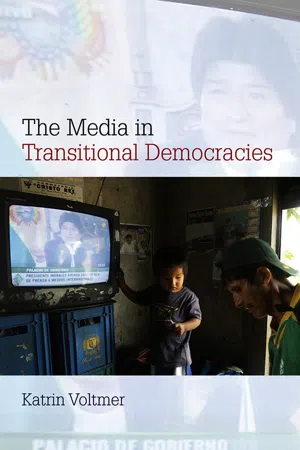
The last quarter of a century has seen an unprecedented wave of democratization around the globe. In these transitions from authoritarian rule to a more democratic order, the media have played a key role both by facilitating, but frequently also inhibiting, democratic practices to take root. This book provides an accessible and systematic introduction to the media in transitional democracies. It analyses the problems that occur when transforming the media into independent institutions that are able to inform citizens and hold governments to account. The book covers the following topics:
Information
Part I
What Democracy? What Media?
What Democracy? What Media?
The first part of this book is devoted to the values and norms that constitute our understanding of a ‘good’ democracy and the role the media are playing in democratic life. For many democracy activists struggling against an authoritarian regime, democracy is primarily defined by all those things which it is not: state violence and fear, restrictions on individuals’ autonomy to lead the life they want to live, manipulative state propaganda, restrictions on free speech and, in many cases, economic decline. But once the dictator and his (rarely her) clique have been removed and crude censorship is abolished, a clearer vision of what democracy and free media actually mean is needed to build the new order.
The recent wave of democratization, which has brought democracy to more countries of the world than ever before, has revitalized scholarly debates about the standards of ‘good’ democracy and democratic media. Yet, at the same time, there seems to be a widening gap between the political and journalistic practices in the newly emerging democracies, on the one hand, and the sophistication of academic debate, on the other. Evidently, democracy on the ground is a fuzzy and contested concept that defies clear-cut definitions. A key argument of the two chapters that make up Part I of this book is therefore that the norms of democracy and free media have to be contextualized in the light of the specific historical, cultural and political circumstances in which a particular new democracy emerges. Alongside a core of indispensable principles, democratic practice has, as will be discussed in Chapter 1, to navigate through numerous normative paradoxes that cannot be resolved in a uniform, one-size-fits-all manner. It is therefore important to develop a better understanding of the particular cultural values and contextual constraints in which political actors and journalists in new democracies operate.
Chapter 2 engages in a more detailed discussion of two key principles of democratic media: independence and diversity. Like other democratic norms, these principles allow for a wide range of interpretations and practices. Not only emerging democracies, established democracies too have to address fundamental questions like: ‘How free is a “free media”?’ and ‘What are the best ways of practising and fostering diversity?’ These are difficult questions, and different circumstances will require different answers.
Following the reasoning of the philosopher Onora O’Neill, Chapter 2 argues that freedom of the press involves not only the rights of the speaker – i.e., the media and all those who seek to communicate their views through the media – but the communication process as a whole. Press freedom therefore comes with the responsibility to consider the consequences of journalistic outputs on the listeners. From this more holistic perspective, the ultimate goal of press freedom is to enable a robust and inclusive public debate, which is at the heart of a healthy and sustainable democracy. In new democracies, achieving this goal is a particular challenge. The volatility of the transition process, fragile institutions and the centrifugal forces frequently unleashed by the breakdown of dictatorial rule make it an extremely difficult task to find the right balance between freedom and openness, on the one hand, and responsibility and restraint, on the other.
The discussion of the diversity norm focuses on two different modes of representing different opinions, interests and identities that exist in society: internal and external diversity. While internal diversity, with its principle of neutral and balanced reporting, has become the standard of professional journalism, widely taught in journalistic textbooks and codified in codes of practice, it is argued that both forms of media diversity have their specific strengths and drawbacks. A particular point is made to emphasize the role that partisan and advocacy media can play in building political identities and mobilizing the citizens of new democracies to participate in public life. However, there is also the risk of external diversity being a source of destructive divisions and intolerance.
1
Democracy and Democratization: One Idea, Many Roads
There are probably few words in contemporary political public discourse that bear as much hope and aspiration as ‘democracy’. Equally, there are probably few words that are as much overused. As democracy is becoming ‘the only story in town’ – to paraphrase Linz and Stepan’s (1996: 5) famous definition of a consolidated democracy being ‘the only game in town’ – the boundaries of what it actually means are becoming increasingly blurred. The pervasiveness of a democracy discourse that was unleashed after the end of the Cold War and is constantly reinforced by global media has made it ever more difficult to distinguish between democratic and non-democratic politics. Under the cloak of democracy, political leaders have suppressed opposition and ‘managed’ election results to legitimize their power. Meanwhile, the 1993 invasion of Iraq by Western troops under the command of the US has equally been justified by its purportedly democratic mission: to end dictatorship and to bring democracy to the country. However, for many people, the Iraq War has given democracy a bad taste as something that is used as a Trojan horse to promote the neo-imperialist interests of the West.
With the unprecedented spread of democracy around the world in recent decades, the meaning of the term has become increasingly contested not only among scholars, but also amongst political factions and various groups of democracy activists. Is Russia a democracy? Is Turkey democratic enough to be allowed into the European Union? And is Britain becoming less democratic with the introduction of new security laws to fight terrorism? Depending on one’s understanding of what democracy is, the answers will be different. In fact, the many struggles and popular protests that swept across the globe in 2011 were driven by an urge for democracy that encompassed citizens in established and emerging democracies as well as in dictatorships: protesters in the Arab world demanding freedom, justice and respect; the ‘Occupy’ movement in the US, Britain and many other Western democracies demonstrating against the unchecked power of financial markets; and Greek demonstrators defending their right to a decent living standard and their country’s independence from external dictates.
This chapter explores how an idea with universal appeal – government by the people – is interpreted and practised in different ways at different times and in different places. Even though democracy is founded on a set of indispensable principles and values, this chapter argues that it is surprisingly elastic and adaptable to specific circumstances arising from the historical, cultural and political trajectories in which it is implemented. In fact, it is the openness of the democratic idea that has kept it alive over centuries and enables it to grow roots in places that have little in common with the countries where institutionalized democracy first developed. Because of the ambiguous boundaries of the concept, we would be mistaken to try to pin down the ‘true’ or ‘best’ form of democracy. Instead, the way in which democracy is practised is always a specific balance between local values and universally shared norms, thus giving way to a wide range of variations that challenge rigid definitions of what democracy should look like.
Lost in definitions: democracy and democratization
Democratization research is struggling with a conceptual uncertainty that lies at the very heart of its subject: the impossibility to agree on what exactly democracy is. This problem is becoming even more apparent as more countries with no, or only weak, cultural ties with the Western world abandon autocracy and embark on implementing democratic institutions of government. For most of the twentieth century, democratization was perceived as a process whereby emerging democracies set out to adopt Western models of democratic governance – most notably the American presidential system with extensive mechanisms of checks and balances, or the British Westminster model of parliamentary democracy. However, the outcomes of transitions, especially in Asia and sub-Saharan Africa, frequently defy this expectation. Even the democracies in Central Eastern Europe, a region that regards itself as part of the historical and cultural heritage of the West, seem to function in somewhat different ways from their proclaimed role models.
One of the conceptual problems with democracy is that any definition always involves both ideals of what is regarded as ‘good’ democracy and empirical descriptions of how democracy works in actual existing democratic countries. Since democracy was not invented at the ‘green table’, but emerged as a product of specific historical circumstances,1 the concept and institutional arrangements of modern democracy are bound to be ambiguous and in some cases even contradictory. Democracy developed in an iterative, sometimes arbitrary, way, or – as Dahl (2000: 25) puts it: ‘Democracy, it appears, is a bit chancy.’ Hence, the outcomes of this process could well have been different from what is known as democracy today. The contextual nature of democracy applies as much to its ancient Athenian form, which is now – rightly or wrongly – regarded as the origin of modern democratic governance, as to liberal democracy of our time. As Dahl (1989: 24–33) shows, it was only by combining the idea of equal votes as a mechanism of decision-making (isonomia) and the non-, or pre-democratic practice of representation inherited from medieval institutions, that democracy was made fit for politics in modern territorial nation-states. The conclusion from this observation is that if democracy is the product of specific historically contingent political and intellectual developments, then different forms of democratic governance could be possible.
So, what then is democracy as we know it? The key idea is encapsulated in the Greek words of which the term ‘democracy’ is composed – demos: people; kratos: power or rule – describing a form of government whereby the ultimate power lies with the people. Since in modern representative democracy ‘rule by the people’ is mainly exercised through elections, one way of determining whether or not a country is a democracy is by finding out if it conducts elections to select its political leaders. However, as countless rigged elections with results of almost 100 per cent of votes in favour of the incumbent highlight, more is necessary to qualify a country as democratic. Elections have to be fair and free, open to all citizens and conducted periodically. For a country emerging from autocracy, organizing elections that meet these requirements is an enormous achievement. The so-called minimalist school of thinking in democratization research therefore regards holding free and fair elections a sufficient definition of democracy (Przeworski et al. 1995).
Other scholars have challenged this reduction of democracy to elections, arguing that elections alone do not make for a ‘good’ democracy (for an overview of various notions of the prerequisites of democracy, see Bernhagen 2009a). To start with, elections are only meaningful if there exist real alternatives between which voters can choose. Viable pluralism not only involves a substantial range of oppositional groups, but also a free press through which divergent views can be expressed and debated in public. Further, to prevent democracy from being taken hostage by autocrats after the election has been won, a system of checks and balances has to be in place that ensures ‘horizontal accountability’ of the ruling elites (O’Donnell 2003). Central to this system of accountability are the rule of law and an independent judiciary, together with a press that acts as a watchdog, monitoring the actions of public figures on behalf of the citizens. A further layer of requirements is added by scholars who emphasize the importance of an active and competent citizenry for the viability of democracy. After all, it is the citizens who are the sovereign of the democratic process, and without their constant engagement, democratic politics would soon be left to a small circle of elites.
What can be observed here is that the definition of what democracy is – and should be – tends to expand its boundaries very quickly once one starts thinking about how the key idea of ‘government by the people’ can be achieved in practice. There is a noticeable danger of conceptual overstretching as layers of criteria and sub-criteria are added to the key definition of democracy. Paradoxically, the conceptual expansion is both realistic, because based on the empirical observation of democracy’s complexities when enacted in real life, and idealistic, in the sense that no real existing society is able to achieve all the conditions stated by theorists of a maximalist school of democratic scholarship.
One of the weaknesses of mainstream definitions of democracy is that most of them take a rather essentialist approach. Whether by reduction or by expansion of the conceptual scope, the unspoken assumption seems to be that eventually the true nature of democracy can be grasped by observing its features in existing, apparently functioning democracies. As a consequence, the empirical manifestation of the established democracies and their media systems in Europe and North America serve, often inadvertently, as normative standards for a ‘good’ democracy. However, this Euro- and US-centric approach underestimates the degree to which democracy is reinterpreted and enacted by the people who live in a particular democracy, no matter how consolidated the system is. Abstract concepts, like freedom, representation or justice, as well as practices, like voting, running for office or joining an online discussion forum, mean different things in different cultural and political contexts. Thus, the meaning and practices of democracy are constantly reconstructed and renegotiated in the light of the experiences and beliefs of the people who participate in the democratic enterprise. Deep history that may date back over centuries can be as important as actual situational factors in shaping the interpretations of democracy. It is for this reason that democratization scholar Laurence Whitehead (2002: 187) proposes an ‘interpretavist’ approach to democratization, in which the meaning and practices of democratic politics are achieved in a process of social construction. Instead of having a fixed meaning that can be applied universally, an ‘interpretavist’ definition of democracy is embedded in broader cultural, historical and political discourses that together shape the outcome of the transition process. Even established democracies periodically go through times of interpretative uncertainty and self-reflection, for example in the event of high-profile political scandals or national disasters. However, they can rely on an accumulated set of previous agreements, laid down in official documents (court decisions, committee reports, etc.) or stored in collective memory, that serve as a point of reference in the actual debate. Citizens and policymakers in emerging democracies operate on far less solid ground.
However, challenging the conceptual purity of democracy and acknowledging its cultural determinants raise new problems and questions. Does this mean that we have reached a postmodern age of democracy where ‘anything goes’? Is, for example, Putin’s vision of a ‘sovereign democracy’ (see Okara 2007) with restricted rule of law and the absence of media freedom in broadcasting just one of many variants of democracy? Obviously, the concept of democracy has to maintain its core of shared values, otherwise it would lose its meaning altogether. Whitehead (2002) is concerned about this possible conclusion that could be drawn from his notion of an ‘interpretavist’ approach to democracy. He suggests the notion of a ‘floating but anchored’ (ibid.: 6) conception of democracy and its key values, where the core meaning is grounded, but more peripheral concepts are open to debate and interpretation.
Democratic paradoxes
As discussed above, the principles and institutions of ‘government by the people’ and the conditions that guarantee effective popular participation form the indispensable foundation of democracy. These are complemented by broader value orientations and peripheral concepts that are believed to support and enable democratic rule. Pluralism, competition and individualism are taken as examples here because they are not only central to the variations of democracies across cultures, but also of crucial importance for how the role of the media is perceived in these contexts, as will be discussed in more detail in Chapter 2. Unfortunately, these – as numerous other – democratic values do not solve the ambiguity problem of democracy. On the contrary. Rather than being distinct and clear-cut categories, these concepts are part of value dimensions; i.e., they comprise opposing, yet interdependent, preferences. The point is that, for a functioning democracy, both aspects of these value dimensions are vital, and the expansion of one usually happens at the expense of the other. In other words, democracy is built on normative paradoxes that require constant reinterpretation and readjustment in response to changing circumstances. Western democracy discourses tend to emphasize one pole of these value dimensions, thereby making the opposing end of the dimension less salient, even less legitimate. However, even within Western democracies there exists a considerable variation of value preferences.2 But the scope of possible shades and the normative ambiguity involved have become more visible with the emergence of new democracies outside the Western world. The following discussion illustrates the ‘multivalence’ (Paley 2002: 477) of democratic value orientations with regard to the three exemplary value dimensions mentioned above.
Pluralism versus unity
The toleration of difference – in lifestyles, political views or cultural identities – is one of the defining aspects that distinguishes democracies from non-democratic regimes, which tend to impose homogeneity on their societies, if necessary even with means of suppression and physical violence. Pluralism allows individuals and communities to express and practise their uniqueness. With increased social and geographical mobility in modern societies and the global flow of ideas, the need to accommodate difference has become even more imperative. At the same time, societies – or, as political communities, polities – need a sense of unity that integrates the plurality of individual and group endeavours. Modern societies are becoming acutely aware of the centrifugal forces of diversity. As a response, in many countries discourses of unity have emerged, like, for example, the discussion about ‘Britishness’ initiated in 2006 by the then Chancellor Gordon Brown. It is probably indicative for the multiculturalism of British society that these ideas have not been widely followed up. In many new democracies the urgency to solve the pluralism versus unity dilemma is much more pressing. In contexts where nation-building is incomplete, where the central power has only limited reach and where a multitude of ethnicities compete for domination, unity and integration are a matter of survival. Under these circumstances, national media are frequently used as a means to limit pluralism and to promote a unifying national narrative. Not surprisingly, this instrumentalization of the media regularly triggers criticism from international media development groups. But in societies that are at risk of disintegration or even sectarian violence, a stricter control on who is saying what in the public sphere might be the lesser evil.3
Conflict versus consensus
Conflict and competition are regarded as the engine of the democratic process. From Mill’s (1972/1859) notion of a ‘marketplace of ideas’, to Schumpeter’s (1954) understanding of democracy as elite competition, to Dahl’s ‘polyarchy’ (1971), democratic theory emphasizes conflict not only as an unavoidable side-effect of pluralism, but as a virtue. Mill, for example, believes that the confrontation of conflicting ideas eventually brings about ‘truth’. In opposition to an understanding of democracy as a competitive power balance, and based on Habermas’s (1984) notion of the ‘ideal speech situation’, theorists of deliberative democracy have recently pushed the emphasis towards the other end of the dimension by focusing on consensus as a desired outcome of public communication (see Gutmann and Thompson 1996). The acceptance of conflict varies not only across individuals, but also across cultures. Asian societies, especially those with a strong Confucian tradition, tend to avoid open conflict, which is often – rather mistakenly – regarded as an impediment to the development of a democratic culture (Fukuyama 1991). Even though consensus and social harmony are often used by political authorities as a pretext for oppressing oppositional voices, the ability to build bridges and to minimize divisions can be seen as an important resource for navigating through the turmoil and uncertainties of transition.
Individualism versus collectivism
Democracy and its principle of ‘government by the people’ is based on the autonomy and dignity of the individual. The rule of ‘one wo-man, one vote’ implies that every citizen, regardless of his or her social background, ethnicity or sex, has the right and the ability to participate in democratic decision-making. In fact, this acknowledgement of the dignity and uniqueness of the individual contributes much to the appeal of democracy in societies where rigid hierarchies, poverty and social exclusion dominate political life. It is therefore not by accident that women fought in large numbers at the frontline of Egypt’s democratic revolution in 2011 – and that they feel themselves to be the main losers, as the military and conservative religious groups secure their grip on post-Mubarak Egypt. At the same time, it is the individualism of the West that triggers widespread resistance to democracy in many non-Western societies. Here, Western-style individualism is often regarded as aggressive and destructive because it is perceived as being acted out without regard to the needs and feelings of others and to the detriment of the cohesion of the community. Most non-Western cultures prefer a position on the individual...
Table of contents
- Cover
- Contemporary Political Communication
- Title page
- Copyright page
- Introduction
- Part I: What Democracy? What Media?
- Part II: The Media and Political Change Across Time and Space
- Part III: Transforming the Media
- Conclusion
- References
- Index
Trusted by 375,005 students
Access to over 1.5 million titles for a fair monthly price.
Study more efficiently using our study tools.
Frequently asked questions
Yes, you can cancel anytime from the Subscription tab in your account settings on the Perlego website. Your subscription will stay active until the end of your current billing period. Learn how to cancel your subscription
No, books cannot be downloaded as external files, such as PDFs, for use outside of Perlego. However, you can download books within the Perlego app for offline reading on mobile or tablet. Learn how to download books offline
Perlego offers two plans: Essential and Complete
- Essential is ideal for learners and professionals who enjoy exploring a wide range of subjects. Access the Essential Library with 800,000+ trusted titles and best-sellers across business, personal growth, and the humanities. Includes unlimited reading time and Standard Read Aloud voice.
- Complete: Perfect for advanced learners and researchers needing full, unrestricted access. Unlock 1.5M+ books across hundreds of subjects, including academic and specialized titles. The Complete Plan also includes advanced features like Premium Read Aloud and Research Assistant.
We are an online textbook subscription service, where you can get access to an entire online library for less than the price of a single book per month. With over 1.5 million books across 990+ topics, we’ve got you covered! Learn about our mission
Look out for the read-aloud symbol on your next book to see if you can listen to it. The read-aloud tool reads text aloud for you, highlighting the text as it is being read. You can pause it, speed it up and slow it down. Learn more about Read Aloud
Yes! You can use the Perlego app on both iOS and Android devices to read anytime, anywhere — even offline. Perfect for commutes or when you’re on the go.
Please note we cannot support devices running on iOS 13 and Android 7 or earlier. Learn more about using the app
Please note we cannot support devices running on iOS 13 and Android 7 or earlier. Learn more about using the app
Yes, you can access The Media in Transitional Democracies by Katrin Voltmer in PDF and/or ePUB format, as well as other popular books in Social Sciences & Media Studies. We have over 1.5 million books available in our catalogue for you to explore.