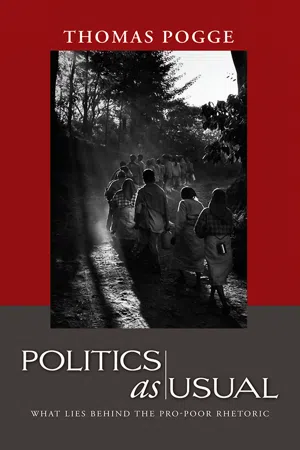
Heavily promoted by Western governments and media, this comforting view of the world is widely shared, at least among the affluent. Pogge's new book presents an alternative view: Poverty and oppression persist on a massive scale; political and economic inequalities are rising dramatically both intra-nationally and globally. The affluent states and the international organizations they control knowingly contribute greatly to these evils - selfishly promoting rules and policies harmful to the poor while hypocritically pretending to set and promote ambitious development goals. Pogge's case studies include the $1/day poverty measurement exercise, the cosmetic statistics behind the first Millennium Development Goal, the War on Terror, and the proposed relaxation of the constraints on humanitarian intervention. A powerful moral analysis that shows what Western states would do if they really cared about the values they profess.
- English
- ePUB (mobile friendly)
- Available on iOS & Android
eBook - ePub
About this book
Worldwide, human lives are rapidly improving. Education, health-care, technology, and political participation are becoming ever more universal, empowering human beings everywhere to enjoy security, economic sufficiency, equal citizenship, and a life in dignity. To be sure, there are some specially difficult areas disfavoured by climate, geography, local diseases, unenlightened cultures or political tyranny. Here progress is slow, and there may be set-backs. But the affluent states and many international organizations are working steadily to extend the blessings of modernity through trade and generous development assistance, and it won't be long until the last pockets of severe oppression and poverty are gone.
Information
1
What Is Global Justice?
1.0 Introduction
A literature search on “global justice” finds this to be a newly prominent expression. There were more books and essays on global justice in the first few years of the new millennium than in the preceding one, at least as far as computers can tell. Of course, some of the broad topics currently debated under the heading of “global justice” have been discussed for centuries, back to the beginnings of civilization. But they were discussed under different labels, such as “international justice,” “international ethics,” and “the law of nations.” This chapter explores the significance of this shift in terminology. Having been involved in this shift for more than three decades, I realize that there is likely to be a personal element in my account of it, which is due to the specific motives and ideas that have animated my thinking and writing. This is not an objective scholarly report from a distance, which, in any case, would be hard to write at this early time.
For centuries, moral reflection on international relations was focused on matters of war and peace. These issues are still important and much discussed. Since World War II, however, other themes have become more prominent due to increasing global interdependence and an erosion of sovereignty. The United Nations and the Universal Declaration of Human Rights reflect efforts to establish globally uniform minimum standards for the treatment of citizens within their own countries. The Bretton Woods institutions and later the World Trade Organization powerfully shape the economic prospects of countries and their citizens. Global and regional organizations, most notably the UN Security Council and the European Union, have acquired political functions and powers that were traditionally thought to belong to national governments.
These developments are in part a response to the horrors of World War II. But they are also fueled by technological innovations that limit the control governments can exert within their jurisdictions. Thus, industrialization has massive effects that no country can avoid – effects on culture and expectations, on biodiversity, climate, oceans, and atmosphere. New communication technologies make it much harder to control the information available to a national population. And many of the goods demanded by more affluent consumers everywhere require ingredients imported from foreign lands. The traditional concerns with the just internal organization of societies and the moral rules governing warfare leave out some highly consequential features of the modern world.
1.1 The extent of global poverty
After some delay, academic moral reflection has responded to these developments. Beginning in the early 1970s, philosophers and others have asked probing questions about how the emergence of a post-Westphalian world modifies and enlarges the moral responsibilities of governments, corporations, and individuals. These debates were driven also by the realization that world poverty has overtaken war as the greatest source of avoidable human misery. Many more people – some 360 million – have died from hunger and remediable diseases in peacetime in the 20 years since the end of the Cold War than perished from wars, civil wars, and government repression over the entire twentieth century.4 And poverty continues unabated, as the official statistics amply confirm: 1,020 million human beings are chronically undernourished, 884 million lack access to safe water, and 2,500 million lack access to basic sanitation;5 2,000 million lack access to essential drugs;6 924 million lack adequate shelter and 1,600 million lack electricity;7 774 million adults are illiterate;8 and 218 million children are child laborers.9
Roughly one third of all human deaths, 18 million annually, are due to poverty-related causes, easily preventable through better nutrition, safe drinking water, cheap rehydration packs, vaccines, antibiotics, and other medicines.10 People of color, females, and the very young are heavily overrepresented among the global poor, and hence also among those suffering the staggering effects of severe poverty. Children under the age of 5 account for over half, or 9.2 million, of the annual death toll from poverty-related causes.11 The overrepresentation of females is clearly documented.12
Such severe deficits in the fulfillment of social and economic human rights also bring further deficits in civil and political human rights in their wake. Very poor people – often physically and mentally stunted as a result of malnutrition in infancy, illiterate due to lack of schooling, and much preoccupied with their family’s survival – can cause little harm or benefit to the politicians and officials who rule them. Such rulers have far greater incentives to attend to the interests of agents more capable of reciprocation: the interests of affluent compatriots and foreigners, of domestic and multinational corporations, and of foreign governments.
1.2 The moral significance of global poverty
Three facts make the great ongoing catastrophe of human poverty deeply problematic, morally.
First, it occurs in the context of unprecedented global affluence that is easily sufficient to eradicate all life-threatening poverty. Suppose we think of the very poor narrowly as those who suffer the deprivations detailed above – lack of access to safe food and water, clothing, shelter, basic medical care, and basic education. This narrow and absolute definition of severe poverty corresponds roughly to the World Bank’s “$2.50 per day” poverty line, according to which a household is poor just in case the local cost of its entire consumption, per person per day, has less purchasing power than $2.50 had in the United States in 2005. Although 48 percent of the world’s population, 3,085 million human beings, were reportedly living below this poverty line in 200513 – on average, 45 percent below it – their collective shortfall from this line amounts to only 2 percent of global household income.14 A 2 percent shift in the distribution of global household income could wholly eradicate the severe poverty that currently blights the lives of nearly half the human population.
While the income ratio between the top and bottom decile of the human population is a staggering 273 : 1,15 their wealth ratio is ten times greater still. In 2000 the bottom half of the world’s adults together owned 1.1 percent of global wealth, with the bottom 10 percent having only 0.03 percent, while the top 10 percent had 85.1 percent and the top 1 percent had 39.9 percent.16 Severe poverty today is avoidable at a cost that is tiny in relation to the incomes and fortunes of the affluent – vastly smaller, for instance, than the Allies’ sacrifice in blood and treasure for victory in World War II.
Second, the unprecedented global inequalities just described are still increasing relentlessly. For the 1988–98 period, Branko Milanovic finds that, assessed in terms of purchasing power parities (PPPs), the Gini measure of inequality among persons worldwide increased from 62.2 to 64.1, and the Theil from 72.7 to 78.9.17 He adds that real incomes among the poorest 5 percent of world population (identified by PPP comparison) declined 20 percent during 1988–93 and another 23 percent during 1993–8, even while real global per capita income rose 5.2 percent and 4.8 percent respectively.18 I confirm and update his findings with other, more intuitive data below.19 There is a clear pattern: global inequality is increasing as the global poor are not participating proportionately in global economic growth.
Third, conditions of life anywhere on earth are today deeply affected by international interactions of many kinds and thus by the elaborate regime of treaties and conventions that profoundly and increasingly shape such interactions. Those who participate in this regime, especially in its design or imposition, are morally implicated in any contribution it makes to ever-increasing global economic inequality and to the consequent persistence of severe poverty.
1.3 From international to global justice
These plain facts about the contemporary world render obsolete the traditional sharp distinction between intra-national and international relations. Until the twentieth century, these were seen as constituting distinct worlds, the former inhabited by persons, households, corporations, and associations within one territorially bounded society, the latter inhabited by a small number of actors: sovereign states. National governments provided the link between these two worlds. On the inside, such a government was a uniquely important actor within the state, interacting with persons, households, corporations, and associations, and typically dominating these other actors by virtue of its special power and authority – its internal sovereignty. On the outside, the government was the state, recognized as entitled to act in its name, to make binding agreements on its behalf, and so on – its external sovereignty. Though linked in this way, the two worlds were seen as separate, and normative assessments unquestioningly took this separation for granted, sharply distinguishing two separate domains of moral theorizing.
Today, very much more is happening across national borders than merely interactions and relations among governments. For one thing, there are many additional important actors on the international scene: international agencies, such as the United Nations, the European Union, the World Trade Organization, the World Bank, and the International Monetary Fund, as well as multinational corporations and international non-governmental organizations (NGOs).20 Interactions and relations among states and these new actors are structured through highly complex systems of rules and practices, some with associated adjudication and enforcement mechanisms. Those actors and these rules powerfully influence the domestic life of national societies: through their impact on pollution and climate change, invasive diseases, conflict and violence, culture and information, technology, and (most profoundly) through market forces that condition access to capital and raw materials, export opportunities, domestic tax bases and tax rates, prices, wages, labor standards, and much else.
This double transformation of the traditional realm of international relations – the proliferation of international, supranational, and multinational actors, and the profound influence of transnational rules and of the systematic activities of these actors deep into the domestic life of national societies – is part of what is often meant by the vague term globalization. It helps explain why “global” is displacing “international” in both explanatory and moral theorizing. This terminological shift reflects that much more is happening across national borders than before. It also reflects that the very distinction between the national and international realms is dissolving. With national borders losing their causal and explanatory significance, it appears increasingly incongruous and dogmatic to insist on their traditional role as moral watersheds.
1.4 Interactional and institutional moral analysis
The emergence of global-justice talk is closely related to the increasing explanatory importance of social institutions. There are two distinct ways of looking at the events of our social world. On the one hand, we can see such events interactionally: as actions, and effects of actions performed by individual and collective agents. On the other hand, we can see them institutionally: as effects of how our social world is structured and organized – of our laws and conventions, practices and social institutions. These two ways of viewing entail different descriptions and explanations of social phenomena, and they also lead to two distinct kinds of moral analysis or moral diagnostics.
Take some morally salient event – for example, the fact that some particular child suffers from malnutrition, that some woman is unemployed, or that a man was hurt in a traffic accident. We can causally trace such events back to the conduct of individual and collective agents, including the person who is suffering the harm. Doing so involves making counterfactual statements about how things would or might have gone differently if this or that agent had acted in some other way. We can then sort through these counterfactual statements in order to determine whether any of the causally relevant agents ought to have acted differently and thus is partly or wholly at fault for the regrettable event. This will involve us in examining whether any such agents could have foreseen that their conduct would lead to the regrettable event and could also reasonably have averted the harm without causing substantial costs to themselves or to third parties. Inquiries of this kind might be referred to as interactional moral analysis or interactional moral diagnostics.
Often, regrettable events can also be traced back to standing features of the social system in which they occur: to its culture, for example, or to its institutional order. In this vein, one might causally trace child malnutrition back to high import duties on foodstuffs, unemployment to a restrictive monetary policy, and traffic accidents to the lack of regular motor vehicle safety inspections. Doing so involves making counterfactual statements about how things would or might have gone differently if this or that set of social rules had been different. We can then sort through these counterfactual statements in order to determine whether the causally relevant rules ought to have been different and whether anyone is responsible for defects in these rules that are partly or wholly to blame for the regrettable events. This will involve us in examining whether those responsible for the design of the relevant rules – for instance, Members of Parliament – could have foreseen that these rules would lead to harm and could reasonably have formulated them differently without causing substantial harm elsewhere. We might refer to inquiries of this kind as institutional moral analysis or institutional moral diagnostics.
Interactional moral analysis emerged quite early in the evolution of moral thought. Institutional moral analysis is more demanding, presupposing an understanding of the conventional (rather than natural or divine) nature of social rules as well as of their – often statistical – comparative effects. Even a mere 80 years ago, the poor and unemployed were still often seen as lazy and delinquent merely on the ground that others of equally humble origins had risen from dishwasher to millionaire. Many people then did not understand the structural constraints on social mobility: that the pathways to riches are limited and that the structure of prevailing markets for capital and labor unavoidably produce certain basic rates of (“structural”) unemployment and poverty. Nor did they understand that existing rates of unemployment and poverty could be influenced through intelligent redesign of the rules. Today, after Keynes, the US New Deal, and various similar national transformations that also include the Bolsa Família program in Brazil, these matters are well understood, and governments are held responsible for their decisions regarding institutional design and for the effects of such decisions on the fulfillment or frustration of human needs.
This understanding has been – belatedly, yet admirably – articulated in philosophy through John Rawls’s classic A Theory of Justice. Through this grand work, Rawls has firmly established social institutions as a distinct domain of moral assessment and has marked this domain terminologically by associating it with the term (social) justice. This terminological innovation has taken hold, by and large, at least in Anglophone philosophy. So the term justice is now predominant in the moral assessment of social rules (laws, practices, social conventions and institutions) and used only rarely in the moral assessment of the conduct and character of individual and collective agents. In the wake of Rawls the distinction between institutional and interactional moral analysis has come to be marked as a distinction between justice and ethics.
1.5 Global institutional analysis
We are quite familiar today with the focus of Rawls’s book: with institutional moral analysis...
Table of contents
- Cover
- Dedication
- Title page
- Copyright page
- Acknowledgments
- General Introduction
- 1 What Is Global Justice?
- 2 Recognized and Violated by International Law: The Human Rights of the Global Poor
- 3 The First UN Millennium Development Goal: A Cause for Celebration?
- 4 Developing Morally Plausible Indices of Poverty and Gender Equity: A Research Program
- 5 Growth and Inequality: Understanding Recent Trends and Political Choices
- 6 Dworkin, the Abortion Battle, and Global Poverty
- 7 Making War on Terrorists: Reflections on Harming the Innocent
- 8 Moralizing Humanitarian Intervention: Why Jurying Fails and How Law Can Work
- 9 Creating Supranational Institutions Democratically: Reflections on the European Union’s “Democratic Deficit”
- Bibliography
- Index
Trusted by 375,005 students
Access to over 1.5 million titles for a fair monthly price.
Study more efficiently using our study tools.
Frequently asked questions
Yes, you can cancel anytime from the Subscription tab in your account settings on the Perlego website. Your subscription will stay active until the end of your current billing period. Learn how to cancel your subscription
No, books cannot be downloaded as external files, such as PDFs, for use outside of Perlego. However, you can download books within the Perlego app for offline reading on mobile or tablet. Learn how to download books offline
Perlego offers two plans: Essential and Complete
- Essential is ideal for learners and professionals who enjoy exploring a wide range of subjects. Access the Essential Library with 800,000+ trusted titles and best-sellers across business, personal growth, and the humanities. Includes unlimited reading time and Standard Read Aloud voice.
- Complete: Perfect for advanced learners and researchers needing full, unrestricted access. Unlock 1.5M+ books across hundreds of subjects, including academic and specialized titles. The Complete Plan also includes advanced features like Premium Read Aloud and Research Assistant.
We are an online textbook subscription service, where you can get access to an entire online library for less than the price of a single book per month. With over 1.5 million books across 990+ topics, we’ve got you covered! Learn about our mission
Look out for the read-aloud symbol on your next book to see if you can listen to it. The read-aloud tool reads text aloud for you, highlighting the text as it is being read. You can pause it, speed it up and slow it down. Learn more about Read Aloud
Yes! You can use the Perlego app on both iOS and Android devices to read anytime, anywhere — even offline. Perfect for commutes or when you’re on the go.
Please note we cannot support devices running on iOS 13 and Android 7 or earlier. Learn more about using the app
Please note we cannot support devices running on iOS 13 and Android 7 or earlier. Learn more about using the app
Yes, you can access Politics as Usual by Thomas W. Pogge in PDF and/or ePUB format, as well as other popular books in Philosophy & Philosophy History & Theory. We have over 1.5 million books available in our catalogue for you to explore.