This profound and provocative book will appeal to a wide audience. It will also be of particular interest to students and professionals in the areas of sociology, anthropology, theology and philosophy.
- English
- ePUB (mobile friendly)
- Available on iOS & Android
eBook - ePub
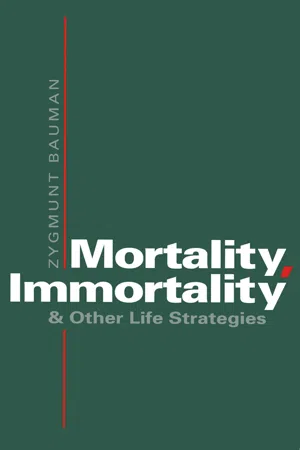
Mortality, Immortality and Other Life Strategies
About this book
Zygmunt Bauman's new book is a brilliant exploration, from a sociological point of view, of the 'taboo' subject in modern societies: death and dying. The book develops a new theory of the ways in which human mortality is reacted to, and dealt with, in social institutions and culture. The hypothesis explored in the book is that the necessity of human beings to live with the constant awareness of death accounts for crucial aspects of the social organization of all known societies. Two different 'life strategies' are distinguished in respect of reactions to mortality. One, 'the modern strategy', deconstructs mortality by translating the insoluble issue of death into many specific problems of health and disease which are 'soluble in principle'. The 'post-modern strategy' is one of deconstructing immortality: life is transformed into a constant rehearsal of 'reversible death', a substitution of 'temporary disappearance' for the irrevocable termination of life.
Information
1
Living with Death
Unlike other animals, we not only know; we know that we know. We are aware of being aware, conscious of ‘having’ consciousness, of being conscious. Our knowledge is itself an object of knowledge: we can gaze at our thoughts ‘the same way’ we look at our hands or feet and at the ‘things’ which surround our bodies not being part of them. Our knowledge shares in the existential, inalienable, defining quality of things: it cannot be (except in fantasy) wished away, that is annihilated by the sheer exertion of will. ‘It is there’, stubbornly, relentlessly, ‘permanently’ in the sense that it lasts longer than our active awareness of its presence, and that its ‘staying there’ is not synchronized with our look. We know that we can look at it again and again, that we will find it in place the moment we focus our alertness on the right point – turn our eyes (our attention) in the right direction. (When the thought we are looking for, and know ‘to be there’, cannot ‘be found’ at the moment, we call the failure ‘lapse of memory’; we explain the difficulty in the same fashion in which we think of the absence of other things we expected to find in a certain place but did not – like a lost pen or a pair of glasses: we do not suppose that the things ceased to exist, only that they have been moved, or that we could not locate them as we have been looking in the wrong direction.) When our knowledge is hard to bear with, our only escape is to treat it the way we treat things that offend us: we sweep such things away, put them at a distance from which their stench or repulsive sight is less likely to affect us; we hide them. Offensive thoughts must be suppressed. Failing that, they must be prettified or otherwise disguised, so that their ugly look would not vex us. But as with all things, escape is seldom complete and conclusive. We must not suspend our vigilance; we must keep trying – and we know it.
There is hardly a thought more offensive than that of death; or, rather, of the inevitability of dying; of the transience of our being-in-the-world. After all, this part of our knowledge defies, radically and irrevocably, our intellectual faculties. Death is the ultimate defeat of reason, since reason cannot ‘think’ death – not what we know death to be like; the thought of death is – and is bound to remain – a contradiction in terms. ‘Neither my birth nor my death can appear to me as my experiences’, observed Merleau-Ponty. ‘I can only grasp myself as “already born” and “still living” – grasping my birth and death only as pre-personal horizons.’ Sigmund Freud is of a similar view: ‘It is indeed impossible to imagine our own death; and whenever we attempt to do so we can perceive that we are in fact still present as spectators.’ Edgar Morin concluded in his pioneering study of the anthropological status of death that ‘the idea of death is an idea without content’; or, to put it another way, it is ‘the hollowest of the hollow ideas’, since its content ‘is unthinkable, inexplicable, a conceptual je ne sais quoi’. The horror of death is the horror of void, of the ultimate absence, of ‘non-being’. The conscience of death is, and is bound to remain, traumatic.1
Knowledge that cannot be believed
And there are more than enough reasons for the consciousness of mortality to be traumatic. First and foremost, thinking about death defies thought itself. The nature of thought is its non-confinement, its ‘untiedness’ to time and space: its ability to reach into the time which is no more or the time that has not yet been, to visualize places that eyes cannot see nor fingers touch. In all such times and places, however, the thought that conjures them up remains present; they ‘exist’ only in and through its act of ‘conjuring up’. The one thing thought cannot grasp is its own nonexistence: it cannot conceive of a time or place that does not contain it anymore, as all conceiving includes it – thought, the thinking capacity – as the ‘conceiving power’. (This incapacity of thought to imagine its own non-being had been perversely presented by Descartes as the world-sustaining potency of thought: we think, therefore we exist; our act of thinking is the one and only existence we cannot doubt, an existence by which all other certainties are to be measured.) Because of this organic incapacity of thought it simply cannot occur to us that our consciousness – so obvious, so pervasive, so ubiquitous – may, like other things, cease to be. Thought’s power is, one may say, born of weakness: thought seems all-powerful because certain thoughts cannot be thought and thus are ‘blotted out’ by default rather than by design. Most importantly and crucially, the thought that cannot be thought and thus may well escape scrutiny is the thought of non-existence of thought. The resulting cosy self-confidence of thought, so comforting and so desirable, would be foolproof, if it were not for the knowledge of death. Death is, after all, precisely the unthinkable: a state without thought; one we cannot visualize – even construe conceptually. But death is, is real, and we know it.
There are, of course, other things we know of, without being able to visualize and ‘understand’ them. The spatial and temporary infinity of the universe is the classic case: indeed, it is a mind-boggling state of affairs for the very reason that its alternative – the temporal or spatial confinement of the universe – can be visualized no better. This is frightening enough: a spectacular insight into the irreparable disjointment between mind and body, between what the mind can think and what the body can ‘see’, directly or metaphorically. But thought’s quandary brought up by the reality of death reaches deeper than that. The predicament that death reveals is still more radically frightening. One can, after all, think of existence without stars and galaxies, without matter even; one cannot think, however, of an existence without thought. So death – an unadorned death, death in all its stark, uncompromised bluntness, a death that would induce consciousness to stop – is the ultimate absurdity, while being at the same time the ultimate truth! Death reveals that truth and absurdity are one … We cannot think of death otherwise than of an event of which we (who, as we know, have ceased to be) are witnesses; events at which we (we, thinking and seeing foundations of all experience) are present in that relentless, obstinate fashion that is the constitutive mark of awareness. Whenever we ‘imagine’ ourselves as dead, we are irremovably present in the picture as those who do the imagining: our living consciousness looks at our dead bodies. Death does not just defy imagination: death is the archetypal contradiction in terms, The non-being of matter is difficult, nay impossible, to imagine; to imagine the non-existence of mind is downright impossible. Such a non-being may be thought only in its denial. The very act of thinking death is already its denial. Our thoughts of death, to be at all thinkable, must already be processed, artificed, tinkered with, interpreted away from their pristine absurdity. As La Rochefoucauld used to say, one cannot look directly at either the sun or death.
Also in yet another respect death blatantly defies the power of reason: reason’s power is to be a guide to good choice, but death is not a matter of choice. Death is the scandal, the ultimate humiliation of reason. It saps the trust in reason and the security that reason promises. It loudly declares reason’s lie. It inspires fear that undermines and ultimately defeats reason’s offer of confidence. Reason cannot exculpate itself of this ignominy. It can only try a cover-up. And it does. Since the discovery of death (and the state of having discovered death is the defining, and distinctive, feature of humanity) human societies have kept designing elaborate subterfuges, hoping that they would be allowed to forget about the scandal; failing that, hoping that they could afford not to think about it; failing that, they forbade speaking of it. According to Ernest Becker, ‘all culture, all man’s creative life-ways, are in some basic part of them a fabricated protest against natural reality, a denial of the truth of human condition, and an attempt to forget the pathetic creature that man is … Society itself is a codified hero system, which means that the society everywhere is a living myth of the significance of human life, a defiant creation of meaning.’2
Death is the ultimate defeat of reason, as it exposes the absurdity that lies at the foundation of reason’s logic and the void that underpins – indeed, nourishes – reason’s audacity and self-confidence. There is little reason can do about this defeat, and the fashion in which it tries to extricate itself from rout only adds to its humiliation. In Charles W. Wahl’s words, death ‘does not yield to science and to rationality’, and thus ‘we are perforce impelled to employ the heavy artillery of defence, namely, a recourse to magic and irrationality’.
We tend to lie (to cover up the silence we would be sunk in, hopelessly, were we ready or able to speak what we know but do not wish to remember) whenever we speak of death; we lie whenever we refer to the event of death as ‘passing on’, and to the dead as the ‘departed’. Yet the lie is not conscious, because ‘at bottom’, as Freud states, ‘no one believes in his own death’, and our unconscious ‘behaves as if it were immortal’.3
One would, however, add to Freud’s observation that we need not strain ourselves in order not to believe in death; there is no active effort of denial behind the disbelief – it is the facing the opposite of disbelief which takes effort. If not prompted or prodded, we fall back easily into the state of consciousness from which the thought of our own death (that is, of the terminal point of that state of consciousness) is simply absent. That effortless, ‘natural’ state, from which we do not emerge unless a force is applied, seems for this reason misnamed; the prefix ‘dis-’ in dis-belief suggests a ‘marked’ member of the opposition, while it is its opposite (that is, the belief in one’s own death), that is contrived and construed as the extraordinary disruption of ‘normality’. The constitutive order of beliefs reverses, so to speak, the order of the conceptual work of reason. When thinking about being and non-being, we try hard (and, usually, in vain) to construe nothingness as the absence of existence. Logically, non-being is the ‘marked’ member of the opposition. Psychology, however, defies logic, and with beliefs (and non-beliefs) concerning death it is the other way round: the non-belief, the assumption of the non-being of death is the benchmark against which we assess the credibility of its opposite – the reality of personal death, one’s own death. It is the belief in non-death (misnamed as ‘disbelief in death’) which is given’, self-evident, taken for granted.
Through the work of belief the imaginary masks as the truth, while the true is detoxicated or banished from consciousness. We live as if we were not going to die. By all standards, this is a remarkable achievement, a triumph of will over reason. Looking at the effortlessness with which that formidable feat is attained daily by most of us, one doubts whether it has been secured with individual resources alone. More powerful forces must have been at work. The disbelief must have been permitted, sanctioned, legalized beforehand, so that wan individual faculties of understanding are seldom tested by the need to argue, to substantiate, to convince, to ward off counter-proofs – a hopeless task in the best of circumstances. As it were, disbelief performs its protective service reasonably well only as long as it stays unexamined and is not looked at closely and attentively. Disbelief is too counterfactual, too illogical, too absurd to survive a superficial scrutiny, let alone an inquisitive one. Thus, it is in the end fortunate that the ‘problem’ which disbelief attempts to blot out is hardly a problem in the first place. Problems are defined by having solutions; this one does not. Discovery of the absence of a solution is the ultimate source of horror. What the social sanction of disbelief amounts to is permission not to look, and to refrain from asking for reasons.
Notoriously, societies are arrangements that permit humans to live with weaknesses that would otherwise render life impossible. Perhaps most crucial of such arrangements is one that conceals the ultimate absurdity of the conscious existence of mortal beings; failing the concealment, one that defuses the potentially poisonous effects of its unconcealed, known presence. (Let us note, that – as in their other benefactory functions – societies strive here to cope with the consequences of their own deeds. After all, our ‘knowing that we know’, and thus being aware of death’s absurdity, we owe to living in society: to being animals with language, that product as well as existential foundation of the self-same society that later struggles to repair the damage it has done.)
The existential ambivalence of being
As individuals, we know that our individual bodies are mortal, though – as we have seen above – the fact of possessing such knowledge suggests that our minds are not, not in the same way at any rate: the thought can slight time and reach beyond the confines of bodily mortality. But thanks to this uncanny ‘extemporality’ of thought we also know that the opposite is true: while my own, individual thinking will in all probability grind to a halt at the moment of my death, with the demise of my individual body bodily existence will not really end. It will continue, much as it started before the appearance of my body and before the beginning of my own thinking, before my ‘entering the world’. It will continue in the form of the bodily presence of other people. My personal existence is surrounded on both sides by the existence of predecessors and successors. Surrounded, yet not anchored, not rooted, not bound: why has my personal existence been squeezed in this particular place and not in any of the countless others I know of or am able to imagine? No one perhaps expressed more fully that fundamental puzzle of personal existence, that mind-boggling accidentality, contingency of being, than Pascal (Pensée 205):4
When I consider the short duration of my life, swallowed up in eternity past and to come, the little space that I fill, and even can see, engulfed in the infinite immensity of spaces of which I am ignorant and which know me not, I am terrified, and am astonished at being here rather than there; for there is no reason why here rather than there, why now rather than then.
Neither the beginning nor the end are absolute. Not just the spirit, but the body as well are, so to speak, irreparably torn between mortality and immortality: doomed to cessation in one respect, each is destined to last in another. Neither is straightforward, both are ambivalent where they are most vulnerable: in reasons, or the absence of reason, of being where they are. It is this ambivalence with which societies play. Ambivalence of being is a waste-product of society; but at the same time the ineradicable ambivalence of existence supplies the raw material from which social organizations are woven and cultures are sculpted.
According to Freud, to be exact, that ambivalence precedes society: it is in place before society starts its work. In humans, that unique species in which the capacity and the necessity to learn has almost totally displaced and replaced the natural equipment for life, Freud recognized just two instincts: that of life and that of death.5 All instincts, Freud insists, are conservative: in-built drives pressing to return to equilibrium, urging ‘towards the restoration of an earlier state of things’. But the ‘earlier state of things’, ‘the initial state’ from which they once departed and to which instincts prompt them to return, is for all living organisms the same: the state of inorganic matter. It is for this reason that ‘the aim of all life is death’. Death, the return to the inanimate state of inorganic matter, is the goal to which all life tends and to which it eventually arrives on its own and in its own time, unless disturbed by outside pressures.6 And yet the status quo ante entailed not only the non-existence of the organism. It entailed as well the existence of the species. For the conservative function to be duly performed, the death instinct must be supplemented by the instinct of life: thanatos by libido, death-drive by the sex-drive. Between themselves, the two in-born instincts meet and satisfy, so to speak, nature’s requirements. In some non-humanly ‘objective’ nature’s perspective, they collaborate closely in bringing about a joint yet cohesive accomplishment which ca...
Table of contents
- Cover Page
- Title Page
- Copyright
- Contents
- About this Book
- 1 Living with Death
- 2 Bidding for Immortality
- 3 The Selfish Species
- 4 Modernity, or Deconstructing Mortality
- 5 Postmodernity, or Deconstructing Immortality
- Postscript: “To die for …’, or Death and Morality
- Index
- Back Page
Trusted by 375,005 students
Access to over 1.5 million titles for a fair monthly price.
Study more efficiently using our study tools.
Frequently asked questions
Yes, you can cancel anytime from the Subscription tab in your account settings on the Perlego website. Your subscription will stay active until the end of your current billing period. Learn how to cancel your subscription
No, books cannot be downloaded as external files, such as PDFs, for use outside of Perlego. However, you can download books within the Perlego app for offline reading on mobile or tablet. Learn how to download books offline
Perlego offers two plans: Essential and Complete
- Essential is ideal for learners and professionals who enjoy exploring a wide range of subjects. Access the Essential Library with 800,000+ trusted titles and best-sellers across business, personal growth, and the humanities. Includes unlimited reading time and Standard Read Aloud voice.
- Complete: Perfect for advanced learners and researchers needing full, unrestricted access. Unlock 1.5M+ books across hundreds of subjects, including academic and specialized titles. The Complete Plan also includes advanced features like Premium Read Aloud and Research Assistant.
We are an online textbook subscription service, where you can get access to an entire online library for less than the price of a single book per month. With over 1.5 million books across 990+ topics, we’ve got you covered! Learn about our mission
Look out for the read-aloud symbol on your next book to see if you can listen to it. The read-aloud tool reads text aloud for you, highlighting the text as it is being read. You can pause it, speed it up and slow it down. Learn more about Read Aloud
Yes! You can use the Perlego app on both iOS and Android devices to read anytime, anywhere — even offline. Perfect for commutes or when you’re on the go.
Please note we cannot support devices running on iOS 13 and Android 7 or earlier. Learn more about using the app
Please note we cannot support devices running on iOS 13 and Android 7 or earlier. Learn more about using the app
Yes, you can access Mortality, Immortality and Other Life Strategies by Zygmunt Bauman in PDF and/or ePUB format, as well as other popular books in Social Sciences & Sociology. We have over 1.5 million books available in our catalogue for you to explore.