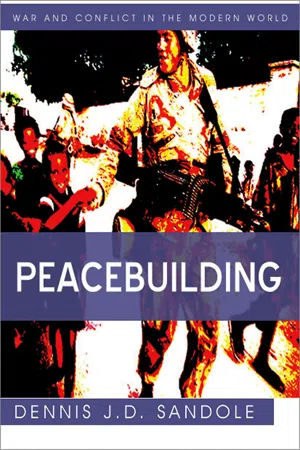
In this book, Dennis Sandole explores the theory and practice of peacebuilding, discussing the differences and similarities between core aspects of peace processes, namely violent conflict prevention; conflict management; conflict settlement; conflict resolution and conflict transformation. Assuming no prior knowledge on the part of the student reader, the volume distinguishes between proactive and reactive peacebuilding as strategies to pre-empt or otherwise respond to global problems, such as identity conflicts, failing/failed states, terrorism, pandemics, poverty, forced migrations, climate change, ecological degradation, and their combined effects. Drawing on a wide range of conflicts such as Bosnia-Herzegovina, Cambodia, East Timor, Haiti, South Africa and Macedonia, the book debates the 'lessons learned' from past experiences of reactive as well as proactive peacebuilding, plus the challenges which lie ahead for those striving to bring about sustainable peace, security and stability to war-torn or otherwise fragile regions of the globe.
- English
- ePUB (mobile friendly)
- Available on iOS & Android
eBook - ePub
Peacebuilding
About this book
Preventing violent conflicts and establishing comprehensive lasting peace in some of the world's most turbulent regions has become the new global imperative. But to be effective, peacebuilding must be a multilateral, not a unilateral process. Even for the world's sole surviving superpower, promoting and sustaining durable peace requires communication, co-ordination, co-operation, and collaboration between local, national and international actors, nongovernmental as well as governmental.
Information
CHAPTER ONE
Peacebuilding and the Global Problematique
Introduction
Everyone is beset with problems, some more stressful than others (e.g., foreclosed mortgages, loss of employment, catastrophic diseases, caring for aging relatives, imprisonment, living in the midst of natural disasters or active war zones)! Furthermore, through still ongoing revolutionary advances in communications technology, we are in constant touch with our and others’ problems via cell phones, the Internet, and other satellite-based systems. For example, as I first began to write these lines in June 2007, I was regularly shifting back and forth on the Internet to discern the latest developments in London involving two parked Mercedes Benz automobiles loaded with explosives, plus the attempted firebombing of the passenger terminal at Glasgow Airport in Scotland.
What was not clear to me at the time was why the apparent culprits in this case, young male Muslim physicians, originally from India and the Middle East but later resident and working in the United Kingdom, would want to perpetrate acts of terrorism against their British hosts. More importantly, many of us are not aware of how interconnected these actions are or can be with other developments. This is not merely a conceptual issue where, in PhD dissertations, published works, and research reports, we have to identify possible and actual linkages, but an operational issue as well. As former US Secretary of State Madeleine Albright put it (2008, pp. 6–7): “the problem with most advice is that it is better on the ‘what’ than on the ‘how.’ … Presidents appreciate being told what they might do, but they need people around them who can show them how to do it.”
To solve Problem A, therefore, we may also have to take into account, operationally as well as conceptually, problems B, C, R, W, and Z (noting linked factors within as well as between the various areas). Otherwise, our problem-solving efforts – good intentions and sound intelligence to the contrary – may make us more a part of the problem than of the solution (Anderson, 1999). This is especially likely with peacebuilding, which deals with complex problem solving locally, nationally, regionally, and globally, often with nuanced linkages within and across multiple levels.
Peacebuiding: A Comprehensive Approach to Complex Problem Solving
So, “What is peacebuilding?” Moreover, how do we do it when, among others, global warming, poverty, WMD proliferation, state failure, terrorism, and the financial and economic crises are impacting the situation we wish to address through some peacebuilding project?
On first glance, “peacebuilding” seems to break down nicely into the “building” of “peace.” But what kind of peace? Conflict and peace studies tell us that there are at least two types: negative peace and positive peace (Galtung, 1969). Negative peace is what most people outside the field mean when they discuss or think of “peace”: the absence of hostilities, usually between states but between other units as well. This absence can be achieved through either prevention of likely violence (proactive) or suppression of ongoing violence (reactive). Thus, ceasefires are experiments in often temporary negative peace which may or may not lead to peace settlements, which would be more substantive approaches to negative peace.1
Regrettably, with the exception of conflict and peace studies scholars, students, and activists (e.g., Gandhi, King), rarely does one think of peace in the “positive” sense. This is one of the major problems with the world as we confront it today: national decision-makers, even of major states (including the American superpower and its rising Russian rival), tend to become stuck in the domain of Realpolitik-prioritized negative peace. Unless they can frame options outside the negative peace “box,” they will never be able to achieve them.2 In other words, with the exception of serendipitously stumbling on to something, we have to be able to conceive or “think” of it before we can actually take steps to achieve it.
While negative peace might be a necessary condition of positive peace, it tends not to be a sufficient condition, although some might claim that, over an extended period of time, positive peace could conceivably arise out of negative peace (Sandole, 2007a, chs 5 and 9). Nevertheless, aiming for negative peace, through either proactive prevention or reactive suppression, would certainly be a laudable goal in and of itself. I personally wish we had more negative peace in the world instead of the violence of Rwanda in 1994, Srebrenica in 1995, or Darfur at present. Negative peace is not, however, an optimal condition, because it stops short of dealing with the underlying, deep-rooted causes and conditions of the conflict which might escalate, or has escalated, to the violence that negative peace measures would address. The negative peace in Bosnia-Herzegovina, for example, which has endured for nearly fifteen years since its imposition by the Dayton Peace Accords, is now closer to a collapse into violent conflict than it is to a tipping point toward positive peace (McMahon and Western, 2009; Whitlock, 2009b).
This is the utility of positive peace measures: at least “in theory,” they deal with the underlying, deep-rooted causes and conditions of a conflict which might develop, or has developed, into manifest violence. While stopping a war would certainly be helpful in creating conditions conducive to determining what its causes were, one could, nevertheless, endeavor to achieve positive peace goals in the absence of negative peace. The probability of achieving positive peace, however, would be low unless negative peace was first secured.
Here, we confront a puzzle: while everything that we have said thus far would suggest that peacebuilding usually means building positive peace, only what has come to be called maximalist peacebuilding would do that. By contrast, minimalist peacebuilding, which does not deal with underlying causes and conditions, means building negative peace, although perhaps with some elements of positive peace (Call and Cousens, 2008).3
The fact that “positive peace” is often not denoted by “peace” may help explain why maximalist peacebuilding is a relatively rare (and recent) phenomenon. Indeed, there were few references to it as an option until former UN Secretary General Boutros Boutros-Ghali (1992) included it in his seminal report to UN heads of state and government as the brutal wars in former Yugoslavia were getting underway.
Another reason why maximalist peacebuilding is rare is because of its complex, multi-actor, multi-level nature, whether one is responding to a specific situation either before or after violence has been brought to an end. Few of us have the patience or the complex problem-solving skills to coordinate persuasively third-party inputs from a multitude of interveners over a period of twenty or more years (see Nan, 2003; Lederach, 1997). So, rather than risk failure, we may not even attempt complex responses to complex problems at all, thereby reinforcing the tendency toward minimalist peacebuilding, which does not address underlying causes and conditions.
This raises the issue of the ways in which third-party interveners can respond to likely or actual conflicts. Using the metaphor of a “burning house” common to diplomats and the military, third-party interveners could, depending upon the likely or actual intensity of the “fire” (Fisher, 1997, ch. 8; Fisher and Keashly, 1991), do any or all of the following:
- Preventive diplomacy (violent conflict prevention): Take steps, based upon early warning, to prevent a house from “catching on fire” in the first place (proactive);
- Peacekeeping (conflict management): When the house is on fire, either because of the failure of violent conflict prevention efforts or through avoidance of their use, taking steps to prevent the fire from spreading (reactive);
and
- Peacemaking: When attempts to prevent the fire from spreading have failed, then attempt either:
- Coercive peacemaking (conflict settlement): Suppressing the fire (reactive)
and/or
- Noncoercive peacemaking (conflict resolution): Dealing with the underlying causes and conditions of the fire (reactive), which establishes a basis for:
- Peacebuilding “writ small” (conflict transformation), or what John Burton calls conflict provention: Working with the survivors of the fire on their long-term relationships so that, the next time they have a problem, they do not have to burn down the house, the neighborhood, or the larger commons in the process of dealing with it (reactive/proactive).
An alternative to this neat, linear progression from preventive diplomacy to peacebuilding “writ small” is for potential third parties to adopt a holistic peacebuilding perspective “writ large” at the outset of their engagement with a particular conflict system (see Burton, 1997). At the same time, they would consider conducting other third-party interventions within its parameters and, in the process, be strategically proactive. Over the course of an intervention, this would include maximalist as well as minimalist peacebuilding.4
Peacebuilding, therefore, is a dynamic approach and process, comprising a number of third-party interventions, with different actors performing different tasks at the same time and/or different points in time (see Diamond and McDonald, 1996). The underlying assumption is that, given the complex nature of conflicts in the post-Cold War/post-9/11 worlds, only some combination and sequence of approaches – in contrast to any one of them – is necessary to capture the complexity of conflict in any given situation.
The challenges for potential third parties, explored in this volume, include dealing with significant ontological, epistemological, and methodological issues surrounding the analytical differences, but also the substantive overlap and possible linkages between (a) violent conflict prevention, (b) conflict management, (c) conflict settlement, (d) conflict resolution, and (e) conflict transformation. The objective in each case is to determine the appropriate “mix” of reflective, two-way interaction between theory and practice necessary for achieving and sustaining maximalist peacebuilding. Otherwise the threat of collapse into a resurrected violent conflict situation is always present (see Sandole, 2009a; Sandole, 1999).
As already indicated, peacebuilding tends to be reactive (hence, “postconflict peacebuilding”). This occurs when third parties attempt an intervention only after the emergence of an actual violent conflict involving significant human rights violations – after “the house has been set alight” (e.g., as in Bosnia-Herzegovina during the early 1990s). In ad hoc reactive peacebuilding, members of the international community focus initially on one particular type of intervention (in Bosnia, conflict management through the United Nations Protection Force, UNPROFOR). However, if that fails, they may move on to other types. In Bosnia, this consisted of conflict settlement through NATO bombing of Serb forces and then, following the Dayton Peace Accords (see Holbrooke, 1998), peace enforcement with the Stabilization Force (SFOR), followed by the Implementation Force (IFOR), and eventually the European Union Force (EUFOR – “Althea”). Ad hoc reactive peacebuilding can, through successive “trial and error,” develop into one possible trajectory toward conflict transformation (in Bosnia, through the conflict parties taking the steps necessary to achieve eventual membership in the European Union; see chapter 3 of this volume).
By contrast, proactive peacebuilding is what third-party interveners would attempt before a violent conflict occurs. In this case, interveners would design and implement an intervention to achieve violent conflict prevention – to prevent “the house from catching on fire.” This is what Alger (2007, pp. 312–15) means by “long-term peacebuilding,” which includes Lund’s (2009) comprehensive use of conflict prevention. If that fails, interveners may decide on a strategy of partial ad hoc reactive peacebuilding – i.e., selecting one or more options and then, for example, moving first to conflict management (preventing the fire from spreading) and, if that fails, to conflict settlement (coercively suppressing the fire). If, however, their initial effort at proactive prevention succeeds – for example, as it did with the United Nations Preventive Deployment Force (UNPREDEP) in Macedonia (see Sokalski, 2003 and chapter 3 of this volume) – they may then decide to go forward with a strategy of comprehensive proactive peacebuilding: employing the full array of multi-sectoral, multi-actor interventions in which all categories of intervention are designed and implemented from the outset of an engagement with a particular violent conflict system within a conflict transformation framework (see Sandole, 2007a, ch. 3).
Comprehensive peacebuilding is a major source of effective regional and global governance, especially (but not only) in and across Africa, Asia, Latin America, the Middle East, Southeastern Europe, and the former Soviet Union – what conflict resolution pioneer John W. Burton (1990, 1997) refers to as conflict provention and Oliver Ramsbotham, Tom Woodhouse, and Hugh Miall (2005) as cosmopolitan conflict resolution. It constitutes, “in theory,” the ultimate antidote to the theory-policy deficits in our collective efforts to understand and deal with the deep-rooted causes and conditions of global terrorism – to move beyond minimalist into maximalist peacebuilding.
The major premise underlying this framing of peacebuilding is that “national interest” is global interest and vice versa, especially within the current parameters of globalization and the foreign policy agenda of President Obama (see chapter 5 of this volume). Moreover, to achieve any objective along the conflict prevention–transformation gradient at the local, state, interstate, or regional levels, policymakers must pay attention to the global level as well. As Ramsbotham et al. (2005, p. 115), put it: “Conflict formations run through our political communities at all levels, from the global to the national to the local. Moreover, these conflict formations are intertwined … [Accordingly,] there is no possibility of addressing local and regional conflicts without also taking the global and international setting into account” (emphasis added).
This volume reminds us that peacebuilding – whether reactive or proactive, ad hoc (single objective) or comprehensive (multi objective), minimalist (negative peace) or maximalist (positive peace) – is a multilateral and not a unilateral process (even for the world’s sole surviving superpower).
Peacebuilding’s Essential Context: The Global Pr...
Table of contents
- Cover
- Further praise for Peacebuilding
- Title page
- Copyright page
- Acknowledgements
- Dedication
- Prologue
- CHAPTER ONE Peacebuilding and the Global Problematique
- CHAPTER TWO Complex Problem Solving in Violent Conflicts
- CHAPTER THREE Improving the Record
- CHAPTER FOUR Peacebuilding and the “Global War on Terror”
- CHAPTER FIVE The US and the Future of Peacebuilding
- Epilogue
- References
- Index
Trusted by 375,005 students
Access to over 1.5 million titles for a fair monthly price.
Study more efficiently using our study tools.
Frequently asked questions
Yes, you can cancel anytime from the Subscription tab in your account settings on the Perlego website. Your subscription will stay active until the end of your current billing period. Learn how to cancel your subscription
No, books cannot be downloaded as external files, such as PDFs, for use outside of Perlego. However, you can download books within the Perlego app for offline reading on mobile or tablet. Learn how to download books offline
Perlego offers two plans: Essential and Complete
- Essential is ideal for learners and professionals who enjoy exploring a wide range of subjects. Access the Essential Library with 800,000+ trusted titles and best-sellers across business, personal growth, and the humanities. Includes unlimited reading time and Standard Read Aloud voice.
- Complete: Perfect for advanced learners and researchers needing full, unrestricted access. Unlock 1.5M+ books across hundreds of subjects, including academic and specialized titles. The Complete Plan also includes advanced features like Premium Read Aloud and Research Assistant.
We are an online textbook subscription service, where you can get access to an entire online library for less than the price of a single book per month. With over 1.5 million books across 990+ topics, we’ve got you covered! Learn about our mission
Look out for the read-aloud symbol on your next book to see if you can listen to it. The read-aloud tool reads text aloud for you, highlighting the text as it is being read. You can pause it, speed it up and slow it down. Learn more about Read Aloud
Yes! You can use the Perlego app on both iOS and Android devices to read anytime, anywhere — even offline. Perfect for commutes or when you’re on the go.
Please note we cannot support devices running on iOS 13 and Android 7 or earlier. Learn more about using the app
Please note we cannot support devices running on iOS 13 and Android 7 or earlier. Learn more about using the app
Yes, you can access Peacebuilding by Dennis J. D. Sandole in PDF and/or ePUB format, as well as other popular books in Politics & International Relations & International Relations. We have over 1.5 million books available in our catalogue for you to explore.