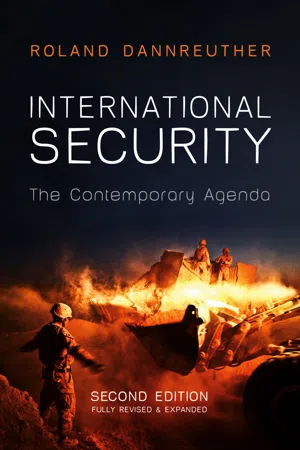
International Security is a cutting-edge analysis of the key security challenges and developments in the post-Cold War world. Drawing on a wide range of contemporary examples, from the Iraq war to the rise of China, it is an essential guide for students and policy makers seeking to understand the theoretical and empirical debates over the fast-changing nature of international security today.
The book is organized into four main parts. Part 1 provides an analytical framework for the book, identifying the most significant post-Cold War shifts in international security and recent theoretical developments in security studies. Part 2 analyses the root causes for contemporary warfare, the dilemmas and debates over military intervention, and the role played by the UN, NATO and other organizations in maintaining international peace and security. Part 3 assesses the challenges of environmental security, including the threat of resource-based conflict, most notably over oil and water, and the perceived security challenges of international migration. Part 4 discusses the new security challenges posed by international terrorism, the proliferation of weapons of mass destruction, and cyber warfare. It explores the strategies and policies adopted by the United States, particularly in the aftermath of 9/11 and assesses the implications of the rise of China and other emerging powers.
This book will be essential reading for students and analysts of international relations, international security and strategic studies.
- English
- ePUB (mobile friendly)
- Available on iOS & Android
eBook - ePub
About this book
Information
PART I
Analytical Framework
Analytical Framework
CHAPTER 1
Thinking about Security after the Cold War
Certain events come to define a critical turning point in history, to punctuate the end of one era and to inaugurate a new and distinctively different age with all its unknown qualities and uncertainties. The end of the Cold War is undoubtedly one of these historical points. Its symbol-filled date is 1989, when a series of popular revolutions liberated East-Central Europe, dismantled the ‘iron curtain’, and so enfeebled the Soviet Union that the once all-powerful state disintegrated and collapsed two years later. With such a fundamental shift in the strategic landscape, security analysts naturally seized on the opportunity to think critically about the meaning and implications of the end of the Cold War for the study of international security. This chapter identifies three of the most radical of these questionings of Cold War working assumptions and principles. There is, first, the debate over the changing nature of contemporary war and, in particular, the argument that the threat of large-scale conflict between the great powers appears to have disappeared or greatly declined. Second, there are the implications of attention shifting from an East–West to a North–South axis, with the growing scepticism of the capacity of the ‘state’ to assume its traditional responsibility for the provision of security. And, third, there is the structural change from a bipolar world and the resultant implications for the relationship between power, security and legitimacy in international politics.
These concerns, and the wide-ranging debates and arguments they have generated, are clearly intimately linked to the transition from the Cold War to the post-Cold War period. The decline in the threat of large-scale warfare, the increasing focus on the South and state weakness, the problem of how to manage a single global hegemon while new great powers are emerging: these are all significant outcomes of the collapse of the Cold War structure. But the Cold War captures only one, and sometimes not the most important, dimension of the changing dynamics in international security. Two other global processes and longer-term developments need at the very least to be added: the material transformations linked to globalization; and the ideational and normative changes which contribute to longer-term processes such as the delegitimization of imperialism and other fundamental shifts in moral understandings of appropriate international behaviour. Neither of these two dynamics fits neatly on to the structure or the timing of the Cold War.
Trying to fit dates to globalization is controversial, with debates over whether it is a twentieth-century phenomenon or whether it has its roots in the nineteenth century or even earlier (see R. Jones 1995; Hirst 1997; Hobson 2004). However, in the late twentieth century, the most recent phase of globalization is generally recognized to have gained its initial momentum in the late 1950s and then, with the exception of the economic downturn of the 1970s, to have been in a fairly constant upward trajectory both during and beyond the Cold War. The result has been an exponential increase in the amount of goods and services traded internationally; a transformation in the opportunities for travel and communications; and a proliferation of regional and international regimes and institutions, many of which were created specifically to meet the demands of globalization. The end of the Cold War only encouraged and opened new opportunities for the process of globalization. Indeed, the main impact of the Cold War was to limit globalization to the West because of the Soviet-imposed economic autarky in the East. It was also, at least in part, the failure of the Soviet Union to adapt to the challenge of globalization which finally sealed its fate (see, for example, Wohlforth and Brooks 2000–1). The end of the Cold War thus only further invigorated and provided a more expansive stage for the dynamic of globalization.
The charting over time of more subtle normative transformations, such as the delegitimization of imperialism, is even more problematic. But the Cold War was distinctive in that, for the first time, the main hegemonic actors – the United States and the Soviet Union – self-consciously defined themselves as anti-imperialist and supported the national self-liberation of colonial states formerly controlled by Europe. This resulted in the number of states growing from the fifty-one original signatories of the United Nations Charter in 1945 to the current 193 member states. This, by its very nature, complicated international security arrangements and gave a ‘voice’ to peoples and nations formerly excluded from international debate. It also underlined a normative consensus that imperialism could no longer be recognized as a legitimate form of governance. This, in turn, has placed significant constraints on the actions and policies of the more powerful states in the international system and, in theory if not always in practice, strengthened the claims of the weak. Analysts have sought to identify similar cumulative ideational transformations, such as the expansion of the norms of human rights and democracy over the twentieth century, which have had similarly radical implications for international practice (on democracy, see Diamond and Plattner 1996; on human rights and humanitarian intervention, see Finnemore 2003; Wheeler 2000).
Debating the causes of the great power peace
The relative unimportance of the Cold War and the potential significance of other material and ideational shifts are illustrated by the debate over the causes for the perceived decline in the threat of large-scale warfare between the great powers. It is generally recognized that the end of the Cold War was itself a symptom rather than an independent cause of this. The threat of large-scale warfare has been a constant feature of the history of modern Europe, and the Cold War was ‘fought’ on the same basic assumption that such a devastating war was an ever present possibility. The historical uniqueness of the Cold War was not in the way it was conducted but in the manner of its conclusion. Unlike earlier hegemonic challenges to gain European supremacy, the confrontation ended peacefully and without recourse to war. This broke Churchill’s cardinal rule that ‘people talked a lot of nonsense when they said that nothing was ever settled by war. Nothing in history was ever settled except by war’ (quoted in Gilbert 1983: 860–1). How then to explain this resolution of a major ideological confrontation, which, as Fred Halliday notes, was a comprehensive social, political and economic conflict, in essentially a peaceful manner (Halliday 1994: 170–90)? What more fundamental lessons does this hold for understanding the prospects of war in the post-Cold War period?
It should be stated that not everyone is convinced that the ending of the Cold War signals a radical transformation in the conditions for war and peace. Some hold firm to the traditional (realist) rules of the game and argue that the decreasing expectation of war is only a temporary aberration and that traditional great power military competition will eventually return with a vengeance (see Mearsheimer 1990; Waltz 2000). Such critics would also tend to point to China and the substantive debate remaining about the potential military threat it poses (D. Roy 1996; Munro 1997; M. Brown et al. 2000). But these sceptics are a minority compared to those who do accept that at least the most economically and politically powerful states in the international system – the US, Europe and Japan – now enjoy the unprecedented historical luxury of not needing to prepare for war against one another. This is most markedly felt in Europe, where the process of European integration is generally seen to have made war practically inconceivable between the formerly warring states of the region. For these analysts who see a critical transformation in the structural conditions of international politics, the key question is what the underlying causes might be (see, for example, Van Evera 1990–1; Jervis 1991–2; Mandelbaum 1998–9).
Declining political instrumentality of war
A good starting point for thinking about this is to take Carl von Clausewitz’s central insight that war is quintessentially a political activity and ‘not merely an act of policy, but a true political instrument, a continuation of political intercourse, carried out with other means’ (Clausewitz 1984 [1832]: 87). War is a purposeful activity and its rationale and logic are defined in terms of its political instrumentality. But Clausewitz was also one of the first to recognize that the attainment of political objectives becomes more difficult in an age of political revolution and mass democracy. With his own experience of fighting in the Prussian army against the mass popular armies of revolutionary France, he saw that now ‘war, untrammelled by any conventional restraints, had broken loose in all its elemental fury’ (ibid.: 593). Clausewitz was, in this sense, a prophet of the total wars of the twentieth century where whole societies became mobilized to fight for their country and for the goal of ‘unconditional surrender’. Certain technological advances, most notably the invention of the railways and the machine gun, dramatically increased the bloodiness and brutality of war by making it possible to bring more soldiers to the battlefield and then to kill those soldiers in a more efficient manner. The sociologist Charles Tilly has made a rough calculation that battle deaths increased from 9,400 per year in the sixteenth century to 290,000 per year during the first half of the twentieth century (Tilly 1990: 74).
John Mueller argues that it is this experience of the totality and bloodiness of the two world wars which is the principal cause for the ‘obsolescence of war’ and the general realization that war has lost its political instrumentality in the management of great power relations (Mueller 1989, 2004). For other analysts, such as Martin Van Creveld, it is the subsequent development of nuclear weapons, and the gradual realization that there could be no conceivable political justification for an all-out nuclear war, that reduced the prospect of large-scale interstate war and dramatically reversed the earlier four-century increase in the scale of warfare (Van Creveld 1991a). As such, the critical turning point was the promotion by the Soviet leader Nikita Khrushchev of ‘peaceful coexistence’ and the subsequent development of détente between the superpowers. Kenneth Waltz extended the implicit logic of this contention to argue that ‘the more nuclear weapons the better’, on the basis that such nuclear proliferation would replicate globally the stability found in the superpower relationship (see chapter 10 below; and Waltz 1981). The uneasiness and reservations many have felt towards such nuclear optimism reflect a broader scepticism over whether possession of nuclear weapons and peace can be so easily conflated (Sagan and Waltz 2003: ch. 2). The fact that military planners on both sides of the iron curtain continued to prepare for a nuclear war similarly qualifies an unduly benign perception of the pacifying effects of nuclear weapons (Kissinger 1957; Freedman 1989: 87–114). But there is nevertheless much plausibility in the realist-informed claim that nuclear weapons do generally change the strategic advantage of those possessing them, increasing the advantages of defensive as against offensive warfare. This, in turn, discourages aggression and generally reduces the security dilemma faced by all states (Lynn-Jones 1995; Van Evera 1999).
Increasing economic benefits of peace
A logical counterpart to the argument of the declining political instrumentality of war is that the economic benefits of peace have correspondingly grown. The argument of the pacific effects of high levels of economic interdependence is a foundational belief in liberal thought, with free trade and economic integration having been seen, from Adam Smith and David Ricardo onwards, to have political as well as economic benefits. The architects of the European integration process after the Second World War were driven by such convictions and were far from complacent that the mere memory of the horrors of two world wars would be sufficient to avoid further relapses into traditional European rivalries. They were convinced that peace needed to be physically constructed through the building of dense economic linkages and interdependencies so as to make it increasingly irrational to use force for the resolution of political conflicts (Haas 1958; Monnet 1978). Similar claims are also increasingly made about the dynamic of globalization, in that the deepening of global economic ties reduces the benefits of military prowess and territorial acquisition. Richard Rosecrance has expressed this as the rise of the ‘trading world’, which has finally gained supremacy over the more traditional ‘military-territorial’ world (Rosecrance 1986).
The assumed linkage between trade and peace is, though, controversial. The classic counter-example is the First World War where, contrary to the optimism of such contemporary liberals as Norman Angell, conflict developed between the two most interdependent trading nations of Germany and Great Britain (Angell 1912; Waltz 1988). Studies have also suggested that military occupation can pay economically and is not necessarily the economic burden often depicted by liberal critics of war (Mearsheimer 2001: 12; see also Labs 1997). Global capitalism tends to suffer from periodic crises and recessions, such as that of 2008–9, which exacerbate international tensions. More radical critics of globalization highlight the way that power relations of domination and coercion provide the underlying context for the seemingly apolitical and non-violent global processes of economic (neo-liberal) expansion. Even the case of European integration requires a critical recognition that it was a process actively supported by the United States and was dependent on US external security guarantees (Joffé 1984; Lundestad 1998). This was not just a US guarantee against Soviet attack but also a reassurance against potential revanchist German aggression. Without such extensive security guarantees, it would have been unlikely that France, in particular, would have been sufficiently confident to take the path of European integration.
Nevertheless, when the arguments for the benefits to be gained through economic interdependence are combined with the increased costs and loss of instrumentality of large-scale warfare, then a stronger cumulative case for the great power peace can be made. The shift in the overall strategic calculations of the relative costs and benefits to be gained through war has certainly contributed to the transformation of the European continent. This ultimately also extended as far as the Soviet Union, where it gradually became clear to Soviet elites that their relative power was being undermined by the failure to integrate with the wider world. The Soviet Union then followed China’s earlier shift from a strategic posture based on relative war-fighting capabilities to one conditioned on export-oriented growth. The necessary precondition for this was to restructure relations with the West on the basis of inclusion and integration rather than on autarky and military confrontation. Economic processes were, therefore, significant forces for peace.
Towards the democratic peace?
Nevertheless, the continuing authoritarianism, nationalist self-assertion and evidence of regional bullying found in post-Cold War Russia and China weaken the confidence that the strategic cultures of both countries exclude the option of war, including large-scale war. This provides one supporting element in the argument that the most critical condition for pacific interstate relations is the presence of a community of democracies, which is furthermore demonstrated by the empirical claim that no democratic state has ever gone to war with another democratic state (Doyle 1983a, 1983b; Russett 1993; J. Ray 1995; Brown, Lynn-Jones and Miller 1996; Russett and Oneal 2001). The democratic peace thesis has gained much of its prominence through capturing the spirit and optimism of the post-Cold War period, ensuring a popularity not only within academia but among policy-makers and world leaders. The thesis also gained credibility with the significant expansion of the number of democracies from the 1970s, which culminated in the democratic liberation of East-Central Europe (Huntington 1991). With the end of the Cold War, the Kantian dream of realizing a ‘democratic peace’ has never seemed closer, particularly in traditionally war-torn Europe.
There are three broad arguments which have sought to provide fuller causal explanations for how peace develops from democracy. The first highlights the institutional constraints within liberal democracies which inhibit the initiation of large-scale conflict. Among these are the separation of powers, the checks and balances within the political system, and the need to engage public support for any war-making activity. All of this contrasts with dictators or authoritarian leaders, who can potentially initiate wars secretly and swiftly on their own personal whim (Russett 1993: 30–8; see also Lake 1992). The second focuses on the norms and values which distinguish liberal democracies from their authoritarian counterparts. Here the argument is that liberal democracies are habituated to the resolution of conflicts through compromise, negotiation and respect for the rule of law in their own domestic affairs. When such democracies engage with other democratic states, these norms and habits are externalized and a mutual respect for common political values precludes resort to the use of force (Doyle 1986). The third aspect highlights how these mutually respected common norms and values forge shared transnational identities, which consolidate a sense of community and common purpose among democratic states. Such ‘communities of values’, it is argued, are particularly evident within Europe and between Europe and the United States, where highly institutionalized European and transatlantic security communities can be found (Risse-Kappen 1995; Kahl 1998–9).
Democratic peace theory often also includes arguments about the pacific benefits of economic interdependence (Russett and Oneal 2001: ch. 4). But, as with the economic argument in the previous section, there remains the counter-argument that a simpler and more parsimonious explanation is that the brute realities of countering the Soviet threat, along with the disciplining power of the United States, are the main reasons for the pacific relations between the Western democracies (Layne 1994; Farber and Gowa 1995). The argument that liberal powers are inherently pacific in nature is also significantly questioned by the continuing predilection of liberal democracies to engage in regular military interventions against states in the developing world (Lake 1992; Reiter and Stamm 1998). Similarly, during the Cold War the United States and other Western countries frequently sought to subvert democracies in the developing world, such as in Chile or Iran. Viewed in this critical light, the democratic peace thesis has a less benign aspect, providing a comfortable ideological justification for the North to support its coercive subordination and disciplining of the global South (Barkawi and Laffey 1999; Duffield 2001).
Despite these criticisms, a plausible case can still be made that the consolidation of liberal democracy between the leading states has changed attitudes towards, and the justifications for, war between themselves. In part, this is driven by the sense of the declining utility of war and the increased economic benefits of peace. But the spread and consolidation of democracy have themselves promoted a more consensual and homogeneous political system, where there is a broader acceptance of the political status quo. In the West, anti-systemic threats to democratic states have declined both internally, heralded by the ‘end of ideology’ (Kirchheimer 1966), and externally, through greater cooperation. In contrast to earlier parts of the twentieth century, virulent nationalism has been delegitimized and the sense of the racial superiority of different nations no longer has the same resonance. In Europe in particular, territorial borders have lost their emotive power, so that the fate of Alsace-Lorraine or of the ‘lost’ German territories no longer preys on the minds of European leaders (Vasquez 1993; M. Anderson 1996; Huth 1996). The ‘post-heroic’ age has, thus, greatly reduced the earlier celebration of the cult of war and the glorification of the warrior.
Implications of the great power peace
By emphasizing the multiple causalities of the reduction of the prospect of large-scale interstate warfare, a more nuanced understanding is possible of the prospects for war and peace around the world. The conditions for an internal peace are strongest among the most economically developed liberal democracies, such as the United States, Europe a...
Table of contents
- Cover
- Dedication
- Title page
- Copyright page
- Figures and Tables
- Acknowledgements
- Introduction: The Challenge of the New Security Agenda
- PART I: Analytical Framework
- PART II: The ‘New Wars’ and Intervention
- PART III: Environment, Resources and Migration
- PART IV: Asymmetric Power and Asymmetric Threats
- Conclusion: The Challenges for the Future
- References
- Index
Trusted by 375,005 students
Access to over 1.5 million titles for a fair monthly price.
Study more efficiently using our study tools.
Frequently asked questions
Yes, you can cancel anytime from the Subscription tab in your account settings on the Perlego website. Your subscription will stay active until the end of your current billing period. Learn how to cancel your subscription
No, books cannot be downloaded as external files, such as PDFs, for use outside of Perlego. However, you can download books within the Perlego app for offline reading on mobile or tablet. Learn how to download books offline
Perlego offers two plans: Essential and Complete
- Essential is ideal for learners and professionals who enjoy exploring a wide range of subjects. Access the Essential Library with 800,000+ trusted titles and best-sellers across business, personal growth, and the humanities. Includes unlimited reading time and Standard Read Aloud voice.
- Complete: Perfect for advanced learners and researchers needing full, unrestricted access. Unlock 1.5M+ books across hundreds of subjects, including academic and specialized titles. The Complete Plan also includes advanced features like Premium Read Aloud and Research Assistant.
We are an online textbook subscription service, where you can get access to an entire online library for less than the price of a single book per month. With over 1.5 million books across 990+ topics, we’ve got you covered! Learn about our mission
Look out for the read-aloud symbol on your next book to see if you can listen to it. The read-aloud tool reads text aloud for you, highlighting the text as it is being read. You can pause it, speed it up and slow it down. Learn more about Read Aloud
Yes! You can use the Perlego app on both iOS and Android devices to read anytime, anywhere — even offline. Perfect for commutes or when you’re on the go.
Please note we cannot support devices running on iOS 13 and Android 7 or earlier. Learn more about using the app
Please note we cannot support devices running on iOS 13 and Android 7 or earlier. Learn more about using the app
Yes, you can access International Security by Roland Dannreuther in PDF and/or ePUB format, as well as other popular books in Politics & International Relations & Peace & Global Development. We have over 1.5 million books available in our catalogue for you to explore.